What Is Vocal Fry and How Do You Fix It?

Vocal fry is the low, creaky, crackling sound in the voice that often shows up at the end of phrases. This guide covers what it is, who uses it, how it affects your career, and how to fix it. It is written for adults and teens, including professionals, performers, and anyone who wants a clearer, stronger voice.
Vocal fry goes by several names. Glottal fry, pulse register, and creaky voice all describe the same thing. It is the lowest register of the human voice.
For most people, vocal fry is a natural speech habit rather than a health problem. A speech-language pathologist can help you find out which situation applies.
Key Takeaways
Vocal fry, also known as glottal fry or pulse register, is produced when the vocal folds shorten and close before popping open, letting air move through slowly and creating a low, crackling sound.
It is most common among young women in American English, but people of all genders, ages, and languages use vocal fry.
Occasional vocal fry is not physically harmful. Regular use, especially with throat pain or vocal fatigue, can signal an underlying voice condition.
Breath support, pitch, and phrasing fix most cases of vocal fry.
What Does Vocal Fry Sound Like?
Is Vocal Fry Bad for Your Voice?
How Does Vocal Fry Affect Your Career?
When Does Vocal Fry Signal a Voice Disorder?
What We See Working with Clients
What Is Vocal Fry?
How the Vocal Fry Register Works
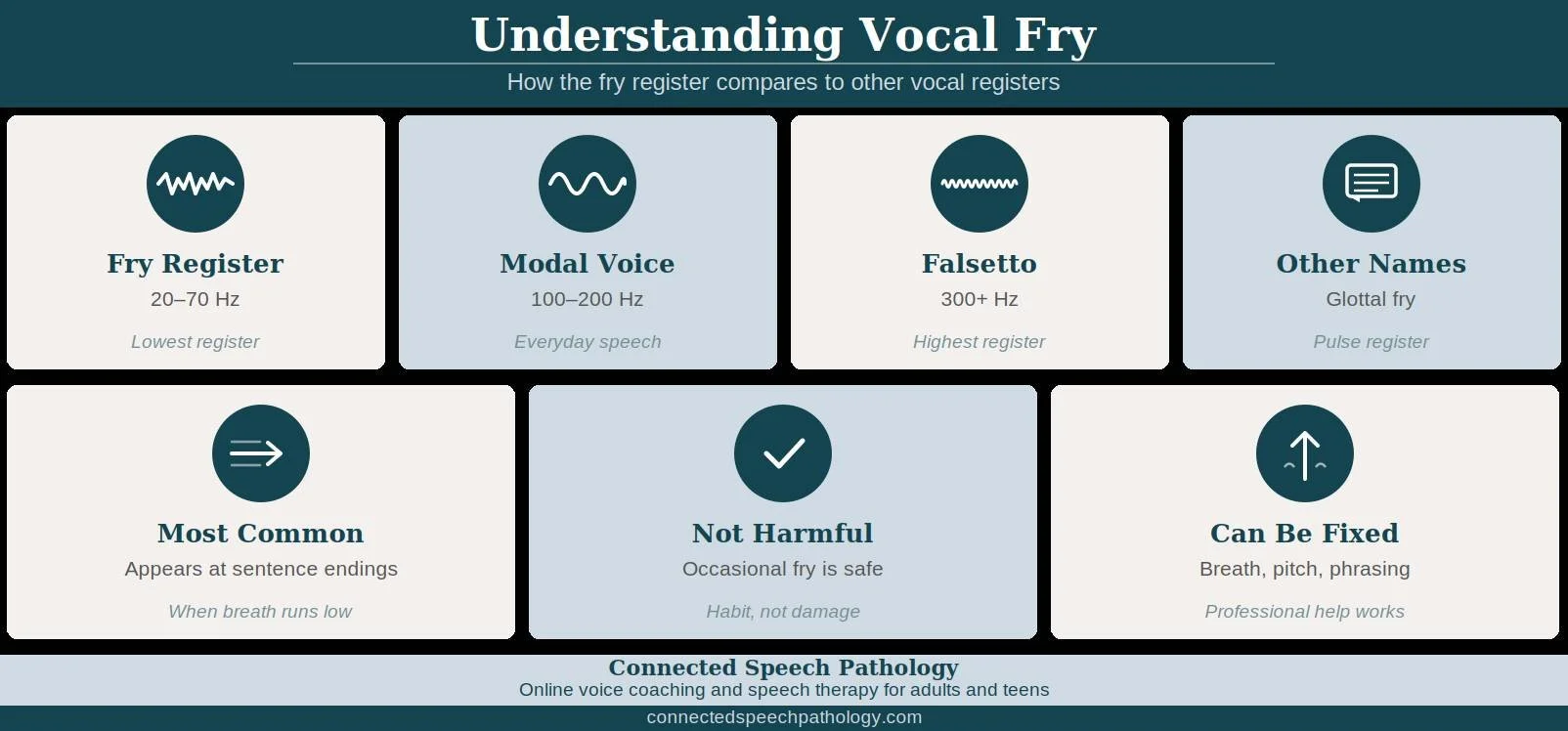
The vocal fry register is the lowest of the three main vocal registers. The other vocal registers are the modal register, which is everyday speech, and falsetto. Vocal fry is also called glottal fry or pulse register.
The vocal cords shorten and close completely before popping open. Air passes through slowly, creating a low-frequency rattling sound. The vocal fry register is characterized by a distinct sizzling or frying sound, which is why many people compare it to bacon crackling in a pan.
The fry register can reach pitches much lower than the modal register, sometimes up to eight octaves below everyday speech. In many languages, creaky voice is a standard linguistic feature used to distinguish word meanings or mark the end of a thought. Danish has a feature called Stod that works the same way.
What Happens to Your Vocal Folds During Vocal Fry
In the modal register, the vocal folds open and close in smooth waves, around 100 to 200 times per second. In the fry register, that pattern changes completely. The cords shorten, thicken, and press loosely together.
Two muscles drive this shift. The thyroarytenoid shortens and thickens the cords. With the cricothyroid quiet, air pressure drops and the vocal cords vibrate slowly, far below the rate of normal speech.
Normal voices move between vocal registers with ease, with a little vocal fry appearing at lower pitches without extra effort. The vocal anatomy involved is the same for every speaker. A touch of creaky voice at the end of a phrase is so common that most listeners do not consciously notice it.
What Does Vocal Fry Sound Like?

Vocal fry sounds like a low, slow crackle or rattle, especially at the end of a sentence or phrase. Think of a voice trailing off like a phone with a dying battery. Some people describe it as a croaking sound or a string of low bass notes.
Vocal fry is everywhere in pop culture. Kim Kardashian, Britney Spears, and Katy Perry are often cited as examples among women in entertainment. Male voices use it too, including Morgan Freeman and Jeff Goldblum, who use it to create a distinct persona in speech and musical performances.
Radio personalities, podcasters, and media figures use a touch of vocal fry to sound warm and relatable. Ira Glass of This American Life covered the topic after a 2011 study at Long Island University. That study found that two-thirds of college-age Americans use vocal fry at the ends of phrases.
Vocal fry samples range from barely noticeable to pronounced across different speakers. Valley-girl speech patterns from earlier decades featured heavy use of vocal fry. Today, the sound spans demographics, communication styles, and age groups well beyond its origin.
Who Uses Vocal Fry and Why?

Young Women, Young Female Speakers, and the Vocal Fry Trend
Young adult female speakers in American English use vocal fry the most. Studies show that young women use vocal fry at a rate four times higher than that of men when reading aloud. Vocal fry among young women rose sharply in the early 2000s, linked to reality TV and celebrities such as Katy Perry and Kim Kardashian.
The female voice became most closely associated with vocal fry in American media. The rise of vocal fry in women's speech drew both academic study and public criticism. Some people link it to a valley-girl speech pattern, though vocal fry in women's voices now spans many demographics and communication styles.
The vocal fry register is a recently discovered speech phenomenon in formal phonetics. Some linguists say vocal fry has always existed in various English dialects and predates its recent popularity. In the 20th century, vocal fry was common among male speakers of Received Pronunciation, such as the voice associated with James Bond.
Discussion of the fry register began among vocal music teachers in the early 1970s. The vocal fry register has been recognized in American English for only the past few decades, though its sound was known in phonetics much earlier. Young people in the early 21st century adopted it as a common speech pattern.
Why Do People Use Vocal Fry?
Vocal fry in casual speech signals a relaxed, approachable communication style. When people speak this way, they are often heard as warmer and more relatable. Radio personalities and podcasters use it in informal settings to build a connection with their audience.
Ikeno and Hansen (2007) studied social mirroring. Young adult women, ages 18 to 29, produced the most fry when speaking with a partner who also spoke that way. Mirroring is how habits spread through social groups and shape speech patterns.
The use of vocal fry has become linked to an urban-oriented, upwardly mobile communication style. But vocal fry is often perceived by many listeners as a sign of boredom or low effort. Many speakers are unaware of how their natural vocal habits are perceived by others.
Is Vocal Fry Bad for Your Voice?

Most experts agree that occasional vocal fry is not physically harmful. Lee Akst is a Johns Hopkins otolaryngologist. He says that vocal fry does not damage the vocal cords, but regular reliance on it can cause vocal strain and may need retraining to fix.
Forced vocal fry is a different matter. Relying on it as a main speaking pattern can cause voice fatigue and a loss of vocal power and clarity. Consistent use can make women and men sound weak, monotone, or unclear in noisy environments.
Excessive tension in the throat during forced fry can create a glottal scrape sensation, compounding the strain. Singers and speakers sometimes use vocal fry carefully to release throat tension and reduce breathiness. If the pattern becomes an ongoing habit, vocal rest and protecting your voice while singing are both worth reading about.
How Does Vocal Fry Affect Your Career?

Habitual vocal fry carries real career consequences. Rindy Anderson is an assistant professor at Duke University. Her 2014 study found that young women using vocal fry were heard as less competent, less educated, and less trustworthy.
The study documented persistent negative perceptions of vocal fry in professional settings. Women are especially affected, with female speakers perceived as less hirable when vocal fry is prominent. The habitual use of this speech pattern is considered annoying to many listeners and hiring managers.
People over 40 are particularly likely to perceive vocal fry as a sign of boredom or low engagement. Some older men say they hate the sound in professional contexts. For job interviews and high-stakes presentations, vocal fry is bad news for first impressions.
Public opinion on the use of vocal fry is polarized. Some view it as trendy and sophisticated, particularly among upwardly mobile young women in urban-oriented industries. Others see it as a sign of poor speech habits, and the criticism falls disproportionately on women.
Vocal fry is perceived less negatively by younger speakers than by older listeners. But the overall sentiment remains unfavorable in corporate and public speaking roles. Understanding how to improve prosody of speech helps speakers take back control of how they are heard.
When Does Vocal Fry Signal a Voice Disorder?

Habitual vocal fry and a voice disorder can sound alike, but they come from different places. Habitual fry can be turned off. Bruce Gerratt is a voice researcher whose test is simple: if you can produce a clean sound at will, the fry is a habit, not a disorder.
Conditions that cause a persistent creaky voice include muscle tension dysphonia, vocal nodules, vocal polyps, and vocal cord dysfunction. With these conditions, the creaky quality is consistent and does not improve with rest or effort.
See a voice professional if your throat hurts during or after talking, if your voice gives out quickly, or if the fry has been there for weeks without improving. Throat pain after talking is worth reading separately if any of this sounds familiar.
How Do You Fix Vocal Fry?
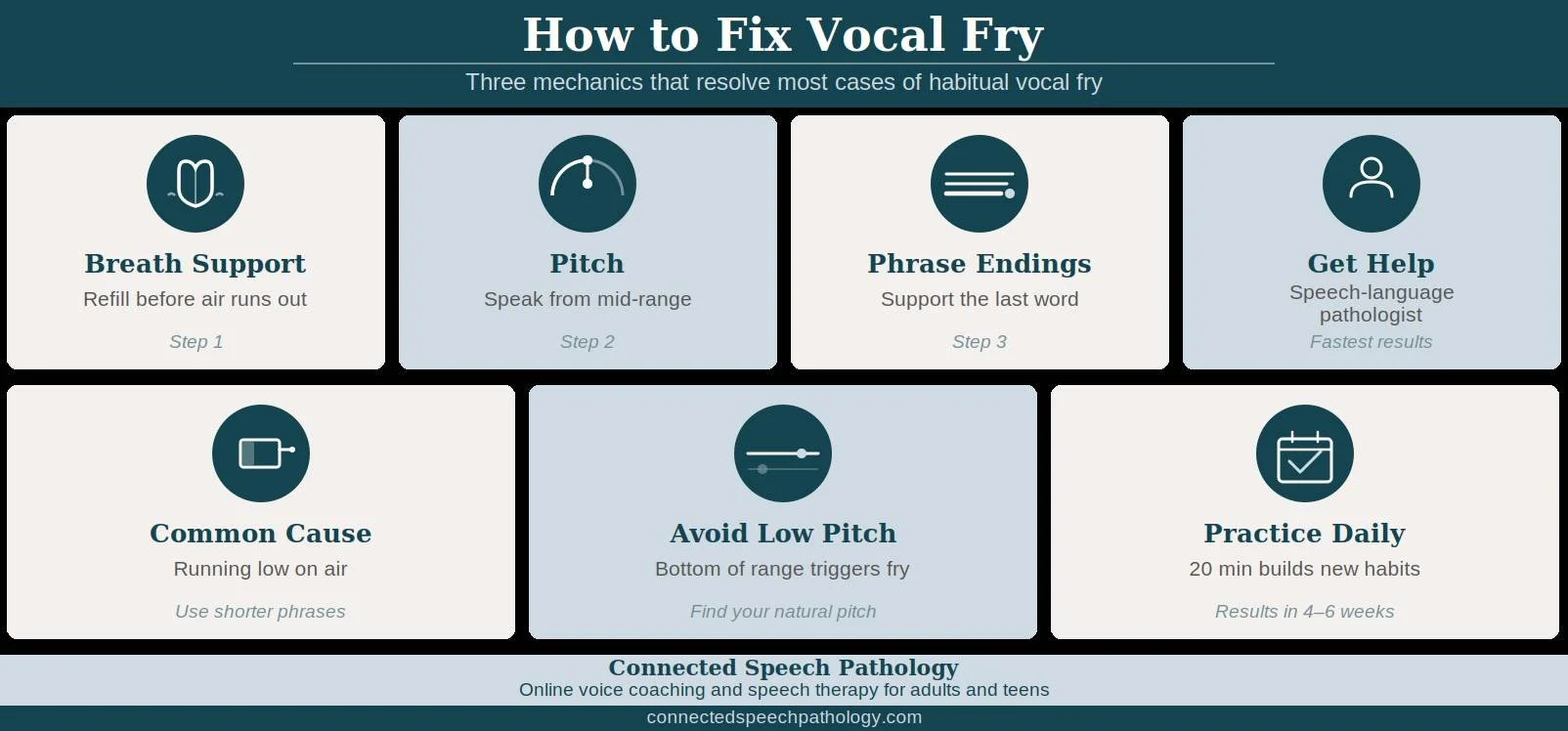
For habitual vocal fry, three mechanics drive the fix: breath, pitch, and phrasing. Most speakers need to work on all three to gain clean control across their vocal registers.
Breath Support and the Fry Register
Your vocal folds need steady air to vibrate cleanly. Most speakers who use vocal fry regularly run out of breath before finishing a phrase. By the last few words, air drops and the cords slip into the lower pitch of the fry register.
Adequate breath support and modifying resonance are two effective solutions. Breathe so your belly expands outward rather than your chest rising. Speak from that breath, refill before you run out, and use short phrases rather than long unbroken sentences.
Resonant voice therapy is a technique speech-language pathologists use alongside breath work. It shifts the vibration forward into the face and mouth, so the vocal cords find their normal register without extra effort.
Pitch and Vocal Fry
Speaking at the bottom of your pitch range keeps the vocal folds slack, making vocal fry easy to slip into. The goal is not to speak artificially higher. It is to find the middle of your range where your voice resonates most cleanly.
A useful test: hum until you find a note that vibrates in your chest and face at the same time. Start phrases from that note, not the bottom of your range.
For more on using pitch deliberately, voice inflection and how it shapes how others understand you is worth reading.
Phrasing and End-of-Phrase Vocal Fry
Vocal fry most often enters at the end of a sentence or phrase. That is where breath is lowest and pitch drops furthest. Supporting the last words of each phrase stops the vocal cords from losing tension at that moment.
Practice holding the last few words and final vowels of each phrase until they are fully clear. When you hear the rattle starting, that is your cue to add breath sooner next time.
Vocal projection exercises are worth trying for performers and speakers who need fry-free delivery at volume.
What We See Working with Clients

Most clients with a creaky voice are surprised at how fast they can produce a clean tone. Correcting breath support in real time is often all it takes.
Professionals and performers usually have a strong awareness of how their voices sound and how they impact their communication, which often leads to faster progress. Radio personalities and podcasters often find that their vocal fry is worse in the first ten minutes of a session. Professionals who present a lot notice it most under pressure, when shallow breathing kicks in.
The harder cases involve glottal fry tied to tension in the throat and neck. These clients often have a history of muscle tension dysphonia, or they push their voice hard in general. Progress is still real, but it takes longer and usually involves manual techniques alongside breath and pitch work.
Frequently Asked Questions About Vocal Fry

1. What does vocal fry mean?
Vocal fry is the lowest vocal register, producing a low, creaky, crackling sound. It is produced when the vocal folds shorten and close before popping open, letting air move through slowly. In American English, it most often shows up at the end of a sentence to mark the completion of a thought.
2. Does Billie Eilish use vocal fry?
Yes, Billie Eilish uses vocal fry as a deliberate stylistic choice. It creates the intimate, whispery quality that became a signature of her early work. Her use of the fry register is intentional, not an uncontrolled habit.
3. Does Adele use vocal fry?
Yes, Adele uses vocal fry extensively, especially at the ends of phrases and in quiet moments of a song. It adds rawness and emotional weight to her voice. Vocal fry can add emotional weight, grittiness, or intimacy to a performance when used intentionally.
4. Is vocal fry attractive?
It depends on who is listening. Vocal fry is perceived less negatively by younger audiences. The overall sentiment remains unfavorable in professional settings, where vocal fry is perceived as a sign of low engagement.
5. Who speaks with vocal fry?
Vocal fry is most common among young women in American English, though men, older speakers, and people across many languages use it. Among young adult female speakers, it appears at a rate four times higher than among men. Celebrities like Britney Spears and Kim Kardashian helped popularize it in the early 2000s.
6. When should I see a speech-language pathologist for vocal fry?
See a speech-language pathologist if vocal fry is on every word and does not improve with rest. Also seek help if your throat hurts during or after talking, if your voice tires quickly, or if breathing exercises have not helped after several weeks. Excessive use of vocal fry that leads to voice fatigue or throat pain can be classified as a speech disorder.
How Connected Speech Pathology Can Help

Connected Speech Pathology works with adults and teens whose vocal fry is affecting their career, performance, or vocal health. Our speech-language pathologists identify the underlying cause of the creaky voice and build a plan around it.
For professionals, presenters, podcasters, and performers, we offer targeted training through our Voice and Performance Coaching program. If you suspect an underlying voice condition, our clinical team offers Voice Therapy for Voice Disorders with assessment-based treatment.
All sessions are online. The first step is a free consultation.
Summary
Vocal fry, also called glottal fry or creaky voice, is the lowest vocal register. The vocal folds shorten, close, and pop open, allowing air to move through slowly and producing a low, crackling sound. For most adults and teens, vocal fry is a natural speech habit rather than a disorder.
Lee Akst of Johns Hopkins confirms that vocal fry does not damage the vocal cords on its own. Regular reliance on vocal fry can cause voice fatigue and may require retraining. Improving breath support, pitch, and phrase endings resolves most cases.
When a creaky voice is present on every word and accompanied by throat pain or fatigue, it may point to a condition such as muscle tension dysphonia or vocal nodules. Bruce Gerratt's test applies: if you can turn it off at will, it is a habit. Connected Speech Pathology offers voice coaching and speech therapy for adults and teens, all online.

About the Author
Allison Geller is a communication coach, speech-language pathologist, and founder of Connected Speech Pathology, an international online practice providing professional communication coaching and speech therapy for children, teens, and adults. With more than two decades of experience, she has worked in medical and educational settings, published research on aphasia, and leads a team of specialists helping clients improve skills in public speaking, vocal presence, accent clarity, articulation, language, fluency, and interpersonal communication.