How To Be Comfortable With Your Voice

Many adults feel some level of discomfort with their voice. It can show up as not liking how you sound, struggling with volume or pitch, or feeling like your voice does not reflect your confidence or intent.
This article explains how these patterns develop and what you can do to change them, so you can feel more comfortable and in control when you speak.
Key Takeaways
Discomfort with your voice can show up in different ways. It may be how you sound on recordings, your pitch, your volume, or a sense that your voice does not reflect how you want to come across.
With the right guidance, you can adjust pitch, volume, tone, and clarity in ways that feel more natural and controlled.
Confidence builds when you receive clear, specific feedback on how you sound and how you come across. Intentional practice leads to meaningful, lasting change.
Working with a coach helps you focus on what matters most to your goals, whether that is sounding more confident, speaking more clearly, or feeling more comfortable using your voice day to day.
How to Be Comfortable With Your Voice
A Simple Exercise to Become More Comfortable With Your Voice
Build Executive Presence and Overcome Anxiety
Frequently Asked Questions About Becoming Comfortable With Your Voice
How to Be Comfortable With Your Voice
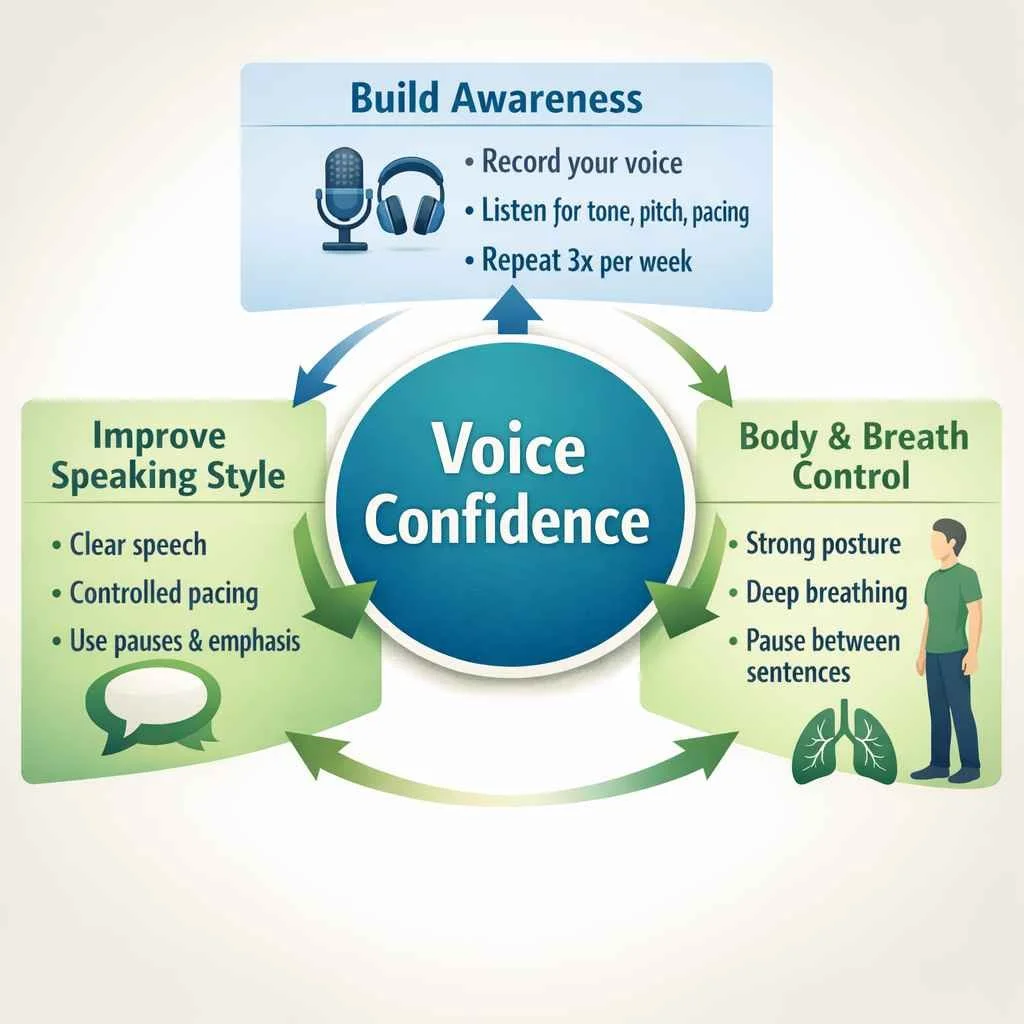
The best way to be comfortable with your voice is to practice, actively listen, and build self-acceptance. Many people are surprised by how their voices sound when they hear them on a recording. This guide breaks down simple, practical ways to improve your speaking style, feel more confident, and get more comfortable with your own voice in everyday situations.
Confidence builds as your voice becomes more familiar. Small changes in how you speak, breathe, and present yourself can make a noticeable difference to listeners.
Build Awareness Through Your Voice
Awareness is the first step. You need to hear how your voice sounds to change it.
Hit record on your phone, microphone, or camera and capture short audio or video clips. Then listen back with headphones and focus on your tone, pitch, pacing, and clarity.
For example, notice whether you speak too fast, too quietly, or with a flat voice. You can also pay attention during real conversations with friends, family members, or coworkers.
The more you listen, the more familiar your voice becomes, and the less surprising it feels.
Improve Your Speaking Style for Better Communication
Your speaking style directly affects how your message lands with your audience.
Focus on clarity, pacing, and vocal variety to avoid sounding monotone. Small adjustments like pausing, emphasizing key words, and matching your vocal tone to your emotions can make your speech more engaging.
If your pitch feels off, whether too high or too low, or your voice feels too quiet or too loud in a room, you can adjust this with practice and awareness.
Try a simple exercise: record yourself explaining a short story, then play it back and notice what stands out. This helps you become more aware of how you sound to listeners.
Use Body Language and Breathing to Support Your Voice
Your body language plays a big role in how your voice sounds.
Posture, eye contact, and facial expressions all support clearer, more confident speech. Standing or sitting upright allows your breath to support your voice more effectively.
Take deep breaths before you speak and pause when needed. Controlled breathing helps you avoid rushing and improves vocal control.
If you tend to run out of breath or feel tension, practicing breathing for a few minutes each day can make a noticeable difference.
Build Confidence Through Practice and Feedback
Confidence comes from understanding your voice and knowing how to adjust it.
Practice in real conversations, meetings, or presentations. The more you speak, the more natural it feels.
What makes the biggest difference is feedback. When you actively listen and get guidance on your tone, clarity, and delivery, you improve faster.
Working with a coach can help you focus on what actually matters for your goals, whether that is executive presence, clearer communication, or feeling more confident when you speak.

Speech Coaching for Impactful Voice
Check out our blog on speech coaching for impactful voice for more information!
A Simple Exercise to Become More Comfortable With Your Voice

If you are not sure where to start, this simple exercise is one of the fastest ways to get more comfortable with your voice.
Start by hitting record on your phone, microphone, or camera, and talk for 1 to 2 minutes. You can describe your day, tell a short story, or explain something you care about. The goal is to speak naturally, not perfectly.
Then listen back with headphones. Pay attention to how your voice sounds, your tone, pacing, and clarity. Notice what stands out. Most people are surprised at first, especially if they hate hearing their recorded voice, but that reaction fades quickly with repetition.
Choose just one thing to adjust. It might mean slowing down, speaking a little louder, or pausing instead of rushing your words.
Record again and apply that change. This is where the progress happens. Small, focused adjustments make a bigger difference than trying to fix everything at once.
Repeat this a few times a week. Over time, your voice will start to feel more familiar, and your confidence will follow.
Build Executive Presence and Overcome Anxiety

Executive presence is not just about what you say. It is how your voice sounds, how you carry yourself, and how clearly your message lands with your audience.
Your speaking style, tone, and body language all matter. Eye contact, facial expressions, and posture support a more confident and controlled voice. When your body is steady, your voice follows.
If you tend to rush or feel anxious, start with your breath. Take a moment, breathe deeply, and give yourself time to speak at a steady pace. Pausing is not a mistake. It actually makes you sound more confident and gives your listeners time to process your words.
Public speaking anxiety usually stems from feeling unsure about how you come across. That is why practice alone is not always enough.
Start in a low-pressure setting like a quiet room, then build up to conversations with friends, small groups, and eventually larger audiences. As your voice becomes more familiar and easier to control, the anxiety starts to decrease.
Working with a communication coach can make a difference. Instead of guessing what to fix, you get clear feedback on your tone, clarity, and delivery, which helps you build confidence faster.
Frequently Asked Questions About Becoming Comfortable With Your Voice

1. Why do I hate hearing my own voice?
Most people hate hearing their own voice because it sounds different from the voice they hear in their heads. When you listen to a recording, you are hearing your voice the way everyone else does, without that internal resonance. That difference can make your pitch and tone feel off or unfamiliar. The more you listen, the more familiar it becomes, and the reaction usually fades.
2. How can I improve my voice quickly?
You can improve your voice faster by focusing on one or two specific changes at a time, like pacing, volume, or tone. Short, consistent practice sessions help, especially when you actively listen and apply what you notice. You do not need hours of practice, but you do need to be intentional. Clear feedback, especially from a coach, can speed this up significantly.
3. Is it normal to feel anxious about speaking?
Yes, it is very common to feel anxious about speaking. This often comes from not knowing how your voice sounds to others or feeling unsure about how you are coming across. As your voice becomes more familiar and easier to control, that anxiety tends to decrease. Practice helps, but understanding what to adjust makes a bigger difference.
4. Can I change how my voice sounds?
Yes, you can change how your voice sounds. You can adjust your pitch, tone, volume, and speaking style with the right techniques and practice. Some people need small adjustments, while others may benefit from more targeted support if there is strain, hoarseness, or another voice concern. Your voice is flexible and can be trained.
5. What is the best way to practice speaking?
The best way to practice speaking is a mix of real conversation and focused exercises. You can use recordings to build awareness, but also pay attention to how you speak in meetings, presentations, or everyday interactions. Try simple exercises like slowing your pace, adding pauses, or using more vocal variety. Consistent, intentional practice builds confidence over time.
How Connected Speech Pathology Can Help

At Connected Speech Pathology, we help adults improve how they sound and how they come across in real conversations. Our communication coaching focuses on speaking style, vocal variety, clarity, and confidence, all tailored to your specific goals.
You receive direct, personalized feedback on your voice, including tone, pacing, volume, and overall delivery. We may use recordings or live practice, but the focus is on helping you make changes that actually carry over into everyday situations.
We also support challenges such as speaking anxiety, uncertainty about your voice, or a desire to strengthen your executive presence. The goal is not just to practice, but to help you feel more comfortable, more in control, and more confident when you speak.
Summary
Feeling comfortable with your voice takes awareness, practice, and patience. Your voice may sound different from what you expect, whether on a recording or in conversation, but that is normal.
With small adjustments to your breathing, tone, and speaking style, you can make meaningful changes over time. As your voice becomes more familiar and easier to control, your confidence follows.

About the Author
Allison Geller is a communication coach, speech-language pathologist, and founder of Connected Speech Pathology, an international online practice providing professional communication coaching and speech therapy for children, teens, and adults. With more than two decades of experience, she has worked in medical and educational settings, published research on aphasia, and leads a team of specialists helping clients improve skills in public speaking, vocal presence, accent clarity, articulation, language, fluency, and interpersonal communication.