What Is a Monotone Voice and How Do You Fix It?

A monotone voice is a speaking voice that stays flat throughout, with little or no variation in tone from word to word. This article covers what causes a monotone voice, why it matters, and how to fix it. Whether you are a professional who has been told you sound monotone, someone who notices it in recordings, or an adult who wants to connect more naturally in conversation, this guide gives you practical answers.
Vocal expressiveness can often be improved with the right support, though the extent of change varies from person to person. A flat delivery is a habit for some people. Anxiety, neurological differences, or vocal patterns that formed early drive it in others. Keep reading to find out which applies to you and what to do about it.
Key Takeaways
A monotone voice remains at the same pitch throughout speech. The word comes from the Greek “monotonia,” meaning one tone. Vocal pitch is primarily determined by the frequency of vocal fold vibration, or how quickly the vocal folds vibrate during speech. Factors such as vocal fold tension, length, and breath support all influence this process.
Causes range from habit and social anxiety to neurological conditions like Parkinson’s disease and autism spectrum disorder. Not every monotone voice has a medical cause.
A flat delivery reduces listener engagement and makes it harder for your audience to focus on what matters in your message. Research on prosody shows that listeners rely on pitch variation to parse meaning, emotion, and emphasis.
Vocal variety is a trainable skill. Communication coaches work with professionals, executives, teens, and adults every day on pitch range, inflection, and expressive delivery.
Why Does a Monotone Voice Matter?
How Do You Fix a Monotone Voice?
Exercises to Add Vocal Variety
When Is a Monotone Voice a Sign of Something Else?
What We See Working with Clients
What Is a Monotone Voice?

A monotone voice stays at the same pitch throughout, with an unchanging tone that sounds flat regardless of the words being spoken. The term comes from the Greek word “monotonia,” meaning one tone. When you speak in a monotone, your voice sounds even and emotionally neutral, no matter what you are saying.
Think of it like a song played on one note. If you sing or listen to a song with no variation in pitch, no rise and fall, it sounds boring within seconds. The same principle applies to a speaking voice that stays completely flat.
Pitch is determined by the frequency of vocal fold vibration. The vocal folds are two small bands of tissue in the larynx that vibrate as air passes through them during speech. Higher pitch corresponds to faster vibration, while lower pitch corresponds to slower vibration. This vibration rate is influenced by factors such as vocal fold tension, length, mass, and breath support.
An expressive voice shifts this constantly, rising on a question, falling to close a statement, and jumping to draw attention to key words.
Prosody is the term speech professionals use for the melody of speech: the pattern of tone, pace, rhythm, and stress that gives language its expressiveness. A monotone voice lacks prosodic variation.
Listeners experience it as speech that sounds robotic or boring, even when the words themselves are well-chosen. Learn more about how voice inflection shapes meaning in every sentence.
It sounds flat because the delivery lacks movement, not because the content is weak. That is good news: the content does not need to change, only how you sound when you deliver it.

Voice Inflection: How It Impacts the Way Others Understand You
Check out our blog about voice inflection for more information!
What Causes a Monotone Voice?
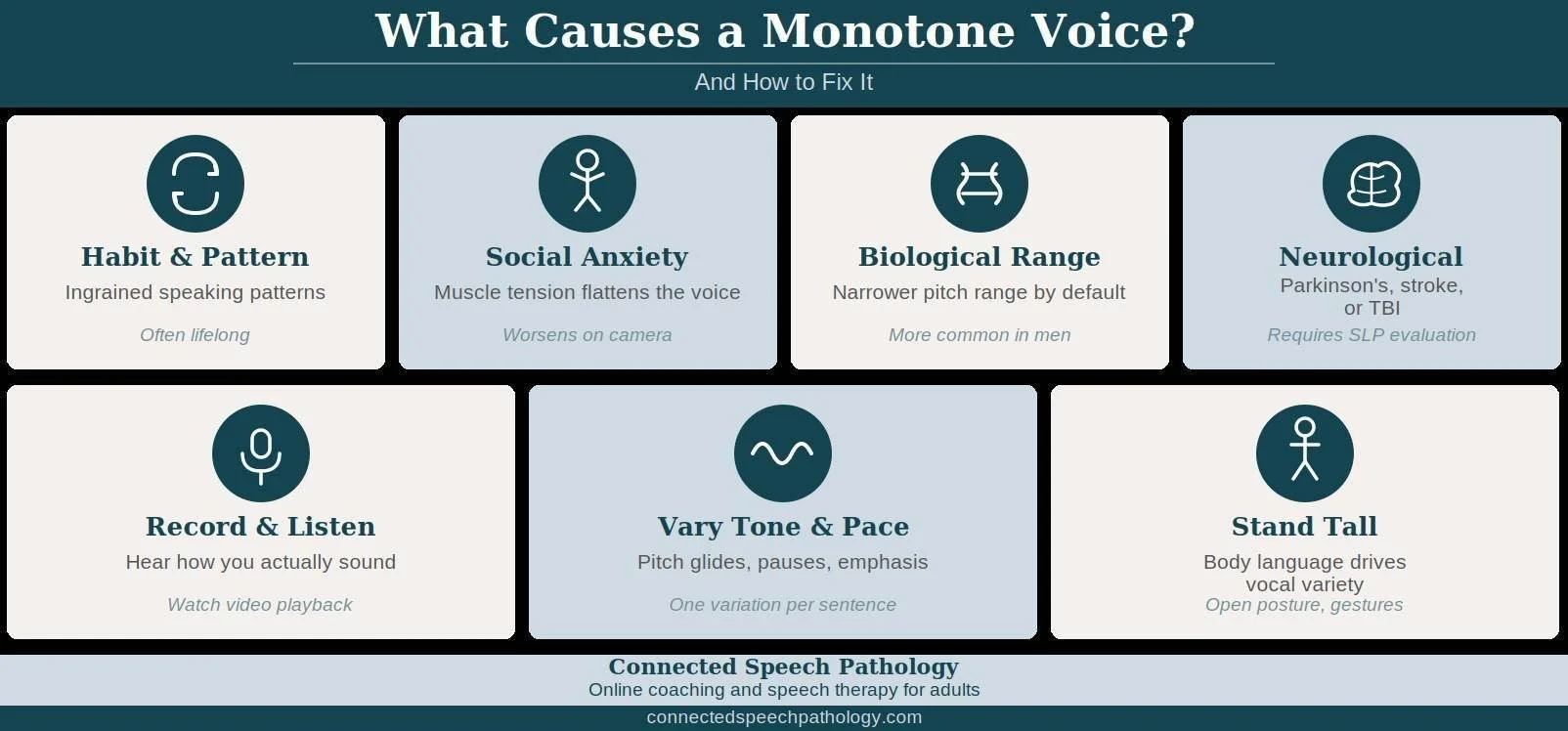
A monotone voice stems from several factors. Habit, anxiety, personality, and medical conditions all play a role, and many people have more than one at play.
Habit and Vocal Patterns
For many adults, a flat tone is simply a deeply ingrained habit. A flat tone is one of the ways tone of voice in communication can misfire, since listeners read it as boredom even when you feel engaged. The way you speak forms early and becomes automatic. Cultural background and family communication style play a major role here. In some cultures or households, more restrained vocal expression is the norm, while in others, a wider pitch range and more animated delivery are expected.
People raised in environments where emotional expression was more reserved often default to a narrower pitch range without realizing it. This is not incorrect or deficient, but it can be perceived as monotone in settings where more vocal variation is expected.
Many adults have spoken this way for decades. They may not notice how their delivery differs across contexts or how others perceive it.
Awareness alone does not change the pattern, but it is the starting point. Real change begins with understanding where the habit comes from and deciding whether it needs to shift for a specific context.
Social Anxiety
Social anxiety can affect how the voice sounds across a range of situations. When a person feels anxious while speaking, muscle tension in the throat and neck can restrict the natural movement of the vocal folds.
The result is often a flatter, tighter delivery that may come across as less engaged. This can show up in conversations, phone calls, meetings, or any situation where someone feels evaluated or under pressure.
Someone who uses natural variation in relaxed settings may sound noticeably more monotone when anxiety is present. The words stay the same; anxiety changes how they come out. See our guide on overcoming fear of speaking in front of groups for related strategies.
Testosterone and Biological Factors
Men generally tend to have more monotone voices than women. After puberty, the voice drops in pitch, resulting in a flatter tone and a narrower natural range.
Research in speech and prosody consistently shows gender differences in pitch range and variation. Female speakers tend to use a wider pitch range and greater pitch variability, while male speakers, on average, use flatter intonation patterns.
A naturally lower voice does not have to stay monotone, but it may require more deliberate use of pitch variation to create contrast and emphasis. A shaky or flat voice in public speaking often shares this biological component.
Personality and Communication Style
Personality also plays a significant role in how much someone varies their delivery. For example, introverted individuals often speak with less vocal range in professional settings.
Introverted or deeply logical individuals may talk with less emotional expression, not because they lack feeling, but because their speaking style does not prioritize vocal performance. A soft voice and a monotone voice often travel together in this group.
Neurological and Medical Causes
Several conditions reduce vocal range. Parkinson’s disease is among the most common, and about 90% of people with Parkinson’s develop voice difficulties.
The pattern is called hypophonia, meaning abnormally soft and flat speaking. Connected Speech Pathology offers LSVT LOUD and SPEAK OUT! for Parkinson’s, which specifically targets prosodic flatness.
Stroke can cause dysarthria, a speech impairment in which the muscles you use to speak are weakened or poorly coordinated. Traumatic brain injury and multiple sclerosis create similar changes. Speech therapy for stroke and neurological conditions addresses these patterns directly.
Depression also affects how you sound. Researchers describe positive attenuation, where depression limits the brain’s response to rewarding experiences. Reduced motivation and cognitive engagement directly limit vocal expressiveness, so a flat delivery is a symptom, not a choice.
Why Does a Monotone Voice Matter?

A flat delivery makes it harder for listeners to follow your message. Audiences listen more closely, retain more, and engage longer when a voice has variety.
A monotone voice makes it harder for listeners to stay focused. When you listen to someone who speaks in a monotone for more than a minute, you start to drift.
Listeners need movement in a voice to stay engaged. If you want listeners to remember your message, variation in delivery is what makes it stick.
When you speak in a monotone, listeners cannot use prosodic cues to find what matters most. They have to work harder to focus, and many will disengage before they get there.
The amygdala, the part of the brain that processes emotion, responds more actively to speech with a varied tone. Vocal expressiveness creates a cognitive hook that keeps an audience attentive.
In audio-only settings like phone calls and podcasts, facial expressions and body language are invisible. Your voice is the only tool you have to convey different emotions and create a connection.
How Do You Fix a Monotone Voice?

Fixing a monotone voice depends on the underlying cause. For many adults, it involves learning to hear their own patterns and developing the habits to vary them. With the right practice, it is possible to speak with more life and engagement in real conversation.
If reduced vocal variation is related to a neurological condition such as Parkinson’s disease or stroke, a more structured speech therapy approach is typically needed to target voice and motor speech changes. For habit-based patterns, the following strategies are a practical starting point.
Record Yourself
Record a few minutes of yourself speaking, not reading a script. Listen to the recording and note where your tone stays flat the longest.
Most people are surprised the first time they hear how their voice sounds. Your voice sound in a recording is almost always different from what you hear in your head.
A flat, robotic voice sound on playback is the most common reaction. Most people immediately think, “I sound monotone,” the first time they listen to themselves carefully.
Expand Your Tone Range
Your pitch range is the distance between the lowest and highest notes you use when you speak. Practicing different tones by humming scales trains the vocal folds to move fluidly. For structured exercises with a coach, see our guide on vocal projection exercises for professionals and performers.
Read dialogue aloud and deliberately exaggerate the rise and fall of your voice.
Playing with your voice in private creates options you can use in public. Play with exaggeration first; a natural range will follow. Most people who play with volume and pitch in practice find that it transfers to a real conversation faster than expected.
Use Inflection on Certain Points
Every statement has a word that carries the most meaning for your audience. Good inflection means landing on that word with a shift in tone to draw attention to it. Identify the single most important word in each statement, then put a deliberate pitch change on it.
One intentional variation per statement is enough to start. This skill creates focus for your listener and makes your words land with more clarity. Key words get the emphasis they deserve.
Vary Your Pace and Use Pauses
Pace variation works alongside pitch variation. A consistent pace that never speeds up or slows down creates the same flatness as a voice with no tonal range.
Slowing down before an important point adds weight to what follows. Speeding up through background detail signals that you are giving context, not a conclusion.
Using intentional pauses creates anticipation. They give listeners time to absorb what you said before you move on.
Most people who sound monotone also talk too fast. If your tone comes across as monotone and hard to listen to, pacing is often the first fix.
Body Language and Posture
Body language and vocal delivery are directly linked. Stand tall with an open posture before you speak.
Standing tall and using natural hand gestures tends to produce a more varied tone automatically. Your facial expressions also feed into how your voice sounds.
A rigid posture and locked arms constrain the breathing and muscular freedom that the voice depends on. Your body affects how you sound more than most people realize.
Exercises to Add Vocal Variety

These exercises target the mechanics behind habit-based monotone speech.
Tone Glides
Say a single word and slide your vocal pitch from the bottom of your range to the top, then back down. “Hello” works well. The goal is a smooth, unbroken glide.
Two minutes of this each morning trains your voice to move fluidly across different tones.
Sentence Stress Practice
Take any sentence and say it five times, each time emphasizing a different word. For example: “I didn’t say he took the money.” The meaning shifts with each repetition. This builds consistent practice with stress placement and intonation.
Read Aloud from Dialogue
Novels with strong characters are ideal. Read each character’s lines as if performing them.
Try to convey different emotions through voice alone: excitement, sadness, surprise. You are training your voice to feel comfortable with the range.
If you sing even occasionally, singing exercises are also effective. When you sing, you are already practicing controlled tone variation, and that practice transfers to how you speak.
The Counting Exercise
Count from one to ten, assigning a different emotional tone to each number. Say “one” with excitement, “two” with sadness, “three” with surprise, “four” with anger.
If you feel angry, your voice naturally rises and tightens. This disconnects tone variation from content and helps people who feel self-conscious about sounding expressive. Many people feel exposed when they first try to vary their delivery.
Diaphragmatic Breathing
Diaphragmatic breathing means breathing so your belly moves rather than your chest. It provides the airflow foundation for a full, varied voice.
Practice lying flat with a book on your stomach, breathing so the book rises and falls. Transfer that to how you breathe when you speak.
Good breathing also supports a louder, more projected voice. A loud voice and an expressive voice often develop together.
When you need to speak loudly and clearly across a room, diaphragmatic breathing makes it possible. A soft voice and a flat delivery often travel together, and both improve when you speak from the diaphragm.
When Is a Monotone Voice a Sign of Something Else?

A monotone voice alone does not confirm any diagnosis. It is a symptom shared across many conditions, and context always matters.
Neurological Changes
If a flat tone appeared suddenly in an adult who previously spoke with normal expressiveness, it warrants attention. Sudden changes in prosody can follow neurological events like stroke or traumatic brain injury. Voice therapy for voice disorders can evaluate whether the change is neurological.
Depression and Flat Affect
A monotone voice, low energy, disinterest in activities, or significant mood changes are worth discussing with a physician or mental health provider. Depression and flat affect often travel together, and the voice is one of the first things people close to someone notice. See our post on why your throat feels tight when you talk for related patterns.
Autism Spectrum Disorder
Autism spectrum disorder may lead to a monotone voice that has been present since childhood. Autism may affect prosody differently than habit or anxiety.
A child with autism may not recognize the need to change tone in different social situations. Children with ASD can sometimes talk in a flat tone regardless of their emotional state.
A flat, monotonous voice can make it harder for a child with autism to engage with peers, especially if their speech is perceived as less expressive. This can affect communication development and reduce willingness to participate in social situations.
A speech-language pathologist who works with autistic individuals is the right starting point for any family with concerns about communication. Some autistic adults choose to work on tone variation for professional contexts, while others focus on broader communication goals. Coaching approaches vary based on individual priorities and preferences.
What We See Working with Clients

Most adults who come in for a monotone voice have heard some version of the same feedback over time. A manager might say they sound flat, or a colleague may mention it’s hard to tell what they’re emphasizing.
One common example is a manager who runs meetings and communicates clearly, but their team doesn’t engage. When we review it, the content is strong, but key points don’t stand out because everything is delivered at the same pitch.
We also see professionals who present often but lose their audience halfway through. They tend to move quickly, with few pauses, and their tone doesn’t shift to mark transitions or highlight important ideas.
Another pattern is someone who sounds natural and expressive with friends but is much flatter at work. They’re trying to be clear or professional and end up limiting their vocal range without realizing it.
The encouraging part is how quickly this can change. Small adjustments to pacing, emphasis, and pitch start to shift how the message lands almost immediately. Within a few sessions, delivery begins to match the strength of the content.
Frequently Asked Questions About Monotone Voice

1. Is a monotone voice bad?
Not inherently. A steady, even tone reads as calm, authoritative, and confident in the right context. It becomes a problem when the way you speak makes it hard for listeners to focus on what matters in your message.
Many successful communicators have a naturally narrower pitch range and work with it rather than against it.
2. Can a monotone voice be a sign of autism?
A monotone voice is one characteristic that can be associated with autism and has been noted in research since autism spectrum disorder was first described in 1943. However, a monotone voice alone does not indicate autism. Other differences in social communication, interaction, and sensory processing would also be present.
An evaluation by a speech-language pathologist or psychologist is the appropriate next step if there are concerns.
3. Does depression cause a monotone voice?
Depression can be associated with a flatter, less expressive voice. Many individuals experience reduced emotional reactivity and lower energy, which can affect vocal expression, including pitch variation, volume, and pacing.
A monotone voice alone does not indicate depression. Still, if changes in vocal expression occur alongside low mood, reduced motivation, or loss of interest in daily activities, it may be worth discussing with a healthcare provider.
4. Can you fix a monotone voice on your own?
You can make real progress with consistent effort: recording yourself, working on pitch glides and sentence stress, and reading aloud to convey different emotions all build the habits that support vocal variety. The gap most self-practice hits is feedback.
Without someone telling you what they actually hear, it is hard to know whether your expressiveness matches the listener’s experience. A communication coach closes that gap.
5. Who are some well-known people with monotone voices?
Ben Stein is probably the most recognized, known for his role as the economics teacher in “Ferris Bueller’s Day Off.” Henry Kissinger spoke with a narrow, measured tone throughout his career. Sam Harris, a podcaster and author, uses a largely steady delivery that many listeners find compelling for its calm, focused quality. These examples show that a monotone voice is not always a liability.
How Connected Speech Pathology Can Help

Connected Speech Pathology works with professionals, executives, and adults who want to communicate with more clarity and impact. If a flat tone is getting in the way of how your words land, our communication coaches work with you on vocal variety, tone range, and expressive delivery. Voice and performance coaching is also available for those who need a stronger performance or broadcast application.
For monotone voices due to neurological or clinical causes, our speech-language pathologists provide evaluation and targeted treatment. Sessions are online and structured around your specific goals.
Summary
A monotone voice is a flat speaking voice in which pitch remains nearly constant regardless of content or emotion. Habit, anxiety, personality, and biological tone range account for most non-clinical cases. Neurological conditions like Parkinson’s disease, stroke, and autism produce monotone speech through different mechanisms.
Vocal variety is a trainable skill. Tone range exercises, intentional inflection, pace variation, diaphragmatic breathing, and body awareness all create measurable change with consistent practice.

About the Author
Allison Geller is a communication coach, speech-language pathologist, and founder of Connected Speech Pathology, an international online practice providing professional communication coaching and speech therapy for children, teens, and adults. With more than two decades of experience, she has worked in medical and educational settings, published research on aphasia, and leads a team of specialists helping clients improve skills in public speaking, vocal presence, accent clarity, articulation, language, fluency, and interpersonal communication.