Why Does My Throat Feel Tight When I Talk? Causes of Throat Tightness and How to Relieve It

Why does my throat feel tight when I talk? The usual answer is that the muscles around your voice box are working harder than they need to. Here is what to know about throat tightness when you talk: what the tight feeling is, what causes it, how to sort one cause from another, and how it is treated.
If you are an adult whose throat tightens through a long day of meetings or teaching, or you feel pressure in your throat that nobody has explained, the cause is worth pinning down. Getting the cause right matters, because voice strain, acid reflux, and anxiety each respond to different care.
Tightness in the throat is rarely dangerous on its own, though some warning signs need urgent help.
Key Takeaways
A throat that feels tight when you talk usually means the muscles around your voice box are working too hard. The vocal cords are often normal, so an exam can look clean while the tight feeling stays real.
Acid reflux, anxiety, thyroid issues, allergic reaction, and infections all produce the same throat tightness. When it shows up, and what comes with it, points toward the cause.
Voice work with a speech-language pathologist is the usual care when muscle tension is the cause. An evaluation looks at your breathing, how you start sounds, and where your effort goes.
Tightness arriving suddenly with difficulty breathing, chest pain, or swelling is a medical emergency. Throat tightness lasting more than a few weeks needs medical evaluation even when mild.
What Is Throat Tightness When You Talk?
What Causes Your Throat to Feel Tight When You Talk?
How Can You Tell Which Cause Is Behind Your Tight Throat?
How Do You Relieve Throat Tightness?
What We See Working with Clients
Frequently Asked Questions About Throat Tightness When Talking
What Is Throat Tightness When You Talk?

Throat tightness when you talk is a squeezing feeling across the front of the neck during or after speaking. It happens when the laryngeal muscles, the ones wrapped around your voice box, grip harder than the job requires. The tight feeling is a common symptom rather than a diagnosis, and several conditions make your throat feel tight.
Tightness and soreness are different signals. Soreness points toward irritated tissue, tightness toward muscle effort or pressure. If what you feel is mostly throat pain, the underlying cause and the care are different.
Tightness, Pressure, and Globus Sensation
Tightness in the throat shows up as pressure, a tight band across the neck, or a lump that will not swallow away. That lump feeling has a name, globus sensation, medically known as globus pharyngeus. Nothing is stuck, and the sensation comes from muscle tension rather than an upper airway obstruction.
Other symptoms travel with the tightness in the throat:
A voice that tires by afternoon, or sounds strained when you push the vocal cords for volume
A frequent need to clear the throat, or trouble swallowing that comes and goes
Hoarseness when the vocal cords are involved, plus neck or jaw soreness after a long talking day
What Causes Your Throat to Feel Tight When You Talk?

Six causes account for most cases, from how you use your voice to medical conditions. Muscle tension is the most likely underlying cause when talking is the trigger, and other symptoms alongside it tell you more than the tightness does.
Muscle Tension Dysphonia and Vocal Strain
Muscle tension dysphonia is a voice disorder where the throat muscles squeeze harder than speaking requires, even though the true vocal cords themselves are usually normal.
Instead, the laryngeal examination often shows excessive muscle tension, including compression of the structures above the vocal cords (supraglottic hyperfunction) during speaking.
The false vocal folds may partially come together, and the space above the vocal cords may appear narrowed as the surrounding muscles contract excessively. The true vocal cords typically have normal structure and movement, but their vibration can be affected by the excess muscle tension around them.
Talking for long stretches or talking loudly or screaming pushes those throat muscles into a bracing habit, and overuse of the vocal cords keeps it there.
Speech therapy for muscle tension dysphonia releases the bracing rather than resting the voice.
Anxiety, Stress, and Panic Attacks
Anxiety tightens the throat through the stress response that speeds your heart and shortens your breath. Neck, jaw, and throat muscles brace, and speaking takes more work than it should.
Panic attacks push this into a choking sensation, and globus sensation is often linked to stress in people with no anxiety disorders. The physical symptoms are real, not imagined.
Acid Reflux, GERD, and Laryngopharyngeal Reflux
Acid reflux causes throat tightness by irritating tissue at the back of the larynx. The National Institute of Diabetes and Digestive and Kidney Diseases estimates that about 20 percent of people in the United States have gastroesophageal reflux disease, where heartburn occurs more than twice a week.
Acid reflux symptoms include a burning sensation behind the breastbone and a tight-sounding voice in the morning, and GERD symptoms overlap with them almost exactly. When stomach acid reaches the throat with no burning sensation at all, the pattern is called laryngopharyngeal reflux.
Gastroesophageal reflux disease left untreated can lead to esophageal damage, so stomach acid that keeps reaching the larynx is worth treating.
Vocal Cord Dysfunction and Laryngeal Dystonia
Vocal cord dysfunction makes the vocal cords close when they should open, so the throat feels like it is closing. Asthma is the common misdiagnosis, and vocal cord dysfunction responds to breathing retraining in online voice therapy rather than to an inhaler.
Laryngeal dystonia makes the laryngeal muscles spasm during speech, and eosinophilic esophagitis brings tightness with difficulty swallowing. Both need a physician to confirm first.
Thyroid Disorders and Goiter
Thyroid disorders cause tightness through pressure rather than muscle effort. The thyroid gland is a butterfly-shaped gland at the base of the neck, and a goiter, an abnormal enlargement of it, presses on everything around it.
Tightness and difficulty swallowing are the usual result.
A healthcare provider checks thyroid hormone levels and images the thyroid gland when problems are suspected.
Allergic Reaction, Anaphylaxis, and Infections
An allergic reaction can make your throat feel tight and swollen within minutes. Over 100 million people in the U.S. experience allergies annually, and most stay mild. Anaphylaxis is a life-threatening allergic reaction needing emergency care, and epinephrine is the standard medical treatment for it.
Other symptoms of anaphylaxis include difficulty breathing and swelling of the lips or tongue, so a severe allergic reaction is obvious.
Viral infections and bacterial infections work gradually instead. A throat infection, such as strep, leaves a red throat that feels tight while your immune system fights it.
Bacterial infections clear with antibiotics, while viral infections run their course.
How Can You Tell Which Cause Is Behind Your Tight Throat?
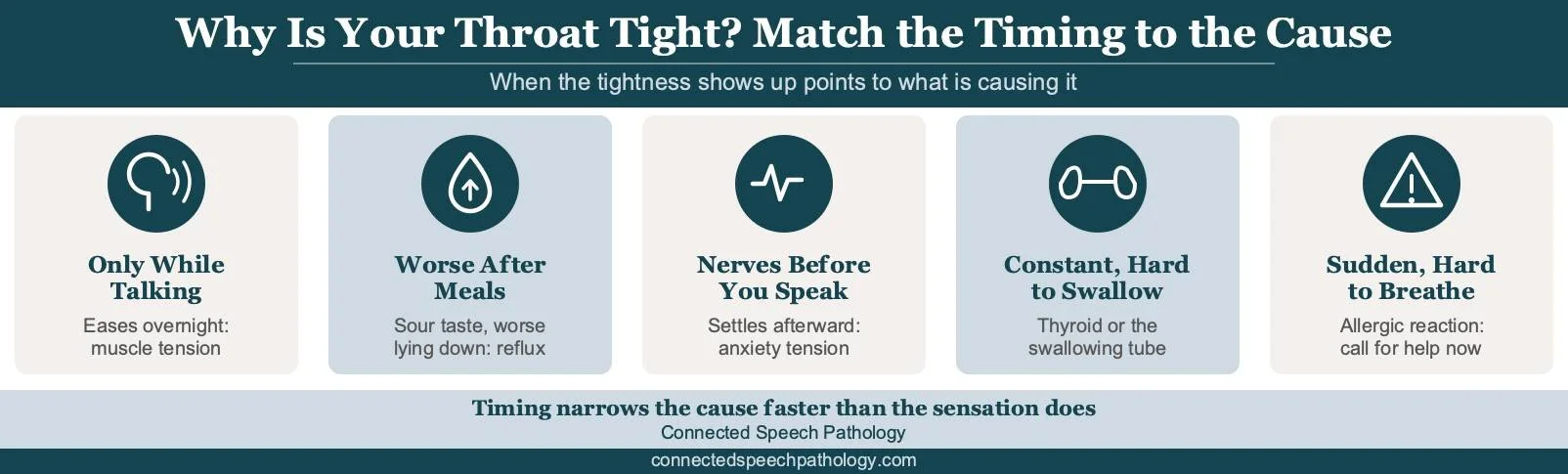
Timing narrows the cause faster than the sensation does, so work from the pattern:
Only while talking, easing overnight: muscle tension from voice overuse
Worse lying down, after meals, or with a sour taste: acid reflux or laryngopharyngeal reflux
Arrives with nerves before speaking, settles afterward: anxiety-driven tension
Constant, with difficulty swallowing food: thyroid issues or a swallowing problem
Sudden, with difficulty breathing or swelling: allergic reaction, treated as an emergency
More than one cause can be true at once, and none of this replaces an accurate diagnosis. Reflux irritation and tension often arrive together, because a sore throat gets guarded.
When Throat Tightness Is a Medical Emergency
Sudden tightness with trouble breathing is a medical emergency needing immediate medical attention. Call emergency services when any of these appear:
Difficulty breathing, noisy breathing, or the sense that the airway is closing
Swelling of the lips, tongue, or face
Chest pain, or tightness that spreads into the jaw or arm
Tightness starting within minutes of a food, sting, or medication
Tightness in the throat lasting more than a few weeks requires medical evaluation, as does persistent tightness with weight loss, a neck lump, or a voice change past three weeks.
How Do You Relieve Throat Tightness?

Relief depends on the cause. Most throat tightness responds to one of three approaches: short-term comfort, medical care for a physical cause, or voice work for a tension pattern.
Short-Term Relief and Relaxation Techniques
Hydration is essential to keep the throat moist and reduce tightness, and it is the first rule of taking care of your voice. Water throughout the day does more than a lozenge at bedtime. Relaxation techniques help when tension is part of the picture, and gentle neck release, warm liquids, and unhurried deep breathing lower the bracing response.
Slow breathing through the nose steadies the system faster than forced deep breathing does. Healthy lifestyle changes matter most when reflux is involved, so avoiding trigger foods, eating earlier, and raising the head of the bed reduce symptoms.
Over-the-counter medications, such as antacids, help with flares, and over-the-counter lozenges soothe a raw throat.
Medical Treatment by Cause
Medical treatment targets whatever is producing the tightness, because over-the-counter relief does not reach the cause. GERD treatment usually starts with lifestyle changes and proton pump inhibitors, medicines that lower acid production in the stomach and belong with a prescribing healthcare provider rather than a self-directed plan.
Allergy shots address allergic causes, and thyroid hormone levels are corrected when the gland is the problem. Antibiotics are reserved for confirmed bacterial infections, and each of these needs a healthcare provider.
A laryngologist, an ear, nose, and throat physician who specializes in voice disorders, is the right first stop when the cause is unclear. Serious complications are uncommon, and an examination rules them out in severe cases.
Voice Therapy for Muscle Tension Dysphonia
Voice therapy is how muscle tension dysphonia is commonly treated, and it retrains effort instead of resting the voice. A speech-language pathologist who specializes in voice starts with an evaluation, often including videolaryngostroboscopy, a camera exam showing the vocal cords in slow motion.
Sessions usually include humming and resonant voice exercises that move sound forward, gentle release of the muscles outside the larynx, breath-support work, and pitch glides. Your speech pathologist chooses what happens in a session and what becomes guided practice. Doing them with the wrong technique can add strain, so they stay guided.
Some people ease up within weeks of starting speech therapy, and severe cases need several months. Muscle tension dysphonia recovery time depends on how long the bracing has been running.

How to Strengthen Your Vocal Cords
Check out our blog about how to strengthen your vocal cords for more information!
What We See Working with Clients

We work with adults whose voices have to hold up all day, and a tight throat is one of the most common reasons they call.
The examples below are real clients of ours. Identifying details have been changed to protect privacy.
A high school teacher came to us because her throat was sore and her voice tight by fourth period. She got through her morning classes, then pushed to be heard over a full room after lunch.
Her evaluation showed normal vocal cords with a lot of extra muscle effort. We started with gentle release of the muscles outside her larynx, yawn-sigh releases, and resonant voice work to move her sound forward, then built voice breaks into her schedule. She now finishes most days without the afternoon grip.
A sales manager noticed tightness on back-to-back video calls, worse when he ate late. His voice held up in short conversations and gave out during long ones, so he dreaded afternoons.
We referred him to an ear, nose, and throat (ENT) doctor for an evaluation, and it found signs of irritation from acid reflux. Once that was managed, we worked on easy voice onset, sustained vowels, and pitch glides, plus hydration and pacing breaks between calls. Colleagues stopped asking him to repeat himself.
Frequently Asked Questions About Throat Tightness When Talking

1. Why does my throat feel tight but not sore?
Tightness without soreness usually points to muscle effort rather than inflammation. A sore throat comes from irritated tissue, while tightness comes from muscles gripping too hard. A clean exam with a tight feeling is the classic picture of overworked throat muscles.
2. Can anxiety cause throat tightness when speaking?
Yes, anxiety tightens the throat through the body's stress response. Neck, jaw, and throat muscles brace, breathing turns shallow, and speech takes more effort. The sensation is physical, and it improves for many people once both the anxiety and the tension are addressed.
3. When should I worry about throat tightness?
Seek emergency care for sudden tightness with trouble breathing or swelling. Other symptoms also call for prompt medical evaluation: chest pain, a lump in the neck, weight loss, or a voice change past three weeks. When symptoms persist, book a visit even if the tightness stays mild.
4. Does throat tightness from voice strain go away on its own?
Mild voice strain often settles with rest, but entrenched tension patterns do not. Rest removes the load without changing the habit, so the tightness returns once talking resumes. Voice therapy addresses the pattern itself, and most people who complete it speak with less effort and feel more comfortable with their voice.
5. Can voice therapy fix throat tightness, or do I need a doctor first?
See a doctor first when the underlying cause has not been identified. An ENT exam can rule out reflux damage, thyroid enlargement, and vocal cord problems that voice work cannot address. Once that is managed, voice therapy is suggested for most people.
How Connected Speech Pathology Can Help

Connected Speech Pathology provides online speech therapy for adults whose voices have to hold up all day. Our voice-focused pathologists look at how you breathe, how you start sounds, and where the extra effort goes.
What makes the work different is that it is built around your real talking day. We shape the plan around the meetings, classes, or calls where the tightness shows up.
Summary
Most people asking why does my throat feel tight when I talk are dealing with throat muscles that work harder than speaking requires. Muscle tension dysphonia is the usual name for that pattern.
Gastroesophageal reflux disease, anxiety, thyroid enlargement, allergic reaction, and infection produce the same tight feeling. Timing matters more than the sensation alone.
Voice therapy, guided by a speech-language pathologist specializing in voice, addresses the tension itself. Medical causes are ruled out first, and tightness that arrives suddenly with difficulty breathing needs emergency care.

About the Author
Allison Geller, M.A., CCC-SLP, is a communication coach, speech-language pathologist, and founder of Connected Speech Pathology, an international online practice providing professional communication coaching and speech therapy for children, teens, and adults. With more than two decades of experience, she has worked in medical and educational settings and published research on aphasia. Today, she leads a team of specialists who help clients improve their skills in public speaking, vocal presence, accent clarity, articulation, language, fluency, and interpersonal communication.