Breathing Exercises for Public Speaking: Breath Control Under Pressure
Breathing exercises for public speaking are deliberate deep breathing patterns that calm your nervous system before you speak and keep your breath steady while you talk. Here is what to know about them: why pressure changes your breathing, which techniques work, how to breathe while you are talking, and how long practice takes.
If you are an adult who tightens up before an important presentation, or one who runs short of air mid-sentence, these techniques help. Anxiety climbs fast in those first moments, and your breath is what responds quickest. Breath is the one part of the stress response you can change on purpose, and it is what your voice runs on.
Key Takeaways
Breathing exercises for public speaking are set patterns you practice on purpose, so your breath holds steady when you are nervous. The main ones are diaphragmatic breathing, box breathing, and belly breathing.
A longer exhale is what settles anxiety. Every calming technique here makes the out-breath longer than the inhale.
Breathing while you speak is a separate skill from calming nerves. Speech runs on the out-breath, so the fix for running short of air is shorter phrases and planned breath points.
Five minutes a day is the dose that matters. Most people find their breath control holds in front of a large audience after two to four weeks.
What Are Breathing Exercises for Public Speaking?
Why Stress Changes Your Breathing
Diaphragmatic Breathing for Public Speaking: The Foundation of Breath Control
Breathing Techniques to Calm Your Nerves Before You Speak
How to Breathe While Speaking Without Running Out of Air
What We See Working With Clients
Frequently Asked Questions About Breathing for Public Speaking
What Are Breathing Exercises for Public Speaking?

Breathing exercises for public speaking are set patterns of inhaling, holding, and exhaling you practice ahead of time. Breathing practice is also one part of speech training at work, alongside pace, volume, and organizing what you say. They do two jobs that most advice blurs together: calming nerves before you start, and breath control, which keeps enough air behind your words.
The following techniques are worth learning:
Diaphragmatic breathing, the base skill, where your belly moves while your chest stays quiet.
Box breathing, an equal four-count rhythm of inhale, hold, exhale, hold.
The long count, where you inhale deeply for four counts, hold for seven, and breathe out over eight.
Pursed lip breathing, where you exhale slowly through nearly closed lips.
Silent nose breaths at the punctuation, unheard by the audience.
Phrase practice, where you plan the breath points between groups of words.
The first four settle anxiety in the body, and the last two are speaking mechanics nearly everyone skips. Our online communication coaching works on both halves.
Why Stress Changes Your Breathing

Public speaking anxiety pulls your breathing high into your chest, and that change drives most of what you feel. Steadying your breath is one of the habits in our guide on how to articulate your thoughts more clearly. The fight or flight response speeds your breath up, so you take fast, shallow breaths from the top of your lungs. In front of an audience, that fast breathing brings a racing heart, a dry mouth, and physical tension.
Shallow chest breathing is a poor fuel supply for speech. Your voice runs on a steady stream of air past your vocal cords, and shallow chest breathing gives you uneven bursts instead. Rising anxiety levels and a shaky voice arrive together for that reason.
The way out is the exhale. A long, slow out-breath stimulates the vagus nerve, and the vagus nerve switches on your parasympathetic nervous system, dropping your heart rate and blood pressure.
Diaphragmatic Breathing for Public Speaking: The Foundation of Breath Control

Diaphragmatic breathing is the base skill behind breath control, and every other technique sits on top of it. Your diaphragm is a dome-shaped muscle under your lungs, and when the diaphragm contracts it draws air into the lower part of them. Belly breathing is the same thing under a plainer name, with the belly moving while the chest stays still.
How to Practice Diaphragmatic Breathing
Sit comfortably with one hand on your belly and the other on your chest. Inhale deeply through your nose until your abdomen rises, then exhale slowly through pursed lips as the diaphragm relaxes. Repeat for six to eight rounds, keeping the out-breath longer than the inhale.
Many people start lying down, where a full breath is easier to feel, then practice sitting and standing.
How Often to Practice
Short daily sessions beat occasional long ones. Consistent breath control practice makes it automatic, so it holds when you are nervous. Most people notice a steadier voice inside a month.
Breathing Techniques to Calm Your Nerves Before You Speak
Slow breathing techniques calm your body down from high alert in the minutes before you take the stage. Pick one, get familiar with it in advance, and repeat it before every talk.
Box Breathing for the Minutes Before You Speak
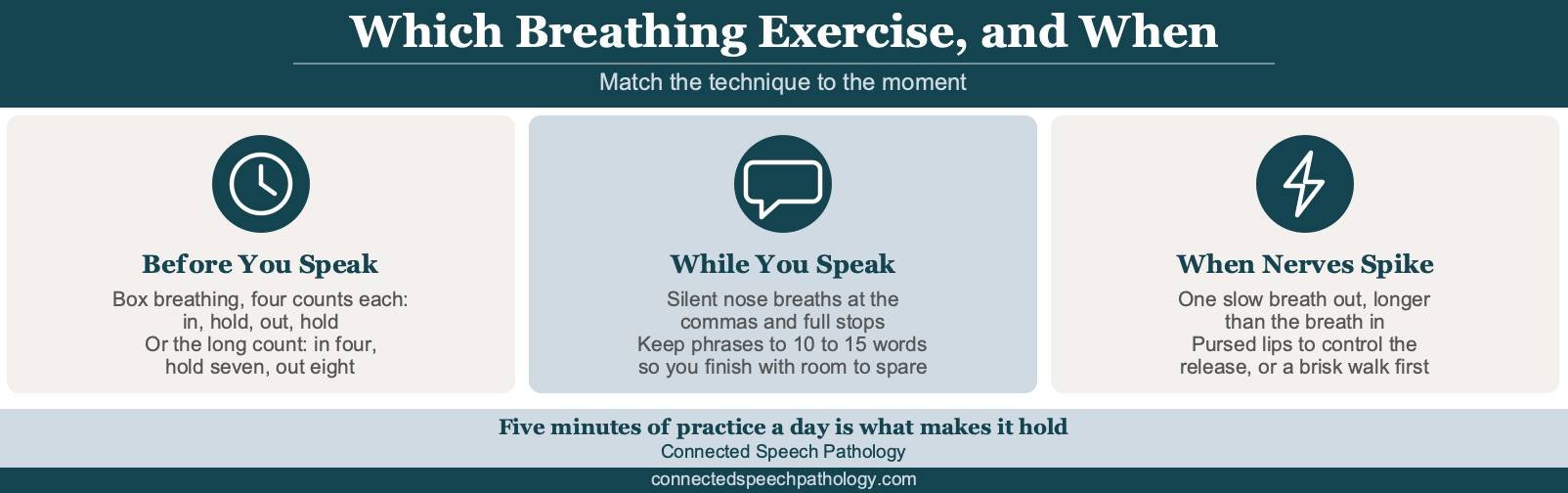
The box breathing technique uses equal counts for inhaling, holding, and exhaling. Inhale for a count of four, hold, breathe out, then hold empty for the same length, and repeat the cycle four times. Navy SEALs use box breathing to stay calm under pressure, and the counting gives your focus a job instead of leaving it on the audience.
The 4-7-8 Technique for a Fast Reset
A long count is the fastest technique for calming nerves when you have only a minute. Inhale deeply through your nose for four, hold for seven, then exhale completely through your mouth over eight. Two rounds is plenty, since the slow breath out does the work.
Pursed Lip and Alternate Nostril Breathing
Pursed lips slow your out-breath, and you take in more oxygen with less effort. Breathe deeply in through your nose, then let the air out through nearly closed lips, as if cooling a spoonful of soup. Alternate nostril breathing, a yoga technique, does a similar job, and the slow pattern can build lung capacity over time.
If your hands are shaking, pair conscious breathing with movement. A brisk walk or a few jumping jacks burns off adrenaline first, and controlled breathing lands better.
How to Breathe While Speaking Without Running Out of Air

Breathing while speaking is a mechanical skill, separate from anything you do to calm down beforehand. Speech happens on the exhale, so every sentence spends breath you already took in. Running short of air halfway through a sentence is a planning problem.
Speak on the Exhale and Keep Your Phrases Short
One comfortable breath lasts about a phrase, which for most speakers is 10 to 15 words. Mark your notes in phrases that length, and you will finish each one with room to spare. Read a paragraph aloud, draw a slash wherever you run short, then shorten the words before that slash.
Long sentences are the usual culprit, since a sentence that reads well can be too long to say in one breath. Splitting it in two gives you a place to breathe.
Take Silent Nose Breaths at the Punctuation
Breathe through your nose at the natural pauses, at commas and full stops, and the breath stays silent. A fast gulp through the mouth is audible from the third row, and an audience reads that sound as anxiety. A brief pause between ideas also reads as confidence.
Practice by reading aloud and breathing only at the pauses.
Skip the Big Deep Breath Before You Start
Almost every guide tells you to breathe deeply before you begin, and that advice backfires. A large breath held at the top raises the pressure under your vocal cords, so your voice has a pressed, strained sound on the first phrase. You also start from a full chest, where you have the least control over the air.
Take an ordinary breath instead, let a little go, and start talking. On stage, the speaker who gasps before the first line is usually the one whose voice sounds strained on the opening line.

How To Improve Public Speaking Skills
Check out our blog on how to improve public speaking skills for more information!
What We See Working With Clients

We coach adults on presentations, meetings, and interviews, and breath work turns up in nearly every plan.
The examples below are real clients of ours. Identifying details have been changed to protect privacy.
One client, a product manager, ran short of breath halfway through his sentences on quarterly review calls. Stakeholders kept asking him to repeat himself, and he dreaded those calls a week out. We began with diaphragmatic breathing lying down, until he felt his belly move without his chest joining in.
Then we marked the breath points in his slide notes and rewrote three long sentences into shorter phrases. The gasping eased over about six weeks, and he stopped losing the ends of his sentences.
Another client, a nonprofit director, spoke fast and thin on stage and did not hear it happening. Her staff said her strongest points were the hardest to catch, because her voice dropped at the end of each line. We worked on a slow breath out for the wings, silent nose breaths at the punctuation, and a deliberate pause after her opening line.
She recorded three practice runs and listened for where she pushed through without breathing. Her voice steadied, and she grew more comfortable through a full 10-minute talk.
Frequently Asked Questions About Breathing for Public Speaking

1. How do breathing exercises help with public speaking?
Deep breathing steadies your breath supply and slows your heart rate. A long exhale switches on your parasympathetic nervous system, so the physical symptoms of anxiety settle in a minute or two.
2. Can breathing exercises fix public speaking anxiety?
They reduce the physical side of anxiety, though they do not replace practice. Controlled breathing brings your body down from a racing heart and physical tension, which often keeps you calm through the first minute. Speaking anxiety eases with time on stage, and a speech coach speeds that up.
3. What is the 4-7-8 breathing technique?
You inhale for four counts, hold seven, and breathe out over eight. The long exhale is what calms you, so the ratio matters more than the exact counts. Two rounds before your next presentation is enough.
4. Should I take a deep breath right before I start speaking?
A normal breath works better than a big one. A held deep breath pushes too much pressure below your vocal cords, and your first words sound forced. Take an ordinary breath, release a little, then begin.
5. How long does it take for breathing exercises to work?
The calming exercises work in minutes, and breath control takes weeks. The box breathing technique lowers your heart rate quickly, and breath control while speaking becomes a habit after two to four weeks.
How Connected Speech Pathology Can Help

Connected Speech Pathology works with adults on breath control for presentations, meetings, and interviews. Our communication coaches listen for where your breath runs out, then build practice around your own talks and calls. The phrase marking and the breath points go into your own slides and scripts, so what you practice is what you say.
Sessions are online, so you practice on the same setup you will present from. Our online voice and performance coaching also covers projection, pacing, and sound for professional speakers.
If breathlessness is new, happens when you are not speaking, or comes with chest discomfort, see a doctor.
Reach out to find where your breath gives out and what to do about it.
Summary
Breathing exercises for public speaking work on two fronts: calming your body before you speak and keeping your voice steady while you talk. Diaphragmatic breathing is the base technique, box breathing handles the nerves, and your parasympathetic nervous system does the rest once your out-breath slows.
Keep your phrases near 10 to 15 words, pause to breathe at the punctuation, and skip the big breath before your first line. Five minutes of practice a day is what makes it hold on stage. Your breath is the one part of the stress response you can control on purpose.

About the Author
Allison Geller, M.A., CCC-SLP, is a communication coach, speech-language pathologist, and founder of Connected Speech Pathology, an international online practice providing professional communication coaching and speech therapy for children, teens, and adults. With more than two decades of experience, she has worked in medical and educational settings and published research on aphasia. Today, she leads a team of specialists who help clients improve their skills in public speaking, vocal presence, accent clarity, articulation, language, fluency, and interpersonal communication.