Voice Inflection: How It Impacts The Way Others Understand You

Voice inflection is the change in pitch, tone, and volume that shapes how listeners understand spoken words. Rising and falling patterns can turn the same words into a question, a statement, or a correction. Adults who speak in meetings, give talks, or want to sound clearer in everyday conversation can change these patterns with practice.
The same sentence can sound like a question, a confident statement, or a criticism, depending on how your voice rises and falls. Listeners react to that sound before they weigh what was said, and learning how inflection works helps you speak with confidence.
Key Takeaways
Voice inflection changes how the same words are understood. Shifts in pitch, tone, and volume tell listeners what you mean and how you feel.
Upward inflection and downward inflection send different signals. A rising tone can turn a plain sentence into a question, while a falling tone signals confidence and completion.
A monotone voice makes speech harder to follow. Varied pitch keeps listeners engaged and highlights your most important points.
Practice strengthens vocal control. Recording yourself, emphasizing key words, and varying your pitch all sharpen your message.
Upward Inflection and Downward Inflection in Speech
How Pitch and Volume Level Shape the Intended Message
Body Language and Voice Inflection
Strategies to Practice Voice Inflection
What We See Working with Clients
What Is Voice Inflection?

Voice inflection is the rise and fall of the human voice as you talk. Those changes in pitch, tone, and volume shape how a sentence is understood, and they carry emotion, intent, and emphasis. Inflection is one of the four parts of tone of voice in communication, alongside pitch, volume, and pace. You may also hear it called intonation or pitch inflection. Without inflection, speech can sound flat and harder to follow.
A calm, steady voice can signal authority, while a higher pitch often communicates excitement, surprise, or strong emotion. Inflection can even convey anger or sarcasm, where the sound carries more of the meaning than the wording does. Research in communication shows that vocal tone affects how attitudes and emotions are perceived.
How Voice Inflection Changes the Meaning of the Same Words
Say "That was interesting" with a higher pitch and it sounds like surprise. Say the same words in a lower tone and it sounds like doubt or criticism. The wording never changed, only the pitch, and that is what gives listeners the precise meaning.
Upward Inflection and Downward Inflection in Speech

Inflection in speech can be grouped into two main types: rising and falling. The inflection at the end of a sentence tells listeners whether you are asking or telling. The table below shows what each pattern does and what listeners tend to hear:
| Inflection pattern | What the pitch does | What listeners hear |
|---|---|---|
| Upward inflection | Rises on the final word | A question, uncertainty, or a request for confirmation |
| Downward inflection | Falls on the final word | Confidence, certainty, and completion |
| Word emphasis | One word gets extra stress | The focus of the sentence shifts to that word |
| Monotone | Barely changes | A flat sound that is harder to follow |
| Connected Speech Pathology | connectedspeechpathology.com | ||
Upward Inflection and Higher Pitch
Upward inflection, sometimes called rising inflection, happens when a speaker's pitch rises at the end of a sentence. Raising the voice to a higher pitch this way can turn a statement into a question, as in “You finished the report?” When statements often end on a rising note, some listeners hear uncertainty, even when the speaker feels sure. The pattern is common in everyday speech.
Downward Inflection and a Lower Pitch
Downward inflection, also called falling inflection, occurs when the pitch falls at the end of a sentence. The falling pattern signals confidence and completion, and speakers who speak in a lower register often use it to close an important point. Ending a statement on a lower note sounds decisive, and listeners tend to hear certainty, a sign the speaker is confident in what they are saying.
How Pitch and Volume Level Shape the Intended Message

Pitch and volume level work together to shape how the intended message is heard and perceived. A higher pitch often expresses excitement or surprise, while a lower voice can signal calm authority. Dropping too low, though, can lead to vocal fry, a creaky sound that can strain the voice and blur clarity.
Volume works the same way. Speaking louder can add power to a point, while lowering the volume can draw an audience in and encourage them to listen carefully.
Controlled inflection also shapes how leaders are heard. Steady pitch, a deliberate pace, and clear emphasis help a speaker convey confidence, which is one reason executive voice coaching focuses on delivery.
Using Voice Inflection to Place Emphasis in a Sentence
Voice inflection lets a speaker place emphasis on certain words, and the word you stress sets the focus of the whole sentence. For example, saying “I finished the report today” with emphasis on “today” points listeners at the timing, while stressing “I” shifts the focus to who did the work. Skilled speakers emphasize key words rather than every word, because when everything is stressed, nothing stands out and the important ones lose their power.
Avoiding a Monotone Voice
A monotone voice keeps nearly the same pitch and tone from the first word to the last, and most people struggle to stay focused when they listen to it for long. A dynamic voice with pitch variation is more engaging, adds clarity, and helps an audience catch the important points.
Nervousness, a fast-speaking pace, and simple habits can all flatten the voice. Our guide to fixing a monotone voice covers the causes and what helps.
Body Language and Voice Inflection

Body language and voice inflection convey one combined message. Facial expressions, posture, and gestures all color how the voice is heard. A steady voice with a relaxed stance and eye contact reads as confident to an audience during a presentation, and an upright posture gives the lungs room to support a stronger, steadier voice.
Strategies to Practice Voice Inflection
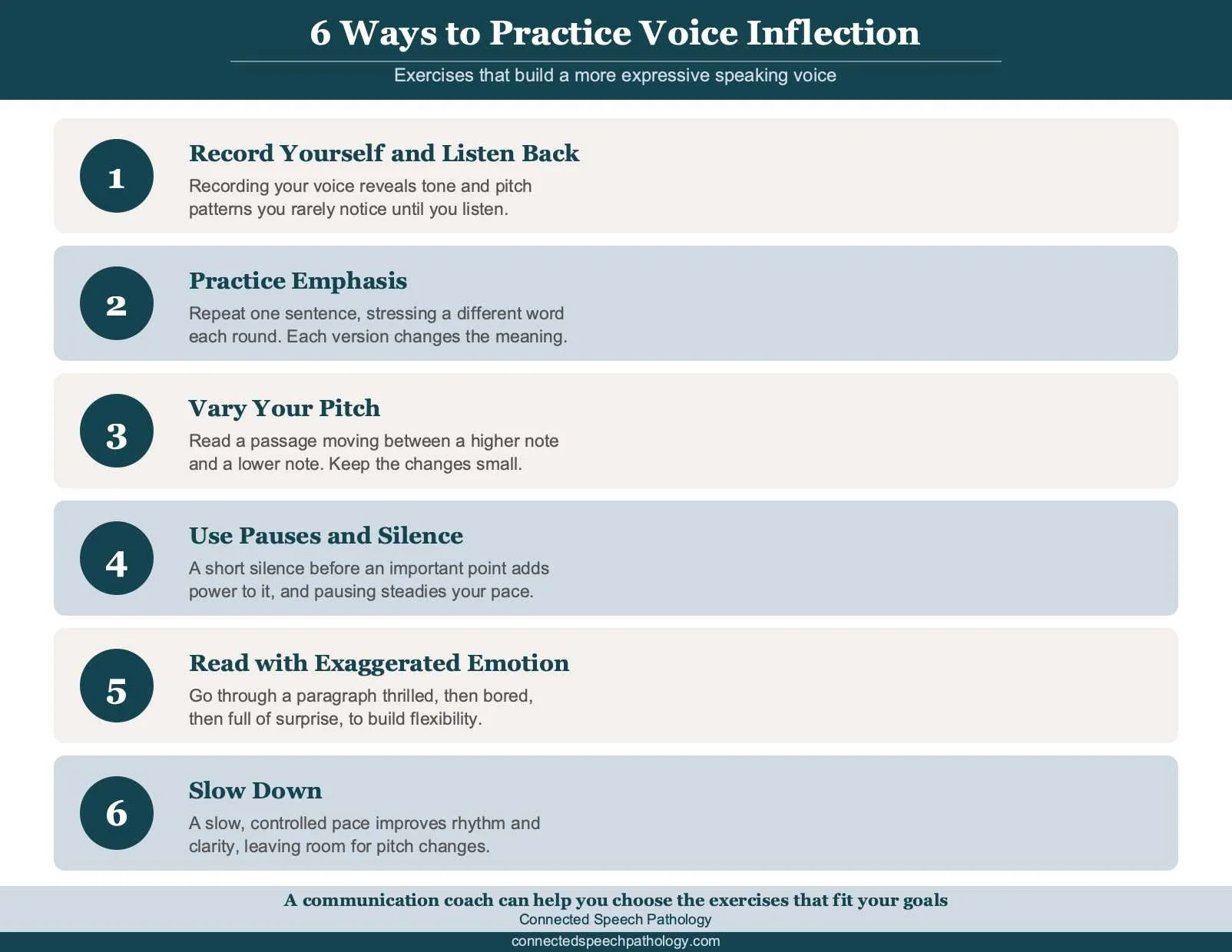
Voice inflection improves with practice, feedback, and careful listening, whether the setting is a conversation or public speaking. The exercises below are suggestions, and a communication coach can help you choose the technique that fits each person and goal.
Exercises to Build Better Voice Control
Record yourself and listen back. Recording your voice helps identify tone and pitch patterns you rarely notice until you listen.
Practice emphasis. Repeat one sentence several times while stressing a different word each round. Each version is an example of how emphasis changes the meaning of the same words.
Vary your pitch. Read a passage while moving between a higher note and a lower note, the same skill used to control the pitch of your voice. The goal is natural voice inflection, so keep the changes small and let them come naturally.
Use pauses and silence. A short silence before an important point adds power to it. Pausing also steadies your breathing and your pace.
Read with exaggerated emotion. Go through a paragraph as if you were thrilled, then bored, then full of surprise. Practicing with exaggerated emotional reading builds flexibility.
Slow down. A slow, controlled pace improves rhythm and clarity in speech and leaves room for pitch changes an audience can hear.
Training the Voice for Clear Communication
Voice training is a structured way to build the skills behind natural inflection. When a person works with a communication coach, sessions often cover breath control, pitch awareness, and articulation.
Breath support gives the voice a steady foundation. Controlled breathing lets a speaker hold pitch through a long sentence, and that ability makes a bigger change in pitch possible without strain.
As the coordination between breathing, the vocal cords, and mouth articulation improves, speech sounds clearer and more engaging. Voice training programs build these skills step by step.

Speaking Voice Coach
Check out our blog about speaking voice coach for more information!
What We See Working with Clients

In our practice, adults often tell us their words look fine on paper and something gets lost out loud. The examples below are real clients of ours. Identifying details have been changed to protect privacy.
One client, a project manager, came to us because colleagues kept treating her decisions as open questions. Her updates ended on a rising note, so a sentence like “We will ship this Friday” sounded like a question rather than a plan.
Her sessions used recorded meeting excerpts, and hearing the pattern herself made the habit obvious. She then practiced contrastive stress drills and ended each recommendation with her pitch falling instead of rising. Her decisions now sound settled, and colleagues re-confirm them less often.
Another client, a software engineer, spoke in a near monotone during sprint demos. His audience drifted within minutes, and he re-explained the work all week.
His coach had him mark one key word per slide to emphasize, read passages between a higher and a lower note, and plan a pause before each main point. The demos hold attention longer now, and the questions he gets afterward are about the work itself.
Frequently Asked Questions About Voice Inflection

1. What is vocal inflection in speech?
Vocal inflection is the change in pitch, tone, or volume during speech. It shapes how a sentence sounds, what it means, and the intent it conveys. Clear intonation patterns also make a message easier to listen to and understand.
2. Why is voice inflection important in communication?
Voice inflection tells listeners how to interpret the message behind what a speaker says. Without it, speech sounds flat, while varied vocal patterns keep an audience engaged and make the main ideas easier to understand.
3. What is an example of upward inflection?
Upward inflection is a pitch rise as a sentence closes. Saying “You finished the task?” with rising pitch signals a question, while the same sentence with a falling tone is heard as a confident statement.
4. Can voice inflection be improved with practice?
Yes, voice inflection improves with regular practice and feedback. Recording your voice helps identify patterns, such as a flat tone or frequent rising endings. Simple exercises that vary pitch, emphasis, and pace build your ability to control pitch and tone over time.
5. Why do some people sound monotone when they speak?
A monotone voice happens when pitch and tone stay nearly the same throughout speech. Nervousness, a fast pace, and limited vocal practice are common reasons, and many people do not realize how they are heard by listeners. Exercises that add pitch variation help bring back expression.
How Connected Speech Pathology Can Help

A voice often improves fastest with guided practice and clear feedback. At Connected Speech Pathology, our communication coaches help adults hear how their voices sound to others, then practice varying pitch, controlling loudness, and stressing the important words.
What sets our approach apart is that every session is built around the real situations you speak in, the meeting, the talk, or the hard conversation. Our online communication coaching pairs you with a coach who matches each exercise to your goals. For deeper work on pitch, breath, and vocal power, our voice and performance coaching team can help.
Sessions are online, so you can practice from home or wherever you speak, with steady support between meetings.
Summary
Voice inflection shapes how listeners interpret tone, emotion, and intent in spoken language. Changes in pitch, volume, and emphasis determine how the same sentence is heard and what it means, from a question to a confident statement.
A falling tone signals certainty, pitch variation prevents a flat sound, and practice makes both easier. Strong, natural inflection helps a message stay clear and easy to follow.

About the Author
Allison Geller, M.A., CCC-SLP, is a communication coach, speech-language pathologist, and founder of Connected Speech Pathology, an international online practice providing professional communication coaching and speech therapy for children, teens, and adults. With more than two decades of experience, she has worked in medical and educational settings and published research on aphasia. Today, she leads a team of specialists who help clients improve their skills in public speaking, vocal presence, accent clarity, articulation, language, fluency, and interpersonal communication.