How to Improve Speech Articulation: Exercises and Techniques That Work

Learning how to improve speech articulation means training the articulators- the lips, tongue, jaw, and soft palate- to form each sound clearly. The work itself is simple: slow your speaking rate, move your mouth more fully, and spend a few minutes a day on the sounds you find hardest.
Clear articulation is a motor skill, which means adults can improve it, not only children. The sections below explain what articulation is, which exercises to practice daily, which speech sounds cause adults the most trouble, and which techniques a speech therapist uses. They also explain when unclear speech is a habit and when it is an articulation disorder that needs an evaluation.
If you rush, mumble, or are often asked to repeat yourself, those habits can change. When people understand you the first time, conversations at work and everywhere else become easier, and most people feel more confident as a result.
Key Takeaways
You improve speech articulation by relearning how you move your lips, tongue, and jaw for each sound, then practicing clear speech daily. Rate, mouth movement, and targeted sound practice matter most.
Adults can change how clearly they speak. Articulation is a motor skill, so short, regular practice reshapes it over weeks, not years.
The /r/, /s/, /th/, and /l/ sounds cause the most trouble for adults, and a speech-language pathologist can teach the correct placement for each.
Unclear speech is sometimes a disorder, not a habit. A persistent sound error, or a sudden change in speech, is a reason to see a speech-language pathologist, and a sudden change should be checked by a doctor first.
Daily Exercises to Improve Articulation
Speech Therapy Techniques That Improve Articulation
Habit or Disorder? When Unclear Speech Needs an Evaluation
Communication Skills That Support Clear Speech
What We See Working with Clients
Frequently Asked Questions About Improving Speech Articulation
What Is Speech Articulation?

Speech articulation is the physical production of speech sounds. Your lips, tongue, jaw, and soft palate move in precise, coordinated patterns to shape breath and voice into consonants and vowels. Those four structures are called the articulators, and the tongue is the most active of them.
When the articulators reach the right place at the right time, listeners hear the word you intended. When they miss, the word is unclear. Improving your articulation means relearning those movement patterns until the precise version becomes automatic.
Three similar terms are easy to confuse. Articulation is the physical formation of sounds. Enunciation is how distinctly you produce those sounds when you speak. Pronunciation is the accepted way a word is said, including its stress and vowels.
An accent is a difference, not a disorder. If you want to be understood more easily while keeping your accent, that is a clarity goal, and our guide to clearer speech covers the same skills with the focus on overall clarity rather than individual sounds.
What Causes Unclear Articulation in Adults?
Most adult clarity problems come from habits rather than illness, and habits are the easiest to change. Knowing the cause helps you and a speech therapist decide what to work on. A few patterns account for most cases.
Speaking too fast, so sounds run together before your mouth finishes forming them.
Tension in the jaw, lips, or tongue, which limits how far the articulators can move.
A mumbling habit, where the mouth barely opens and word endings drop off.
A specific sound error carried from childhood, such as a distorted /r/ or /s/ that went uncorrected.
A neurological cause, such as a stroke, Parkinson's disease, or a brain injury, which can weaken or mistime the muscles used for speech.
The first three are habits, and the practice ideas in the next section address them. A lifelong sound error is different: it usually improves with a speech-language pathologist guiding the work, not practice alone. A sudden change in clarity is different again, and the section on habits versus disorders explains how to handle it.
Daily Exercises to Improve Articulation
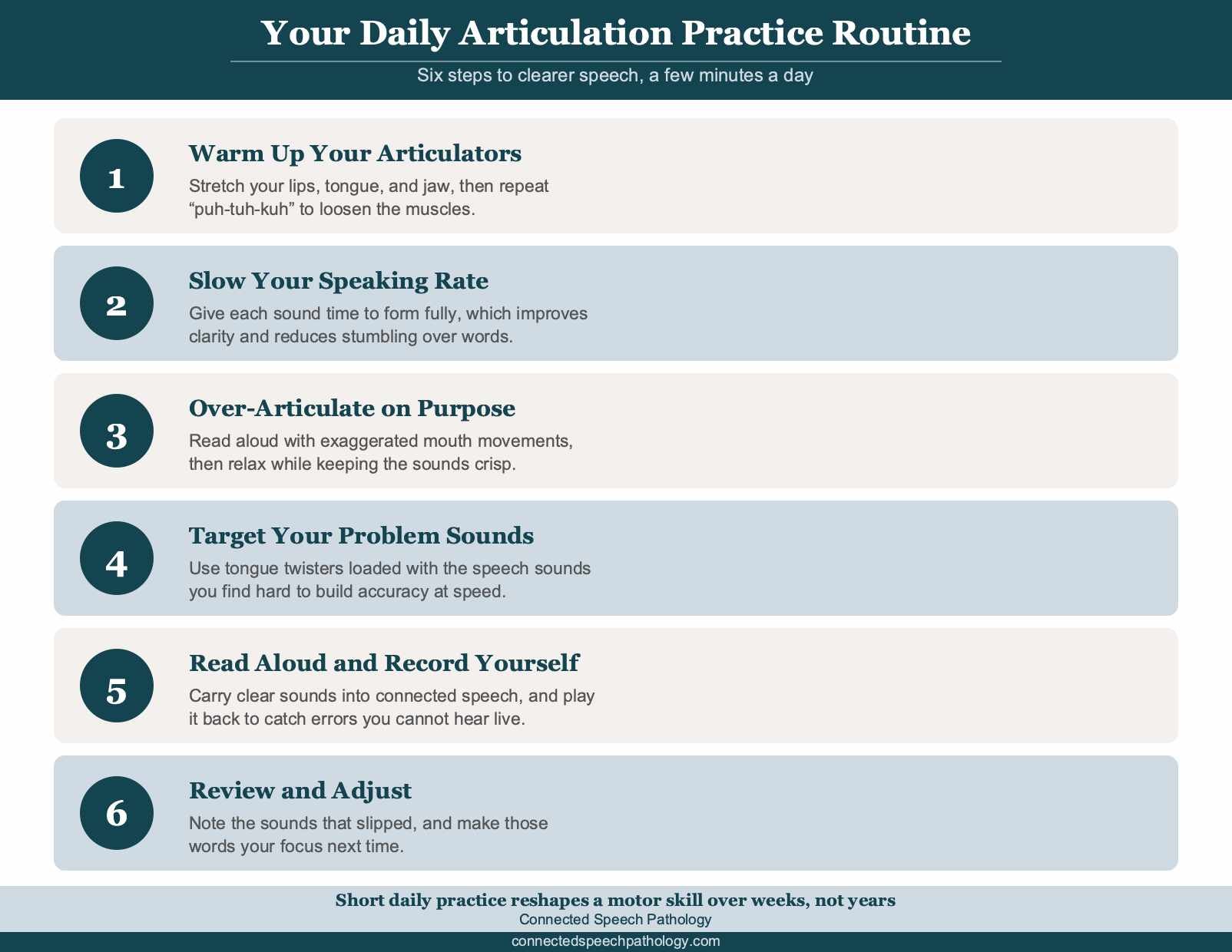
The exercises below are examples, not a prescription. We do not recommend specific exercises unless you are working with a speech-language pathologist, because the right ones depend on which sounds and patterns you need to change.
A communication specialist may suggest routines like these for practice between sessions. Daily practice is what produces the change: short, regular sessions work better than one long session a week, because a motor skill is retained through repetition spread over time. Here is what a typical between-session routine can include.
Warm up your articulators. Stretch your lips, tongue, and jaw, then repeat “puh-tuh-kuh” a few times to loosen the muscles before you practice.
Slow your speaking rate. Deliberately slow down so each sound has time to form fully. Regular practice speaking at that slower pace improves clarity and reduces stumbling over words.
Over-articulate on purpose. Read a paragraph aloud with exaggerated mouth movements, then relax the exaggeration while keeping the crisp, clear sounds.
Target your problem sounds. Spend a few minutes on the specific speech sounds you find hard, using tongue twisters loaded with those sounds to build accuracy at speed.
Read aloud and record yourself. Reading aloud carries clear sounds into connected speech, and recording yourself helps you identify and correct articulation errors you cannot hear in the moment.
Review and adjust. Listen back to your recording, note the sounds that slipped, and make those words your focus next time.
A communication specialist may also add breath support to a between-session routine. Breathing from the diaphragm helps sustain clear, loud speech and steadies your voice, so you stay loud enough to be heard through the end of a sentence instead of getting quieter. Strategic pauses help too: a brief pause gives you time to form the next word instead of rushing it.
Target the Sounds Adults Struggle With Most
A handful of speech sounds cause most of the articulation trouble adults notice: /r/, /s/, /th/, and /l/. Each has an ideal tongue position, but reading about the position is not enough to produce it. An error you have had since childhood is automatic, and you cannot see your own tongue while you speak, so most adults cannot correct these sounds from a description alone. A speech-language pathologist identifies what your tongue is actually doing, teaches the correct placement, and gives you feedback until you can hear and feel the difference yourself.
The table below shows the correct position for each sound and the most common error, so you know what to listen for in your own speech.
| Sound | Where to place your tongue | Common error to correct |
|---|---|---|
| /r/ | Bunch the back of the tongue up, or curl the tip up and back, without touching the roof of your mouth. | A /w/ substitution, so “red” sounds like “wed.” |
| /s/ | Tongue tip near the ridge behind your top teeth, sides sealed, with thin airflow down the center. | A lisp, where air escapes over the sides of the tongue. |
| /th/ | Tongue tip lightly between or just behind the top and bottom teeth, with gentle airflow. | An /f/ or /d/ substitution, so “think” sounds like “fink.” |
| /l/ | Tongue tip on the ridge behind your top teeth, with the sides of the tongue open. | A /w/ or vowel substitution, so “light” sounds like “wight.” |
| Connected Speech Pathology | connectedspeechpathology.com | ||
The /r/ is the error adults most often keep from childhood, and it responds well to focused /r/ practice with a therapist. A /th/ that turns into /f/ or /d/ is also common, and our guide to fixing /th/ errors explains the placement in detail. If you are practicing between sessions, work on the single sound your speech therapist has targeted rather than several at once.
Speech Therapy Techniques That Improve Articulation

Speech-language pathologists improve articulation with structured techniques, but there is no fixed program. Which techniques your SLP uses, and in what order, depends on your specific errors, your goals, and how you respond in sessions.
The daily exercises above are drawn from these same methods, which is why an SLP often assigns them for practice between sessions. If self-practice is not producing change, or a sound has stayed the same for years, that is when to work with a professional.
Traditional Articulation Therapy
Traditional articulation therapy works a single target up a hierarchy, from the sound in isolation, to syllables, to words, to sentences, and finally to conversation. The drill builds accuracy at each level before moving on, so clear production holds up in real speech. It is the core approach for one distorted sound.
Minimal Pairs and Auditory Discrimination
Minimal pairs are two words that differ by one sound, such as “pear” and “bear,” used so you hear and produce the contrast that carries meaning. Pairing this with auditory discrimination training, where you judge whether two sounds are the same or different, sharpens the ear as well as the mouth. Hearing the error clearly is often what makes correcting it possible.
Visual and Recorded Feedback
Practicing in front of a mirror lets you match your mouth to the target position, and recording gives you feedback you can review afterward. Visual feedback techniques aid in self-correction during therapy.
A speech-language pathologist who evaluates how sounds are produced uses these tools to speed up self-correction. How long the work takes depends on the sound and on consistent practice, and our guide to how long speech therapy takes sets realistic expectations.
Keeping a simple record of your practice also shows the progress you can miss day to day. A speech therapist can adjust these techniques as your speech sounds improve, so the plan keeps pace with your improvement and each small gain builds on the last. If you want clearer word endings, our guide to enunciating more clearly goes deeper on that skill.

Articulation Speech Therapy
Check out our blog on articulation speech therapy for more information!
Habit or Disorder? When Unclear Speech Needs an Evaluation

Most unclear speech is a habit that practice can change. Some of it is an articulation disorder that needs professional help. Knowing the difference saves you from months of practice that was not going to be enough on its own.
An articulation disorder is a consistent problem producing certain sounds. The same error shows up wherever that sound occurs, and it makes you harder to understand. If a sound has stayed wrong for years despite effort, an evaluation is the sensible next step.
An evaluation itself is straightforward. A speech-language pathologist listens to how you produce target sounds in different words, checks how your lips, tongue, and jaw move, and looks at whether your errors follow a pattern. Those speech sounds and patterns point to the cause and shape the practice plan.
Speech can also become unclear after a neurological condition. Dysarthria is slurred or weak speech from muscle weakness. Apraxia of speech is a breakdown in planning the movements, so the mouth cannot carry out the sounds you intend, and both are articulation disorders in adults that a speech-language pathologist can treat.
Recovery is also possible with targeted work, including after a brain injury. The key is that a sudden change in speech is handled differently from a lifelong pattern.
Speech that becomes slurred quickly, especially with weakness on one side, drooping, confusion, or trouble swallowing, can signal a stroke and is a medical emergency. Seek a medical evaluation first, before any speech practice, so a doctor can rule out a physical cause. Speech therapy begins once that is clear.
Lasting hoarseness, ongoing pain, or a change in clarity after an illness or injury also warrant a medical check before speech work. Children follow a different set of milestones, and our guide to a child's articulation covers that separately.
Communication Skills That Support Clear Speech

Clear speech sounds are easier to follow when the rest of your delivery supports them. These communication skills do not replace articulation practice, but they help the speech clarity you build reach an audience. A few small habits carry a lot of the weight.
Use strategic pauses instead of filler words, which gives listeners time to process and gives you a moment to form the next phrase.
Keep eye contact while you speak, which improves engagement and keeps attention on your words.
Vary your pitch and emphasis so key points stand out instead of flattening into one tone.
Mind your body language, since an open posture, a relaxed jaw, and a natural smile support both confidence and clear sound.
Organizing your thoughts before you speak helps too, because a clear message is easier to convey and communicate effectively. Practicing these strategies alongside your sound work builds stronger communication skills that show up in meetings, presentations, and casual conversations. For public speaking in particular, our guide to speaking in public with confidence pulls these threads together.
None of this asks you to change your personality or perform for an audience. It is about giving your listener clear speech sounds and full sentences to follow, so your ideas come across with less effort on their part and increased confidence on yours.
What We See Working with Clients

In our practice, we work with adults who want to be understood more easily every day.
The examples below are real clients of ours. Identifying details have been changed to protect privacy.
One adult came to us because colleagues kept asking him to repeat himself on video calls. He spoke quickly and dropped the ends of his words, and he had started to say less in meetings to avoid it.
We worked on slowing his rate and over-articulating word endings, with short daily practice and recordings he reviewed between sessions. His speech became easier to follow within a couple of months, and he told us he speaks up more often now.
Another adult had carried a distorted /r/ sound since childhood, a pattern that had gone uncorrected for years. She avoided saying her own name and certain words in introductions.
Her sessions used articulation therapy focused on tongue placement for /r/, moving from single words up to conversation. The sound grew clearer over time, and she said introductions no longer make her tense.
Frequently Asked Questions About Improving Speech Articulation

1. Can adults improve their speech articulation?
Yes. Articulation is a motor skill, and the brain keeps forming new connections with targeted practice in adulthood. Habits like rushing often improve within a few weeks of regular practice, while a specific sound error improves fastest with a speech-language pathologist guiding the work.
2. How long does it take to improve articulation?
It depends on the sound and on how consistently you practice. A clarity habit like rushing can shift in a few weeks, while a distorted sound carried from childhood usually takes longer. A speech-language pathologist can give you a realistic timeline after hearing your speech.
3. What is the difference between an articulation disorder and simply mumbling?
Mumbling is usually a habit that practice can fix. The mouth barely opens, and word endings drop off. An articulation disorder is a consistent error producing specific sounds that reduces how well others understand you, and a speech-language pathologist can tell the two apart.
4. Do I need a speech therapist, or can I improve articulation on my own?
Many clarity habits improve with self-practice on rate, over-articulation, and reading aloud. If a specific sound has stayed the same for years, or your speech changed suddenly, a speech therapist is the better route. Online speech therapy works well for many adults.
5. How do tongue twisters and reading aloud help articulation?
Tongue twisters pack a target sound into a short phrase. That builds accuracy and speed on the sound you find hard, while reading aloud carries clear production into connected speech. Recording either one helps you catch errors you miss in the moment.
How Connected Speech Pathology Can Help

At Connected Speech Pathology, our speech-language pathologists provide online speech therapy for adults who want to speak more clearly, articulate their words, and be understood the first time. We assess how your speech sounds are produced, identify what is getting in the way, and build a practice plan around your specific speech patterns and goals.
What sets our approach apart is a plan tailored to the sounds you find hard, not a generic exercise sheet. Sessions run one-to-one over video, so you practice where you talk day-to-day, and they fit around your schedule.
Summary
Learning how to improve speech articulation means relearning how you move the articulators, the lips, tongue, jaw, and soft palate, and practicing clear speech sounds a little every day. Slow your speaking rate, over-articulate on purpose, and read aloud while recording yourself so you can hear which words need work. The /r/, /s/, /th/, and /l/ sounds cause most of the trouble for adults, and a speech-language pathologist can teach the correct placement for each.
Adults can change how clearly they speak, because articulation is a motor skill that improves with steady practice. When a sound has stayed the same for years despite effort, an articulation disorder is sometimes the cause, and a speech-language pathologist can assess and treat it with articulation therapy. If your speech changes suddenly, see a doctor first, then work on clarity once a physical cause is ruled out.

About the Author
Allison Geller, M.A., CCC-SLP, is a communication coach, speech-language pathologist, and founder of Connected Speech Pathology, an international online practice providing professional communication coaching and speech therapy for children, teens, and adults. With more than two decades of experience, she has worked in medical and educational settings and published research on aphasia. Today, she leads a team of specialists who help clients improve their skills in public speaking, vocal presence, accent clarity, articulation, language, fluency, and interpersonal communication.