Communication Coaching for Neurodivergent Professionals: Strategies, Support, and What to Expect

Communication coaching for neurodivergent professionals is one-on-one support that builds workplace communication skills around how you think. A coach helps you handle real moments at work, like meetings, feedback, and email. The work covers the challenges you face, the strategies that help, the types of coaching, and how to build self-advocacy and confidence.
If you're autistic, have ADHD, or simply communicate in a different style than your workplace expects, coaching can help. You don't need a formal diagnosis to start.
Many workplaces reward fast, indirect communication. That pace can leave capable people feeling overlooked, even when their ideas are strong. Coaching gives you clear tools to share those ideas your own way, without changing who you are.
Key Takeaways:
Communication coaching for neurodivergent professionals builds workplace skills that fit how you think. It works on real moments at work, like meetings, feedback, and email, not on changing you.
Coaching targets the challenges neurodivergent adults meet at work. These include unspoken rules, executive function, and a workplace pace built for speed.
The work is practical and personal. A coach helps you build clear scripts, self-advocacy, and strategies you can use this week.
Coaching plays to your strengths. It helps you speak up with less stress, and it protects your energy.
What Is Communication Coaching for Neurodivergent Professionals?
Communication Challenges Neurodivergent Professionals Face at Work
Effective Communication Strategies for Neurodivergent Professionals
Types of Communication Coaching and What Sessions Look Like
Neurodiversity Coaching, Self-Advocacy, and Confidence
What We See Working with Clients
Frequently Asked Questions About Communication Coaching for Neurodivergent Professionals
What Is Communication Coaching for Neurodivergent Professionals?
Communication coaching for neurodivergent professionals is one-on-one support for building workplace communication skills that fit you. A coach helps you prepare for real moments, like meetings, feedback talks, and email, so your ideas come through clearly. The goal is to lower communication-related stress by making unspoken workplace expectations plain.
The work is practical and personal. Your coach watches how you communicate day to day, then helps you build practical strategies for expressing ideas at work. You don't need to treat your communication style as a flaw, because the aim is a better fit, not a fix.
Coaching works with many communication styles. No two neurodivergent individuals process information the same way. Some coaches are neurodivergent people themselves, and that lived experience can make the work feel grounded.
Neurodiversity coaching treats how you think as a strength to build on. That matters because forcing yourself to communicate like everyone else is tiring and rarely lasts. A good coach works with the way you already process information, whether that means writing before you speak or asking for an agenda first.
It's a more useful kind of communication support for neurodivergent adults than generic advice to speak up more. The point is to make your workplace a better fit, on terms that work for you.
Communication Challenges Neurodivergent Professionals Face at Work

Neurodivergent professionals often experience communication challenges at work. Most workplace communication challenges come from a gap between how you communicate and what the job quietly expects. Naming that gap is the first step, since you can't build a strategy for a problem no one has made plain.
Workplaces Built for Speed and Indirect Language
Most workplaces prize rapid responses and indirect language. That pace is hard when you process carefully or take words at face value. A manager who says "circle back when you get a chance" often means "by Friday," and that gap is easy to miss.
Vague instructions like these can lead to missed deadlines and stress. The strain looks like a performance problem, but it's a communication one. When workplace expectations stay unspoken, you burn energy decoding them instead of doing the work you're good at.
Coaching helps you ask for the clarity you need, so less is left to guesswork. A quick question up front saves hours of second-guessing later.
Reading Unspoken Social Cues
Some neurodivergent adults find it harder to read social cues, like tone, body language, or the point behind small talk. Many also take literal language at face value, so a hint or an implied request can slip by. A colleague's short reply can read as anger when it's just that they're busy.
When a workplace runs on unwritten rules, plain social interactions take more effort than they should. Coaching on social skills lightens that load over time.
A coach makes those hidden rules clear and practical. You work on how to read nonverbal communication, when eye contact helps and when it doesn't, and how to handle small talk in a way that feels real instead of forced.
The Executive Function Load Behind Communication
Executive function is the set of mental skills you use for planning, organizing, working memory, and time management. Neurodivergent professionals often face executive function challenges at work, and they show up right away in communication. Holding a thought while someone interrupts, framing an answer on the spot, or tracking a fast group chat all lean on executive function.
When that load runs high, strong ideas can come out jumbled or slip away. Coaching links executive function to communication head-on, so you build habits that lower the mental effort. The work pairs well with focused executive functioning coach support when planning and organization are the harder part.
The link runs both ways for many adults with ADHD. Trouble organizing thoughts into words is a common experience. Effective communication strategies cut that cognitive load, so your point lands the way you meant it.
Effective Communication Strategies for Neurodivergent Professionals
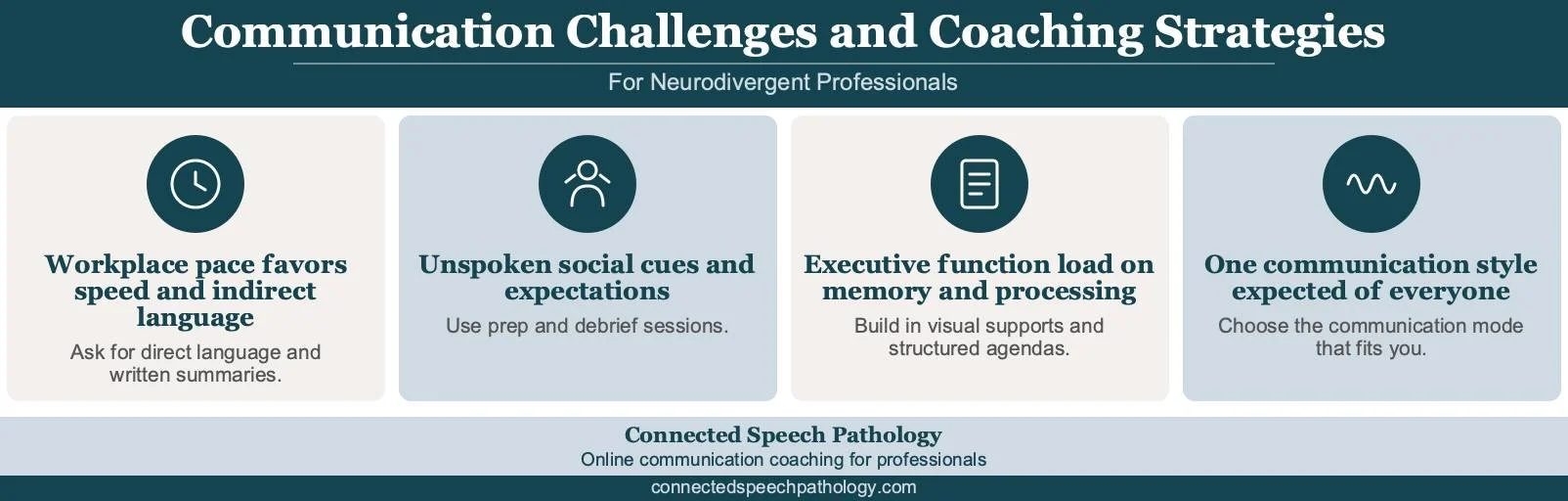
Effective communication strategies make your message clearer and more predictable, without hiding how you sound. The most useful tools are practical, and a coach helps you pick the communication skills that fit your role and your day. Clear communication cuts misunderstandings and helps you communicate effectively.
Ask for Direct Language and Written Summaries
Direct language and written summaries are two of the most useful tools for neurodivergent communication at work. After a spoken conversation, a short written recap confirms what was decided and who does what next. You can ask for it plainly: "Can you send me the main points in an email so I have them in writing?"
Written summaries take pressure off memory and on-the-spot processing. They also give you a record to check later, which helps if you lost part of a fast discussion. These are habits you can use to communicate effectively at work without changing your natural style.
Use Prep and Debrief Sessions
Prep and debrief sessions are short, planned moments before and after a key talk. Before a meeting, you set your main point and the questions you expect. Prep and debrief sessions can improve how a conversation goes, since you're not composing and reacting at once.
A debrief afterward is just as useful. You note what went well, what felt unclear, and what to try next time. In coaching, your coach often runs these with you, then hands the routine over so it becomes a habit you keep.
Build In Visual Supports and Structured Agendas
Visual supports and structured agendas give a talk a shape you can follow. An agenda sent ahead of a meeting tells you what's covered and when your turn comes. Visual supports and structured agendas boost engagement, because they lower the guesswork about what happens next.
Small structure helps more than it looks. A shared doc, a bullet list, or a simple order of topics keeps a discussion from feeling like a moving target. You can ask for an agenda in advance as a reasonable adjustment, not a special favor.
Choose the Communication Mode That Works for You
Multiple communication modes let you use the channel where your ideas come through best. Some people think most clearly in writing, while others do better talking it through on a quick call. Match the mode to the message: a complex update goes in a written brief, and a fast question goes in a chat.
You don't have to accept that every exchange must be a live meeting. When you pick the mode, you keep your focus and energy for the work that matters.

How to Improve Communication As a Neurodivergent Adult
Learn how to improve communication as a neurodivergent adult.
Types of Communication Coaching and What Sessions Look Like
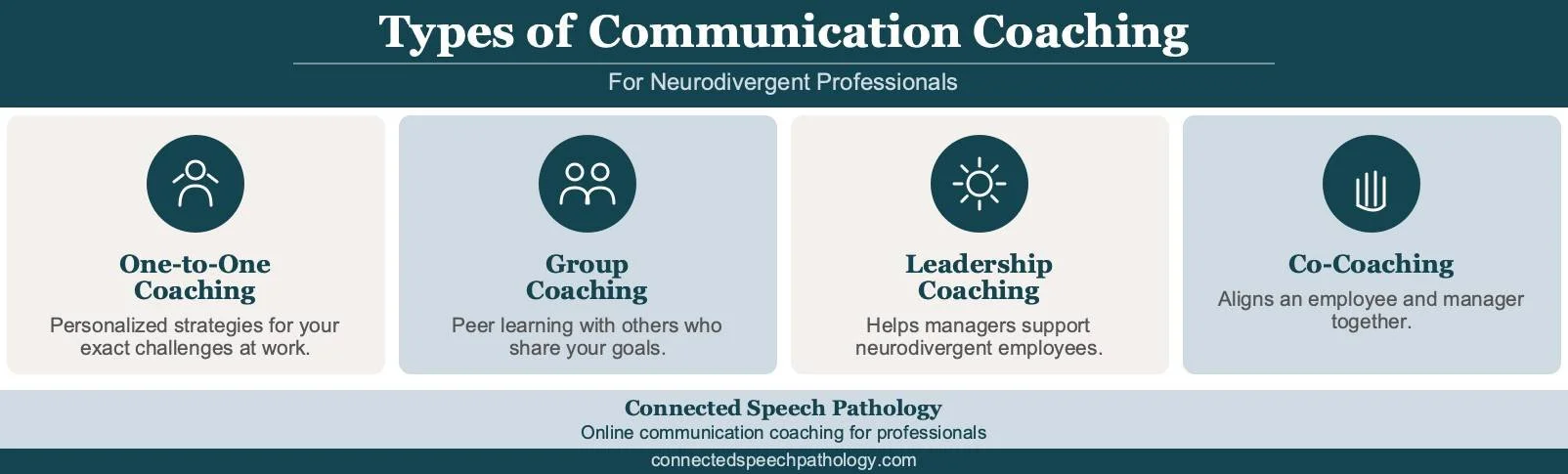
Communication coaching comes in a few forms, so the right fit depends on your goals and your job. Each type shares the same aim, which is clearer communication that fits how you think. Coaching sessions can run individually, in a group, or alongside the people you work with.
One-to-One Coaching
One-to-one coaching gives you practical strategies for the exact challenges you meet at work. The coaching sessions are built around your goals, your role, and the moments you find hardest. You get focused time to prep for a real talk, then practice it through role play first.
Group Coaching
Group coaching brings together neurodivergent professionals with similar goals. It builds peer learning and support among the people in the room. Many find it a relief to learn they aren't the only one working through these moments.
Leadership Coaching
Leadership coaching helps managers support neurodivergent employees more effectively. A manager builds the communication skills to give clearer instructions, provide guidance, offer reasonable adjustments, and set plain workplace expectations for the whole team. That kind of coaching support often lifts communication for everyone, not only neurodivergent staff.
Co-Coaching for Employees and Managers
Co-coaching works on communication between an employee and a manager together. The coach helps both people reach a better understanding of each other's communication styles and agree on practical ways to work better. It helps when a working relationship keeps stalling on the same misunderstandings.
What a Coaching Session Looks Like
Coaching usually opens with an initial assessment of your goals, strengths, and the moments you want to handle in a new way. From there, sessions combine practice, feedback, and role-play. Role play lets you rehearse a performance review or a hard talk before you face it for real.
Regular coaching sessions also build rapport with your coach, which makes the practice feel safer. You try a strategy at work, then bring back what happened so you can adjust it together.
Ongoing coaching support keeps the work steady between sessions. Coaching on social interactions pairs well with social skills training for neurodivergent adults when day-to-day interaction is the harder part.
Neurodiversity Coaching, Self-Advocacy, and Confidence

Neurodiversity coaching centers on self-awareness, not on hiding how you communicate. You gain insight into your own communication style and how it aligns with your workplace's expectations. That awareness lets you choose a strategy on purpose rather than guessing or copying others.
Self-Advocacy and Asking for What You Need
Self-advocacy is the skill of knowing your own needs and stating them clearly. Coaching improves self-awareness and self-advocacy, so you can explain what helps you do your best work. Strong self-advocacy rests on clear communication of your personal needs, and that's what coaching helps you practice.
Neurodivergent adults learn to request accommodations through self-advocacy. You ask for what supports you, whether that's written instructions, an agenda, or a quiet space to focus. Framed as reasonable adjustments, these asks help you deliver good work.
A script makes the ask easier. You can say, "I do my best thinking with the agenda in advance, so please share it the day before." A clear, specific ask is easier for a manager to say yes to, and it keeps the focus on the result.
Coaching builds confidence in a steady, practical way:
You practice real conversations, so high-stakes moments feel familiar.
You build strategies that ease the anxiety tied to communication challenges.
You get honest feedback on what's working, which grows self-confidence over time.
Confidence and self-advocacy build on each other. As these skills grow, more of your career potential shows in the room, and your confidence follows. That steadier communication supports career growth, from leading a project to stepping into a bigger role.
Self-Awareness Instead of Masking
Masking is the effort of hiding natural traits to seem more neurotypical, like forcing eye contact or scripting small talk all day. Many autistic adults carry the same daily effort. It can help you blend in, but it drains energy and can lead to burnout. Coaching helps prevent that burnout, because self-awareness lets you spend energy where it counts instead of on constant self-monitoring.
Neurodiversity-affirming coaching won't push you to meet neuro-normative standards you can't keep up. Instead, coaching highlights strengths, such as creativity, deep focus, and analytical thinking, then builds habits that let those strengths show. As you understand your own patterns, you read situations with more ease and build stronger working relationships.
Many clients tell us the real shift comes from understanding their own communication styles. Once you see your patterns clearly, you can work with a team without second-guessing every exchange.
If you're still exploring how you think and process, a reflective neurodivergent quiz can be a gentle starting point. Self-awareness is where communication starts to feel less like a performance.
What We See Working with Clients

In our coaching, we work with neurodivergent professionals who want workplace communication to feel less draining. The examples below are real clients of ours. Identifying details have been changed to protect privacy.
One client, an autistic software engineer, found daily stand-up meetings exhausting. Fast back-and-forth left him little time to process, so he'd either stay quiet or over-explain and lose the room. Colleagues sometimes read his silence as disinterest, which was the opposite of the truth.
In coaching, we built a short prep routine before each meeting and wrote quick one-point summaries he led with. He practiced asking for the agenda in advance, and role-played the moments he dreaded, like being put on the spot for a status update.
Over a couple of months, he started leading his updates with a clear headline and felt steadier when questions came fast. He now asks for a written agenda as a matter of routine, and meetings feel less like something to survive.
Another client, a marketing professional with ADHD, struggled most in feedback conversations. She'd lose her train of thought when a manager interrupted, then fill the silence by talking past her point. Performance reviews left her anxious for days beforehand.
Our coach set up a debrief routine and kept written notes in view. We wrote a self-advocacy script asking for a moment to gather her thoughts and practiced pacing so she could pause without rushing to fill the gap.
She came across as clearer and calmer in her next review, and the dread eased. Clear feedback loops with her manager also cut the anxiety that used to build before every check-in.
Frequently Asked Questions About Communication Coaching for Neurodivergent Professionals
1. What is communication coaching for neurodivergent professionals?
It is one-on-one support that builds workplace communication skills. A coach helps you prepare for real moments like meetings and feedback, then build strategies that fit your style. The focus is a better fit at work, not changing who you are.
2. How is communication coaching different from job coaching?
Communication coaching centers on how you express ideas and understand others at work. Job coaching is broader, covering tasks, workflow, and general work performance. The two can pair up, but communication coaching goes deep on the communication itself.
3. Do you need a formal diagnosis for communication coaching?
No, a formal diagnosis is not required to start communication coaching. Coaching works from your goals and the situations you find hardest, whether or not you have a diagnosis. Many neurodivergent adults benefit, whether or not they identify with the term.
4. Can communication coaching improve confidence in communication skills?
Yes, coaching builds confidence through practice and honest feedback. As you rehearse real conversations and build self-advocacy skills, high-stakes moments start to feel more familiar. Communication coaching builds confidence that carries across meetings, feedback, and everyday interactions.
5. Does communication coaching work online?
Yes, online coaching is effective for many neurodivergent professionals, though fit varies by person. You practice on camera in the same format as your real calls, and meeting from home can lower sensory load. Online coaching also removes travel, so you can work with the right coach rather than the nearest one.
How Connected Speech Pathology Can Help

Connected Speech Pathology offers communication coaching for neurodivergent professionals. Every coach on our team is trained in speech-language pathology. So your coach knows both your message and how you process it.
We support neurodivergent professionals across many roles with online communication coaching. We tailor each coaching plan to your goals, your role, and the moments you find hardest.
Every session happens online, and you can join from home or the office, at a pace that fits you.
Summary
Communication coaching for neurodivergent professionals builds workplace skills around how you think. It eases the executive function load, the unspoken rules, and the fast pace that make work harder. The approach plays to your strengths and aims for a better fit at work.
You build clear strategies, self-advocacy, and steadier confidence over time. Group, leadership, and individual coaching all share the same aim. That aim is clearer communication on terms that work for you.

About the Author
Allison Geller, M.A., CCC-SLP, is a communication coach, speech-language pathologist, and founder of Connected Speech Pathology, an international online practice providing professional communication coaching and speech therapy for children, teens, and adults. With more than two decades of experience, she has worked in medical and educational settings and published research on aphasia. Today, she leads a team of specialists who help clients improve their skills in public speaking, vocal presence, accent clarity, articulation, language, fluency, and interpersonal communication.