Articulation Disorder in Adults: Causes, Signs, and How Speech Therapy Helps

An articulation disorder in adults is difficulty producing certain sounds correctly, such as "r" or "s." Here is what to know about articulation disorders in adults: the types, the causes, the signs, and how speech therapy treats them. If you are an adult who mispronounces certain words or never outgrew a childhood speech problem, clearer speech is within reach.
Unclear speech can affect your confidence and how well others understand you. The encouraging part is that the adult brain can still learn new speech sound patterns, even decades after childhood. Many adults think speech sound errors are only a childhood issue, yet some people continue to have them for years, while others develop new speech difficulties later in life.
Key Takeaways
An articulation disorder in adults is difficulty producing certain speech sounds correctly. Common examples include the "r" (rhoticism) and "s" and "z" sounds (lisp).
Causes range from a childhood speech problem that was never resolved to hearing loss, dental problems, and neurological events. A stroke or traumatic brain injury also disrupts the muscles used for speech.
A speech-language pathologist diagnoses the disorder and treats it with targeted articulation therapy. Phonetic placement and auditory discrimination are two of the core techniques.
The adult brain can learn new speech patterns. With consistent practice, clearer speech is a realistic goal at any age.
What Are Articulation Disorders in Adults?
What Are the Signs and Symptoms of an Articulation Disorder?
Articulation Disorder vs. Dysarthria vs. Apraxia of Speech
What Is Involved in an Adult Articulation Assessment?
How Does Speech Therapy for Articulation Work?
What We See Working with Clients
Frequently Asked Questions About Articulation Disorder in Adults
What Are Articulation Disorders in Adults?

An articulation disorder is a common speech disorder that affects how specific speech sounds are produced. The lips, tongue, or jaw do not move into the correct position, so certain sounds come out distorted or unclear. The same speech sound errors usually occur consistently each time a person says a word.
Not every speech sound disorder is an articulation disorder. Some speech sound disorders, such as a phonological disorder or apraxia of speech, affect the sound patterns a person uses rather than how individual sounds are produced. A speech-language pathologist can determine the cause of unclear speech and recommend the most appropriate treatment.
What Causes Articulation Problems in Adults?
Articulation problems in adults come from two broad sources: errors that persisted from childhood and conditions that developed later in life. Articulation disorders are among the most common speech disorders treated by speech-language pathologists, although the specific cause varies from person to person.
A speech disorder that was never fully treated in childhood may carry into adulthood. A family history of speech sound disorders may increase the likelihood, as speech disorders can sometimes run in families.
Later-life causes are often physical or neurological. Hearing loss makes it hard to monitor your own speech, and dental issues, such as an overbite or missing teeth, change how sounds are formed.
A cleft lip or cleft palate affects articulation, as do orofacial myofunctional disorders, where tongue and lip habits pull sounds off target. Neurological events, like a stroke, a traumatic brain injury, or cerebral palsy, also weaken these muscles. When the underlying cause is medical, the problem is usually part of a larger picture worth an evaluation by a physician.
What Are the Signs and Symptoms of an Articulation Disorder?

The clearest sign of an articulation disorder is unclear speech, where certain sounds are consistently produced incorrectly. Listeners may have difficulty understanding you, ask you to repeat yourself, or mistake the speech issue for mumbling. Two common examples are rhotacism, which affects the "r" sound, and a lisp, which affects the "s" and "z" sounds.
Articulation errors may include distorted speech sounds, difficulty producing specific consonants, or speech that becomes harder to understand during longer conversations or when speaking quickly. Some adults notice the problem most when saying certain words or speaking in public. Speech-language pathology professionals evaluate which speech sounds are affected and identify the underlying cause of the articulation disorder.
Articulation Disorder vs. Dysarthria vs. Apraxia of Speech
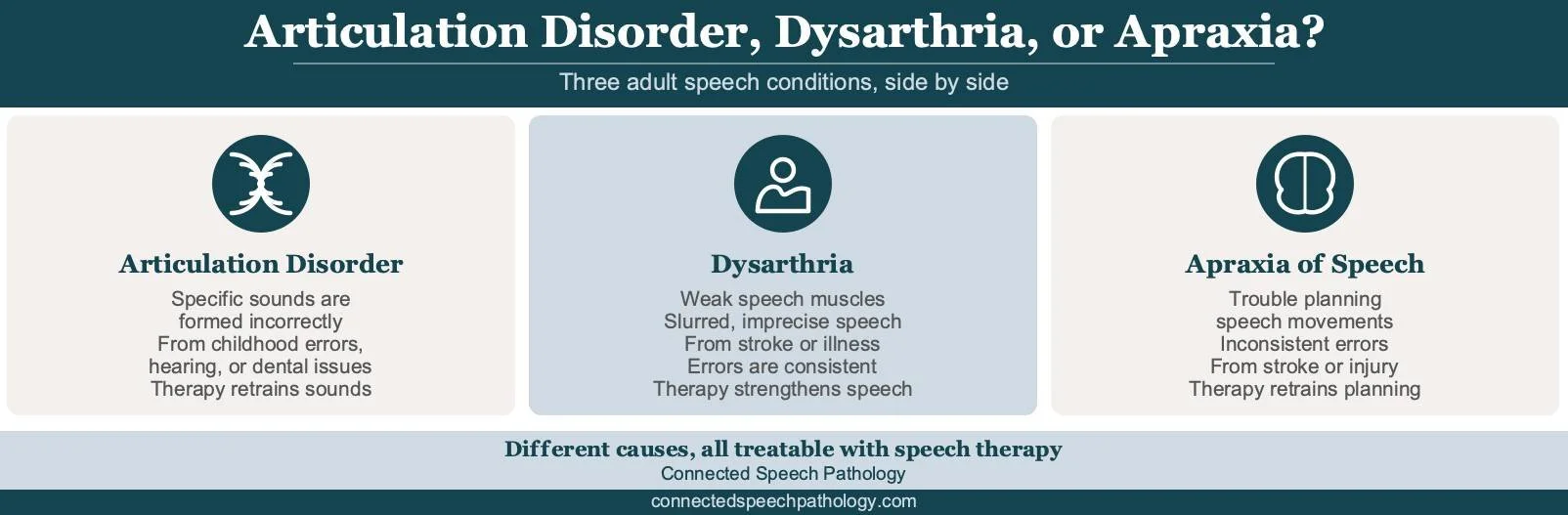
Articulation disorders, dysarthria, and apraxia of speech are all communication disorders that can lead to trouble pronouncing words or sounds, but in different ways. An articulation disorder affects how specific sounds are formed. Dysarthria results from weak or poorly controlled muscles and often produces slurred speech, whereas apraxia of speech is a planning problem in the brain, even when the muscles themselves are not weak.
The distinction matters because it shapes the treatment process, and the table below compares all three across the features that matter most for an accurate diagnosis. Naming the right condition is the first step toward the right care plan and a realistic timeline.
| Feature | Articulation Disorder | Dysarthria | Apraxia of Speech |
|---|---|---|---|
| Where it breaks down | Forming individual sounds | Weak speech muscles | Planning speech movements |
| Error pattern | Set sounds come out wrong | Slurred, consistent errors | Inconsistent, varied errors |
| Typical cause | Childhood errors, dental, hearing | Stroke, illness, brain injury | Stroke or brain injury |
| Muscle strength | Normal | Reduced | Normal |
| Focus of speech therapy | Retrain target sounds | Strengthen and slow speech | Retrain motor planning |
| Connected Speech Pathology | connectedspeechpathology.com | |||
What Is Involved in an Adult Articulation Assessment?

An adult articulation assessment identifies which speech sounds are difficult for you and what is causing the problem. An interview is part of the evaluation process for articulation disorders.
Your speech-language pathologist begins by asking about your speech history, concerns, and goals. They also examine how your lips, tongue, jaw, and other oral structures move during speech and may recommend a hearing test if hearing loss could be contributing to the issue.
Next, you will be asked to produce individual sounds, say words, read aloud, and have a conversation. Your speech-language pathologist listens for speech sound errors, notes when they occur, and may transcribe portions of your speech for a more detailed analysis. The results are used to diagnose the problem and develop a treatment plan.
Seek emergency medical care if your speech suddenly becomes slurred along with facial drooping, weakness, or confusion, as these can be signs of a stroke.
How Does Speech Therapy for Articulation Work?

Speech therapy helps you learn to produce speech sounds more clearly through guided practice. Your speech-language pathologist selects exercises based on the sounds that need improvement, and sessions typically last 30 to 45 minutes.
Speech treatment may include phonetic placement, which teaches where to position your tongue, lips, and jaw to produce a sound correctly, and auditory discrimination training, which helps you hear the difference between your usual pronunciation and the correct one.
As your accuracy improves, you practice the sound in increasingly challenging situations, moving from individual sounds to syllables, words, sentences, and everyday conversation. Regular practice between sessions helps the correct speech pattern become more natural over time.
How to Improve Articulation at Home
Home practice helps reinforce the skills you learn in speech therapy. Short, focused practice sessions are usually more effective than occasional long ones. These strategies can help between appointments:
Practice your target sounds for three to five minutes each day.
Repeat target words slowly before increasing your speaking speed.
Use a mirror to check your tongue and lip placement.
Record yourself reading aloud and listen for sounds that need more practice.
Practice with a trusted family member or friend during everyday conversations.
If a sound remains difficult, let your speech-language pathologist know so they can adjust your treatment plan.
Speech therapy helps you learn to produce speech sounds more clearly through guided practice. Your speech-language pathologist selects exercises based on the sounds that need improvement, and sessions typically last 30 to 45 minutes.
Speech treatment may include phonetic placement, which teaches where to position your tongue, lips, and jaw to produce a sound correctly, and auditory discrimination training, which helps you hear the difference between your usual pronunciation and the correct one.
As your accuracy improves, you practice the sound in increasingly challenging situations, moving from individual sounds to syllables, words, sentences, and everyday conversation. Regular practice between sessions helps the correct speech pattern become more natural over time.
How to Improve Articulation at Home
Home practice helps reinforce the skills you learn in speech therapy. Short, focused practice sessions are usually more effective than occasional long ones. These strategies can help between appointments:
Practice your target sounds for three to five minutes each day.
Repeat target words slowly before increasing your speaking speed.
Use a mirror to check your tongue and lip placement.
Record yourself reading aloud and listen for sounds that need more practice.
Practice with a trusted family member or friend during everyday conversations.
If a sound remains difficult, let your speech-language pathologist know so they can adjust your treatment plan.

Articulation Speech Therapy for Children and Adults
Learn more about articulation speech therapy for children and adults in this blog.
What We See Working with Clients

At Connected Speech Pathology, we work with adults who want clearer, more confident speech, from professionals to retirees adjusting after a health event. The stories below are based on real clients we have worked with. Identifying details have been changed to protect privacy.
One client came to us after living with a distorted "r" sound since childhood. As a manager, he spoke in meetings every day and often felt self-conscious during presentations and video calls because people occasionally asked him to repeat himself.
During speech therapy, we used phonetic placement and mirror work to help him find the correct tongue position and then added auditory discrimination exercises to help him hear the difference between his usual production and the target sound. As his accuracy improved, we practiced the sound in longer conversations and work-related situations until he became more comfortable using it during meetings.
Another client was an actor with a long-standing lisp who came to us after receiving direct feedback from casting professionals that clearer speech would make her a stronger candidate for more roles. She loved performing, but the comments made her realize her speech was becoming a barrier to the opportunities she wanted.
During our sessions, we focused on accurate tongue placement for the "s" and "z" sounds, then practiced carrying those sounds into scripts, monologues, auditions, and spontaneous conversation. As her speech became more consistent, she felt more confident walking into auditions, knowing her articulation no longer distracted from her performance.
Frequently Asked Questions About Articulation Disorder in Adults

1. Can adults fix an articulation disorder?
Yes. Many adults improve their articulation skills with speech therapy. The amount of improvement depends on the cause of the disorder, the sounds involved, and how consistently you practice, but it is never too late to work toward clearer speech.
2. Is it too late to correct speech sounds as an adult?
No. While children often progress quickly, adults make strong gains because they are motivated and practice on their own. The treatment plan is based on your speech goals, the sounds you are working on, and how easily you carry those sounds into everyday conversation.
3. What is the difference between an articulation disorder, dysarthria, and apraxia?
An articulation disorder affects how certain sounds are formed. Dysarthria results from weak speech muscles, while apraxia involves difficulty planning speech movements. A speech pathologist can help differentiate between the three communication issues.
4. Do I need a speech-language pathologist or accent coach?
It depends on your goals. If you have difficulty producing certain speech sounds because of a suspected articulation disorder, start with a speech-language pathologist for an evaluation. If your goal is to refine your pronunciation or modify your accent without an underlying speech disorder, an accent coach may be appropriate.
5. How long does articulation therapy for adults take?
It varies with the sounds involved and how often you practice. Many adults work for several weeks to a few months, with 30- to 45-minute sessions, and home practice accelerates progress. Harder or more numerous target sounds take longer to address.
6. Can sudden articulation problems signal something serious?
Yes. Speech that suddenly becomes slurred or imprecise can be a sign of a stroke or other medical event and requires emergency care. A long-standing pattern is not an emergency, but it is still worth a professional evaluation.
How Connected Speech Pathology Can Help

At Connected Speech Pathology, our speech-language pathologists provide online speech therapy for adults with articulation disorders and other communication difficulties. We begin with a comprehensive evaluation to identify which sounds are affected and why, then build a personal plan around your goals. Because our care is fully online, you practice from home with a speech therapist who understands adult communication.
If you are ready to work toward clearer speech, our team is here to help you take the next step.
Summary
An articulation disorder in adults affects how certain speech sounds are produced, making speech less clear and sometimes harder for others to understand. Some adults have speech sound errors that began in childhood, while others develop articulation problems because of hearing loss, dental changes, or other medical conditions.
A speech-language pathologist can identify the underlying cause and recommend the most appropriate treatment.
Speech therapy helps adults learn to produce difficult sounds more accurately through targeted practice and feedback. With consistent practice between sessions, many adults improve their speech clarity and communicate with greater confidence.
Client Success Story: Real Results from Speech Therapy

About the Author
Allison Geller, M.A., CCC-SLP, is a communication coach, speech-language pathologist, and founder of Connected Speech Pathology, an international online practice providing professional communication coaching and speech therapy for children, teens, and adults. With more than two decades of experience, she has worked in medical and educational settings and published research on aphasia. Today, she leads a team of specialists who help clients improve their skills in public speaking, vocal presence, accent clarity, articulation, language, fluency, and interpersonal communication.