How to Change Your Accent
Your accent is part of who you are. It carries the imprint of the place you grew up in, the family who raised you, and the people you spent your formative years with.
For many adults who learned English as a second language, that identity can also create friction at work: coworkers asking you to repeat yourself, meetings where your ideas get overlooked, or phone calls that feel harder than they should. Over time, those moments can change how comfortable you feel speaking up, even when you know exactly what you want to say.
You can change your accent. With daily practice and guidance from a certified accent trainer, adults at any age can train clearer English pronunciation and build speaking confidence without erasing who they are. The guide that follows walks through how to change your accent, provide realistic timelines, and find a qualified coach.
Key Takeaways
Adults can change their accent at any age with daily practice and guidance from a speech-language pathologist or accent coach.
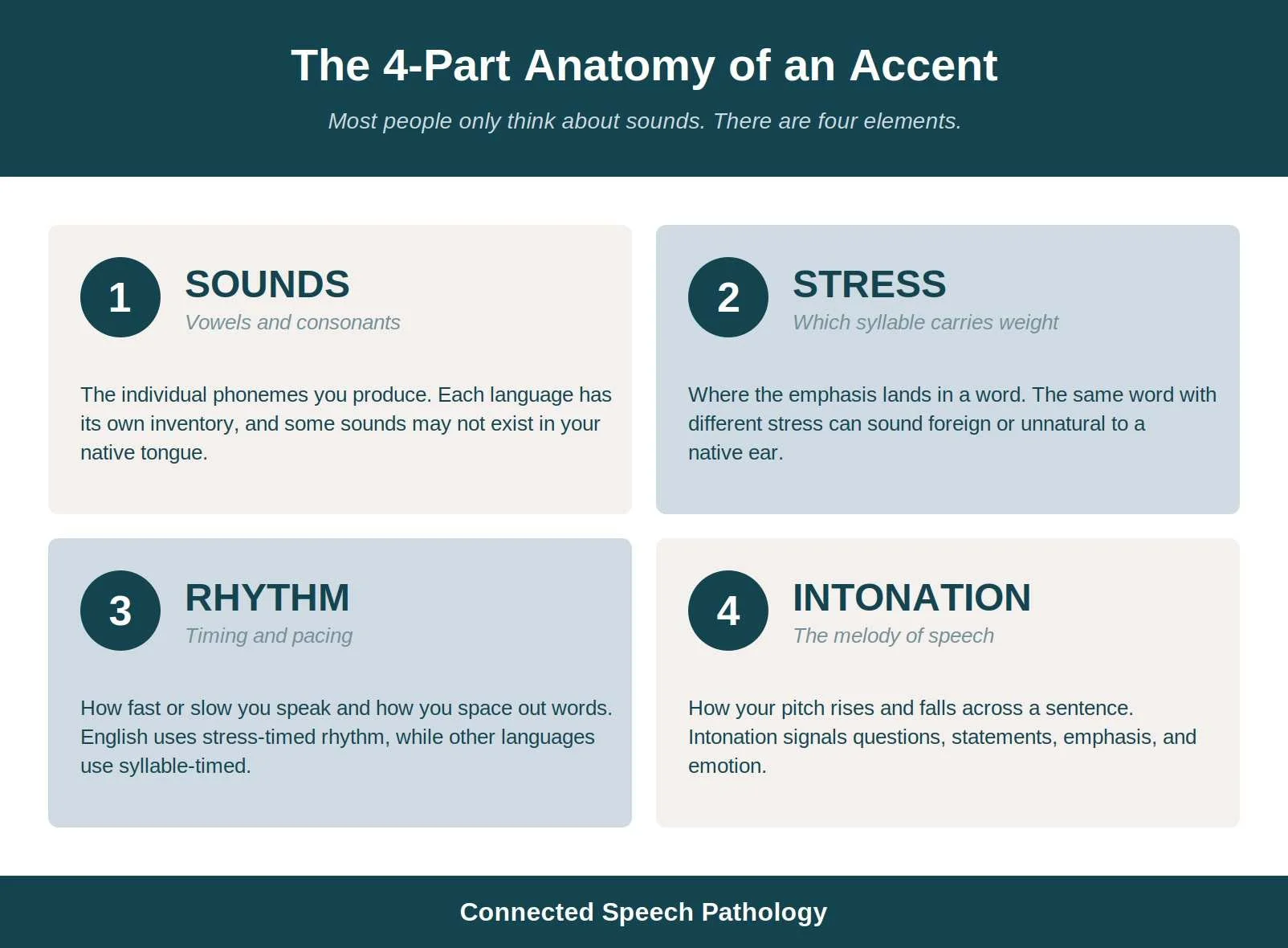
Accent modification targets four main elements of pronunciation: individual sounds, word stress, rhythm, and intonation. Most people only think about the sounds.
Plan for 20 to 30 minutes of focused daily practice, along with several months of consistent work, to notice meaningful changes in speech clarity and confidence.
Sessions usually focus on the patterns that create the biggest communication breakdowns first. Practice often uses real workplace conversations, presentations, interviews, or everyday speaking situations instead of isolated word drills.
What Does Accent Modification Training Look Like?
Who Benefits from Accent Modification Training?
How to Find a Qualified Accent Coach
What We See Working with Clients
What Is an Accent?

Everyone speaks with an accent. An accent is the unique way a group that shares a tongue pronounces its words, and most of us pick up our native accent before we even start school. People's accents feel normal because that is the speech they grew up hearing every day.
Words alone do not constitute an accent. Four elements work together: the individual sounds you produce, the syllables you stress within words, the rhythm of your speech, and the intonation that rises and falls across a sentence. Many regional accents differ in rhythm and emphasis more than in individual letters.
A particular accent, like a Southeastern drawl, a New York lilt, a British accent, or an Australian accent, is also tied to a dialect, which adds variations in word choice and grammar to those four sound elements. People with strong dialects often shift toward a more neutral American accent when they relocate or change careers, and many of us adapt our own accent depending on who we are talking with.
The reference point most accent modification programs work toward is General American, also called Standard American English. You hear this neutral accent from newscasters, podcast hosts, and broadcasters from across the country.
General American is not a "correct" accent. It is a neutral target for adults whose work crosses regions or industries and who want one accent that travels well across professional settings.
Can You Change Your Accent?

Yes, adults can change their accent at any age. Alongside pronunciation, many adults also work on prosody, the rhythm and stress of speech, to sound more natural and engaging. The process usually requires consistent daily practice, several months of focused work, and guidance from a qualified accent coach or speech-language pathologist. Most programs focus on the speech patterns that affect clarity most, including pronunciation, rhythm, intonation, pacing, and the communication habits that shape how natural and confident someone sounds in conversation.
Research on second-language acquisition shows that learners who pick up English after about age 12 tend to retain a foreign accent. That does not mean the accent is fixed. The brain forms strong patterns around the sounds it learns first, and acquiring a new accent in a foreign language requires deliberate retraining rather than passive exposure.
Adults often surprise themselves with how much they can change their accent in everyday speaking. Age matters less than motivation, practice time, and the quality of feedback you receive on your spoken communication. Personality, learning style, and prior experience with a second language all influence pace, but none of them close the door on progress.
The goal is not to erase your accent or pretend you grew up speaking a different accent somewhere else. The goal is clearer communication and more confidence when you talk. You can keep the parts of your local accent you like and target only the patterns that interfere with being understood when speaking.
How Long Does It Take to Change Your Accent?
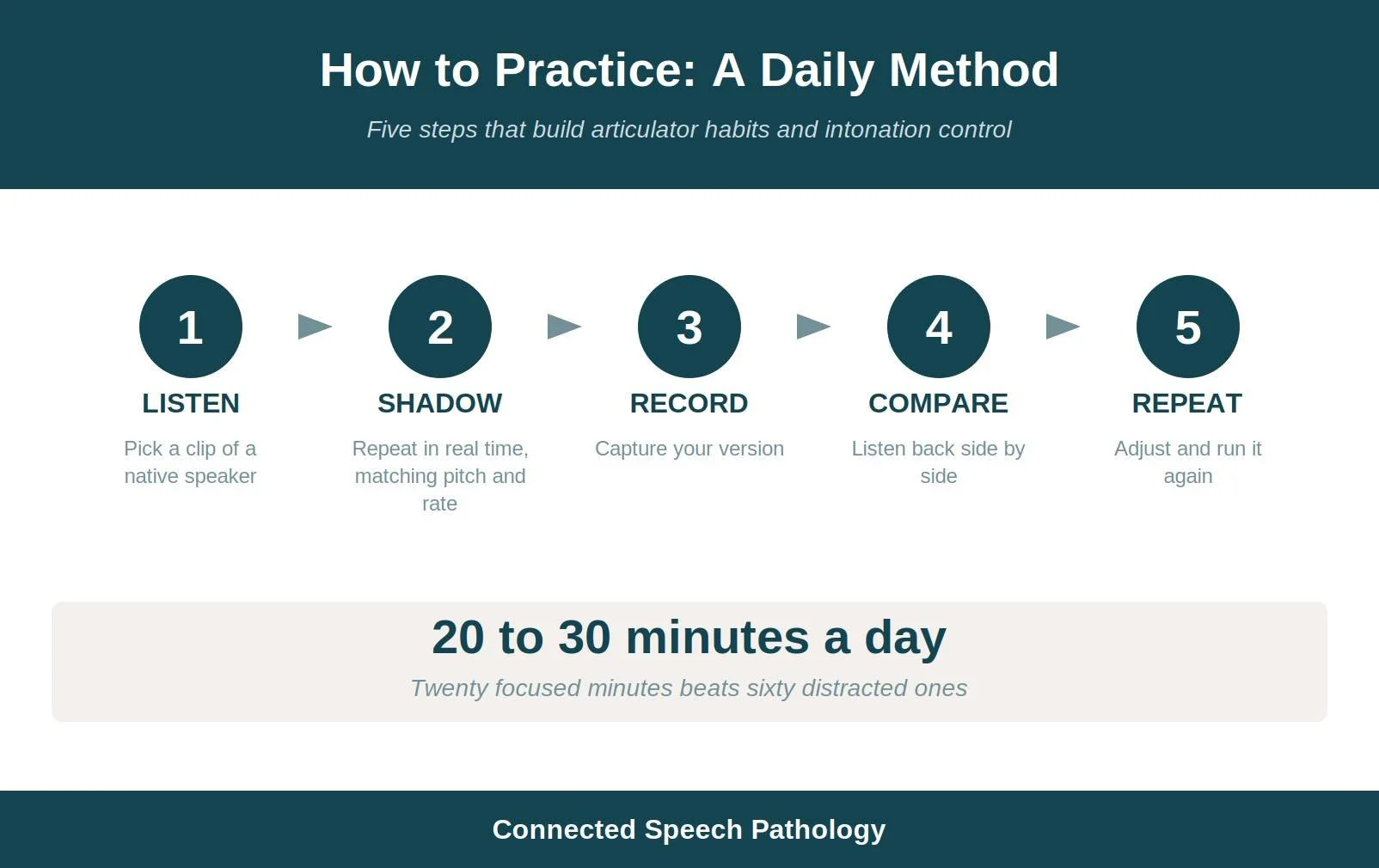
A reasonable timeline is several months of consistent work to see meaningful change. Plan for 20 to 30 minutes of focused effort each day.
Some programs recommend about an hour of practice daily, but quality matters more than duration. Twenty minutes of targeted speaking drills beats sixty minutes of distracted listening.
Several factors affect your pace. The further your native sound system is from English, the more new articulatory patterns you need to build. Adults with a music or rhythm-training background often move faster, because their ears are already trained to notice fine differences in pronunciation.
Muscle memory for speech is the rate-limiting factor. The jaw, lips, and tongue respond to repetition over time, like any other muscles. Daily speaking sessions of 20 to 30 minutes build articulator habits faster than occasional hour-long blocks.
What Does Accent Modification Training Look Like?

Training begins with a recorded evaluation. A speech-language pathologist listens to your speaking style across vowels, consonants, and sound combinations in single words, sentences, and conversation. The evaluation identifies the specific patterns affecting your communication, not a generic list of “common errors.”
Many programs also look beyond pronunciation skills alone. Grammar patterns, word choice, pacing, conversational style, and familiarity with idioms can all shape how natural and confident someone sounds in English.
Training also works on listening skills, not just speech production. Many adults can pronounce a sound correctly during practice but still miss it in fast conversation, meetings, or phone calls. Learning to hear English rhythm, stress, sound contrasts, and connected speech more accurately often improves both comprehension and pronunciation at the same time.
From there, training usually works on several core areas.
Individual Sounds
Vowels and consonants matter because they are the building blocks of pronunciation. Every language uses different sound patterns, and some English language sounds may not exist in a speaker’s native language.
Articulation work focuses on the physical mechanics of speech, including tongue placement, lip shaping, and airflow. The International Phonetic Alphabet (IPA) gives speech-language pathologists a precise way to describe and track those sounds during training.
Minimal Pairs
A minimal pair is a pair of words that differ by one sound, such as ship and sheep or vet and bet. Practicing minimal pairs helps train both listening and pronunciation because the contrast isolates the exact sound difference causing confusion.
Connected Speech
Native speakers rarely pronounce every word separately. Words blend together in connected speech, so “want to” may sound more like “wanna,” and “did you” may sound closer to “didja.”
Many adults notice that listeners understand them more easily once they learn common English linking and rhythm patterns. Even strong pronunciation can still sound unnatural when speech remains overly segmented or evenly timed.
Stress and Intonation
English uses stress and intonation patterns to signal meaning and emotion. The same sentence can sound confident, uncertain, sarcastic, frustrated, or engaged depending on emphasis and pitch movement.
Many adults carry over the rhythm and melody patterns of their first language into English. Accent modification often works on these prosodic features because they shape how natural speech sounds during conversation.
Independent Listening and Shadowing Practice
Many adults also practice shadowing on their own between sessions. Shadowing native speakers, which involves listening to and repeating what they say in real-time, is an effective technique for improving accent and pronunciation.
Short podcast clips, interviews, audiobooks, presentations, and news segments often work well for this type of practice. Recording yourself and comparing your speech to the original speaker can help build awareness of pacing, stress, and connected speech patterns.
Who Benefits from Accent Modification Training?

Adults pursue accent training to sharpen their communication skills, almost never to sound different for its own sake. Research shows that first impressions form within the first few minutes of meeting someone, and regional accents play a significant role in how someone's speech is perceived in those initial moments. For working professionals, that perception has real consequences for both their career and social life.
Common reasons adults seek help include:
Reducing the number of times they get asked to repeat themselves when speaking at work
Communicating more effectively in client-facing or patient-facing roles
Preparing for a presentation, interview, or career step that requires speaking publicly
Sounding more confident when speaking on phone calls and video meetings
Feeling less self-conscious in everyday social interactions
Examples of the professionals who pursue accent modification with Connected Speech Pathology include physicians, attorneys, nurses, engineers, consultants, professors, hospitality staff, broadcasters, corporate employees, actors, and more. Many describe themselves as non-native English speakers with accents they feel are holding them back. Others are native English speakers refining a regional accent for professional reasons, and some are non-native speakers of a second language who simply want stronger speaking skills.
Accent training differs from ESL classes. ESL covers grammar, vocabulary, and reading comprehension, while accent training focuses on how clearly you produce spoken English. The work suits ESL students and other adults whose English ability is already intermediate to advanced.
Support from family, coworkers, or friends who practice with you accelerates progress between sessions.

Accent Reduction Classes
Check out this blog on accent reduction classes for more information!
How to Find a Qualified Accent Coach

Many adults work with a speech-language pathologist who specializes in accent modification and communication clarity. Speech-language pathologists are trained to evaluate pronunciation, listening skills, rhythm, stress patterns, and the physical mechanics of speech, which makes them uniquely qualified for this type of work.
Consulting a Speech-Language Pathologist (SLP) can help identify specific targets for accent modification. The American Speech-Language-Hearing Association (ASHA) maintains a public directory called ProFind for credentialed providers. Search for a speech-language pathologist through ASHA ProFind, then use the specialty filters to look for providers who offer accent modification services.
When evaluating a program, ask a few specific things. A qualified program offers an individualized assessment before training begins, and can provide a detailed inventory of the consonants and vowels addressed during training.
A solid program also teaches the full picture of sounds, stress, rhythm, and intonation rather than drilling only one element.
One note on cost. Insurance companies generally do not cover accent reduction services because an accent is not a speech or language disorder, and ASHA itself states this directly. Most clients pay privately for services.
What We See Working with Clients

A software engineer at a startup came to us after he started pitching his product to executives and investors more often. He was getting asked to repeat himself during presentations, and one executive even repeated his point back to the room so the audience could understand it more clearly.
Sessions focused on speech clarity, pacing, stress patterns, and strategies for high-pressure speaking situations. Several weeks later, he reported fewer interruptions during meetings and felt more comfortable presenting without mentally scripting every sentence beforehand.
Another client, a hospitalist whose native language was Spanish, came in discouraged after receiving negative patient feedback about bedside manner. She felt she was being warm and compassionate, but issues with intelligibility, intonation, body language, and limited use of conversational English phrasing were affecting how patients interpreted her communication.
We also worked with an attorney from Texas who felt his Southern dialect was being judged differently from his colleagues’ speaking styles at a large corporate firm. He worried that clients and coworkers sometimes perceived him as less polished during high-stakes meetings, even though his legal work was strong.
Coaching focused on clarity, pacing, executive communication, and helping clients decide which communication patterns they wanted to maintain versus modify depending on the setting. Over time, many adults report feeling more confident in meetings, presentations, interviews, and workplace conversations without feeling pressured to change the way they speak.
Frequently Asked Questions About Changing Your Accent

1. Can you change your accent as an adult?
Yes. Many of our clients come in saying, "I want to change my accent," and see meaningful progress within several months of weekly accent modification sessions.
Daily practice is also essential. Muscle memory for speech takes time and requires a commitment of 20 to 30 minutes a day for vocal exercises.
2. How long does it take to change your accent?
Most adults notice changes in speech clarity and confidence within several months. Progress depends on daily practice, how often someone uses English, the strength of the accent patterns they want to change, and which pronunciation features affect communication most.
3. Is it possible to lose your accent completely?
Most adults do not erase an accent completely; full erasure is not the goal. The aim is clearer, more intelligible English. Many clients reach a point where listeners stop noticing the accent and hear the message.
4. What is the difference between accent modification and ESL classes?
ESL classes usually teach grammar, vocabulary, reading, writing, and general English comprehension. Accent modification focuses specifically on spoken communication, including pronunciation, rhythm, stress patterns, intonation, and the speech habits that affect how clearly and naturally someone is understood in conversation.
5. Does insurance cover this kind of work?
Insurance does not cover this work. An accent is not a clinical disorder per ASHA, so clients who say "I want to change my accent" usually pay out of pocket or use employer-funded professional development budgets.
How Connected Speech Pathology Can Help

Our online accent modification program starts with a personalized evaluation. Your speech-language pathologist identifies the patterns affecting your clarity and builds a plan around your speaking goals.
Working with a licensed speech-language pathologist (SLP) or a dialect coach provides tailored feedback for correcting speech mechanics. Sessions may include pronunciation, rhythm, stress, intonation, listening skills, grammar patterns, idioms, and workplace communication. Many clients report clearer speech and more confidence after several months of consistent practice.
Summary
You can change your accent over time with consistent practice and targeted training. Many adults work on pronunciation, rhythm, intonation, listening skills, and communication clarity with guidance from a speech-language pathologist.
Changing an accent does not change someone’s identity or personality. The goal is usually to make communication feel easier, clearer, and more confident in the situations that matter most.

About the Author
Allison Geller, M.A., CCC-SLP, is a communication coach, speech-language pathologist, and founder of Connected Speech Pathology, an international online practice providing professional communication coaching and speech therapy for children, teens, and adults. With more than two decades of experience, she has worked in medical and educational settings and published research on aphasia. Today, she leads a team of specialists who help clients improve their skills in public speaking, vocal presence, accent clarity, articulation, language, fluency, and interpersonal communication.