How Accent Reduction Classes Work: What You Need to Know
Accent reduction classes are structured lessons that train you to pronounce American English more clearly, usually with an accent coach. Programs cover sounds, syllable emphasis, and the melody of English, and they differ in format, length, and cost.
Maybe you are one of many adults who speak English as a second language, or with a regional accent, and the way you speak slows you down at work or school. You read and write well, yet people ask you to repeat yourself.
Repeating yourself is tiring. Clearer pronunciation makes meetings, interviews, and everyday communication easier, and you do not need to lose your accent.
Key Takeaways:
Accent reduction classes teach the sound system of American English. A coach trains sounds, syllable emphasis, rhythm, and intonation patterns in real time.
The goal is clarity, so listeners understand you the first time you speak. Matching a native speaker is optional; many students keep a light accent and communicate clearly.
One-on-one lessons move faster than a group class. Every lesson targets your sounds.
Most programs run 10 to 20 weeks. Short daily practice drives the improvement.
What Are Accent Reduction Classes?
What Concepts Are Taught in Accent Reduction Training?
How to Choose the Right Accent Reduction Class
What to Expect From an Accent Reduction Course
Accent Reduction Course Length and Cost
What We See Working with Clients
What Are Accent Reduction Classes?

Accent reduction classes are lessons that teach clearer American English pronunciation. An accent coach evaluates how you speak, picks the targets that get in the way, and trains them in guided lessons and short daily drills. A class runs one-on-one or in a group, online or in person.
The service is also called accent modification or accent training. The goal is clarity: an American accent that listeners understand on the first try. You do not have to sound like a native speaker; better communication and confidence follow as individuals improve.
Who Benefits Most?
Adults who are fluent in English but often misunderstood gain the most from training. Many of them train through online accent reduction, which lets them practice in the same video calls where they work. Physicians, engineers, lawyers, actors, and graduate students depend on how clearly they speak in professional settings, at work or school.
Many students avoid speaking in meetings because repeating themselves is exhausting. Accent modification training can rebuild the confidence to express yourself and communicate effectively at work.
What Concepts Are Taught in Accent Reduction Training?
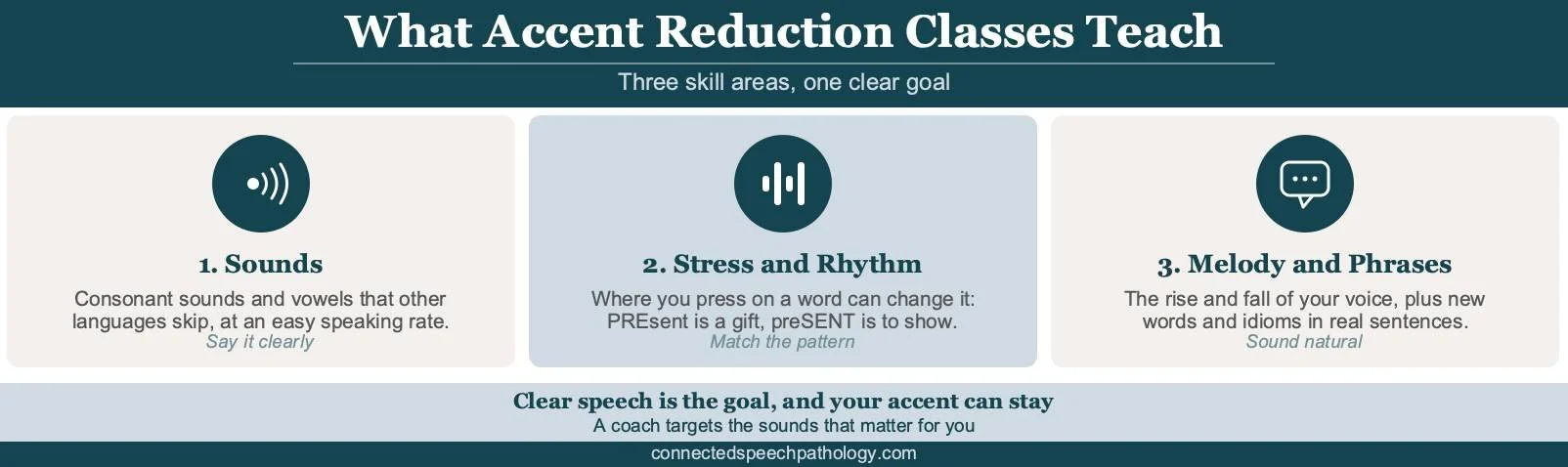
Accent training programs focus on the sound system of American English. Accent coaches teach five core concepts, plus a slower, clearer speaking rate:
Pronunciation. The consonant sounds and vowels that are not used in the same way in other languages. For example, many languages don't have the "th" sound, so "think" can come out as "sink" or "tink." Pronunciation training helps you say words more clearly.
Word stress. PREsent (a gift) and preSENT (to show) differ only in the syllable you emphasize.
Rhythm. English shortens some syllables and stretches others. In casual speech, "I want to go" often becomes "I wanna go." Matching that pattern helps you sound more like a native English speaker.
Intonation. The rise and fall of your voice when you speak signals questions and emotion. "You're leaving?" with your voice rising is a question, while "You're leaving." with your voice falling is a statement, even though the words are the same.
Vocabulary in real phrases. New words, idioms, and common expressions help you understand a native English speaker better. When someone says "break the ice," they mean easing the tension in a room, not anything about actual ice.

Accent Reduction Speech Therapy
Check out our blog on accent reduction speech therapy for more information!
How to Choose the Right Accent Reduction Class

The right accent reduction class matches your goals, schedule, and first language. If your first language is Spanish, our guide to reducing a Spanish accent explains which English sounds to focus on. Titles vary: accent coach, accent advisor, teacher, or trainer. Judge a program by credentials, techniques, and structure:
The instructor is certified, with verifiable expertise in phonetic training
The coach has taught the American accent to speakers of your first language
Lessons are customized after an evaluation, with materials and pronunciation exercises after each class
The format works for you: online or in person, private class format or group
The schedule, length, and cost are a good fit
Ask about a free accent screening, consultation call, or trial lesson before you begin. Hearing what a coach would target lets you compare options with confidence.
What to Expect From an Accent Reduction Course
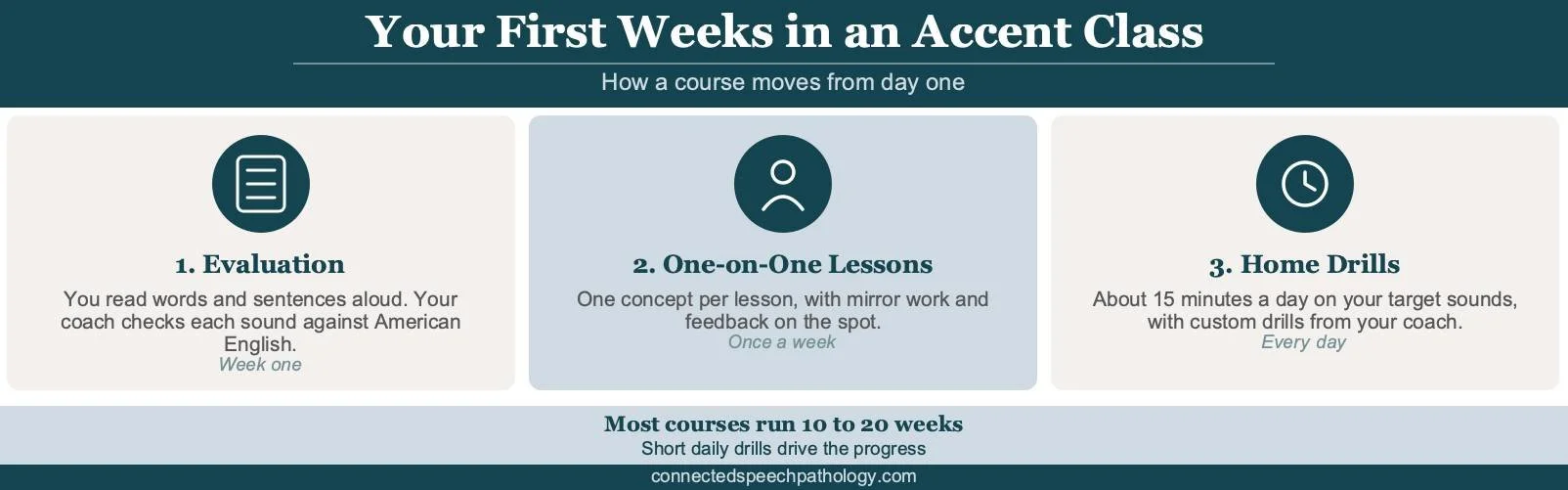
An accent reduction course follows a set arc: an evaluation, weekly lessons, and daily home practice.
Evaluation of Your Skills
The first session is an assessment of your speech patterns. You read word lists, sentences, and a paragraph aloud. Your coach records you, transcribes it, and compares it with General American English, sound by sound.
Your coach asks about your language background, how well you speak English, and where pronunciation gets in your way. They record and transcribe a sample of your speech to pin down exactly which sounds and patterns are giving you trouble. The result is a short list of target sounds and patterns.
One-on-One Accent Reduction Lessons
Each lesson focuses on a single concept and has you apply it right away. In class, your accent trainer often uses a mirror to show where your tongue and lips should be placed, correcting errors on the spot with constructive feedback. Your coach tracks your progress.
Accent coaches build lessons from single sounds to conversation. You will role-play client calls, rehearse presentations, and work on intonation, repeating each technique with your teacher until your new American accent generalizes to conversation.
Home Program
Outside class, the focus shifts to daily drills: accent coaches assign at least 15 minutes of practice a day on your target sounds. Consistent repetition retrains your ear and mouth, improving listening comprehension, pronunciation, and overall clarity.
Daily repetition beats a weekly cram session. Speaking habits are motor skills, and small doses build them faster.
Accent Reduction Course Length and Cost

Most accent reduction courses run 10 to 20 weeks, with one lesson a week. Everyone's learning pace differs, so yours can run shorter or longer.
Students who practice daily usually hear a clearer American accent within a few months. The more you speak between lessons, the faster your progress.
What Classes Cost
The cost of an accent reduction class depends on the format and the coach's credentials. Private accent coaching generally runs between $50 and $200 or more per hour. Group classes and self-paced accent training apps cost less, and online classes usually cost less than in-person instruction.
Many accent reduction coaches offer package pricing for a full course. A school or university class is a lower-cost route, usually taught in groups.
What We See Working with Clients

We provide online, one-on-one accent modification training to professionals worldwide. The examples below are real clients of ours. Identifying details have been changed to protect privacy.
A software engineer from India led daily standups, during which teammates kept asking him to repeat his updates. His assessment showed that /v/ and /w/ sounds, as well as syllable emphasis, were the main targets.
He met with his coach for a weekly class and practiced for 15 minutes a day using customized drills. Within three months, his standups ran without repeats, and with new confidence, he volunteered for a company all-hands talk.
A physician from Colombia was comfortable with face-to-face patient visits yet dreaded phone consultations, with no gestures to help. Her evaluation pointed to intonation and specific sounds at the ends of words.
Her lessons kept the focus on phonetic exercises and role-play of phone calls. She now takes referral calls with confidence, and patients rarely ask her to repeat instructions.
Frequently Asked Questions About Accent Reduction

1. Is accent reduction worth it?
Yes, if being misunderstood costs you time, confidence, or opportunities at work or school. Accent coaches see the biggest gains among students who maintain the daily habit: clearer speech, easier presentations, and enhanced professional opportunities. The skills stay with you after the last lesson.
2. Is it OK to change your accent?
Yes. Your accent is part of your identity, and choosing to change your accent, or keep it, is your decision. Most students aim for clarity rather than erasing their way of speaking.
3. Can you change your accent after 30?
Yes, adults of any age can learn a new American accent. You can begin at any time; the techniques work at any age. With structured accent training and daily drills, students in their 40s, 50s, and beyond make lasting changes.
4. Are online accent training classes as effective as in-person classes?
Yes, an online private class format works just as well. Clear audio and video give accent coaches everything they need for American accent work, and no commute makes it easier to keep up steady attendance, the real driver of success. Compare both in our guide to in-person vs online options.
How Connected Speech Pathology Can Help

Our experienced accent reduction coaches hold graduate degrees in speech pathology. Training covers all aspects of spoken communication. Your course will begin with an evaluation and is tailored to your individual needs and goals.
All lessons are one-on-one and online through our accent reduction training program. You can train your American accent from home or the office. Between lessons, our practice software provides you with custom materials and techniques tailored to your specific sounds, even outside class.
You keep direct access to your coach. That guidance turns effort into success, and you will speak English with confidence.
Summary
Accent reduction classes teach clearer American English through a proven sequence: an evaluation, one-on-one lessons on pronunciation, word stress, and sentence melody, and short daily drills. Most courses run 10 to 20 weeks, and students who speak English with a coach's guidance communicate with lasting clarity and confidence. The goal of accent modification is improved intelligibility, not accent elimination.

About the Author
Allison Geller, M.A., CCC-SLP, is a communication coach, speech-language pathologist, and founder of Connected Speech Pathology, an international online practice providing professional communication coaching and speech therapy for children, teens, and adults. With more than two decades of experience, she has worked in medical and educational settings and published research on aphasia. Today, she leads a team of specialists who help clients improve their skills in public speaking, vocal presence, accent clarity, articulation, language, fluency, and interpersonal communication.