A Guide to Accent Reduction Speech Therapy
Accent reduction speech therapy, also called accent modification, is a service that helps people speak Standard American English more clearly and confidently. Although many people refer to it as "accent modification speech therapy," accent modification is typically not therapy for a speech or language disorder.
Instead, it is specialized communication training that focuses on the sounds, stress patterns, rhythm, and intonation of American English. While accent modification can be applied to many languages, this article focuses specifically on improving clarity when speaking Standard American English.
Clearer speech can boost your confidence at work and in everyday conversations while preserving the accent that is part of who you are. The right plan targets the sounds, stress patterns, and rhythms of American English that may affect intelligibility. Small, steady changes add up to meaningful improvements in clarity.
Key Takeaways
Accent modification helps you speak English more clearly without erasing your identity. People also call it accent reduction.
An accent is a natural difference in communication, not a speech disorder. Accents reflect your native language and where you grew up.
A speech-language pathologist assesses your speech patterns, sets goals with you, and guides targeted work on speech sounds and stress. Sessions are personalized to your goals.
Steady repetition is what makes new speech automatic. Most people meet weekly, rehearse daily, and build clearer speech over a few months.
Who Benefits From Accent Modification?
Benefits of Accent Modification Services
What to Expect From Accent Modification
Why a Speech-Language Pathologist Makes a Great Accent Coach
What We See Working With Clients
What Is Accent Reduction?
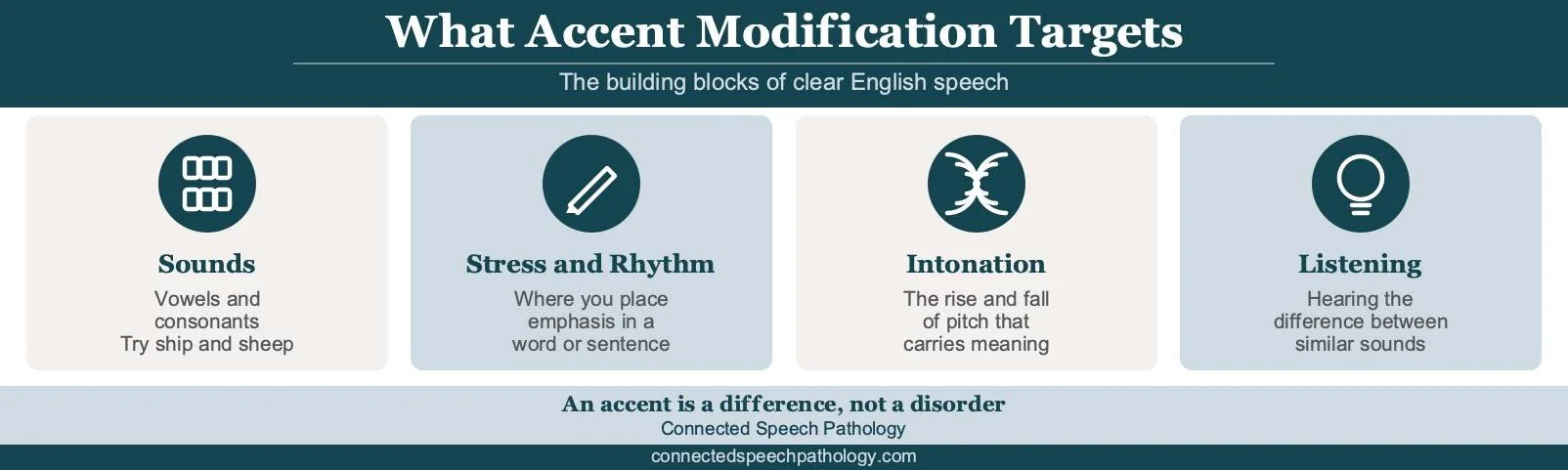
Accent reduction is guided training that helps you produce English sounds, stress, and rhythm clearly. It does not treat a speech or language disorder. An accent simply reflects your native language and where you grew up, and it is a normal part of how people speak.
The goal is clarity, not a new identity. You keep your accent and add a clearer way of speaking when you want it, much like switching registers for different settings.
Some people call this accent reduction, others call it accent modification. Both terms describe the same work: making your speech easier to follow.
Who Benefits From Accent Modification?

Accent modification helps anyone who wants to be easily understood in English. Many people are non-native English speakers who get asked to repeat themselves. Others want their accent to match a specific setting or role.
Typical clients include:
Non native english speakers who want to communicate more clearly in American English
Executives, managers, and team leaders who speak frequently in meetings
Doctors, nurses, and other healthcare professionals who communicate with patients and colleagues
Attorneys, professors, and other professionals whose work depends on clear spoken communication
International students are working toward improving academic success
Customer-facing employees who need to be understood quickly and easily
Religious leaders, including priests and pastors, who speak publicly on a regular basis
Actors preparing for a role with a new accent
Benefits of Accent Modification Services

Accent modification services address both intelligibility and confidence. When people understand you the first time, talking feels easier, and you repeat yourself less.
The benefits show up in real settings:
Clearer speech in presentations and client meetings
More confidence in social settings and at work
Stronger job performance when communication matters
Easier cultural connection for non-native speakers
Clearer speech supports your career without changing who you are. Many professionals modify their accent for stronger public speaking while keeping their own voice.

Accent Reduction Classes
Check out our blog on accent reduction classes for more information!
What to Expect From Accent Modification
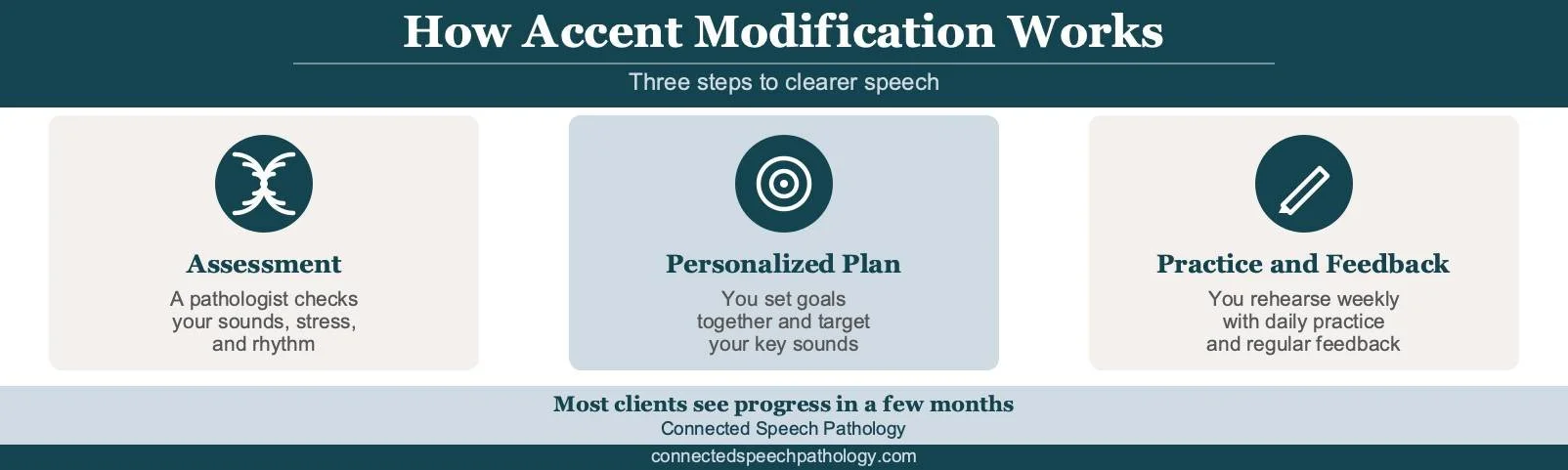
Accent modification begins with an evaluation of your speech patterns. The accent trainer listens to how you produce specific sounds, where you place stress, and the rhythm and intonation of your speech.
They will also ask about your language and background, how long you have been speaking English, your educational experiences, and the communication situations that are most important to you, such as presentations, meetings, patient interactions, interviews, or everyday conversations.
The assessment helps determine which factors may be affecting intelligibility. For some people, the primary challenge is a strong accent.
For others, differences in educational background, limited exposure to spoken American English, or difficulty hearing and producing certain sounds may play a larger role. Together, you and your accent trainer will set goals and develop a personalized accent modification plan.
Accent reduction sessions focus on a few skills at a time. You may practice auditory discrimination, which means learning to distinguish between similar sounds, such as the vowels in "ship" and "sheep." Pronunciation and listening exercises teach the precise mouth movements needed for challenging consonants and vowels.
An accent modification course also targets prosody, the melody of speech. This includes stress, rhythm, pitch, and intonation. In American English, the way a word or sentence is stressed can affect how easily listeners understand the message.
As you progress, you will practice new speech patterns in increasingly realistic situations. This may begin with words and sentences, then move into conversations, presentations, workplace discussions, and other real-world speaking tasks.
Your accent trainer provides regular feedback and strategies for independent practice between sessions. Most people meet once or twice per week and spend a few minutes practicing each day. Over time, that consistent practice helps new speech patterns become more natural and automatic.
Why a Speech-Language Pathologist Makes a Great Accent Coach

A speech therapist is trained in exactly how speech sounds are produced, which suits them well for accent work. They understand the anatomy behind each sound, how stress and intonation carry meaning, and how to teach a new pattern step by step.
Beyond pronunciation, a speech therapist can identify other factors affecting clarity, such as a voice concern. Just as important, a good accent trainer respects your goals and your culture. The aim is to help you communicate effectively, never to judge how you already speak.
What We See Working With Clients

At Connected Speech Pathology, we work with multilingual professionals who are having trouble being understood in American English, even when they have strong language skills and expertise in their fields. Names and details have been changed to protect privacy.
One client was a physician whose first language was not English. He communicated effectively with patients and colleagues, but he often had to repeat key information during appointments.
He focused on a small number of vowel and consonant patterns that affected intelligibility, along with the stress patterns commonly used in American English. As those changes became more consistent, conversations moved more smoothly, and repetition became less common.
Another client was an attorney who regularly presented to clients and colleagues. Individual sounds were only part of the challenge. Important points were sometimes blended together because her pacing and sentence stress did not match listeners' expectations.
We worked on strategies for emphasis, rhythm, and delivery in presentations and meetings. Over time, she felt more confident speaking in high-stakes situations and spent less energy worrying about whether her message would be understood.
In a third example, a client came to us for accent modification after repeatedly receiving feedback that he was difficult to understand during presentations. During the evaluation, it became clear that accent differences were only part of the picture.
He also had a voice disorder that caused reduced vocal clarity and made speech more difficult to understand, especially in large meetings. Because his accent trainer was also a licensed speech-language pathologist, we were able to identify the issue, address both the voice and accent-related factors, and create a plan that targeted the root causes of the problem.
As his voice improved and his speech patterns became more familiar to listeners, communication became significantly easier.
In all three cases, the goal was not to eliminate an accent. The goal was clearer communication. Progress came through targeted practice, regular feedback, and repeated use of new speech patterns in real-world situations.
Frequently Asked Questions About Accent Reduction

1. Is an accent a speech disorder?
No. An accent is a natural difference in how you speak, not a disorder.
2. How long does accent modification take?
Most people see clear progress in a few months. Accent modification may require one to two sessions per week.
3. Does accent modification work?
Yes. With steady work and feedback, your speech becomes clearer and easier to understand.
4. Does insurance cover accent modification therapy?
Usually, no, because an accent is not a medical condition. It is an elective service.
5. Can you completely lose your accent?
Not usually, and that is fine. The goal is clearer speech, not erasing your accent.
How Connected Speech Pathology Can Help

Connected Speech Pathology offers online accent modification with a certified, experienced accent-modification trainer. We start by listening to your speech, then build a plan tailored to your goals, your unique pronunciation patterns, and where clarity matters most. Sessions mix focused exercises, listening work, and real conversations, with feedback at every step.
Every speaker brings a different language background, communication style, and set of goals. Schedule a free consultation to learn how a personalized accent modification plan can support clearer communication in American English.
Summary
Accent reduction, or accent modification, helps you speak English more clearly while keeping your own accent. A speech-language pathologist checks your speech patterns, sets goals with you, and guides work on sounds, stress, and rhythm.
With steady daily effort, clearer speech becomes a habit, and most people feel more confident at work and in daily life.

About the Author
Allison Geller, M.A., CCC-SLP, is a communication coach, speech-language pathologist, and founder of Connected Speech Pathology, an international online practice providing professional communication coaching and speech therapy for children, teens, and adults. With more than two decades of experience, she has worked in medical and educational settings and published research on aphasia. Today, she leads a team of specialists who help clients improve their skills in public speaking, vocal presence, accent clarity, articulation, language, fluency, and interpersonal communication.