What Does a Speech Therapist Do for Adults?

A speech therapist helps adults evaluate, diagnose, and treat communication, voice, cognitive, and swallowing difficulties. They assess the underlying communication problems, develop a treatment plan, teach exercises and strategies, monitor progress, and help adults communicate more effectively in everyday life.
Communication affects nearly every part of adult life, including work, relationships, medical care, safety, and independence. When communication, thinking, voice, or swallowing become more difficult, speech therapy can help adults regain skills, improve function, and participate more fully in daily activities.
Speech-language pathologists evaluate, diagnose, and treat speech, language, voice, cognitive-communication, and swallowing disorders. They also coach adults on non-medical communication goals such as accent modification, cross-cultural communication, public speaking, and workplace communication. Much of this work now takes place online.
In this guide, we'll explain what adult speech therapy involves, the conditions it treats, what happens during therapy sessions, how long treatment typically lasts, and what speech therapy costs.
Key Takeaways
A speech therapist treats more than medical conditions. They help with speech and language skills, cognitive communication disorders, voice issues, swallowing, and everyday communication goals.
Most clinical cases follow a health event. Common triggers include stroke, brain injury, and degenerative disease, alongside voice and communication coaching. However, adults also seek speech therapy for long-standing articulation and fluency disorders, hearing impairment, and communication challenges that become more noticeable in academic, social, or professional settings.
Speech therapy starts with an evaluation. From there, a speech-language pathologist develops a personalized treatment plan that includes regular sessions and home practice.
Speech therapy can fit into a variety of schedules and lifestyles, with both in-person and online options available. Medically necessary treatment is often covered by insurance.
What Speech-Language Pathologists Do for Adults
Conditions Adult Speech Therapy Treats
What Happens in Adult Speech Therapy
Online Speech Therapy for Adults, Cost, and Insurance
What We See Working With Clients
What Speech-Language Pathologists Do for Adults

Speech-language pathologists assess, diagnose, and treat a wide range of speech, language, voice, cognitive, and swallowing disorders in adults. Many people seek speech therapy because they have communication difficulties, difficulty speaking clearly, trouble finding words, voice changes, memory or thinking challenges, or swallowing problems that affect daily life.
During an assessment, a speech-language pathologist looks at how clearly you speak, how easily you understand and use language, how your voice sounds, how well your thinking and communication skills support daily activities, and how safely you swallow. The goal is to identify the underlying cause of the speech and language issues and understand how they affect your ability to communicate effectively.
From there, the speech-language pathologist develops a treatment plan tailored to your goals. Since no two adults share the same goals, treatment is highly individualized.
Conditions Adult Speech Therapy Treats
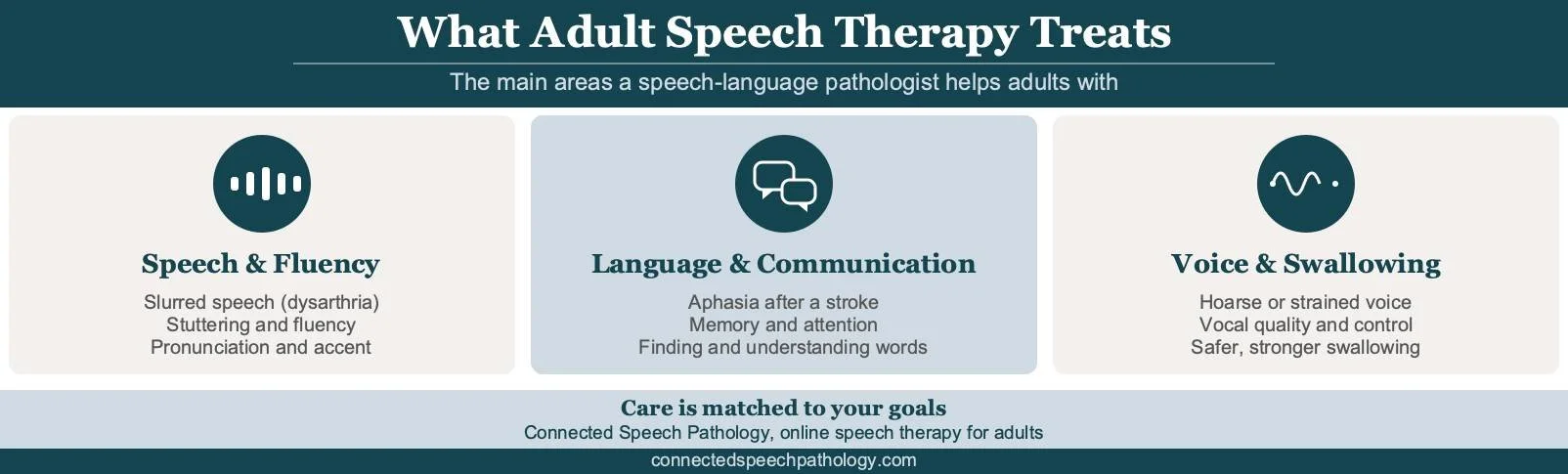
Adults seek speech therapy to improve a range of communication skills. Difficulty communicating can arise after a medical condition or injury, while in others, it has been present for years or has become more noticeable over time. The categories below highlight the most common conditions and communication challenges treated in adult speech therapy.
Speech Disorders and Fluency
Motor speech disorders affect the coordination of speech-producing muscles. Dysarthria can weaken or slow the muscles used for speech, while apraxia of speech can make it difficult to plan and coordinate the movements needed to say words correctly.
Fluency disorders include stuttering and abnormal speech flow.
Speech therapy focuses on improving speech clarity, coordination, and fluency through targeted exercises and communication strategies.
Language Disorders and Communication Disorders After Brain Injury
Language disorders can follow a brain injury. Aphasia, common after a stroke, makes it hard to find words or understand language. Cognitive-communication disorders can also occur, making it harder to focus, remember, and organize what you want to say.
Speech therapy rebuilds these language skills step by step, so an adult can follow a conversation, find the right words, and stay independent. When speech is severely limited, a speech-language pathologist can introduce tools such as a communication board or a speech-generating device so the person can still communicate.
Voice Disorders and Swallowing
Voice disorders often result from injury to the vocal cords, a neurological condition, or other health conditions. Targeted voice therapy rebuilds vocal strength, volume, and control.
Swallowing disorders are a separate but related concern, common after a stroke, cancer treatment, or another illness. A speech therapist uses targeted exercises to improve swallowing safety and strength, which lowers the risk of food or liquid going down the wrong way.
What Happens in Adult Speech Therapy

Speech therapy starts with an evaluation. Your speech-language pathologist asks about your history and the specific communication issues you want to address. You may read aloud, answer questions, complete language tasks, or take part in a conversation so the therapist can identify areas to focus on.
Speech therapy may involve exercises to improve vocabulary and grammar. Speech therapy can also include communication supports, such as sign language, when appropriate for a person's needs. Common therapy techniques include perception exercises and sound production exercises.
Most speech therapy sessions run 30 to 60 minutes, once to three times a week, and a full course can last from a few months to a couple of years. Home practice is often assigned between therapy sessions.
Speech therapy goals focus on real-life communication. One adult may want to order coffee more easily, another may want to lead meetings with confidence, and a third may want to have smoother conversations with family members. Your speech therapist connects therapy activities to those goals and adjusts the plan as your skills develop.
Caregivers and Measurable Progress
Family members and caregivers are often part of the therapy process when additional support is needed. A speech therapist can show them how to reinforce communication strategies at home and build practice into everyday activities, which helps carry skills over between sessions.
Progress is measured throughout therapy. Your speech therapist sets specific goals, tracks improvement over time, and adjusts the treatment plan as needed. Once a goal is met, speech therapy may shift to maintenance or focus on new communication goals.
Speech Therapy for Adults vs. Children
Adults and children may receive speech therapy for some of the same communication challenges, including speech sound disorders, fluency disorders, and voice disorders. At the same time, some communication disorders are more common in children, while others are more common in adults.
The goals and activities are matched to each person's age, needs, and daily communication demands. Children's therapy often incorporates play, learning, and family involvement, while adult therapy may focus more on communication at work, at home, and in the community.

When Should an Adult See a Speech Pathologist?
Find out when an adult should see a speech pathologist in this blog.
Online Speech Therapy for Adults, Cost, and Insurance

Research shows that online speech therapy is as effective as in-person care for most adult goals, and it removes the hassle of travel and scheduling. You practice at home, where the skills are used, and it is easy to bring in a family member when that helps. In-person care still makes sense in several situations, such as when hands-on cueing is needed, during swallowing evaluations, or for some people with more severe communication challenges.
Whether insurance covers it usually depends on why you are there. Care that treats medical conditions, such as communication or swallowing issues after a stroke or illness, is often covered, and Medicare and many plans consider it medically necessary.
Coaching goals, like accent or public speaking, are usually paid out of pocket. It is worth checking your benefits and asking about payment options before you start.
What We See Working With Clients

At Connected Speech Pathology, we work with adults with a wide range of communication goals and challenges. Some clients come to us after a medical event, while others want support with speech, language, voice, fluency, accent modification, or professional communication. Names and details have been changed to protect privacy.
One client came to us months after a stroke. She often knew the word she wanted to say but had trouble retrieving it during conversations, which made family gatherings frustrating. Her speech-language pathologist incorporated word-finding practice and structured conversation tasks, and worked collaboratively with the family to develop home exercises to support communication in everyday situations.
Another client had a pronunciation issue that affected his clarity in conversations and at work. Speech therapy focused on practicing the target sound in words, sentences, and everyday speaking situations so he could use the new pattern more consistently outside of sessions.
A third client, an older adult with Parkinson's disease, wanted to be understood more easily by family members. Speech and voice therapy focused on increasing vocal loudness and speech clarity, so everyday conversations required less repetition.
Frequently Asked Questions About Speech Therapy

1. When should you see a speech pathologist for adults?
Reach out if your speech, voice, or swallowing has changed. Do the same if a communication goal keeps getting in your way. An evaluation will show whether speech therapy can help.
2. What activities are done in adult speech-language therapy?
It depends on your goals. Sessions may include speech exercises, voice exercises, language and memory tasks, swallowing therapy, and practice with real-life communication situations. Many speech therapists also provide activities to practice between sessions.
3. How long does speech therapy take for adults?
It depends on the diagnosis and the goal. Many adults work at it for a few months, while recovery from a serious injury can take a year or more.
4. Does speech therapy work for adults?
Yes, for many adults. It helps people regain skills after an injury and communicate more clearly day-to-day.
5. Can speech therapy help after a stroke or brain injury?
Yes, it often can. It treats aphasia, cognitive-communication, and swallowing problems that often follow a stroke or brain injury.
6. How much does adult speech therapy cost?
It varies by provider and plan. Insurance often covers medically necessary speech therapy, while coaching goals are usually paid out of pocket.
7. What are the signs you need speech therapy?
Signs that you may benefit from speech therapy include difficulty speaking clearly, finding the right words, understanding or using language, using your voice, or swallowing safely. If a communication or swallowing problem is making daily activities more difficult, a speech-language pathologist can evaluate your needs and recommend next steps.
How Connected Speech Pathology Can Help

At Connected Speech Pathology, adults work one-on-one with speech-language pathologists through secure online sessions. Teletherapy allows clients to receive support from home, at work, or while traveling, without the time and expense of commuting to an office.
Online speech therapy is effective for many adult communication goals, including speech, language, voice, fluency, accent modification, and professional communication. Our clinicians help clients apply new skills to the conversations, relationships, and situations that matter most to them.
Learn more about our speech therapy for adults.
Summary
So, what does a speech therapist do for adults? They help adults speak, understand, and communicate more clearly, and they treat voice and swallowing problems along the way. That can mean recovering after a stroke, brain injury, or illness, or simply reaching a personal or professional communication goal.
With a plan built around your life and steady practice, in person or online, real progress is within reach.

About the Author
Allison Geller, M.A., CCC-SLP, is a communication coach, speech-language pathologist, and founder of Connected Speech Pathology, an international online practice providing professional communication coaching and speech therapy for children, teens, and adults. With more than two decades of experience, she has worked in medical and educational settings and published research on aphasia. Today, she leads a team of specialists who help clients improve their skills in public speaking, vocal presence, accent clarity, articulation, language, fluency, and interpersonal communication.