What To Do If You Are Afraid To Speak In Front Of Groups

Feeling afraid to speak in front of groups shows up in workplaces, classrooms, and social settings alike. Most people feel nervous at some point, even when speaking to family or friends. Learning why fear of public speaking happens and how to manage it helps reduce anxiety and build confidence.
Public speaking anxiety often starts before the actual presentation begins. You may feel a rapid heartbeat, sweating, or trembling hands just thinking about speaking in front of a group. Understanding why you experience these reactions helps you adjust to these sensations.
Research shows that fear of public speaking ranks among the most common fears in adults. Even experienced speakers report nervousness before speaking in front of a crowd, so you are not alone!
Key Takeaways
Feeling afraid to speak in front of groups is a common fear shared by most people. Physical reactions such as sweating, trembling hands, and nervousness are normal responses generated in the nervous system.
Public speaking anxiety is strongly connected to the fight or flight response. This response produces physical symptoms that may feel uncomfortable but are part of your body's natural stress response.
Preparation, practice, and positive self-talk help reduce anxiety and build confidence. Repeating helpful thoughts trains your brain to respond calmly during stressful situations.
Gradual practice with real audience members helps you gain confidence over time. Small speaking opportunities help your ability develop step by step.
What Causes Fear Of Public Speaking And Public Speaking Anxiety
Building Confidence Through Practice And Exposure
Techniques To Stay Calm During Public Speaking
Frequently Asked Questions About Speaking In Front Of Groups
What Causes Fear Of Public Speaking And Public Speaking Anxiety

Fear of public speaking develops from both physical reactions and learned negative thoughts. The brain treats speaking in front of a group as a dangerous situation, triggering the body's fight-or-flight response. This reaction creates stress signals that increase nervousness.
When it enters fight-or-flight mode, our body reacts with a rapid heartbeat, sweating, trembling hands, and tight muscles. These symptoms prepare your body to react quickly to a perceived threat.
Negative thoughts increase speech anxiety by convincing your brain that mistakes will lead to embarrassment. That same pattern often fuels anxiety when speaking in groups, where the fear centers on meetings and discussions rather than a formal audience. Worrying about forgetting words or being judged increases fear and tension.
Many people also experience emotional and mental symptoms. These include fear of embarrassment, difficulty organizing thoughts or remembering key points, and strong self-doubt. Recognizing these reactions helps you understand that your response is normal.

Overcome Public Speaking Anxiety
Check out our blog on overcoming public speaking anxiety for more information!
Building Confidence Through Practice And Exposure

Gradual exposure helps reduce fear step by step. Small speaking experiences teach your brain to stay calm in social situations, and confidence builds with repetition.
Start with low-pressure settings, like speaking in front of friends or coworkers. Familiar, supportive faces can make it easier to stay grounded.
In meetings or group discussions, focus on sharing just the key points of your ideas. Then slowly increase your audience size and the complexity of what you’re saying. Begin with one or two listeners before working up to larger groups.
Mistakes are part of the process. Most people are paying attention to your message and your story, not small errors.
Techniques To Stay Calm During Public Speaking
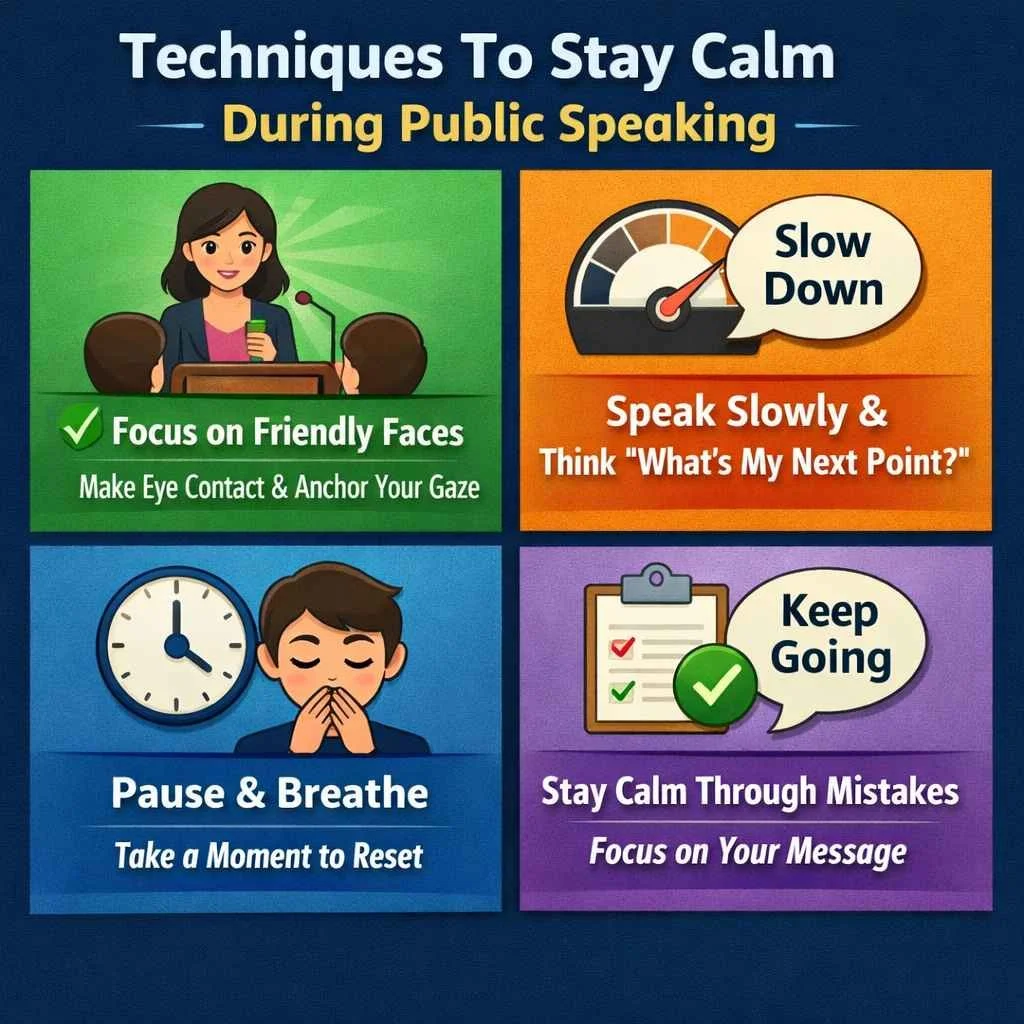
One of the easiest ways to settle yourself is to anchor your eyes. Instead of scanning the whole room, pick one or two people who feel safe and make eye contact for a full thought. Then move on. It makes the room feel smaller and helps your delivery feel more natural.
If your mind starts racing, slow your rate, even just slightly, to give your brain more time to keep up with your words and help your voice sound more grounded. It may feel too slow to you, but to your listener, it usually sounds clear and confident.
As you slow down, anchor your attention on what you are saying rather than how you are coming across. A simple reset is to think, “What’s my next point?” and let yourself move through one idea at a time instead of trying to say everything at once.
When you feel yourself speeding up or losing control, pause. Not a panic stop, just a brief, intentional pause. Take a breath and continue. Most people will not notice the pause, but they will feel the difference in how steady you sound.
It also helps to connect with a few people in the room rather than the whole audience. Looking at one or two familiar or friendly faces while you speak can make the situation feel more manageable and less overwhelming.
If you feel yourself getting tense or losing your place, give yourself permission to pause briefly and take a breath before continuing. That pause helps you reset your pace and keeps your delivery steady.
Mistakes will happen, and that is part of learning. When you stay with your point, speak slowly, and keep moving forward, you come across as more confident than you might feel.
Frequently Asked Questions About Speaking In Front Of Groups

1. Why am I afraid to speak in front of groups even when I know the material?
Fear of public speaking occurs because the brain activates the fight-or-flight response in stressful social situations. This reaction increases sweating, trembling hands, and a rapid heartbeat. Even strong preparation may not stop anxiety completely. Regular practice helps you feel confident.
2. Is public speaking anxiety a type of social anxiety disorder?
Public speaking and performance anxiety can be part of social anxiety disorder, but they are not always. Some people feel nervous only when speaking in front of groups, while others experience a broader fear of being judged across many social situations.
When the fear is intense, persistent, and leads to avoidance of presentations or work-related speaking, it may fall within social anxiety disorder. In those cases, targeted support can make a meaningful difference, helping people participate more comfortably and consistently.
3. What helps reduce speaking anxiety before a presentation?
Preparation, deep breathing, and positive self-talk reduce anxiety before speaking publicly. Visualize success to improve memory and confidence. Slow breathing can be a powerful tool. Positive thoughts improve focus.
4. How long does it take to overcome the fear of public speaking?
Overcoming fear of public speaking takes consistent practice over weeks or months. Improvement depends on practice frequency. Gradual exposure improves comfort. Small steps create progress.
5. What should I do if I forget what to say during a speech?
Pause, take a deep breath, and look at your key points if you forget what to say. Short pauses are normal and often unnoticed. Notes help you recover quickly. Calm breathing supports memory.
How Connected Speech Pathology Can Help

At Connected Speech, we provide online communication coaching that helps adults who feel afraid to speak in front of groups. Our professional communication coaches teach strategies that reduce anxiety and improve confidence. Sessions focus on communication, education, and practical speaking skills.
We support adults who experience public speaking anxiety. We guide clients through structured speaking practice that improves voice control and organization. Online sessions help clients practice in familiar environments.
We create personalized communication coaching plans based on each person's goals. Our communication coaches help clients practice real speaking tasks such as meetings, presentations, and group discussions. Repeated practice helps clients build confidence and reduce fear.
Summary
Feeling afraid to speak in front of groups is a common fear that affects most people. Physical symptoms, negative thoughts, and limited practice often increase anxiety. Preparation, breathing, and positive thinking help reduce stress.
Small speaking opportunities help build confidence over time. Structured communication skills improve clarity and reduce nervousness. Consistent practice supports long-term success.

About the Author
Allison Geller is a communication coach, speech-language pathologist, and founder of Connected Speech Pathology, an international online practice providing professional communication coaching and speech therapy for children, teens, and adults. With more than two decades of experience, she has worked in medical and educational settings, published research on aphasia, and leads a team of specialists helping clients improve skills in public speaking, vocal presence, accent clarity, articulation, language, fluency, and interpersonal communication.