Why Do I Lose My Train of Thought When Speaking

Losing your train of thought when speaking usually means your working memory is overloaded. Stress, distraction, and fatigue are the most common triggers, and sometimes a health condition contributes. The sections below explain what those moments mean, the five main causes, the early signs that deserve a professional check, and the strategies that help you stay focused.
They are written for adults who lose their train of thought in meetings, presentations, and everyday conversations. If you keep asking yourself, “Why do I lose my train of thought when speaking?”, the answer matters because frequent lapses wear down confidence at work and at home.
Key Takeaways
Losing your train of thought is usually a working memory overload rather than a memory problem. Stress, distraction, and fatigue are the most common triggers.
Thought blocking is a sudden stop in thinking while speaking. Occasional lapses like this are a normal human experience.
Slowing down, reducing distractions, and jotting down your main points all protect your focus and lower the load on working memory. Short, regular practice builds the habit.
A doctor should evaluate lapses that are frequent, worsening, or paired with other changes. Memory problems, confusion, or difficulty finding words alongside the lapses deserve prompt attention.
What Does It Mean to Lose Your Train of Thought When Speaking?
Five Common Reasons You Lose Your Train of Thought During Conversation
When Are Disorganized Thoughts a Concern? Early Signs to Watch
How to Stop Losing Your Train of Thought While Speaking
What We See Working with Clients
Frequently Asked Questions About Losing Train of Thought When Speaking
What Does It Mean to Lose Your Train of Thought When Speaking?

Losing your train of thought when speaking means your working memory dropped the thought you were holding. Speaking is a complex process where your brain plans ideas, chooses words, and tracks your listener's reactions at the same time. When you're stressed or distracted, you have less attention available, and you forget the next idea before you can say it.
Most people forget a point during busy or high-pressure moments, and occasional forgetfulness is part of normal communication. When it happens often, it can affect confidence and make conversations harder than they need to be. If you often lose track of what you were saying mid-sentence, it's worth finding out why.
What Is Thought Blocking?
Thought blocking is the clinical name for a sudden interruption in thinking, the moment your mind goes blank mid-sentence. A person experiencing thought blocking stops talking because the thought itself is gone, and the sentence cannot continue until a new one forms.
Occasional thought blocking happens to nearly everyone under stress, distraction, or fatigue. Frequent thought blocking is different because repeated interruptions in thinking can point to an underlying mental health condition. A professional evaluation is the reliable way to tell a habit from a symptom.
How Working Memory Supports Your Thought Process
Working memory is your brain's holding space for the ideas you are about to say. It keeps your next point in mind while you finish your current sentence, so your thought process moves from one point to the next without gaps. Psychology research shows that working memory has a limited capacity for holding information.
Speaking requires real-time organization of ideas and constant monitoring. During a conversation, you are also listening, reading reactions, and adjusting your message, and your executive functions coordinate focus, attention, and task management. Cognitive overload happens when you process too many things at once, and you lose track of the thought.
The same system supports problem-solving, planning, and cognitive function across daily tasks.
Five Common Reasons You Lose Your Train of Thought During Conversation
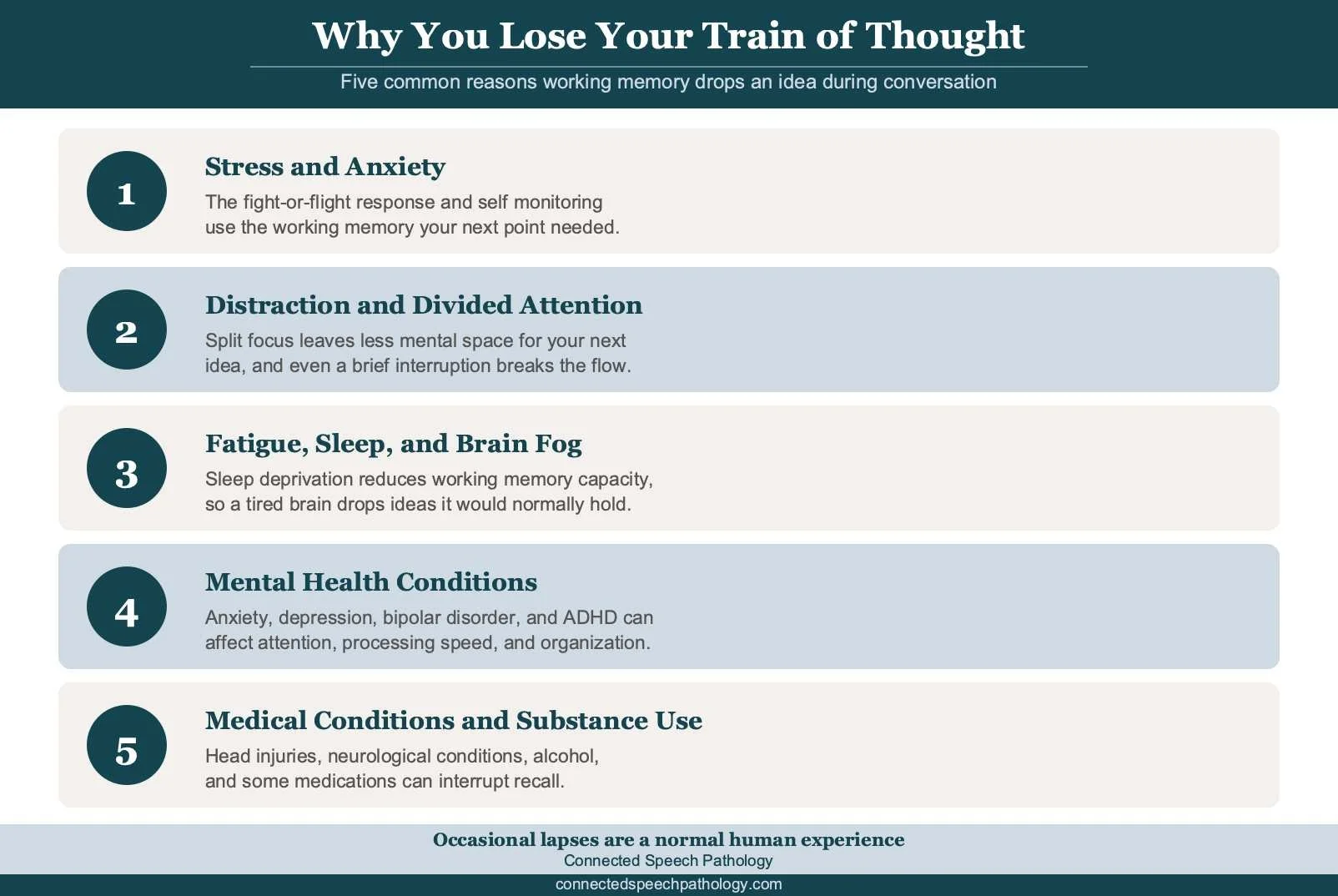
Five causes explain why most people lose their train of thought while talking. Each affects the brain's ability to maintain focus and recall in a different way, and several often act together in the same conversation.
1. Stress and Anxiety
Anxiety triggers the brain's fight-or-flight response, and stress activates hormones that can impair cognitive processing. Under high stress, your attention shifts inward, you start monitoring how you sound, and that self-monitoring uses the working memory your next point needs. Severe anxiety can make you lose track of a conversation entirely.
Social anxiety adds a second load, because worrying about judgment is its own demanding task. Increased tension in the body also reduces mental clarity and makes recall less reliable, which is why thoughts drop off mid-sentence.
Slowing your breathing for a few seconds lowers that internal pressure. If public speaking regularly leaves you anxious, a few deep breaths before you begin give your brain room to settle.
2. Distraction and Divided Attention
Divided attention causes many of the lapses that feel like memory problems. When your focus is pulled in several directions, your brain has less mental space for your next idea, and distractions can derail the story you were in the middle of telling. Even a brief interruption can make you lose the thought and stop talking mid-sentence.
Distractions take obvious forms, like background noise and side conversations, and subtle ones, like checking your phone or mentally running through a to-do list. Environmental changes can disrupt memory retrieval, which is why walking into a different room sometimes makes you forget the thought you meant to share.
If you have trouble focusing in busy settings, choose a quieter one when the conversation matters, so you lose fewer thoughts to background noise.
3. Fatigue, Sleep, and Brain Fog
Sleep deprivation reduces working memory capacity, so a tired brain drops ideas it would normally hold, and the whole thought process slows down. Finding the right words takes longer, pauses grow more frequent, and you forget points you knew a moment earlier. Many people describe the result as brain fog, a slow, unfocused feeling that makes thinking feel effortful.
Sleep disorders, such as sleep apnea, can produce the same brain fog even after a full night in bed. Good rest and stress management improve focus and attention over time, and regular physical activity supports overall well-being.
If brain fog at work is part of your pattern, rest and workload are the first places to look.
4. Mental Health Conditions
Mental health conditions that affect attention, processing speed, or organization can make it harder to hold onto a train of thought. Anxiety, depression, bipolar disorder, and attention-deficit/hyperactivity disorder (ADHD) are the most common examples among the mental illnesses that show up this way.
ADHD often affects working memory and sustained attention, which can make it easier to lose ideas mid-sentence in long conversations. Many adults with ADHD notice the pattern most when organizing thoughts into words at work, where speed and pressure are highest.
Depression can slow the thought process, and on days when you feel sad and drained, ideas take longer to line up. These patterns differ from person to person, and when they are frequent or affect everyday life, a qualified professional can identify what is contributing.
5. Medical Conditions and Substance Use
Certain medical conditions interfere with the brain systems behind language and memory. Head injuries, neurological conditions, and even migraines can cause sudden pauses, memory loss, or difficulty keeping a thought going. Lapses from these causes tend to appear in every setting, including calm ones.
Alcohol and some medications can slow processing speed and reduce attention. If new lapses line up with a new medication, raise it with the prescribing provider first.
Changes that appear suddenly, or that build over a long period, are worth checking early. Early detection of the cause guides the right support and follow-up care.
When Are Disorganized Thoughts a Concern? Early Signs to Watch

Occasionally losing your train of thought is completely normal, especially under stress or fatigue. Frequency, recovery, and change separate a typical lapse from an early sign of something more. The table below shows the difference at a glance.
| Typical lapse | Worth a professional check | |
|---|---|---|
| How often it happens | Now and then, in busy moments. | Many times a day, on most days. |
| How you recover | The thought returns with a pause or a recap. | The thread stays lost, and conversations stall. |
| Where it happens | Mostly under pressure or distraction. | In every setting, including calm ones. |
| What comes with it | Nothing else changes. | Memory problems, confusion, word-finding trouble, or mood changes. |
| Next step | Practice the strategies below. | Start with a medical evaluation. |
| Connected Speech Pathology | connectedspeechpathology.com | ||
A pattern of disorganized thinking looks different from a busy day. Warning signs include regularly losing your train of thought mid-sentence, struggling to organize familiar ideas, and finding it hard to keep up while talking with more than one person. A family member is often the first to notice.
Thought blocking can also happen in psychosis, but that is a rare cause. Schizophrenia, one condition that can involve psychosis, affects about 1 in 300 people worldwide. Stress and fatigue explain far more cases.
Consider speaking with a doctor if lapses are persistent, worsening, or interfering with daily life. That is especially important if you also notice memory problems, confusion, changes in focus or mood, or difficulty finding words. Some people start avoiding conversation to hide the problem, and that social isolation makes both mood and communication harder.
If symptoms come on suddenly or follow a head injury, seek medical care promptly.
How to Stop Losing Your Train of Thought While Speaking

You can lower the load on your working memory before you say a word. A lighter load makes the thought you need harder to lose. The ideas below are suggestions, and a communication coach or speech-language pathologist is best placed to choose the ones that fit your situation, since not every strategy suits every speaker.
Start with pace and breathing. Slowing down and taking a steady breath before you begin speaking gives your brain time to organize your message.
Externalize your thoughts before important conversations. Jotting down your three main points before a meeting gives you something concrete to return to.
A pre-presentation routine builds focus and calm. Reviewing your notes, checking your technology, and taking a few slow breaths puts your attention in one place before you start speaking.
Practicing with deliberate interruptions strengthens recall under real conditions. Ask a practice partner to break in with questions, hold your place, and return to your point. Regular practice sessions of this kind make interruptions feel routine.
Finally, protect your health basics. Sleep, movement, and a manageable mental load shape your focus before any technique does.
How to Recover in the Moment
Losing your train of thought happens to every speaker sometimes, and a calm recovery reads as composure. Four moves help you find your place without apologizing:
Pause on purpose. A silent moment gives the thought time to return and reads as composed.
Recap your last point. Restating what you just said usually brings the next thought back.
Name it plainly. A simple “I lost my train of thought for a second” resets the moment, and listeners move on with you.
Check your notes. Glancing at your key points is a normal part of prepared speaking.

How to Organize Your Thoughts When Speaking
Check out our blog on how to organize your thoughts when speaking for more information!
What We See Working with Clients

In our practice, adults often tell us they know exactly what they mean and still lose it mid-sentence. The examples below are real clients of ours. Identifying details have been changed to protect privacy.
One client, a director in his forties, kept losing his train of thought in leadership meetings whenever questions interrupted his planned points. He had started reading updates word for word, and the harder he tried to hold every detail in his head, the more often he went blank.
We replaced his scripts with three-point outlines and worked on pacing with planned pauses at natural breaks. His practice runs included deliberate interruptions, so he rehearsed holding his place and returning to it, plus a short recovery recap.
He still loses his train of thought occasionally in tense meetings. Now he recovers with a recap instead of an apology, and he has stopped writing scripts altogether.
Another client, a nurse in her twenties with ADHD, went blank mid-sentence during shift-change handoffs. Written charting came easily, and talking through reports at speed did not, so colleagues had begun finishing her sentences.
Her sessions built a fixed handoff sequence, with her opening points jotted on a card and a slower speaking rate that gave her working memory room. She practiced the same recovery moves, pausing and recapping, until they felt natural.
Her handoffs run more smoothly now, and she volunteers details she used to drop. Late-night shifts are still the hardest, so she schedules important updates earlier.
Frequently Asked Questions About Losing Train of Thought When Speaking

1. Why do I lose my train of thought mid-sentence?
Losing your train of thought mid-sentence usually means working memory is overloaded. Stress, fatigue, anxiety, and divided attention all increase the chance that you lose track of ideas while talking. Frequent lapses deserve further assessment from a professional.
2. Is thought blocking linked to mental health conditions?
Yes, frequent thought blocking can be linked to certain mental health disorders. Anxiety, including social anxiety, depression, and bipolar disorder, can all affect focus, processing speed, and the organization of ideas, and in rare cases, involuntary thought blocking occurs in psychosis. A mental health professional can evaluate what is contributing and recommend support.
3. Is it normal to stop talking mid-sentence sometimes?
Yes, it is normal to stop talking mid-sentence now and then. A lost thought shows up for most people in complicated social situations and demanding stretches of life, and momentary lapses tend to fade as stress or workload eases. Frequent sudden stops that do not improve deserve attention.
4. Can medical conditions or substance use cause thought blocking?
Yes, medical conditions and substance use can cause thought blocking. They affect brain function and memory, and neurological conditions, head injuries, alcohol, and some medications can all interrupt recall. Start with your doctor when lapses are new, and bring medication questions to the prescribing provider.
5. Do I need professional help to stop losing my train of thought?
Many people improve on their own when the cause is stress, pace, or preparation. A communication coach or speech-language pathologist helps when you lose the thread frequently, when anxiety or ADHD is involved, or when lapses affect your work and relationships. Start with a doctor when lapses come with other cognitive or mood changes.
How Connected Speech Pathology Can Help You

At Connected Speech Pathology, our speech-language pathologists and communication coaches work with adults who lose their train of thought in meetings, presentations, and daily conversations. We listen to how you talk in real situations and identify what is crowding your working memory.
We provide online speech therapy for adults, so you practice on the same video calls where the problem shows up. Sessions pair pacing and breathing work with outline building for a real presentation, or add memory supports and interruption practice when ADHD or anxiety is part of the picture.
Progress shows up in ordinary places, like finishing the point you started or getting through a talk without losing your place.
Summary
The answer to “Why do I lose my train of thought when speaking?” is usually working memory overload, driven by stress, distraction, or fatigue, and sometimes by a condition, such as ADHD or depression. Thought blocking, the sudden stop in thinking mid-sentence, is a normal human experience when it happens occasionally.
Practical habits lower the load on your thought process. Slow your pace, reduce distractions, write down the points you plan to make, and protect your sleep. Practicing recovery moves, like pausing and recapping, keeps one lost thought from stopping the whole conversation.
If lapses are frequent, worsening, or paired with memory or mood changes, start with a medical evaluation. A communication coach can then help you stay focused and recover in the situations that matter most in daily life.

About the Author
Allison Geller, M.A., CCC-SLP, is a communication coach, speech-language pathologist, and founder of Connected Speech Pathology, an international online practice providing professional communication coaching and speech therapy for children, teens, and adults. With more than two decades of experience, she has worked in medical and educational settings and published research on aphasia. Today, she leads a team of specialists who help clients improve their skills in public speaking, vocal presence, accent clarity, articulation, language, fluency, and interpersonal communication.