TBI Speech Therapy Treatment: How Adults Recover Speech, Language, and Cognitive-Communication Skills
A traumatic brain injury can change how you speak, find words, and follow conversations long after the physical bruises heal. The cognitive and communication side effects are often the hardest part of recovery. TBI speech therapy treatment focuses on rebuilding communication and cognitive-communication skills affected by the injury.
Speech therapy after a TBI focuses on improving communication and cognitive-communication skills affected by the injury. Treatment may address speech clarity, language, attention, memory, problem-solving, or voice, depending on the person’s needs. A speech-language pathologist evaluates those changes and builds goals around daily communication demands.
Read on to learn what TBI speech therapy treatment looks like and what to expect at each phase of recovery. We cover the language and communication disorders that may occur following a brain injury. You'll also see the techniques speech-language pathologists use and how to work with your medical team.
Key Takeaways
TBI affects speech, language, and thinking together. A brain injury can cause slurred speech, word-finding trouble, and difficulty organizing thoughts in conversation. Treatment addresses all three as well as any other communication challenges.
Early speech therapy treatment improves outcomes. Starting speech therapy in the first weeks after a TBI helps the brain rebuild communication pathways while plasticity is highest. Recovery continues for months and often years after the initial injury.
Cognitive-communication therapy is the core of adult TBI recovery. Cognitive-communication therapy is often part of TBI recovery for adults. Some adults mainly struggle with attention, memory, organization, or conversation skills, while others have speech, voice, or swallowing changes such as dysarthria. Treatment focuses on the communication difficulties affecting that person’s daily life.
Treatment works alongside your medical team. Treatment often works alongside a person’s broader medical care team. Coordination with physicians, neurologists, occupational therapists, and other providers may be part of the recovery process.
What Is TBI Speech Therapy Treatment?
How TBI Affects Speech, Language, and Communication
How Does Speech Therapy Treat TBI?
Common Speech Therapy Treatment Techniques for TBI
What to Expect During TBI Recovery
Working With Your Medical Team and Family
What We See Working with Clients
What Is TBI Speech Therapy Treatment?

TBI speech therapy treatment helps adults improve communication and cognitive-communication skills affected by a traumatic brain injury. Treatment is individualized and may change over time based on the person’s symptoms, goals, and recovery.
Sessions often combine focused practice with real-world communication tasks. The goal is to support communication in daily life, including conversations, meetings, work tasks, and social interactions.
How TBI Affects Speech, Language, and Communication
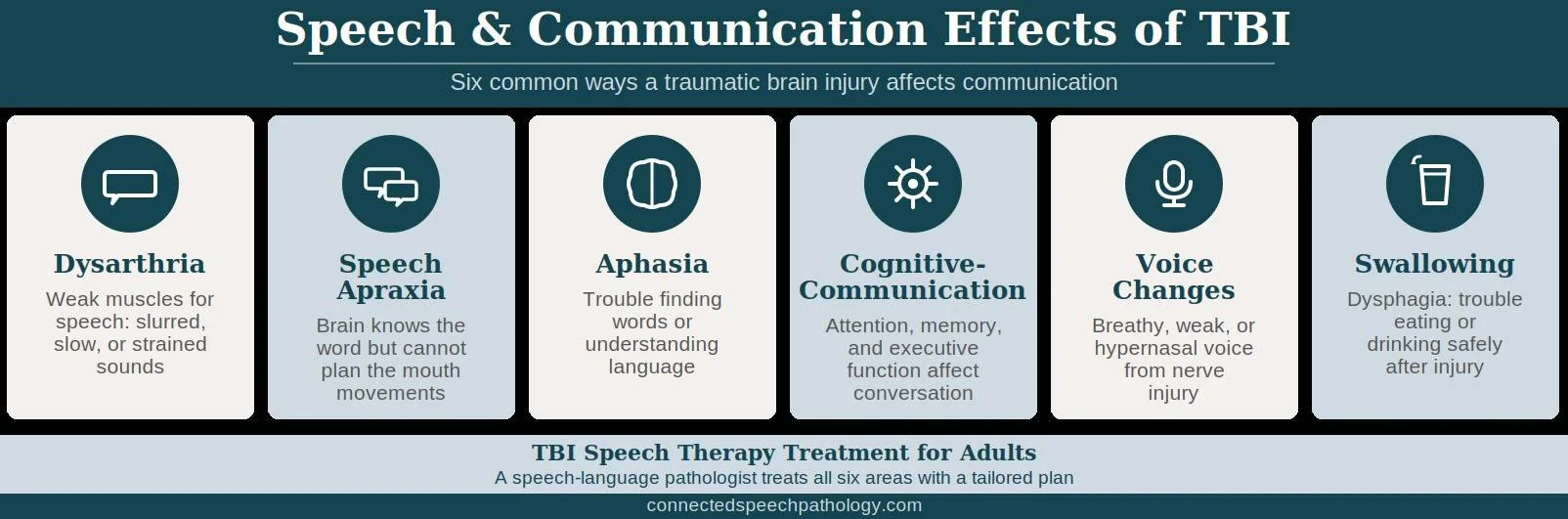
A traumatic brain injury can affect speech, language, thinking, voice, and swallowing. Some people also develop neurogenic stuttering after a brain injury, a fluency disorder in adults that a speech-language pathologist can evaluate. When the language changes are the main issue, this can look like expressive language disorder in adults. The pattern depends on which brain areas were injured and the severity of the injury. Many adults experience changes across more than one area of communication.
In most right-handed people, language functions are mainly supported by the left hemisphere. The same pattern appears in about two-thirds of left-handed people. Injury to those language regions can lead to aphasia.
Damage affecting motor planning or motor control areas may lead to apraxia of speech or dysarthria.
Motor Speech Disorders: Dysarthria and Speech Apraxia
Some adults develop speech clarity problems after TBI, including slurred speech, slow speech, or difficulty coordinating movements for speech. Dysarthria occurs when a brain injury affects the motor control needed for speech.
Speech may sound slurred, slow, strained, breathy, or imprecise, depending on which muscles and movement patterns are affected. Treatment may focus on breath support, articulation, vocal quality, speech rate, and other strategies that make speech easier to understand.
Apraxia of speech is a motor planning disorder. The brain has difficulty organizing and sequencing the movements needed for speech, even though the muscles themselves are not impaired.
Speech may sound inconsistent, effortful, or disrupted, with visible groping for sounds. Treatment focuses on rebuilding accurate movement patterns through repeated, structured practice and cueing.
Aphasia and Language Comprehension
TBI can affect language comprehension, word retrieval, reading, and written communication. Some adults lose track of conversations or struggle to organize thoughts into sentences.
Aphasia disrupts language at the level of comprehension, expression, or both. You may understand language but struggle to retrieve the words, or hear words clearly but lose the meaning. Reading and writing are usually affected, too.
Sudden difficulty finding words is one of the most common signs adults notice. The brain knows the word but cannot retrieve it in real time.
Cognitive-Communication Deficits
Cognitive-communication deficits are the most common consequence of TBI in adults. The injury affects attention, memory, executive functioning, problem-solving, and the ability to follow and participate in conversation.
Changes in frontal lobe function can also impact emotional regulation, impulse control, and social judgment. Adults may interrupt more, speak before organizing their thoughts, misread social cues, or have difficulty adjusting their tone based on the situation.
These difficulties can affect work, relationships, and daily routines, even when speech sounds normal. People may lose the thread in meetings, forget what they were saying mid-sentence, or struggle to organize ideas clearly. Even simple conversations can feel more effortful in the early stages of recovery.
Voice and Resonance Changes
Some adults notice vocal fatigue, reduced volume, strained voice quality, or swallowing difficulty after TBI. These symptoms may appear alongside other communication changes or on their own.
Voice can change after a TBI when the brain’s control of breath support, vocal fold movement, and coordination is disrupted. This may be due to central motor control issues or associated nerve involvement. Changes in loudness, pitch, and vocal quality are common, and the voice may sound weak, strained, or unsteady.
Resonance can also be affected. Some adults develop hypernasality if the soft palate does not close effectively during speech, allowing air to escape through the nose.
Swallowing Difficulties
Swallowing difficulties, called dysphagia, occur in some cases. A speech-language pathologist evaluates safety and develops strategies to reduce the risk of choking.
How Does Speech Therapy Treat TBI?

Speech therapy can support TBI recovery by helping people rebuild communication skills, manage cognitive-communication changes, and use strategies for daily conversations. A speech-language pathologist conducts an evaluation, sets goals tied to daily life, and adjusts the plan as you recover.
The first step is a comprehensive assessment. A speech therapist evaluates speech clarity, language, attention, memory, executive functioning, voice, and swallowing to understand how the brain injury affects daily communication. Those findings guide the treatment plan, which may change over time as recovery progresses.
Adults often make more meaningful progress when treatment connects to real-life communication tasks. Examples can include leading a meeting, ordering at a restaurant, reading work emails, or managing a calendar. Functional goals focus on skills that matter in daily life.
Common Speech Therapy Treatment Techniques for TBI

Speech therapy after TBI uses different techniques depending on the communication problems involved. Most adults do not use just one approach. A speech-language pathologist combines strategies based on the person’s goals, symptoms, and daily communication demands.
Restorative Exercises
Restorative exercises target skills the brain is struggling to perform after injury. Sessions may include word-retrieval practice, speech-sequencing tasks, attention drills, memory exercises, or breath-support work for voice and speech clarity.
Speech therapy usually progresses from structured practice into more functional communication. A person may start with guided exercises and then apply the same skills in conversation, work tasks, or community activities.
Compensatory Strategies
Compensatory strategies help adults communicate more effectively while recovery continues. These tools do not replace recovery work. They support communication in daily life when attention, memory, processing speed, or organization remain difficult.
Strategies may include written reminders, note-taking systems, calendar apps, pacing techniques, conversation scripts, or environmental changes that reduce distraction. A speech-language pathologist adjusts these supports based on the person’s routines and goals.
A 2023 update to the INCOG guidelines for cognitive rehabilitation after TBI recommends combining two approaches. Direct retraining is paired with compensatory strategies for the strongest functional gains. Treatment using both outperforms either alone.
Functional Communication Practice
Functional practice focuses on communication tasks that the person actually uses outside speech therapy. Exercises may involve reading work emails, organizing a presentation, rehearsing phone calls, summarizing information, or managing conversations in noisy settings.
A 2024 review in the Journal of Speech, Language, and Hearing Research found that functional communication tasks often lead to better carryover than isolated drills alone. Adults with TBI generally benefit more when speech therapy connects directly to daily communication demands.
External Supports and Communication Tools
Some adults benefit from communication supports during recovery. These tools may help when language, memory, or speech clarity problems make conversation difficult.
Supports can include written cueing systems, visual supports, low-tech communication boards, or speech-generating devices. Some adults use these tools temporarily, while others continue using them long term.
How to Improve Articulation After a Brain Injury
Check out our blog about improving articulation after a brain injury for more information!
What to Expect During TBI Recovery
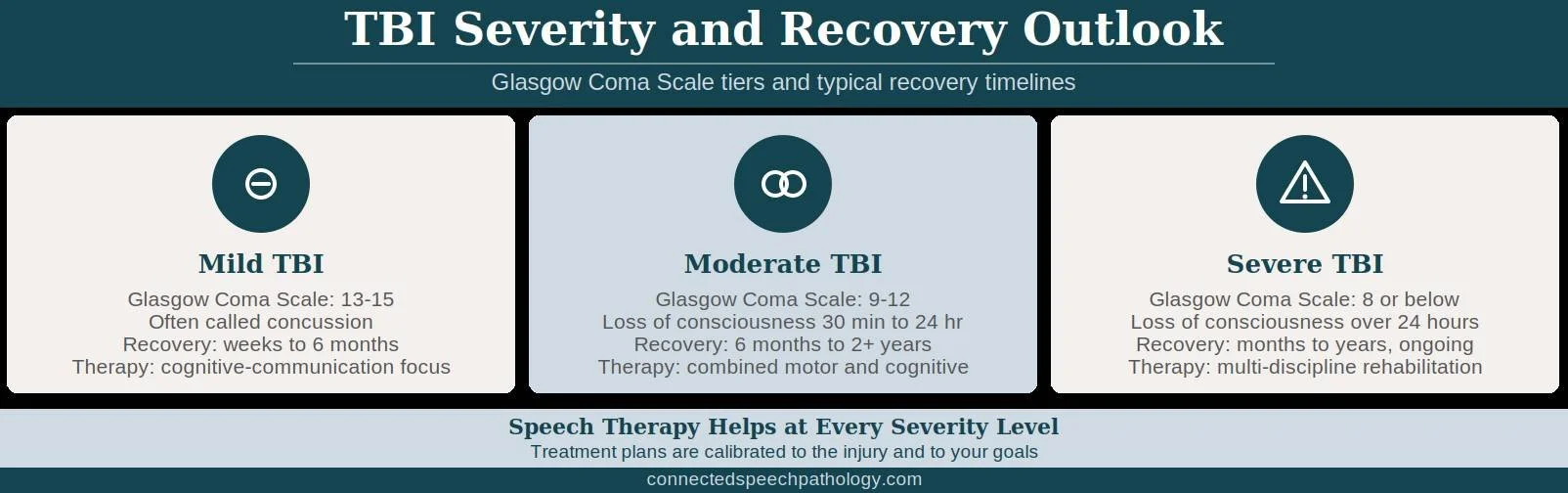
Recovery from a traumatic brain injury follows a phased pattern, and your treatment changes at each phase. How long speech therapy takes depends on the severity of the injury and the consistency of treatment. The CDC estimates 2.5 million TBI-related emergency department visits, hospitalizations, and deaths in the United States each year.
Falls are the leading cause of death for adults over 65, and motor vehicle accidents are the leading cause of death for adults 15 to 44.
Severity is measured with the Glasgow Coma Scale. Mild TBI scores 13 to 15, moderate scores 9 to 12, and severe scores 8 or below. The scale predicts the general trajectory but not the day-to-day progress.
The First Six Months of Brain Injury Recovery
The first six months bring the fastest changes. Plasticity is highest in this window, and most adults see meaningful gains in speech clarity, word retrieval, and attention. Sessions tend to be more frequent during this phase.
Setting short-term goals tied to immediate function works best here. Reading one work email start to finish or holding a five-minute family conversation are real milestones.
Six to Twenty-Four Months
Progress continues past six months but slows. Cognitive-communication skills often improve well into the second year, especially when treatment stays consistent. Compensatory strategies begin to do more of the work in this phase.
Adults returning to work usually reach this stage. Treatment shifts toward higher-level tasks like meetings, presentations, and managing competing demands.
Beyond Two Years
Recovery can continue beyond two years, especially for cognitive-communication skills.
A 2022 review in Brain Injury found measurable gains three to five years post-injury in moderate-to-severe cases. The brain keeps adapting.
Treatment at this phase tends to be less frequent and more strategic. Adults work on specific goals rather than broad rebuilding.
Returning to Work and Daily Life
Most adults with TBI focus their recovery on getting back to work, school, or family responsibilities. A speech-language pathologist builds those goals directly into the plan. Tasks such as leading meetings, reading dense reports, and managing a calendar serve as practice material.
Pacing matters more than effort. Pushing too hard, too fast often triggers symptom flare-ups that set recovery back. Your speech therapist will help calibrate the workload, so progress builds steadily.
Working With Your Medical Team and Family

TBI speech therapy treatment often happens alongside care from a broader medical team. A speech-language pathologist evaluates communication changes after brain injury and coordinates with other providers when needed to support recovery.
Most adults work with several professionals at once. The combination may include:
A neurologist or physiatrist managing the medical side of recovery
A speech-language pathologist treating speech, language, voice, swallowing, and cognitive-communication
An occupational therapist supporting daily living and executive functioning skills
A physical therapist working on mobility, balance, and strength
A psychologist or counselor supporting emotional adjustment
Family members are often part of the recovery process too. They may notice communication changes the person does not recognize, help practice strategies between sessions, and provide context about daily challenges. Resources from the Brain Injury Association of America can help families understand what recovery may look like.
What We See Working with Clients

A mid-career professional came to us six months after a motor vehicle accident left him with a mild TBI. His speech was clear, but he kept losing his train of thought in client meetings. He also missed details in long emails.
Twelve weeks of cognitive-communication therapy paired with executive function strategies turned things around. He returned to leading presentations and managing his full client load.
Another client was an adult woman eighteen months post a fall and a moderate TBI. At intake, she gave two- and three-word responses at family dinners. Frustration was visible in every interaction.
Sessions focused on sentence formulation, conversational pacing, and word retrieval. Six months in, she was holding full conversations again and planning a return to part-time work.
Frequently Asked Questions About TBI Speech Therapy

1. How soon should TBI speech therapy treatment start?
Speech therapy should begin as soon as a physician clears you medically. Early intervention takes advantage of the brain's highest period of plasticity. Starting in the first weeks after a TBI is associated with stronger long-term outcomes.
2. How long does speech therapy take after a TBI?
Most adults need six months to two years of consistent speech therapy after a moderate TBI. Mild TBI often resolves within three to six months of cognitive-communication work. Severe cases require longer treatment with regular adjustments.
3. Can speech therapy help with cognitive-communication problems after TBI?
Yes, cognitive-communication therapy is the main treatment for adults with TBI. Speech therapists target attention, memory, executive functioning, and conversation skills. Most adults spend more time on cognitive-communication than on speech sounds.
4. Does TBI speech therapy work for mild traumatic brain injury?
Yes, mild TBI often produces communication problems that respond well to speech therapy. Many adults with mild TBI struggle with word retrieval, attention, and organizing thoughts, even when speech sounds fine. Targeted treatment shortens recovery and reduces long-term symptoms.
5. Can adults fully recover speech after a TBI?
Many adults make a full recovery, especially after mild TBI with consistent treatment. Moderate and severe cases typically see major gains over one to three years. Outcomes depend on injury severity, treatment consistency, and overall health.
How Connected Speech Pathology Can Help

Connected Speech Pathology provides online speech therapy for adults recovering from a traumatic brain injury. We work alongside your medical team to deliver structured care from the comfort of your home. Treatment covers cognitive-communication, language, swallowing, articulation, and voice.
Our speech therapy for stroke and neurological conditions is built specifically for adults recovering from TBI, stroke, and related injuries. Sessions are private, flexible, and built around your work and family schedule.
Your speech therapist begins with a thorough evaluation and develops a plan tailored to your daily life. Treatment uses functional goals, compensatory strategies, and direct retraining together.
Summary
TBI speech therapy treatment helps adults rebuild speech clarity, language, cognitive-communication, voice, and swallowing skills after a traumatic brain injury. A speech-language pathologist focuses on the changes that matter most to your daily life. The plan adjusts as recovery progresses.
Recovery is steady when treatment starts early and stays consistent. Adults working with the right speech-language pathologist alongside their medical team can return to work, family conversations, and the life they had before the injury.

About the Author
Allison Geller, M.A., CCC-SLP, is a communication coach, speech-language pathologist, and founder of Connected Speech Pathology, an international online practice providing professional communication coaching and speech therapy for children, teens, and adults. With more than two decades of experience, she has worked in medical and educational settings and published research on aphasia. Today, she leads a team of specialists who help clients improve their skills in public speaking, vocal presence, accent clarity, articulation, language, fluency, and interpersonal communication.