Overcoming Post-Concussion Syndrome Speech Problems

Post-concussion syndrome speech problems are communication changes that continue after a concussion. Most often, they affect memory, word-finding, and organizing thoughts, not the muscles used for speech. Many adults notice them long after leaving the emergency room, even once headaches and dizziness fade.
These changes fall under cognitive communication difficulties, and they can make work, conversation, and daily tasks feel harder. If your thinking or talking feels different since a head injury, you are not imagining it, and you are not alone. Early assessment and speech therapy can rebuild communication skills, thinking skills, and confidence.
The sections below explain why these problems happen, how a speech therapist assesses them, and what helps you recover.
Key Takeaways
Cognitive over motor: Most of these speech problems affect thinking skills like memory and word-finding, not the muscles that produce speech.
Symptoms can linger: Communication difficulties can last weeks, months, or longer after a concussion or mild traumatic brain injury.
Assessment guides care: A speech-language pathologist checks speech, language, memory, and attention to build a targeted treatment plan.
Speech therapy helps: Structured practice and cognitive rehabilitation rebuild communication skills and confidence for daily life.
What Are Post-Concussion Syndrome Speech Problems After a Brain Injury
Common Communication Difficulties After a Head Injury
Post-Concussion Syndrome and Persistent Post-Concussion Symptoms
Assessment Tools for Communication Problems After a Concussion
How Speech Therapy Treats Post-Concussion Syndrome Speech Problems
What We See Working with Clients
Frequently Asked Questions About Post-Concussion Syndrome Speech Problems
What Are Post-Concussion Syndrome Speech Problems After a Brain Injury
Post-concussion syndrome speech problems are communication difficulties that continue after a concussion or brain injury. They often last longer than a few weeks. Most involve cognitive communication difficulties, which means trouble with memory, attention, word-finding, and organizing thoughts rather than with how speech sounds.
That distinction is why these problems get missed. Speech sounds normal, so the effort behind it stays invisible, and many people say conversation now drains them in a way it never used to. Family members sometimes notice the difficulty before the person does.
These difficulties fall under the category of cognitive-communicative disorders. They cause the most trouble at work, where communication is heavily relied on for meetings, calls, and emails. They affect relationships too, once someone starts declining invitations to avoid the strain.
How a Concussion Affects the Brain and Communication
A concussion changes how the brain processes information and controls thinking skills. The frontal lobes manage executive functions like attention, planning, and holding a thought while you use it. A mild traumatic brain injury disrupts that work, and the resulting neurological symptoms show up in conversation long before anyone connects them to the injury.
Speaking is a complex process. Memory, attention, cognitive abilities, and language all run at once, and executive functions keep them coordinated while a conversation is still moving. The frontal lobes help the brain plan and process speech in real time, so when that system is strained, the whole exchange takes more effort. Post-concussion syndrome disrupts both the cognitive and physical processes required for communication.
The result differs from person to person. Some people speak clearly but cannot follow what was just said to them, and others find that slower information processing makes a fast exchange feel like too much at once. That difference is what shapes the treatment plan, and it is why an assessment tells you more than a general list of symptoms.
Common Communication Difficulties After a Head Injury
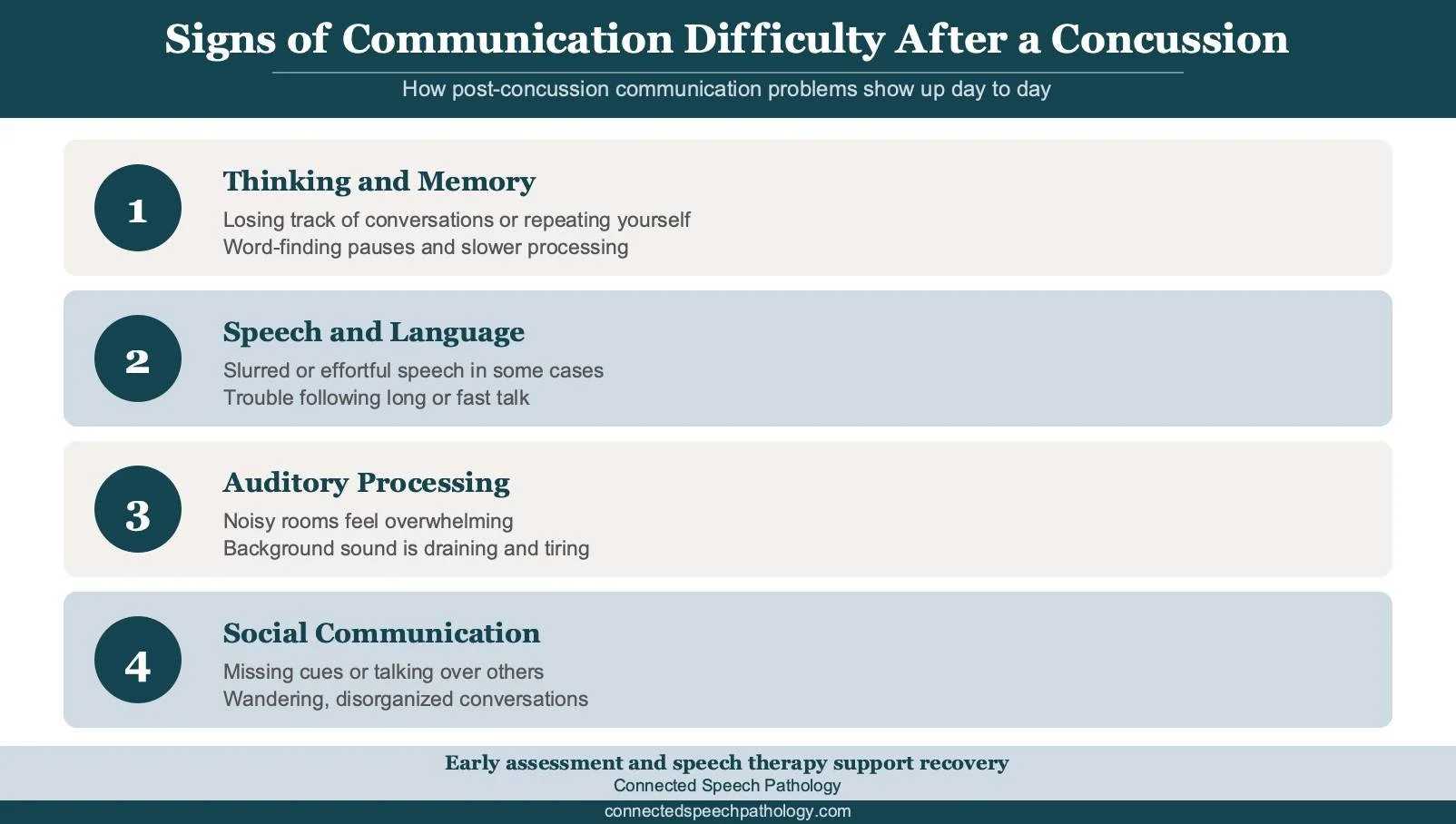
These difficulties rarely show up alone. Most people have a mix, and the mix is what makes the problem hard to describe to a doctor. One person struggles most with attention, another cannot find the right words, and a third notices their speech itself has changed.
The changes can be subtle early in recovery. A quiet one-on-one talk goes fine, and then a meeting or a noisy restaurant is too much. That gap between easy settings and hard ones is often the first real clue.
Cognitive Communication Difficulties
Cognitive communication difficulties affect the thinking skills that support speech and language. These cognitive skills include attention, memory, processing speed, and problem-solving. Deficits in these areas interfere with speaking, understanding language, and written language.
Attention is a common problem. Sustained attention is hard to hold, so people lose track of conversations or repeat something they already said, and planning what to say takes effort that used to be automatic. Symptoms fluctuate with mental fatigue as the day goes on, and cognitive fatigue during a long social interaction causes focus and coherence to break down. A conversation that felt easy in the morning is hard by evening.
Auditory processing overload makes it hard to follow conversations in noisy environments, which is why background sound feels draining after a head injury. Written language takes more effort too, so emails and reports often take longer than before, and reading and spelling can feel harder.
At work, this often looks like re-reading the same email several times, or leaving a long meeting unsure what was decided. At home, it can mean losing a step in a recipe or asking for the same instruction twice. These cognitive deficits are common after a head injury, and naming the specific moments gives a therapist far more to work with than "my memory is bad."
Speech, Language, and Auditory Processing Problems
Some communication problems after a concussion involve speech, language, and auditory processing more directly. Slurred speech can point to a motor speech change like dysarthria. In dysarthria, the muscles used for speech production are affected, so it becomes harder to speak fluently.
Dysarthria is less common than cognitive communication difficulty, and it is more likely in severe cases. It still deserves assessment, because the right approach differs. Language comprehension can change too, so understanding language during long or fast speech gets harder.
Word-finding trouble is one of the most common of these difficulties. The word is familiar, and the person knows what they mean, but it will not come when they need it. Names and specific nouns tend to go first. In conversation, it sounds like a pause mid-sentence, a substitution such as "that thing," or a longer sentence that works around the missing word. Some people lose the thread of what they were saying while they search.
Language skills that once ran automatically now need attention, because the brain is working harder to process language after an injury.
Social Communication Problems
Social communication relies on timing, tone, and reading other people's cues. A concussion can disrupt all of them. After a head injury, some people miss visual cues, talk over others, or struggle in group conversations.
Disorganized discourse can make it hard to keep thoughts linear. A story wanders, or the point gets lost, and fatigue makes those moments worse.
Many people start avoiding conversations to reduce the strain, and over time, that affects relationships. These communication issues respond well to support. Most people rebuild their comfort in group settings with practice and a few adjustments to how and where conversations happen.
Post-Concussion Syndrome and Persistent Post-Concussion Symptoms

Post-concussion syndrome refers to symptoms related to a concussion that last beyond the expected recovery window. Common symptoms include headaches and dizziness, but memory problems, difficulty concentrating, and trouble understanding language are just as frequent and far more likely to be missed.
Most people recover within a few weeks, and the usual recovery process is gradual. When symptoms continue past that point, they are called persistent post-concussion symptoms. These cases benefit from a comprehensive approach.
Why Symptoms Continue During Recovery
Symptoms continue when the brain struggles to keep up with the demands of thinking and communicating at once. Stress, fatigue, and difficulty concentrating often make them worse. Returning to full activity too quickly can slow concussion recovery.
Research on TBI rehabilitation has found that roughly 73% of inpatients have cognitive communication difficulties. That figure shows how closely brain injury and communication are linked. Recognizing the pattern matters, because pacing and support can ease the load while the brain heals.
Certain triggers tend to flare symptoms, including poor sleep, long screen time, and skipped breaks. Short, planned rest before the next demand does more than pushing through, and steady daily routines make the fluctuation easier to predict.
Assessment Tools for Communication Problems After a Concussion

Assessment tools identify the specific communication deficits behind post-concussion syndrome speech problems. A clear picture keeps care focused rather than generic. Speech-language pathologists evaluate speech, language comprehension, memory, cognitive abilities, and auditory processing.
Early assessment separates communication problems from other concussion symptoms, and it gives a clear starting point for the recovery process. A speech therapist also reviews the patient's history and the tasks you find hard.
Standardized assessment often draws on two main tools. One is a set of questionnaires you fill out, known as patient-reported outcome measures. The other is discourse analysis, where the therapist looks at how you organize and deliver connected speech.
The therapist also watches you handle real tasks, like following multi-step directions or making a short phone call. Feedback comes in clear, plain language. Your progress is tracked over time, and the plan changes as you improve.
How Speech Therapy Treats Post-Concussion Syndrome Speech Problems

Speech therapy for post-concussion syndrome speech problems rebuilds communication skills and the thinking skills behind them. Goals stay tied to daily life. Speech therapy targets the cognitive communication difficulties that make conversation, work, and reading harder.
Progress depends on consistent, meaningful practice, not drills with no link to real situations. The table below shows how common challenges tend to look day to day, and how speech therapy addresses each one.
| Communication challenge | What it looks like day to day | How speech therapy helps |
|---|---|---|
| Word-finding difficulty | Pausing to search for a word, or leaning on vague fillers | Word-retrieval practice and strategies to keep speech flowing |
| Memory and attention | Losing track of conversations or repeating yourself | Memory and attention exercises tied to real tasks |
| Slurred or effortful speech | Speech sounds less clear, especially when tired | Clear-speech practice for the muscles used to talk |
| Auditory overload | Struggling to follow talk in noisy rooms | Listening strategies and changes to the environment |
| Disorganized thoughts | Stories wander, or the main point gets lost | Practice organizing ideas before speaking or writing |
| Connected Speech Pathology | connectedspeechpathology.com | ||
Most patients make meaningful gains with steady speech therapy, especially when it starts early. Research on TBI rehabilitation supports speech-language pathologist involvement for most patients. Goals are set with you, so the work matches the parts of daily life that feel hardest.
Speech Therapy for Cognitive Communication Difficulties
Speech therapy treats the communication problems caused by brain injury. It works on the underlying skills and the real tasks that depend on them. A speech therapist supports word finding, speech production, and social communication, and sessions center on real tasks like planning a call or writing an email.
Speech-language therapy includes strategies for attention, memory, and cognitive communication that carry over into work and home. Even when speech sounds normal, speech therapy improves word retrieval and verbal memory that quiet symptoms tend to hide.
Common techniques include word-finding drills, memory strategies, and scripts for high-pressure moments like phone calls. A speech therapist also teaches clear-speech methods when slurred speech is present. Each skill is practiced first in session, then carried into real situations.

Benefits of Cognitive Speech Therapy
Check out our blog covering the benefits of cognitive speech therapy for adults.
Cognitive Rehabilitation and Compensatory Strategies
Cognitive rehabilitation rebuilds thinking skills step by step. It uses cognitive therapy and structured practice to strengthen memory, attention, and executive functions over time. Small gains in one area often support another.
Compensatory strategies add practical ways to work around ongoing difficulty. Cognitive therapy pairs them with tools that fit real routines, like phone reminders and written checklists. Over time, it also protects everyday cognitive function on hard days.
Strategies for pacing and cognitive rest can help manage communication fatigue, so demanding conversations happen when focus is strongest. Environmental modifications, like reducing background noise, ease auditory processing strain in everyday settings. These changes rebuild independence gradually.
Skills practiced in sessions are built to transfer into daily routines. Simple language exercises and memory drills can be repeated at home between visits. The goal is steady progress, not perfect performance in one session.
A Multidisciplinary Approach to Concussion Recovery
A multidisciplinary approach recognizes that a concussion affects many systems at once. Recovery often involves more than one type of care. Speech-language support frequently works alongside occupational therapy and physical therapy.
Occupational therapy helps with daily tasks and return-to-work planning, while physical therapy addresses balance and headaches. Speech-language pathology connects these efforts to the thinking and communication side of recovery.
Multidisciplinary care improves recovery from communication deficits after a concussion. Several healthcare providers often share the plan, and resources from the Brain Injury Association recommend this coordinated model. Bringing providers together helps a person manage overlapping symptoms and eases the sense of recovering alone.
What We See Working with Clients

In our practice, post-concussion recovery rarely looks like a straight line, and small, steady wins tend to matter more than fast ones. The examples below are real clients of ours. Identifying details have been changed to protect privacy.
One adult came to us months after a mild brain injury from a fall. Her speech sounded fine, yet she kept losing her train of thought in meetings and dreaded group calls at work.
We focused on word-retrieval practice, pacing strategies, and short rehearsals before high-stakes conversations. Over several weeks, she began finishing her points in meetings. She started keeping a small notebook to anchor longer discussions.
She still tires by late afternoon. We planned her hardest tasks for the morning to work with that pattern rather than against it. Her manager noticed the difference within a month and stopped scheduling around her, which she counted as a real win.
Another client noticed slurred speech and word-finding trouble after a sports concussion. Assessment showed both a mild motor speech change and cognitive communication difficulty, so his plan addressed both.
His sessions combined clear-speech drills with memory and attention strategies tied to his job as a teacher. He practiced organizing a lesson out loud before class. A simple checklist helped him keep instructions in order.
His speech grew steadier, and he told us the biggest change was feeling confident enough to lead a classroom again. By the end, he was volunteering to run staff meetings, something he had quietly avoided for months.
Frequently Asked Questions About Post-Concussion Syndrome Speech Problems

1. Can a concussion cause speech problems months later?
Yes. Post-concussion syndrome can bring on speech and communication problems months after the injury. These usually involve cognitive deficits like memory and word-finding rather than the speech muscles, and they respond well to speech therapy.
2. How long do post-concussion syndrome speech problems last?
Recovery ranges from a few days to several months, and sometimes longer. It depends on the severity of the injury and the care received. Many patients improve steadily with structured speech therapy.
3. Can a concussion cause slurred speech?
Sometimes. Slurred speech after a concussion can signal a motor speech change like dysarthria, where the muscles behind speech production are affected. It is less common than cognitive communication difficulty and deserves an assessment because the right approach may differ.
4. Can a concussion cause aphasia or word-finding trouble?
A concussion can cause aphasia, which affects word retrieval. Many people notice trouble finding the right words even after a mild injury, and speech therapy for aphasia can rebuild those skills. A speech therapist can assess the pattern and target it directly.
5. Who treats communication problems after a concussion?
Speech-language pathologists treat communication problems related to concussion and brain injury. They assess speech, language, memory, and communication skills, and they often work alongside other healthcare providers as part of a team.
6. Is speech therapy helpful if speech sounds normal?
Yes. Speech therapy helps even when speech sounds normal, but thinking feels harder. Cognitive communication skills often need support, and care focuses on the daily communication tasks that feel effortful.
How Connected Speech Pathology Can Help

At Connected Speech Pathology, we provide online speech therapy for adults with post-concussion syndrome speech problems. Care is delivered through secure telehealth, so you can work on recovery from home. Our speech-language pathologists focus on your communication, cognitive skills, and language skills, plus the daily goals that matter to you.
We begin with an assessment using evidence-based tools. Then we build a treatment plan and a comprehensive approach around the specific communication problems your brain injury has caused. Our care centers on real-world tasks, so the strategies you practice show up in your work, conversations, and relationships.
Communication coaching and speech therapy from our team support recovery after a concussion, and care adapts as your symptoms change. Sessions are scheduled around your energy levels, and we adjust pacing as recovery moves forward.
Summary
Post-concussion syndrome speech problems affect communication, thinking, and confidence after a concussion, and they are more common than many people realize. Because they usually involve cognitive communication difficulties rather than obvious changes to speech, a mild traumatic brain injury can leave effects that are easy to miss. Early assessment from a speech-language pathologist identifies what is actually breaking down, and speech therapy targets it directly.
Cognitive rehabilitation strategies rebuild thinking skills step by step. Many patients make meaningful gains and return to the conversations that matter to them.

About the Author
Allison Geller, M.A., CCC-SLP, is a communication coach, speech-language pathologist, and founder of Connected Speech Pathology, an international online practice providing professional communication coaching and speech therapy for children, teens, and adults. With more than two decades of experience, she has worked in medical and educational settings and published research on aphasia. Today, she leads a team of specialists who help clients improve their skills in public speaking, vocal presence, accent clarity, articulation, language, fluency, and interpersonal communication.