ADHD and Public Speaking: Transform Challenges into Strengths
ADHD can make public speaking more challenging because it affects how you organize your thoughts, stay focused, and control your pace. Here is what to know about public speaking with ADHD: why it can feel harder, which strategies make presentations clearer, how a communication coach or speech-language pathologist can help, and how to use ADHD traits to your advantage. If you are an adult with ADHD who freezes before a presentation, races through your points, or loses your train of thought, you are not alone.
Improving your public speaking skills can help you communicate more confidently at work, in meetings, and during presentations. ADHD can also bring strengths such as creativity, enthusiasm, and original thinking that become assets when paired with effective speaking strategies.
Key Takeaways
ADHD can make public speaking harder because it affects focus, thought organization, impulse control, and speech rate. Those differences can make it more difficult to organize and deliver your message, especially in high-pressure speaking situations.
A simple structure helps most. A linear outline, cue cards, and small preparation chunks take the load off your working memory.
Slowing down, pausing often, and deep breathing can help manage racing thoughts and keep your speaking pace steady during a presentation. Pacing is one of the changes that can make the biggest difference for your audience.
ADHD traits like creativity, energy, and hyperfocus can make presentations more engaging and memorable. The goal is to build speaking strategies that work with those strengths.
A speech-language pathologist serving as a communication coach can provide personalized strategies to improve verbal clarity and focus. Focused, one-on-one support helps you practice until those strategies feel natural.
How Does ADHD Affect Public Speaking?
Strategies to Improve Public Speaking Skills with ADHD
Turning ADHD Traits into Speaking Strengths
How a Communication Coach or Speech-Language Pathologist Can Help
What We See Working with Clients
How Does ADHD Affect Public Speaking?

ADHD affects public speaking through the brain's executive function: the mental system you use to plan, organize, and prioritize what you want to say. That same organizing challenge can make speech ramble, so our guide on how to stop rambling and communicate more effectively offers practical fixes. When executive function works differently, holding a clear train of thought in front of an audience can become more challenging.
Attention-deficit/hyperactivity disorder (ADHD) is a neurodevelopmental disorder that can affect attention, speech, and energy levels, all of which influence how a person communicates during presentations. ADHD can also affect expressive and receptive language skills, making it harder to organize ideas, stay on topic, process questions, or respond in the moment.
Several common challenges show up when people with attention deficit hyperactivity disorder speak in public:
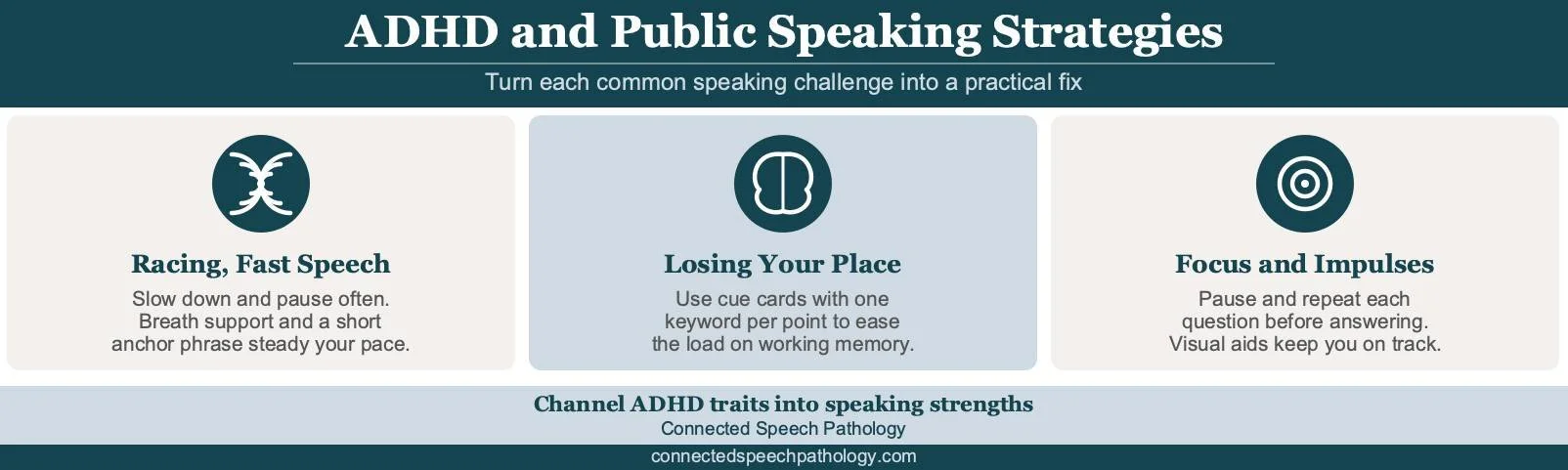
Racing thoughts and fast speech. Many people with ADHD find that racing thoughts make them speak more quickly, especially during presentations. A faster speaking pace can make it harder for your audience to follow your message.
Losing your place. Working memory helps you hold on to your next point while you deliver your current one. During a presentation, that mental "holding space" can become overloaded, making it easier to lose your train of thought. Many people with ADHD also struggle with word recall during speech, which can make it harder to find the right word or continue their train of thought.
Staying on topic. ADHD can lead to difficulty staying on one idea, and a short attention span makes it easy to wander into a side story.
Impulse control. Impulsive behaviors can mean jumping in, adding filler words, or answering before you have fully heard a question.
Anxiety. High anxiety can interfere with delivery, and that stress makes every other challenge feel larger.
These ADHD-related speech problems can affect verbal communication skills and can lead to speech processing difficulties as well. With the right strategies, you can give clear, impactful, and memorable presentations.

ADHD and Communication Difficulties
Check out our blog on ADHD and communication difficulties for more information!
Strategies to Improve Public Speaking Skills with ADHD
Adults with attention-deficit hyperactivity disorder can manage common public speaking challenges by implementing a handful of practical strategies. The same skills carry over to meetings and everyday exchanges, which we cover in our guide to ADHD communication at work. The same is true for listening, and building ADHD listening skills helps you follow the room as well as command it. The goal is to rely on simple systems for structure and pacing, so your working memory has less to manage, and you can focus on delivering your message.
Organizing Your Thoughts and Preparing Your Talk
A clear structure makes public speaking easier for people with ADHD. Writing down every idea first and organizing your thoughts afterward helps turn racing thoughts into a clear, logical presentation.
Map it, then line it up. Mind mapping lets you see your ideas visually before you arrange them into a linear narrative structure that keeps the talk organized.
Break it into chunks. Organizing a speech into clear parts manages cognitive load, so you feel less easily distracted, and no single stretch feels overwhelming.
Use cues, not a script. Utilize bullet points and cue cards instead of a full script to jog your memory. Visual cues and mnemonic devices keep you on track without locking you into a word-for-word read.
Pacing and Vocal Delivery
Intentionally slowing down is the single change that most improves audience comprehension. When you race, your listeners cannot keep up.
Pause on purpose. Pausing frequently gives your audience time to process and gives you a beat to find the right words.
Anchor your sections. A short anchor phrase at the start of each part signals a transition and steadies your pace.
Support your voice with breath. Deep-breathing techniques help you maintain focus and improve verbal clarity, so your words land clearly rather than tumbling out.
Managing Focus, Impulsivity, and the Q&A
Maintaining focus and managing impulses during a presentation can be a struggle, so build in supports for the moments you cannot script.
Keep visible anchors. Visual aids improve focus, keep your presentation on track, and quietly pull your attention back when it drifts.
Handle questions calmly. When someone asks a question, pause and repeat it back before you answer. That habit slows impulsive behaviors and gives you a moment to organize a clear response.
Watch the clock. A visible timer helps if you tend to lose track of time.
Managing ADHD and Public Speaking Anxiety
A few calming techniques reduce anxiety, so nervous energy does not derail your delivery. A brisk walk, deep breathing, and a quick visualization of the talk going well all settle your nerves. Mindfulness can help you feel calmer and respond more deliberately during a presentation.
See it as a conversation. Viewing a speech as a dialogue with the room, rather than a performance, can calm performance nerves.
Practice low and slow. Practicing your speech in advance builds confidence. Rehearse in low-stakes settings, record yourself to spot pacing and clarity to improve, and practice in the actual speaking space when you can.
Turning ADHD Traits into Speaking Strengths

The ADHD traits that make public speaking harder are the same ones that make you a memorable speaker. Leveraging ADHD strengths, rather than fighting them, turns a nerve-wracking talk into an engaging one.
Natural creativity. ADHD speakers often make unexpected connections, which can lead to original content and engaging presentations that hold an audience.
High energy. Channeled well, it reads as passion, and high energy levels lift your delivery when you move with purpose.
Hyperfocus. Embracing hyperfocus helps you concentrate deeply while preparing and stay locked in during the presentation.
Authenticity. A direct, genuine style connects with a room far more than a polished but distant one.
Seen this way, these unique strengths are powerful assets for the stage. The strategies above simply give that energy a clear track.
How a Communication Coach or Speech-Language Pathologist Can Help

Many communication coaches are speech-language pathologists with specialized training in communication. Speech-language pathologists work with the speech, language, voice, and cognitive-communication skills that support clear, effective communication, including thought organization, attention, memory, word retrieval, and verbal expression.
When those skills are applied to professional goals such as presentations, meetings, and leadership communication, rather than to the treatment of a communication disorder, the work is often referred to as communication coaching. The same expertise is used, but the focus is on building practical speaking skills for work and everyday life.
Enhancing Focus and Managing Hyperactivity
Speech-language pathologists help you stay focused and help you manage hyperactivity, using techniques like deep breathing to reduce impulsivity during a presentation. The work is collaborative: your communication coach decides what to practice in session and what to try at home.
Structuring and Organizing Thoughts
Working with a communication coach can improve how you organize your thoughts for public speaking. Communication coaches can help you create outlines and teach mnemonic devices to aid memory. Together, you turn loose ideas into a structure you can follow under pressure.
Improving Vocal Clarity and Delivery
Articulation exercises improve clarity for ADHD speakers, and focused practice refines your delivery and pace. Your communication coach can also help with body language, so your body language, voice, and delivery work together. Many people first improve their public speaking skills through low-pressure practice before facing a real audience.
What We See Working with Clients

At Connected Speech Pathology, we work with many professionals who manage ADHD as they give presentations, lead meetings, and speak in front of groups. The examples below are based on real client experiences from our work at Connected Speech Pathology. Names and details have been changed to protect privacy.
One client, a manager, dreaded quarterly presentations because he knew he would lose his place. He often rushed through his slides, skipped key points without realizing it, and froze when someone asked an unexpected question.
We started by slowing his speaking pace with planned pauses and breath support. He also used cue cards with one keyword per main point rather than full sentences, making it easier to stay on track without reading from a script. For the question-and-answer portion, he practiced pausing, repeating each question, and giving himself a moment to organize his thoughts before responding. Over several sessions, his presentation delivery became more controlled, and he was able to recover more easily if he lost his place.
Another client, a graduate student, felt as though her ideas arrived faster than she could say them. During presentations, she jumped between points, filled pauses with "um" and "like," and often finished without covering everything she wanted to say.
We mapped her ideas, then shaped them into a linear outline she trusted. Recording her practice runs helped her hear her own pacing, and we channeled her energy into purposeful gestures. Her presentations became more organized, and she began to see her creativity as an advantage.
Frequently Asked Questions About ADHD and Public Speaking

1. Can someone with ADHD be a good public speaker?
Yes. Many strong speakers have ADHD and use their creativity and energy to engage a room. With structure and practice, the traits you struggle with can become real strengths.
2. Why do I talk too fast or lose my train of thought when presenting?
ADHD affects working memory and impulse control. Under pressure, your thoughts race ahead, and your next point slips away. Slowing down, pausing, and using cue cards takes the load off your brain and keeps you on track.
3. Does ADHD medication help with public speaking?
Medication helps some people manage focus and impulsivity. Its effects on speaking vary from person to person. Any decision about medication belongs with the prescribing provider who manages your care, not a presentation plan alone.
4. What if I go off-topic or forget my main points during a presentation?
Visual cues and a short outline with bullet points keep you anchored. If you wander, a glance at your cue card and a brief pause lets you find your place and return to your key points.
5. Can a public speaking coach help me with public speaking?
Yes. A public speaking coach who is also a speech-language pathologist can provide personalized strategies for focus, organizing thoughts, and vocal clarity, with targeted support and feedback as you practice.
6. How can I manage public speaking anxiety with ADHD?
Start with deep breathing and visualization to calm nervous energy. Practicing in low-stakes environments can ease public speaking anxiety. Treating the talk as a conversation, not a performance, also helps reduce anxiety before you speak.
How Connected Speech Pathology Can Help

At Connected Speech Pathology, our communication coaches are licensed speech-language pathologists who help adults with ADHD become clearer, calmer speakers. We work online, building public speaking skills around your strengths and the situations you speak in, from meetings to presentations.
Our communication coaches have specialized training in speech, language, voice, and professional communication. They develop personalized strategies aligned with your goals, helping you become a more confident and organized speaker. Ready to feel more prepared the next time you present?
Summary
ADHD and public speaking can be challenging because ADHD affects focus, working memory, organization, and pacing during presentations. At the same time, many people with ADHD bring creativity, energy, and original thinking that can make presentations engaging and memorable.
With clear structure, deliberate pacing, and consistent practice, you can build speaking strategies that work with the way your brain processes information. A speech-language pathologist serving as a communication coach can help you develop those strategies and practice them until they feel natural.

About the Author
Allison Geller, M.A., CCC-SLP, is a communication coach, speech-language pathologist, and founder of Connected Speech Pathology, an international online practice providing professional communication coaching and speech therapy for children, teens, and adults. With more than two decades of experience, she has worked in medical and educational settings and published research on aphasia. Today, she leads a team of specialists who help clients improve their skills in public speaking, vocal presence, accent clarity, articulation, language, fluency, and interpersonal communication.