How to Get Rid of a Raspy Voice and Restore Vocal Clarity

Most cases of a raspy voice stem from a few underlying issues that are often treatable. A raspy voice can derail an important meeting, drain confidence on a client call, or make a long workday feel even longer when the voice fatigues. The right combination of rest, hydration, and targeted voice exercises can reduce discomfort from a raspy voice within days.
Below, we explain what happens in the larynx (voice box) when your voice sounds rough, share home remedies and vocal exercises, discuss when persistent raspiness warrants an ENT visit, and outline how a speech-language pathologist can help.
Key Takeaways
A raspy voice develops when the vocal folds cannot close cleanly or vibrate smoothly. The result is the rough, breathy, or strained quality many people notice when speaking.
Most cases of a raspy voice improve at home within a week. Hydration, voice rest, steam, and avoiding caffeine, alcohol, and smoke can address short-term raspiness after a cough, cold, or heavy voice use.
Targeted vocal exercises can support recovery. Gentle humming, straw phonation exercises, and resonance exercises can help the vocal folds vibrate more efficiently and reduce strain.
Persistent raspiness warrants professional evaluation. See an ENT if symptoms last longer than two weeks, especially if acid reflux, vocal nodules, or another underlying condition may be contributing.
Common Causes of a Hoarse or Raspy Voice
How to Get Rid of a Raspy Voice at Home
Vocal Exercises to Restore Clarity
When to See a Doctor or Voice Specialist
How a Voice Therapist Can Help Restore Vocal Clarity
What We See Working with Clients
Common Causes of a Hoarse or Raspy Voice
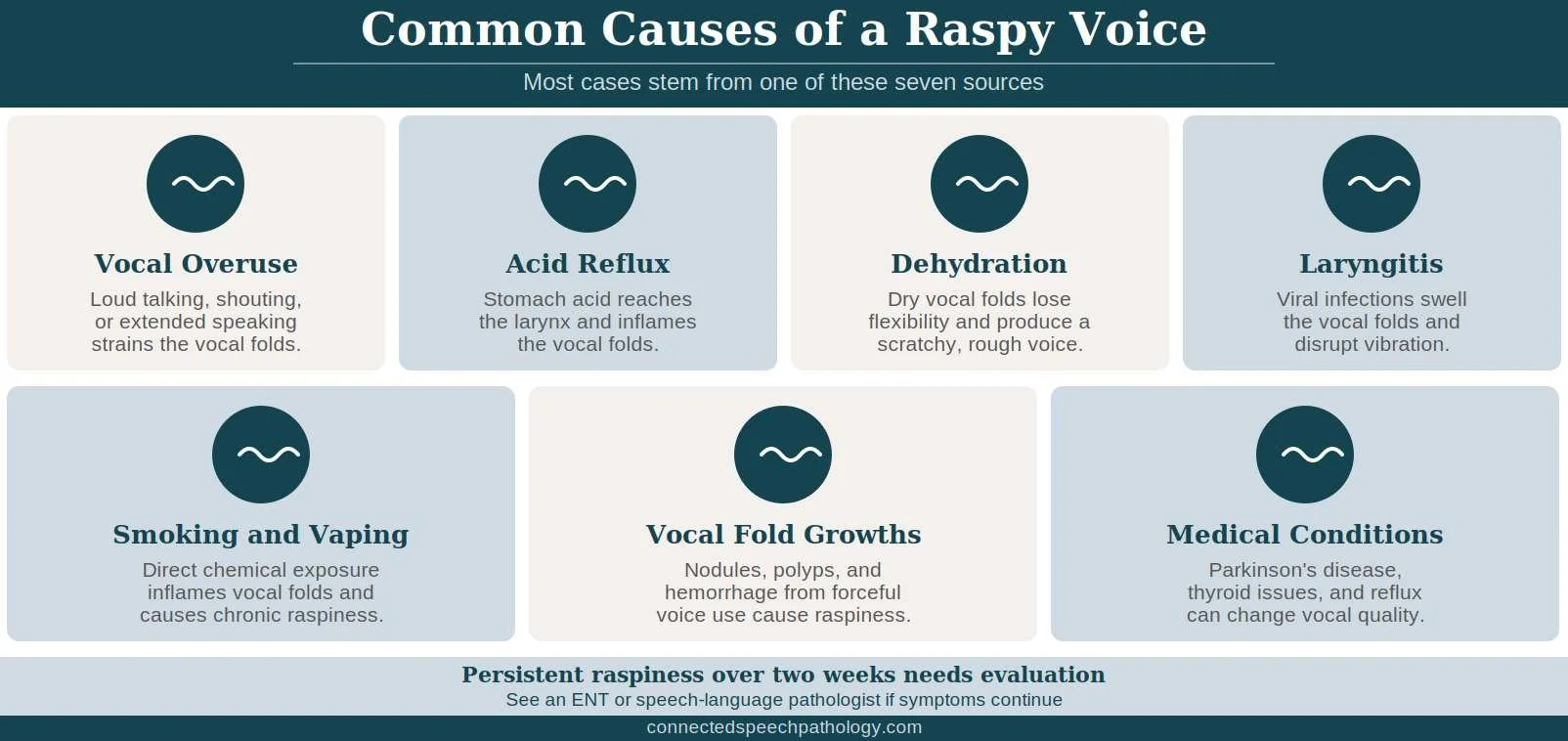
A raspy voice happens when the vocal folds cannot vibrate smoothly.
The vocal folds, often called vocal cords, are two bands of tissue inside the larynx (voice box). As air moves up from the lungs, the vocal cords vibrate to produce sound. When they do not close completely, become irritated or swollen, or work under excessive pressure, the voice can sound rough, breathy, or strained.
Three common voice-production problems can contribute to raspiness and vocal strain:
Incomplete vocal fold closure. When the folds do not close properly, excess air escapes through the gap. The result is a breathy, scratchy voice that may fatigue more quickly.
Excess pressure beneath the vocal folds. Taking in too much air before speaking can increase pressure below the folds and disrupt smooth vibration.
Inflammation or irritation. Acid reflux, mucus, dryness, illness, or heavy voice use can irritate the folds and affect sound quality.
Identifying the underlying cause helps guide the right treatment approach. A raspy voice from a cold often improves with rest and hydration. Raspiness that develops after long days of talking may be linked to muscle tension, inefficient voice use, or incomplete vocal fold closure and can respond to targeted voice exercises.
Below, we cover the most common causes of a raspy voice, as well as less obvious conditions that can contribute to ongoing symptoms.
Vocal Overuse and Muscle Tension Dysphonia
Speaking loudly, shouting, coughing, or throat clearing places pressure on the folds. Habits like vocal fry, a low, creaky speaking pattern, add to the strain over time and can contribute to fatigue, irritation, and potential vocal damage or injury when overused.
Heavy overuse can trigger muscle tension dysphonia, a common voice disorder in which the muscles around the voice box tighten abnormally, producing a strained, raspy quality. Stress plays a role too, since you can lose your voice from stress alone when tension builds in these same muscles. Left unaddressed, the pattern can roll into broader voice problems.

Muscle Tension Dysphonia Recovery Time
Interested in learning more about Muscle Tension Dysphonia? Check out our blog!
Acute Laryngitis and Upper Respiratory Infections
Colds, the flu, and other viral infections cause short-term raspy and hoarse voice symptoms. These illnesses can lead to acute laryngitis, an inflammation of the larynx (voice box) that causes the vocal folds to swell. The swelling disrupts normal vibration, making the voice sound rough, breathy, or weak.
Rasp from viral laryngitis typically clears on its own with rest, hydration, and time.
Dehydration
The vocal folds need moisture to stay flexible. When the body is dehydrated, they can dry out, become less elastic, and irritate more easily. The result is a scratchy, rough voice, especially after long periods of speaking.
Caffeine and alcohol can contribute to dehydration and may irritate the larynx (voice box) in some people. If you drink plenty of water regularly throughout the day, it helps keep the vocal folds lubricated and supports smoother voice production.
Acid Reflux (GERD)
GERD occurs when stomach acid travels up the esophagus and reaches the larynx. Small amounts can inflame the vocal cords and surrounding tissue, leading to chronic raspiness, throat clearing, and morning hoarseness.
Reflux is a common cause of ongoing voice problems. Voice symptoms often continue until the acid exposure is reduced and the irritated tissue has time to heal.
Injuries and Growths on the Vocal Folds
Repeated strain on the vocal cords can lead to vocal fold lesions, such as vocal nodules or polyps, or hemorrhage, in which a blood vessel ruptures from forceful voice use. Nodules and hemorrhage produce distinct symptoms, but both can cause persistent raspiness.
Adults who use their voices heavily for work, including teachers, attorneys, sales professionals, and singers, are at higher risk. Sudden, severe raspiness after yelling or singing should be evaluated quickly to rule out vocal fold hemorrhage.
Allergies and Environmental Factors
Seasonal allergies, sinus infections, and exposure to dry air or pollutants can contribute to mucus buildup and laryngeal irritation. When the vocal cords are coated with excess mucus or swollen from allergies, they may not vibrate cleanly. Spicy foods and reflux triggers can also worsen surface irritation.
Smoking, Vaping, and Secondhand Smoke
Smoking and vaping inflame the vocal cords and may expose them to chemicals that cause long-term damage, leading to chronic hoarseness, raspiness, and increased cancer risk. Secondhand exposure produces the same laryngeal irritation. Quitting is one of the highest-impact changes for vocal health.
Underlying Medical Conditions
Certain neurological diseases, infections, and hormonal imbalances may affect how the vocal folds move and vibrate. Conditions, including Parkinson's disease, thyroid disorders, and lingering upper respiratory infections, can change the voice. Persistent changes, especially those that do not match a recent illness or vocal overuse, warrant a medical evaluation.
How to Get Rid of a Raspy Voice at Home

Mild raspiness clears up at home for most adults within a few days.
Taking care of your voice is mostly a matter of consistent daily habits. The following home remedies cover the steps that make the biggest difference for short-term raspiness.
1. Stay Hydrated
Drink water steadily throughout the day, not just when you feel dry. Aim for about two liters spread out across the day. Warm, non-caffeinated fluids like herbal tea soothe the larynx, and honey can help reduce inflammation.
Avoid ice-cold drinks before speaking, since they may tighten the throat muscles.
2. Rest Your Voice (and Do Not Whisper)
The best way to heal inflamed vocal cords is to be silent. Avoid unnecessary talking, singing, and yelling, especially for the first day or two.
Counterintuitively, whispering puts more strain on vocal cords than soft speech and can worsen inflammation, so use a gentle speaking voice rather than a whisper when you need to talk.
3. Inhale Steam and Use a Humidifier
Steam inhalation and humidifiers help keep the throat moist and thin the mucus coating on the inflamed vocal cords. Run a humidifier overnight in dry rooms, especially in winter.
Spending a few minutes over a bowl of hot water with a towel over your head delivers steam directly to the airway. A hot shower works the same way. A warm saltwater gargle can have a soothing effect on surrounding throat irritation, though it does not reach the vocal cords directly.
4. Cut Caffeine, Alcohol, and Smoke
Caffeine and alcohol dehydrate the body and dry out the laryngeal tissues. Smoke and vape vapor, including secondhand exposure, directly inflames the vocal cords. While your voice recovers, cut back on coffee and alcohol, and avoid any tobacco or vaping.
5. Manage Acid Reflux
If you wake up with a raspy voice or notice throat clearing after meals, reflux is a likely contributor. Avoid spicy foods, large meals close to bedtime, and known trigger foods. Elevating the head of the bed and using over-the-counter medication can help, but speak with your provider before starting any new prescription.
6. Fix Your Posture
Poor posture limits the airflow that drives clean vocal cord vibration. Slouching collapses the rib cage and reduces breath support, forcing the vocal cords to compensate with extra muscle tension. Sitting and standing tall, with the head balanced over the shoulders, restores efficient airflow.
Vocal Exercises to Restore Clarity
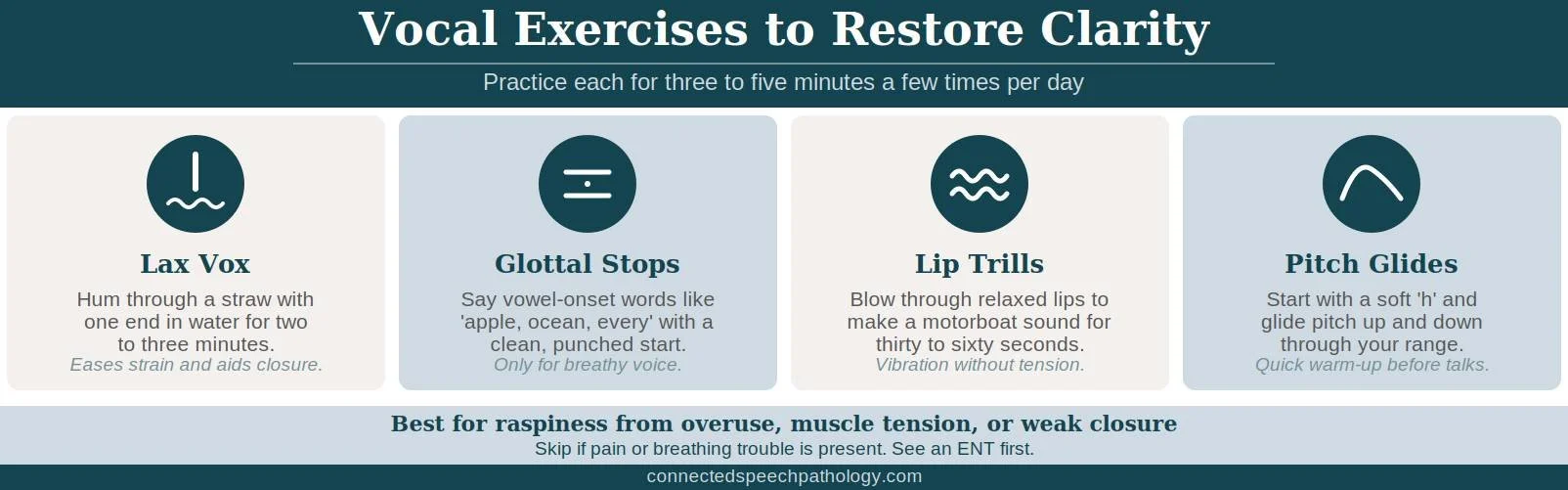
Four targeted exercises help retrain vocal fold closure, reduce strain, and rebuild a clearer voice.
These techniques are used by many speech-language pathologists and voice coaches in voice therapy sessions.
Lax Vox (Straw Phonation in Water)
The Lax Vox Method involves phonating through a straw with one end submerged in water, creating gentle back pressure that relaxes and rehabilitates the vocal folds. It is one of a family of semi-occluded vocal tract exercises (SOVTE), effective for reducing strain and improving closure.
Speaking or humming through a straw creates gentle back pressure that can reduce vocal strain.
To try it, fill a glass about two inches deep with water and place a drinking straw vertically with one end under the surface. Take a comfortable breath, then hum gently through the straw so the water bubbles steadily for two to three minutes.
Glottal Stops for Closure
Practicing glottal stops, a complete closure of the vocal folds followed by an audible release of air, helps strengthen closure and improve voice quality.
This exercise is not appropriate for every cause of raspiness. Speech-language pathologists typically use it when a breathy voice is linked to incomplete vocal fold closure. It is generally avoided when inflammation, vocal fold injury, or significant muscle tension is contributing to symptoms because stronger vocal fold contact may increase irritation.
To practice, say a series of vowel-initial words, such as "apple," "ocean," "every," and "after." Begin each word with a gentle, clean onset rather than a breathy lead-in. The goal is efficient vocal fold closure, not forceful voice production.
Lip Trills
Lip trills help the vocal folds vibrate without excess tension. They can also improve breath support and coordination.
Gently blow air through relaxed lips to create a "motorboat" sound. Continue for 30 to 60 seconds at a comfortable pitch.
Gentle Onset and Pitch Glides
Start a relaxed "h" sound, then slide into a soft hum, gliding the pitch up and down through your comfortable range. Pitch glides warm up the vocal folds without the impact of loud speech and are useful before long meetings or presentations.
When to See a Doctor or Voice Specialist

Consult a doctor or specialist if raspiness lasts more than two weeks.
Persistent hoarseness lasting three weeks or more, especially without a recent cold or flu, often signals a deeper medical issue rather than simple overuse. Chronic hoarseness can indicate serious underlying medical conditions, so early consultation can improve your prognosis.
Diagnosis usually begins with a physical examination by an ear, nose, and throat doctor (ENT). The ENT often uses a laryngoscope, a thin, flexible tube with a light and a camera, to view the vocal cords and assess their movement. The procedure, called laryngoscopy, allows a detailed look at the structures involved in voice production.
The laryngologist will also ask about recent illness, vocal use, reflux symptoms, and lifestyle factors like smoking or excessive shouting.
Imaging studies, such as MRI or CT scans, are sometimes ordered to rule out other underlying conditions. A clear diagnosis is essential for identifying the cause and guiding effective care, often a combination of medical management and voice therapy.
How a Voice Therapist Can Help Restore Vocal Clarity

A voice therapist can help you regain vocal clarity and prevent further strain. A voice therapist is typically a speech-language pathologist with specialized training in voice disorders, pairing evaluation with hands-on retraining to address the root cause of the rasp.
Voice therapy begins with a thorough evaluation that includes perceptual assessments, acoustic or aerodynamic analysis, and collaboration with an ENT specialist.
Once the cause is identified, your voice therapist will build a personalized voice therapy plan designed to:
Reduce tension in the throat and laryngeal muscles
Improve breath support and vocal technique
Address habits like frequent throat clearing or poor posture
Promote a healthy voice through better daily habits and vocal hygiene
Build vocal endurance and efficiency, particularly for professional voice users
Sessions typically include guided vocal exercises, education, and home-practice strategies. Whether the rasp is from overuse, an underlying condition, or inefficient vocal habits, voice therapy offers a safe and effective path back to clearer, more comfortable speech.
What We See Working with Clients

Most adults who come to us for help with a raspy voice fall into one of two patterns.
One client was a senior manager who spent most of the day on Zoom. By 4 p.m., her voice sounded rough, and she found herself repeating things because people couldn't hear her clearly. She was speaking for hours with few breaks, drinking coffee throughout the day, and relying on throat clearing when her voice felt tired.
We helped her build short voice breaks into her schedule, improve hydration, and use gentle vocal warm-ups before long meetings. Within a few weeks, her voice felt stronger at the end of the day, and the raspiness became much less noticeable.
Another client was a business owner who regularly gave presentations and networking talks. He assumed his raspy voice was simply part of getting older. During sessions, we found that he was pushing for volume and carrying excess tension in his throat whenever he spoke to a group.
We focused on breath support, efficient voice production, and reducing the strain he used to project his voice. As speaking became easier, the rough quality in his voice began to fade.
Many adults with a raspy voice are not dealing with a serious vocal fold injury. More often, a combination of heavy voice use, dehydration, inefficient speaking habits, or mild irritation is keeping the voice from working efficiently. Once those factors are identified and addressed, the voice often becomes clearer and more comfortable.
Frequently Asked Questions About a Raspy Voice

1. Why is my voice raspy?
A raspy voice usually comes from strain, dehydration, acid reflux, allergies, or smoking. Overusing your voice by speaking too loudly or for long stretches is the most common trigger in otherwise healthy adults.
2. How do I get rid of a raspy voice fast?
Rest your voice, hydrate, inhale steam, and avoid caffeine, alcohol, and smoke. If you do not improve within two weeks, see an ENT.
3. Does whispering help a raspy voice?
No. Whispering places greater strain on the vocal cords than normal speech and can worsen inflammation by forcing the vocal folds into an awkward, tense position. If you need to talk while your voice recovers, use a soft, easy speaking voice rather than a whisper.
4. How long can a hoarse or raspy voice last?
Mild rasp from overuse clears in a few days. Hoarse voice symptoms from a cold or laryngitis usually resolve within one to two weeks. Hoarseness lasting more than two weeks should be evaluated by a doctor, especially when it occurs without a recent cold or flu.
5. Can dehydration cause a raspy voice?
Yes. Vocal cords need moisture to vibrate smoothly. When the body is dehydrated, it becomes less flexible and more easily irritated, producing a rough, scratchy, hoarse voice, especially after long periods of speaking.
6. Should I see a doctor for a raspy voice?
See a doctor if your raspy voice lasts more than two weeks. Get evaluated sooner if it started suddenly after yelling or singing, or if you have pain, difficulty breathing or swallowing, coughing up blood, or a neck lump. An ENT can rule out nodules, hemorrhage, polyps, or other conditions, and a speech-language pathologist can guide recovery once the cause is known.
How Connected Speech Pathology Can Help

At Connected Speech Pathology, we hold ourselves to the highest standards in voice care. Our therapists are licensed speech-language pathologists who completed in-person training in voice clinics, working alongside otolaryngologists (ENTs) before moving into remote practice.
Because some causes of raspiness are medical, we coordinate with an ENT when one is needed and do not present voice therapy as a replacement for medical evaluation.
Each therapist brings years of experience in voice therapy and vocal coaching. Many team members are also singing voice specialists, so we can integrate functional, artistic, and therapeutic techniques into a single plan.
We take a whole-person view that goes beyond the vocal folds to understand each client's full background, including work demands, lifestyle, and stressors that affect vocal quality.
After your visit with an ENT and you obtain a referral for voice therapy, our process begins with a free consultation. After that, we complete a comprehensive evaluation, including detailed vocal analysis and a personalized care plan.
Sessions are delivered remotely through secure, one-on-one video. During each session, clients get real-time feedback, guided exercises, and clear strategies to rebuild vocal strength, reduce strain, and regain clarity.
If you are a teacher, speaker, singer, or someone who wants your voice to feel better, our specialized therapists are here to help.
Summary
How to get rid of a raspy voice depends on what is driving the rasp. In most adults, it traces back to vocal overuse, dehydration, acid reflux, or recent illness, and improves quickly with rest, hydration, and targeted vocal exercises.
Persistent raspiness lasting more than two weeks, especially when it occurs alongside muscle tension dysphonia or after forceful voice use, warrants a closer look by an ENT and a speech-language pathologist. With the right home recovery and professional guidance, clear, comfortable speech is well within reach.

About the Author
Allison Geller, M.A., CCC-SLP, is a communication coach, speech-language pathologist, and founder of Connected Speech Pathology, an international online practice providing professional communication coaching and speech therapy for children, teens, and adults. With more than two decades of experience, she has worked in medical and educational settings and published research on aphasia. Today, she leads a team of specialists who help clients improve their skills in public speaking, vocal presence, accent clarity, articulation, language, fluency, and interpersonal communication.