How to Make Your New Voice Sound Natural in Everyday Conversation

If your voice sounds the way you want during practice but not in everyday conversations, you have reached one of the hardest stages of voice training. Many people can produce a new voice in structured practice but struggle to carry it into real-world situations.
Making a new voice sound natural means using it consistently during spontaneous conversations. Here is what affects that process: why trained techniques do not carry over on their own, how to progress from structured practice to spontaneous conversation, practical strategies for carryover, and how conversation-based training helps build lasting habits.
If you are a person reshaping your voice, this guide can help you close the gap between a voice that works during practice and one that feels like your own in everyday life.
Key Takeaways
The goal of voice training is to use your new voice in everyday conversations without conscious effort, rather than thinking about pitch, tone, or resonance.
Voice techniques do not carry over into conversation on their own. As your attention shifts to the conversation itself, your voice can slip back into old patterns.
Carryover develops in stages. Practice typically progresses from structured exercises to reading aloud, low-stakes conversations, phone calls, and higher-pressure speaking situations.
Anchor phrases, self-recording, and supportive conversation partners help reinforce new voice patterns. Brief resets can also help when your voice drifts during a conversation.
Conversation training builds lasting carryover because it gives you repeated practice using your new voice in spontaneous, unscripted situations.
What Does It Mean to Make a New Voice Sound Natural?
Why Doesn't Voice Training Automatically Transfer to Real Conversation?
The Voice Generalization Ladder: From Practice to Real Conversation
Practical Strategies for Voice Carryover
Conversation Training Therapy: Practicing in Real, Unscripted Talk
Voice Carryover in Gender-Affirming Voice Training
What We See Working With Clients
What Does It Mean to Make a New Voice Sound Natural?

When you use your natural voice, you simply focus on the conversation because your trained voice has become your default way of speaking. Conscious effort to maintain different elements of the voice is not needed. Speech-language pathologists call this stage generalization, or carryover, when a skill learned in practice transfers to spontaneous, everyday communication.
Everyone's voice has physical characteristics that influence how it sounds. Factors such as your anatomy, age, hormones, overall health, and any underlying voice condition affect your vocal range and quality.
Voice carryover is not about forcing your voice beyond those limits. It is about using your healthiest, most sustainable voice consistently in everyday communication.
Generalization is hard work. Learning to use a new voice in everyday conversations takes mental focus, physical coordination, and repetition, and it can leave you feeling frustrated, vulnerable, or mentally tired. Progress is rarely linear, so it is okay to move at a pace that feels manageable.

Techniques and Tips on How to Improve Your Speaking Voice
Find some tips on how to improve your speaking voice in this blog.
Why Doesn't Voice Training Automatically Transfer to Real Conversation?

A new voice does not transfer to real conversation on its own, because talking competes for your attention. During practice, your whole focus is on how you sound. In conversation, your mind shifts to what you are saying, who you are talking to, and what comes next.
Picture a work call that starts fine. You open with your target voice, then someone asks a hard question, and your attention jumps to the answer. Within a sentence or two, the pitch drifts back to your old habit.
Nothing went wrong with your technique. Your attention shifted to the conversation, and the old pattern took over.
Researchers who study skill learning describe this pattern well. The conditions that improve performance during a practice session are not the same conditions that improve long-term retention and transfer, as Maas and colleagues (2008) describe in their review of motor learning in speech. Practicing in only one setting builds a voice that works reliably only in that setting.
There is also a reason it feels so effortful at first. Logan (1988) proposed that a skill becomes automatic as you build up many consistent repetitions, until the brain retrieves the pattern instead of assembling it step by step. Until you have enough reps, the new voice needs conscious control, and conscious control is what conversation takes away.
The Voice Generalization Ladder: From Practice to Real Conversation
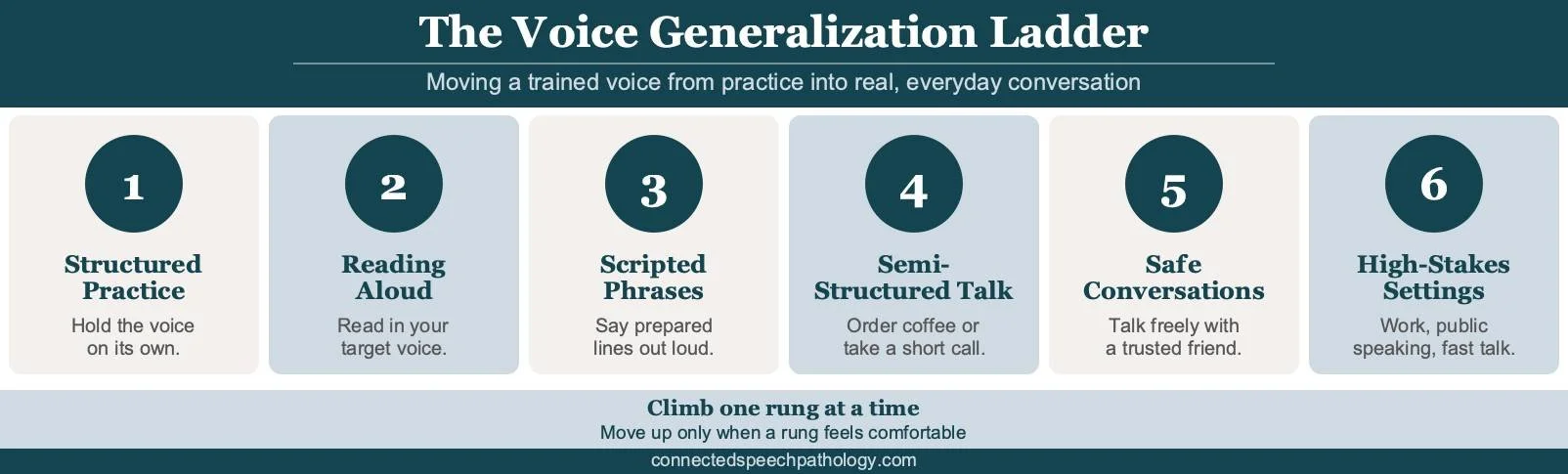
Carryover works best as a ladder, not a leap. You start where the new voice is easy to hold, then add difficulty one rung at a time. Each rung adds a little more of what real conversation demands: attention, speed, emotion, and other people.
Structured practice. Hold the voice in isolation, the way you do with your coach or in solo practice. Everything else builds on it.
Reading aloud. Read a paragraph in your new voice. The words are handled for you, so your attention stays on the sound.
Scripted phrases. Say prepared lines out loud, such as a coffee order or a voicemail greeting, so the voice meets short real content.
Semi-structured talk. Order coffee, make a quick appointment, or take a short call. The exchange is real but predictable.
Spontaneous conversation with safe people. Talk freely with a trusted friend or family member who knows what you are working on.
High-stakes settings. Use the voice at work, in public speaking, and in fast or emotional situations where the old habit is strongest.
Move up only when a rung feels comfortable. Practicing in low-pressure settings first builds the confidence to carry the voice into harder ones. If a rung trips you up, drop back one and get more reps there.
Short, frequent practice beats long, occasional sessions. A few short practice periods each day provide the consistent repetitions that help your new voice become your everyday speaking voice. It also spreads the voice across different moods and settings, which is exactly the variety that helps it generalize.
Practical Strategies for Voice Carryover

There are many ways to strengthen voice carryover. The best strategies depend on your goals, your voice, and the situations where you want your new voice to feel natural. Work with your speech-language pathologist or vocal coach to find the approaches that fit you best.
The techniques below are some of the many tools voice therapists use to support carryover, and not every strategy will be useful for every person. Lasting change comes from building awareness, practicing consistently, and making each technique your own.
Use an Anchor Phrase and Brief Voice Check-Ins
An anchor phrase is a short line you can say in your new voice without thinking, such as a greeting or your own name. Start a call or conversation with it, then let the conversation take over. Throughout the day, take brief voice check-ins by pausing to relax, noticing where your voice sits, and resetting if it has drifted.
Record Yourself and Listen in Real Situations
Recording yourself helps you hear what others hear and identify opportunities for improvement. If you are open to it, record a real conversation, such as a short phone call or a chat with a friend, rather than another practice session. Listen carefully for the moments when your voice stayed consistent and the situations where it drifted.
If listening to recordings of your own voice feels uncomfortable, keep recordings short, make them optional, and focus on one skill at a time.
Practice With Safe People First
A trusted friend, family member, or colleague can be a helpful practice partner for spontaneous speaking. Let them know what you are working on so you do not have to hide it. Real conversations with someone supportive often provide the bridge between structured practice and everyday communication.
When Your Voice Slips or Drops Mid-Conversation
A slip is not a failure, and you do not need to restart the conversation. Finish your thought, use a natural pause, and reset the voice on your next sentence with your anchor. Treating a drop as a normal blip keeps you relaxed, and a relaxed body holds the voice better than a tense one.
Talking Fast, Tired, or Under Stress
Speed, fatigue, and stress are three of the most common situations that make a new voice harder to maintain. When you speak quickly, your pitch, resonance, and articulation can become less consistent. As fatigue sets in, the throat muscles and other muscles that support your voice can tire more quickly.
Once everyday conversations feel comfortable, gradually practice in more demanding situations so speed and stress become part of your training instead of catching you by surprise. Brief vocal warmups and steady breath control can help reduce strain and make your voice easier to maintain.
Stop Over-Monitoring: Focus Outward
Paying close attention to every aspect of your voice can make carryover harder. Maas and colleagues (2008) found that focusing on the listener and your message supports more automatic speech than focusing on the mechanics of your voice. Your voice is more likely to sound natural when your attention is on communicating your ideas.
Your emotional state also influences how easily you can maintain a new voice during conversation. Talk about something you genuinely care about, and let the message become your primary focus.
Focusing on your message, your listener, and your body language often makes your communication feel more natural than monitoring every detail of your voice.
Conversation Training Therapy: Practicing in Real, Unscripted Talk

Conversation training therapy (CTT) uses your trained voice in real, unscripted conversations from the start. It skips the long hierarchy of drills and trains the voice where you need it most. That solves the carryover problem directly, because you build the voice under the exact conditions where it tends to fail.
Speech-language pathologists and voice coaches use this approach deliberately. In a session, that can look like open-ended talk, storytelling, role-play of a hard phone call, or discussing a topic you care about while maintaining your new voice. The work targets natural give and take, including conversational turn-taking, so the voice survives interruptions and quick exchanges.
The method has clinical roots. Gartner-Schmidt and colleagues (2016) formalized conversation training therapy as a clinical voice method, designed to shift voice work toward spontaneous speech rather than leaving carryover to chance at the end of a program. You can practice the same principle by talking from a few bullet points instead of a full script.
A simple home version works well. Pick a topic you know, imagine a friend just asked you about it, and talk about it out loud in your new voice for two minutes. Then make a short recording, listen back once, and pick one thing to adjust rather than everything at once.
The goal is to practice using your voice with real, unplanned speech so the sound and the conversation begin to work together. Daily practice helps your new voice feel less deliberate and more natural.
Voice Carryover in Gender-Affirming Voice Training

Gender-affirming voice training follows the same principles of carryover as any other type of voice change. The goal is a voice that feels like your everyday speaking voice, not one you have to consciously perform.
Because your voice often carries deep personal meaning, carryover can be emotionally challenging. If listening to recordings of your own voice feels difficult, keep recordings short and optional.
Many people find that the discomfort eases as their voice becomes more familiar. If voice dysphoria is part of your experience, that can also influence how comfortable practice feels from day to day.
Voice Feminization
Voice feminization often combines changes in pitch, forward resonance, and intonation. The challenge is keeping those patterns together during spontaneous conversation rather than only during structured practice. Practicing the full voice in real conversations, rather than isolated sounds or exercises, helps those changes become a natural speaking pattern.
People working toward an androgynous voice often follow the same carryover process. The goal is not to hit one perfect sound but to develop a voice that feels authentic and consistent across different situations.
Voice Masculinization
Voice masculinization often focuses on a lower pitch and fuller resonance without adding unnecessary vocal strain. If you are taking testosterone, your voice may continue changing for many months, so your practice should adapt as your voice changes instead of trying to maintain one fixed sound.
Regardless of your voice goals, carryover comes from using your trained voice consistently until it becomes your default speaking pattern. If you take medication that affects your voice, talk with your prescribing provider about any questions or concerns.
What We See Working With Clients

Our practice works with adults who are reshaping their voice for work, performance, gender-affirming reasons, and everyday confidence. Every person's experience with voice carryover is different, so we adjust our approach to fit the individual rather than expecting everyone to follow the same path.
The following are experiences of clients of Connected Speech Pathology. Names and details have been changed to protect privacy.
Voice carryover takes awareness, practice, and patience. Together, we help clients identify the strategies that fit their goals, communication needs, and everyday situations.
We talk about how the voice sounds more natural when the focus is on conveying ideas rather than performance. Some people respond well to anchor phrases, while others benefit more from conversation training, self-recording, or practicing with trusted communication partners. As confidence grows, we gradually step back so clients rely less on our guidance and more on their own skills.
One client had a reliable, trained voice during sessions but lost it on work calls. Together, we developed an anchor phrase for the start of each call, then progressed from voicemail greetings to internal meetings and client conversations. We also reviewed recordings together and created a simple reset cue for moments when the voice drifted.
Over time, the client maintained the new voice through most routine calls, although fatigue still made carryover more difficult.
Another client sounded natural while reading aloud but slipped back into old speaking patterns during casual conversations. We shifted the focus to unscripted conversation training, practiced open-ended discussions, and gradually introduced the new voice with a few trusted friends. On days when fatigue was higher, we shortened practice sessions and adjusted expectations rather than pushing through.
The new voice gradually carried into everyday social situations, while higher-pressure conversations continued to improve with practice.
Frequently Asked Questions About Voice

1. Why does my new voice sound fake or forced?
Early on, a new voice takes conscious control, so it feels forced. It sounds more natural as repeated practice makes it more automatic, and you focus on your message. Some people also notice an overly nasal tone or an overly dark tone early in training before they find a more balanced voice.
2. How long until a new voice feels natural and automatic?
Most people need consistent daily practice over several weeks to months. The timeline depends on how often you practice in real conversation, not just in drills.
3. Why does my voice drop when I am tired or stressed?
Fatigue and stress reduce the fine muscle control your voice relies on. Slow your pace, ease throat tension, and keep practice short on hard days.
4. How do I keep my new voice during public speaking or high-stakes moments?
Use your anchor phrase to settle into your new voice before you start. Then focus outward on your audience and message, and reach these settings last, after easier rungs feel solid.
5. Do I need a speech therapist or communication coach for carryover?
Not always, but a professional can speed carryover with structured practice and feedback. A communication coach or speech therapist helps most when the voice holds in practice but not in real life.
6. Can pushing a new voice strain or damage it?
Forcing pitch or resonance can cause strain and fatigue over time. If talking hurts or your voice tires quickly, ease off and read about practicing your new vocal pitch safely.
How Connected Speech Pathology Can Help

Carryover is the stage where many people get stuck on their own, and guided practice pays off. At Connected Speech Pathology, a voice therapist works with you in real, unscripted conversation, so your new voice is built under the conditions where you use it. We tailor each plan to your voice, your goals, and the settings that matter most.
Our sessions use conversation training, recorded feedback from real situations, and a step-by-step ladder toward higher-stakes speaking.
We support voice and communication coaching for professionals and public speakers.
We also offer gender-affirming voice work and clinical voice therapy where appropriate, all online at a pace that fits your life.
Summary
Making a new voice sound natural is a matter of carryover, not simply learning new techniques. The goal is for your trained voice to become your habitual voice, even when your attention is on the people and ideas around you rather than on your voice.
Carryover develops through consistent practice in real-world situations. Strategies such as gradual progression, anchor phrases, self-recording, and conversation training can all help, but the most effective approach depends on your goals and the situations where you want your voice to feel natural.
With time, practice, and the right support, your new voice becomes less about conscious effort and more about everyday communication. Rather than feeling like something you perform, it becomes a voice that feels comfortable, authentic, and your own.

About the Author
Allison Geller, M.A., CCC-SLP, is a communication coach, speech-language pathologist, and founder of Connected Speech Pathology, an international online practice providing professional communication coaching and speech therapy for children, teens, and adults. With more than two decades of experience, she has worked in medical and educational settings and published research on aphasia. Today, she leads a team of specialists who help clients improve their skills in public speaking, vocal presence, accent clarity, articulation, language, fluency, and interpersonal communication.