Why Am I Stuttering All of a Sudden? Causes, Warning Signs, and Solutions for Adults

If you're asking, "Why am I stuttering all of a sudden?" you're noticing speech disruptions that appeared unexpectedly after years of speaking fluently. Sudden-onset stuttering in adults differs from developmental stuttering, which typically begins in early childhood. In most cases, a specific underlying cause can be identified.
This guide explains the common causes of sudden stuttering in adults, the warning signs that require prompt medical attention, how healthcare professionals diagnose the underlying issue, and the speech therapy approaches that can help improve fluency.
Understanding the cause matters because some triggers are temporary and relatively harmless, while others, such as a stroke, require immediate medical care. Knowing the difference can help you seek the right treatment without delay.
Key Takeaways
Sudden stuttering in adulthood is called acquired stuttering. It is a disruption in speech timing that appears after years of fluent speech rather than during childhood. Symptoms can include repeated sounds, prolonged sounds, or moments when speech feels stuck.
Several underlying conditions can trigger sudden stuttering. Neurological events, psychological stress, and certain medications are common causes. Stroke is one of the most common neurological causes, while emotional trauma and some prescription medications can also contribute.
Sudden stuttering with other neurological symptoms requires immediate medical attention. Call 911 if stuttering begins alongside weakness, facial drooping, confusion, or other signs of a possible stroke. Early treatment can reduce brain injury and improve outcomes.
Many adults improve with appropriate treatment. A speech-language pathologist can identify speech patterns, help determine the likely cause, and create a plan to improve fluency and reduce speaking effort.
What Causes Sudden Stuttering in Adults?
How Is Sudden Stuttering Diagnosed and Treated?
What We See Working With Clients
What Is Acquired Stuttering?

Sudden stuttering is a speech disorder that appears in adulthood after years of fluent speech. Doctors call this an adult-onset fluency disorder, and it is one of several fluency disorders adults live with. It disrupts the timing and flow of speech, which distinguishes it from developmental stuttering. Speech-language pathologists call it acquired stuttering because it develops later in life rather than during childhood.
Developmental stuttering typically begins between ages two and six, when a child's language skills are developing rapidly. Many children recover as their speech and language systems mature. Acquired stuttering follows a different pattern because speech has already been fluent for years before the disfluencies appear.
Adults with sudden stuttering may repeat sounds or syllables, prolong sounds, or experience blocks where a word will not come out. Some people also notice tension in the face, jaw, or throat when speaking. These changes often feel alarming because they appear unexpectedly.
The key point is that persistent stuttering in an adult who has never stuttered before warrants evaluation. Sudden changes in fluency often have an identifiable cause, and finding that cause is the first step toward effective treatment.
For a broader look at changes in adult fluency, see our guide on what causes stuttering in adults.

Developing a Stutter as an Adult: Causes and What to Do
Read this blog to learn more about developing a stutter as an adult.
What Causes Sudden Stuttering in Adults?
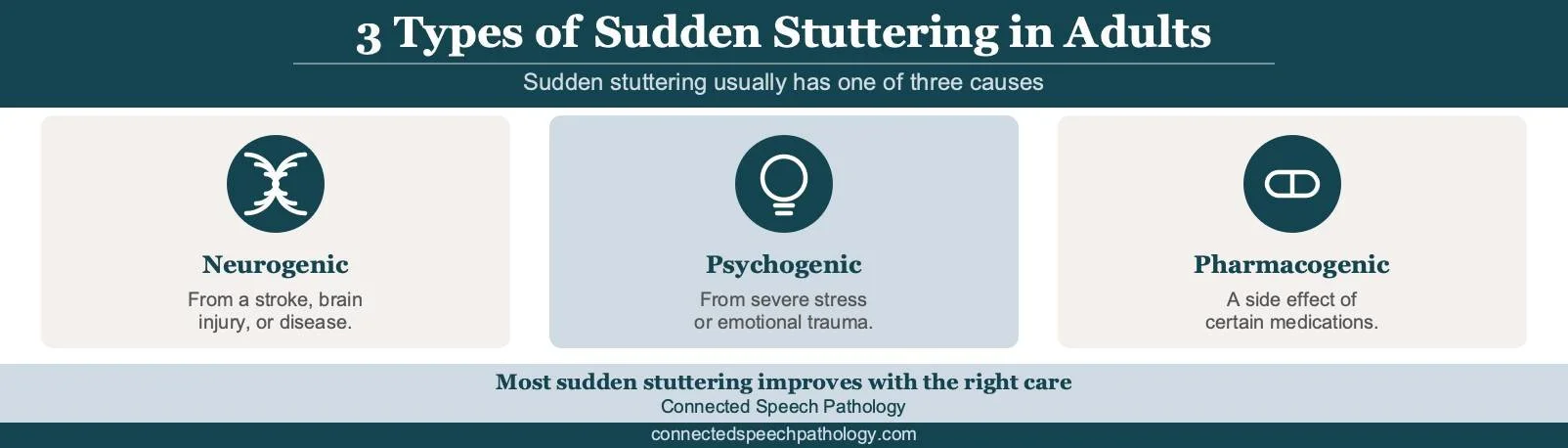
Most sudden stuttering in adults falls into three broad categories: neurogenic stuttering caused by a neurological condition, psychogenic stuttering linked to severe emotional distress, and pharmacogenic stuttering triggered by medication side effects. If stuttering begins suddenly alongside weakness, facial drooping, confusion, or other neurological symptoms, treat it as a medical emergency and call 911.
The underlying cause guides treatment, which is why identifying the source matters. Stress, anxiety, and the return of childhood stuttering can also contribute to sudden changes in fluency.
Neurogenic Stuttering
Neurogenic stuttering occurs when a neurological condition disrupts the brain networks responsible for planning and producing speech. Because the disruption is often sudden, the stuttering can appear with little warning.
Stroke is the most common cause of neurogenic stuttering. Damage to the brain's speech and motor pathways can change how speech signals are coordinated and delivered. Speech therapy for stroke and neurological conditions often focuses on rebuilding communication skills and improving fluency.
A traumatic brain injury can also lead to sudden stuttering. Brain tumors affecting speech-related areas may produce similar symptoms. After a brain injury, speech-language pathologists help people rebuild the communication skills affected by the injury.
Our guide to recovering speech after a brain injury covers that process in more detail.
Neurodegenerative diseases can also affect fluency. Conditions such as Parkinson's disease, multiple sclerosis, and ALS may disrupt the motor control required for smooth speech. Dementia can produce changes in language and fluency as well. Any of these conditions warrants medical evaluation, especially when stuttering is a new symptom.
For Parkinson's disease specifically, speech therapy for Parkinson's disease targets the speech and voice changes that often accompany the condition.
Psychogenic Stuttering
Psychogenic stuttering is associated with significant emotional stress or psychological trauma rather than a structural injury to the nervous system. It can develop after a single traumatic event or during periods of prolonged emotional strain.
Symptoms often fluctuate with a person's emotional state. Stuttering may become more noticeable during periods of distress and lessen during calmer periods. Post-traumatic stress disorder is one situation where this pattern can occur.
Treatment often involves both speech therapy and mental health support. Addressing the emotional factors contributing to stuttering is often part of improving fluency.
Pharmacogenic (Medication-Induced) Stuttering
Some medications can trigger stuttering-like disfluencies as a side effect. This is known as pharmacogenic or medication-induced stuttering.
Medications that affect neurotransmitters in the brain are most commonly involved. Reported examples include certain antipsychotics and selective serotonin reuptake inhibitors (SSRIs). Tricyclic antidepressants can also induce stuttering symptoms, and even the bronchodilator theophylline, used for asthma, has been documented to cause stuttering-like disfluencies.
Medication-induced stuttering often improves when the medication is adjusted under medical supervision. Do not stop a prescription medication without speaking with your healthcare provider. Instead, discuss when the symptoms began and whether they coincide with a medication change.
Stress and Anxiety
Stress and anxiety do not typically create a stutter from scratch, but they can make existing speech disruptions more noticeable. High-pressure situations may increase the frequency or severity of disfluencies.
The connection between anxiety and stuttering runs deep. Research shows that adults who stutter are significantly more likely to experience social anxiety disorder than the general population, with studies reporting rates ranging from about 22% to 60%. Fear of speaking can feed the disfluency, and the disfluency can reinforce the fear. Over time, that cycle may affect confidence, social participation, and mental health.
Can Childhood Stuttering Return in Adulthood?
Sometimes, sudden stuttering is actually the return of developmental stuttering that resolved earlier in life. Adults who stuttered as children may notice symptoms reappear during periods of stress, fatigue, illness, or major life changes.
A family history of stuttering can make this explanation more likely. A speech-language pathologist can help determine whether the stuttering represents a relapse or a new condition and recommend appropriate treatment.
When Should You Call 911?
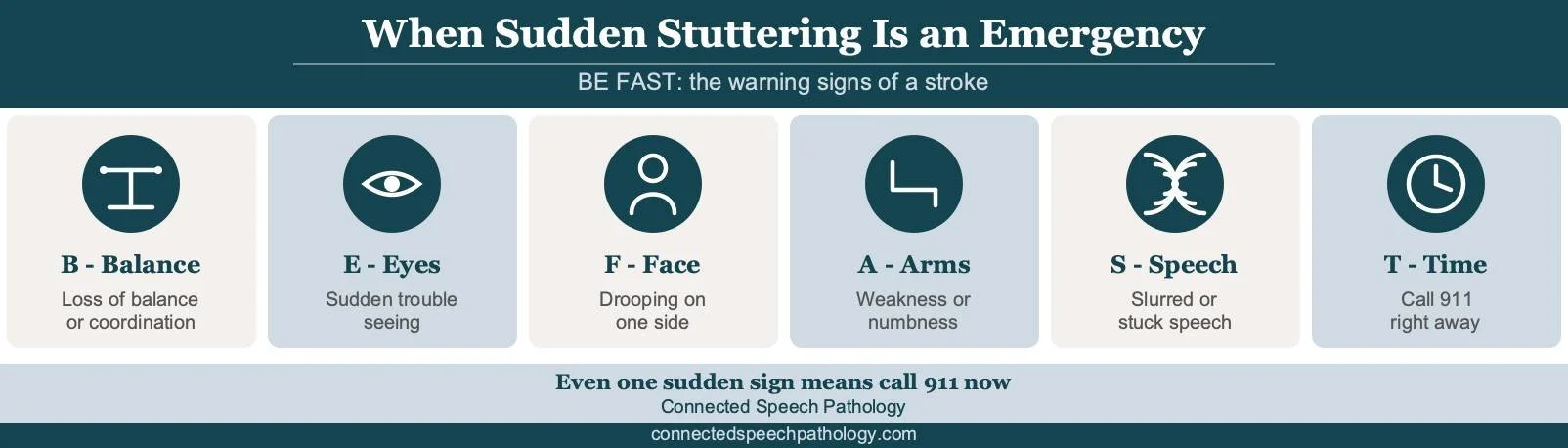
Sudden stuttering becomes an emergency when accompanied by other neurological symptoms, as this combination can signal a stroke. Warning signs that call for emergency care include sudden weakness or confusion, and you should seek immediate medical attention if sudden stuttering occurs with any of them. Sudden-onset stuttering with these signs is the one form that needs urgent care.
Use the BE FAST checklist. Call 911 right away if you notice even one of these coming on suddenly:
Balance: sudden loss of balance or coordination
Eyes: sudden trouble seeing in one or both eyes
Face: drooping or numbness on one side of the face
Arms: weakness or numbness in one arm
Speech: slurred speech, trouble speaking, or trouble understanding others
Time: call 911 immediately and note when symptoms started
Even when sudden stuttering is your only symptom, consulting a healthcare professional is recommended to rule out a serious cause. With stroke, care started within the first hours makes a real difference. When in doubt, get checked.
How Is Sudden Stuttering Diagnosed and Treated?

Diagnosing sudden stuttering means finding the cause, because the cause guides the right plan. Diagnosis can determine whether the stuttering is neurological, psychogenic, or developmental in origin. Care then targets it, usually combining a medical evaluation, a speech and language assessment, speech therapy, and support groups.
Medical Evaluation
A medical evaluation looks for neurological factors or medication-related causes behind the stuttering. Your provider will review your health history and any recent changes, including new prescriptions, illnesses, injuries, or major stressors.
Depending on what they find, they often order a neurological exam and imaging, such as an MRI or CT scan, to check the brain. These tests help confirm or rule out stroke, injury, a tumor, or neurodegenerative diseases that influence stuttering. Stuttering found to have a clear medical cause points to the right course of treatment.
Speech-Language Pathologist Assessment
A speech-language pathologist evaluates how you are stuttering and what makes it better or worse. They look at your speech patterns, the type of speech disfluencies, and your broader speech and language abilities.
The assessment distinguishes neurogenic, psychogenic, and idiopathic stuttering, with the latter having no identifiable cause. The speech pathologist often works alongside your physician and a psychologist when emotional factors are involved.
Speech Therapy and Other Options
Speech therapy is the first-line, most common treatment for stuttering and the cornerstone of care, sometimes alongside language therapy when language skills are affected. A speech therapist teaches practical speech techniques, such as slowing the rate, easy onsets, gentle pauses, and breath support, which can improve speech fluency and reduce speaking tension. Stuttering modification work helps you move through moments of stuttering with less struggle.
Several other options support that core work:
Cognitive behavioral therapy: Cognitive behavioral therapy can help manage anxiety related to stuttering and the emotional and social impact of speaking.
Treating the underlying cause: Resolving a stroke, adjusting a medication, or addressing emotional trauma often does the most to settle the stuttering.
Support groups: These offer emotional support and a sense of connection with other adults who stutter.
Delayed auditory feedback devices: For some adults, delayed auditory feedback can reduce stuttering episodes by changing how you hear your own voice.
For more strategies you can practice, see our guide on how to stop stuttering.
The goal across all of these is to help you manage stuttering and enhance speech fluency with more ease and confidence.
Tips You Can Practice at Home
Managing sudden stuttering between sessions comes down to a few daily habits. None of these replace professional care, but together they make speaking situations feel more manageable.
Use mindfulness and relaxation techniques: Slow breathing and brief mindfulness can reduce stress and improve speech fluency.
Practice with patience: Regular, short practice of your speech techniques builds fluency faster than occasional long sessions, and progress is rarely a straight line.
Build supportive communication: Ask the people close to you to give you time, keep eye contact, and listen without finishing your sentences.
The people around you matter here. When friends and family encourage open communication and respond with patience, the pressure drops, your overall communication skills have room to grow, and it becomes easier to manage stuttering.
What We See Working With Clients

Adults who experience sudden stuttering are often looking for an explanation as much as a solution. In many cases, the first step is to identify the underlying cause and understand what changed. The examples below reflect patterns we commonly see.
One client, a man in his fifties, developed stuttering shortly after a stroke. His speech often became stuck on the first sound of a word, especially when he was tired or speaking quickly. Speech therapy focused on pacing strategies, easier speech initiation, and exercises that improved coordination between breathing and speaking. Over time, conversations became smoother and less effortful.
Another client, a woman in her sixties, developed stuttering shortly after a medication change. The timing raised concerns about a medication-related cause. Her prescribing provider adjusted the medication, while speech therapy focused on reducing speaking tension, slowing the speech rate, and building confidence in everyday conversations. As the medication was adjusted and she practiced the techniques, the disfluencies became far less frequent.
Frequently Asked Questions About Sudden Stuttering

1. Why have I suddenly started stuttering as an adult?
Sudden stuttering in adults usually traces to a neurological, psychological, or medication cause. That can mean a stroke or brain injury, severe stress or emotional trauma, a new prescription, or a relapse of stuttering you had as a child. Because the causes differ so much, it is worth being evaluated rather than guessing.
2. Can sudden stuttering be a sign of a stroke?
Yes. A stroke is one of the most important causes of sudden-onset stuttering and the most common neurological cause. For a full guide, see our article on stuttering after a stroke. If stuttering appears alongside facial drooping, arm weakness, confusion, trouble understanding speech, or other sudden neurological symptoms, call 911 immediately. Prompt treatment can reduce brain injury and improve outcomes.
3. Can stress or anxiety make you suddenly start stuttering?
Stress and anxiety can exacerbate stuttering and make it far more noticeable. They rarely cause a stutter on their own, but high-pressure situations can trigger sudden stuttering in someone who is vulnerable to it. Managing the anxiety alongside the speech tends to work best.
4. Will sudden stuttering go away on its own?
Sometimes. The answer depends on the underlying cause. Medication-induced stuttering may improve after a prescribing provider adjusts the medication, while stuttering related to temporary stress may lessen as the situation improves. Neurogenic stuttering often requires speech therapy, although many people see improvement with appropriate treatment.
5. Can a new medication cause stuttering?
Yes, certain medications can cause stuttering-like symptoms as a side effect. Selective serotonin reuptake inhibitors, tricyclic antidepressants, antipsychotics, and theophylline are documented examples. Talk to your prescribing provider rather than stopping the drug, because the effect is usually reversible when the dose is adjusted.
How Connected Speech Pathology Can Help

Sudden stuttering can feel overwhelming, and the speech-language pathologists at Connected Speech Pathology help adults identify the cause and understand their treatment options. We begin with a thorough assessment of speech, language, and fluency, then create a plan based on the underlying cause and your communication goals.
Our online speech therapy for stuttering uses proven methods, including controlled breathing, speech modification techniques, and gradual practice in real speaking situations. What sets our approach apart is that sessions are tailored to the individual rather than the diagnosis, with strategies applied to the conversations, meetings, and daily interactions that matter most to you.
If your stuttering started suddenly, rule out any emergency first. Then we can help you speak with more ease and confidence.
Summary
Sudden stuttering in adults is an acquired fluency disorder that appears after years of fluent speech. If you're asking, "Why am I stuttering all of a sudden?" the answer is usually linked to a neurological condition, psychological distress, medication side effects, or the return of childhood stuttering. Stroke is the most common neurological cause, so sudden stuttering accompanied by weakness, facial drooping, or confusion should be treated as a medical emergency.
The good news is that many adults improve when the underlying cause is identified and addressed. A speech-language pathologist can determine what changed, recommend appropriate treatment, and help you communicate with greater ease and confidence.

About the Author
Allison Geller is a communication coach, speech-language pathologist, and founder of Connected Speech Pathology, an international online practice providing professional communication coaching and speech therapy for children, teens, and adults. With more than two decades of experience, she has worked in medical and educational settings, published research on aphasia, and leads a team of specialists helping clients improve skills in public speaking, vocal presence, accent clarity, articulation, language, fluency, and interpersonal communication.