How to Stop Stuttering: Expert Advice for Adults, Teens, and Children
One of the most common questions people ask is how to stop stuttering. Stuttering affects roughly 70 million people worldwide, including over 3 million in the United States, across every age group. It disrupts the natural flow of speech through blocks, repetitions, and prolongations, and it shapes how people approach conversations, job interviews, phone calls, and everyday talking.
Stuttering cannot be cured in the traditional sense, but it can be effectively managed. With the right stuttering techniques, consistent practice, and support from a speech-language pathologist, many people who stutter achieve meaningful gains in fluency and confidence. This guide covers what actually works for adults, teens, and children.
Key Takeaways
Stuttering can be managed. Fluency shaping techniques, stuttering modification therapy, and relaxation exercises all have evidence supporting their use. Stuttering cannot be cured, but most people who work with a speech-language pathologist make meaningful progress.
Techniques matter more than willpower. Breathing control, light articulatory contact, slow deliberate speech, pause and phrase, and stuttering modification techniques like pull-outs all target the physical mechanisms that drive stuttering moments.
Anxiety worsens stuttering but does not cause it. Reducing anticipatory tension through mindfulness, gradual exposure to feared situations, and cognitive work is a core part of effective stuttering treatment.
Early treatment produces better outcomes. For children, seek a speech-language pathologist evaluation if stuttering persists beyond a few months, worsens, or is accompanied by tension or avoidance.
How to Manage Stuttering: Techniques for Adults
Tips to Help a Child Who Stutters
How Does Stuttering Happen in the Brain?
Tools and Resources for People Who Stutter
When Should You Contact a Speech-Language Pathologist?
What We See Working with Clients
How to Manage Stuttering: Techniques for Adults
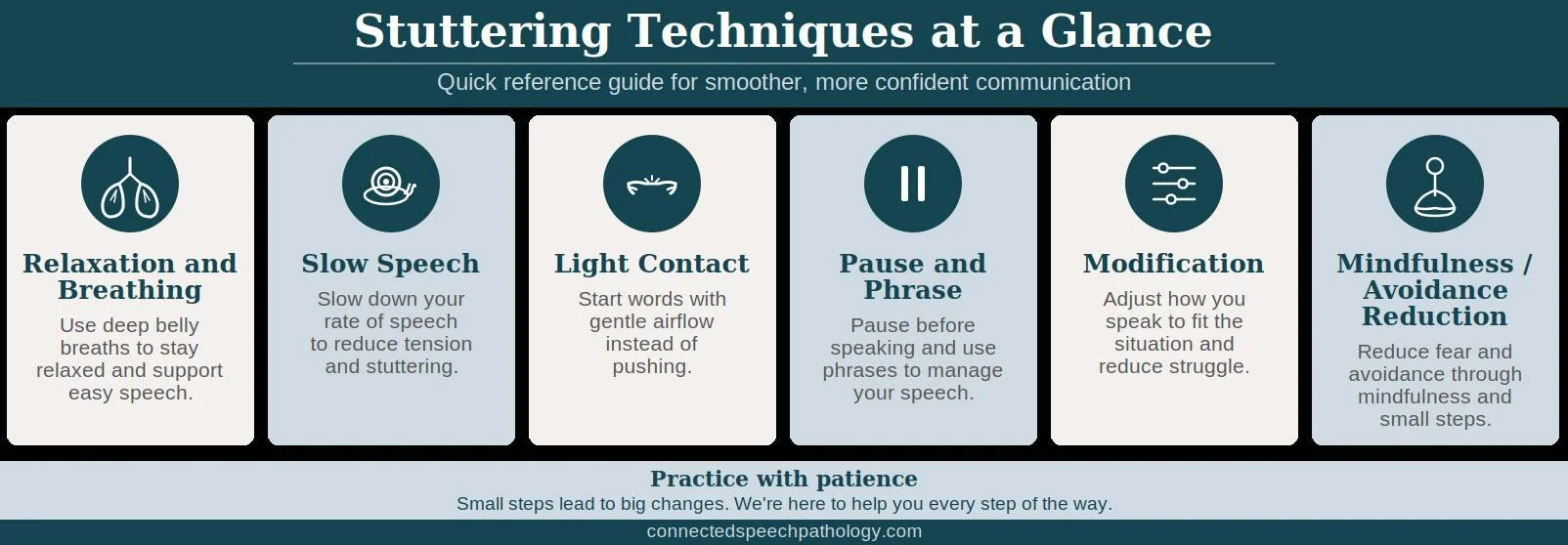
Adults who stutter can make meaningful progress with techniques targeting the physical, cognitive, and emotional dimensions of stuttering. To learn how speech therapy can help with stuttering, including what happens when you start, see our guide. No single approach works for everyone, and the goal is to build a toolkit that holds up across different situations, not to eliminate every moment of disfluency.
1. Relaxation and Breathing
Breathing is the foundation of speech. Many adults who stutter habitually use chest rather than diaphragmatic breathing, which creates tension in the neck and throat muscles involved in producing speech sounds. Learning to breathe from the abdomen may reduce this tension at the source.
To practice: inhale slowly through the nose, letting the abdomen rise while the chest stays still, then exhale slowly through the mouth. Starting speech on a relaxed, well-supported exhale becomes an automatic preparation that reduces stuttering moments before they begin.
2. Speaking Slowly and Deliberately
Rushing to get words out is one of the most consistent stuttering triggers. Reducing your rate of speech gives the brain more time to plan each syllable before initiating it, reducing the likelihood of a block or repetition.
Practicing at a slower pace in quiet settings first, such as reading aloud alone, builds the pattern before applying it in conversations and reduces the risk of the speech motor system outrunning itself.
3. Light Articulatory Contact
Light articulatory contact means producing consonant sounds with minimal pressure between the tongue, lips, teeth, and palate. High articulatory pressure contributes directly to stuttering blocks, and practicing gentle articulatory movements reduces the tension that triggers them.
4. Pause and Phrase
Pausing between phrases gives the speaker time to breathe, regroup, and plan the next stretch of speech. Deliberately pausing every few words during practice reading trains a rhythm of speaking in manageable phrases with intentional rests rather than racing through entire sentences.
5. Stuttering Modification Techniques
Stuttering modification techniques teach people to stutter more easily and less severely rather than eliminate stuttering entirely. Pull-outs involve changing the pattern of a sound mid-block, moving out of it smoothly rather than forcing through. Cancellations involve completing a stuttered word, pausing, and repeating it with an easier movement.
Both are best learned with a speech-language pathologist first and then practiced independently. These techniques specifically target the struggle and panic that turn mild disfluencies into severe blocks.
6. Mindfulness and Reducing Avoidance
Mindfulness reduces the anticipatory anxiety that amplifies stuttering in social situations. A 2018 case study found that adding mindfulness meditation to a structured stuttering treatment program reduced both stuttering frequency and anxiety in adult participants (American Journal of Speech-Language Pathology).
Reducing avoidance matters as much as any technique. Deliberately entering speaking situations that have been avoided, starting with lower-stakes ones and gradually increasing the demand, produces more noticeable improvement in daily functioning than technique refinement alone.

An In-Depth Look Into Stuttering Treatment for Adults
Check out our blog about stuttering treatment for adults for more information!
Tips to Help a Child Who Stutters

For parents, the most powerful thing is creating a home environment that reduces the pressure and self-consciousness a child associates with speaking. How a parent responds in the moment directly affects how a child develops around their stutter.
1. Reduce Time Pressure
Children who stutter are acutely aware when adults are waiting for them to finish. Slow your own rate of speech when talking with your child and give extended pauses after they finish before responding. Avoid completing their sentences or redirecting them mid-stutter, even with good intentions.
An extended wait time signals that there is no rush and that their words are worth the wait. Even well-intentioned interruptions reinforce the idea that stuttering is a problem to be solved rather than a part of talking that can be managed.
2. Ask the Right Kinds of Questions
When a child is having a difficult moment with stuttering, closed-ended questions that require only a yes-or-no answer reduce the speaking load without drawing attention to the struggle. Open-ended questions that require full sentences are appropriate at easier moments, but increase demand during peak stuttering periods.
Follow the child's lead in conversation. If they shift topics or speak more slowly, match their pace and let the conversation feel reciprocal rather than evaluative.
3. Model Calm, Unhurried Speech
Children model the speech patterns of the adults around them. Speaking slowly and calmly yourself provides a speech model that makes a slower rate feel normal rather than conspicuous.
Praise your child for communicating clearly despite the stutter. This shifts focus from eliminating stuttering to effective communication, which is healthier and more sustainable. Praising fluency implicitly frames stuttering as a failure.
4. Seek Early Treatment
Early treatment produces the best outcomes. If a child's stuttering persists beyond a few months, worsens, or is accompanied by physical tension or avoidance of speaking, a speech-language pathologist should evaluate them. For a guide to assessing whether professional support is needed, see Does My Child Need Speech Therapy?.
What Is Stuttering?
Stuttering is a speech fluency disorder in which the normal flow of speech is interrupted by involuntary disruptions. Blocks are silent pauses where sound stops entirely; repetitions involve sounds, syllables, or words repeated involuntarily; prolongations stretch sounds beyond their natural length. Many people who stutter also develop secondary behaviors, such as eye blinking, head jerking, or neck tension, which arise as attempts to push through or escape stuttering moments.
The terms stutter and stammer describe the same condition and are clinically interchangeable. American English speakers use "stutter"; British English speakers use "stammer". Both appear regularly in international research and advocacy, including within the National Stuttering Association.
What Causes Stuttering?
The exact cause of stuttering has not been definitively established, but research consistently points to a combination of genetic, neurological, and environmental factors. Stuttering runs in families, and twin studies show higher concordance in identical pairs than fraternal ones, suggesting a heritable component.
Anxiety does not cause stuttering, but it worsens it reliably. When someone who stutters enters a fear-inducing situation, anticipatory tension disrupts the timing of breathing and voice, triggering a cycle that makes stuttering worse.
Addressing this cycle is a central part of effective stuttering treatment. See our full article on the link between anxiety and stuttering for a deeper look.
What Are the Types of Stuttering?
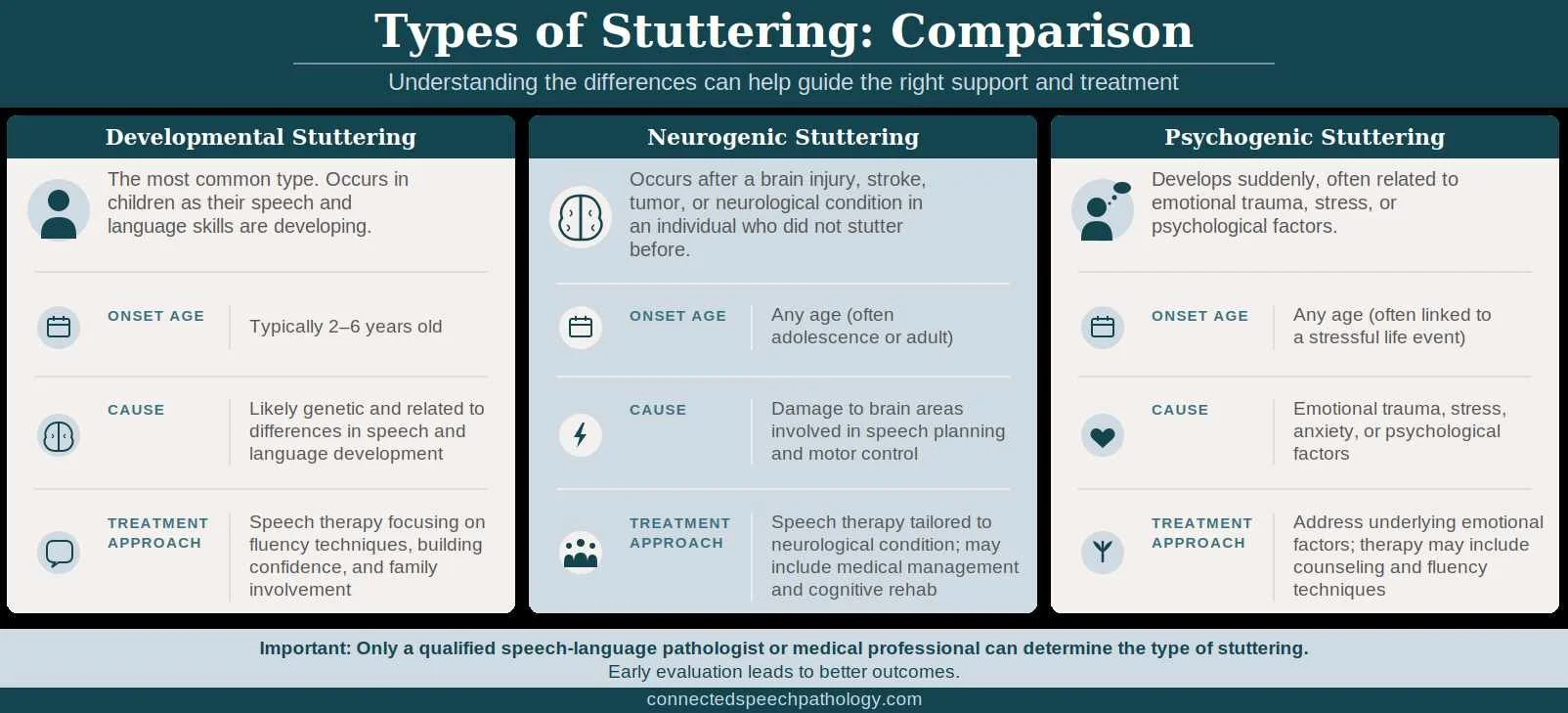
Three distinct types of stuttering exist, each with different causes and treatment implications.
Developmental stuttering is the most common, beginning in childhood between ages two and five as language develops rapidly. Roughly 60 to 80 percent of children who develop stuttering will outgrow it naturally. For those who don't, early treatment significantly improves outcomes.
Neurogenic stuttering results from damage or changes in the central nervous system. A stroke, traumatic brain injury, Parkinson's disease, or other neurological conditions can each disrupt coordination between speech planning areas and the muscles of the lips, tongue, and vocal cords. See our guide on neurogenic stuttering: symptoms, causes, and treatment.
Psychogenic stuttering is the rarest form, typically beginning in adulthood following severe emotional trauma or a significant mental health event. It is not linked to a structural brain difference or developmental pattern. Fluency treatment for psychogenic stuttering involves both speech therapy and psychological support.
How Does Stuttering Happen in the Brain?

The evidence to date suggests that stuttering is a speech motor control disorder. Stuttering is not a problem with language, intelligence, or confidence. Brain imaging research shows that people who stutter have different activation patterns in the basal ganglia, cerebellum, and supplementary motor area, the regions responsible for sequencing and timing the movements involved in producing speech sounds.
Research by Chang and colleagues (2015) using functional MRI found reduced white matter connectivity in left-hemisphere speech networks in children who stutter compared to fluent peers, a difference that partially resolves in those who recover naturally. Fluency shaping techniques work in part by giving the speaker a structured motor pattern that creates a new, more stable pathway through these networks.
Understanding the mechanism matters for treatment. Stuttering reflects a real difference in how the speech motor system sequences and initiates sounds, which is why targeted technique practice, not willpower, is the foundation of effective stuttering therapy.
Tools and Resources for People Who Stutter

Electronic Devices and Apps
Electronic devices that use altered auditory feedback (AAF) play the speaker's own voice back with a slight delay or at a shifted pitch. Both approaches exploit the choral effect: most people who stutter find that speaking in unison with another voice improves their fluency, and AAF devices replicate that effect in real time.
Devices like the SpeechEasy provide AAF during conversations, though results vary considerably and fluency gains don't always generalize away from the device. Apps like Stamurai offer lower-cost access to structured exercises and delayed auditory feedback. These tools work best alongside formal stuttering therapy, not as a replacement for it.
Support Groups
Support groups offer something stuttering therapy alone cannot: regular contact with people who understand stuttering from the inside. The National Stuttering Association (NSA) runs chapters across the United States and hosts an annual conference drawing thousands of people who stutter, their families, and clinicians.
Online communities, including private Facebook groups and platforms like StutterTalk, provide peer connection for those without local chapters. These work best alongside active stuttering treatment.
When Should You Contact a Speech-Language Pathologist?

For children, contact a speech-language pathologist if:
Stuttering has persisted longer than three to six months without improvement.
The child is three years or older, and the stutter is consistent or worsening.
The child shows visible tension, secondary behaviors, or emotional distress around speaking.
The child is avoiding talking or withdrawing from social situations.
For adults and teens, contact a speech-language pathologist if:
Stuttering began suddenly or following a neurological event such as a stroke or head injury. If a stroke caused it, our guide to stuttering after a stroke explains what to expect.
Stuttering is creating anxiety, avoidance, or withdrawal from speaking situations.
Stuttering is affecting work, school, relationships, or overall quality of life.
Self-help techniques have plateaued, and progress has stalled.
Speech-language pathologists who specialize in fluency disorders are trained in fluency shaping, stuttering modification, CBT for speech anxiety, and acceptance-based methods. A general assessment with a specialist is a worthwhile first step, even if someone is unsure whether formal treatment is right for them. For more on what to expect, see our guide to speech therapy for stuttering adults.
If stuttering began recently and without a clear cause, see our article on why people start stuttering all of a sudden.
What We See Working with Clients

One of the clearest patterns we observe is that the techniques clients practice in low-pressure settings don't automatically transfer to high-stakes ones. A client can demonstrate clean, light articulatory contact during a structured reading exercise, but then revert to hard contacts and rushed speech the moment they're on a work call. The gap between knowing a technique and applying it under pressure is where most of the real work in stuttering therapy happens.
Clients who make the most progress are those who deliberately enter speaking situations they've been avoiding. Avoidance narrows a person's world faster than stuttering does, and even a slight reduction yields greater improvement in daily functioning than refining technique alone.
With children, the conversations we have with parents often matter as much as the sessions themselves. When parents slow their speech and stop reacting to stuttering moments with visible concern, children's baseline tension in speaking drops noticeably.
Frequently Asked Questions About How to Stop Stuttering

1. Can stuttering be cured?
In most situations, stuttering cannot be “cured” in the traditional sense, but it can be effectively managed. There is no pill or instant fix to remove stuttering. Many people who stutter achieve significant reductions in stuttering frequency and severity through stuttering therapy and consistent practice of stuttering techniques. Others find that the most useful goal is building communication confidence to handle any situation, regardless of fluency.
2. Does stuttering go away on its own?
Roughly 60 to 80 percent of children who stutter recover naturally, most often before age seven and more commonly in girls than boys. Professional guidance from a speech-language pathologist is the most reliable path toward meaningful improvement.
3. What exercises are most effective for stopping stuttering?
The most evidence-backed exercises combine breathing control, light articulatory contact, slow deliberate speech, and pause-and-phrase practice as physical foundations. Stuttering modification techniques such as pull-outs and cancellations address disfluency as it occurs rather than attempting to prevent it. These exercises are most effective when learned with a speech-language pathologist before being practiced independently.
4. Do electronic devices help people who stutter?
Electronic devices that use altered auditory feedback, such as the SpeechEasy, can reduce stuttering frequency by simulating the choral effect in the ear. Results vary considerably between individuals, and gains don't always generalize to speaking without the device. Apps like Stamurai offer lower-cost access to structured exercises and work best alongside formal stuttering therapy.
5. At what age should a child with a stutter see a speech-language pathologist?
If a child's stuttering has persisted for three to six months, if they show physical tension or emotional distress around speaking, or if they're consistently avoiding talking, a speech-language pathologist evaluation is appropriate at any age. Early treatment produces better outcomes because the brain's speech networks are more adaptable in younger children.
How Connected Speech Pathology Can Help

Connected Speech Pathology offers online stuttering therapy for adults, teens, and children through our dedicated stuttering and fluency therapy program. Our speech therapists specialize in fluency disorders and use evidence-based approaches, including fluency shaping, stuttering modification, and strategies for managing the anxiety and avoidance that accompany stuttering.
We work with each client individually. Children receive play-based treatment with close collaboration from caregivers, and teens and adults work on speech control, reducing avoidance, and building communication confidence across work, school, and social settings.
All sessions are conducted online, which means clients receive expert care without geographic limitations.
Summary
Stuttering affects 70 million people worldwide. It involves blocks, repetitions, and prolongations that disrupt normal speech flow and stem from neurological, genetic, and environmental factors. Anxiety worsens stuttering reliably but does not cause it.
The three types of stuttering, developmental, neurogenic, and psychogenic, each require different approaches. Fluency shaping, stuttering modification, light articulatory contact, diaphragmatic breathing, and mindfulness all have evidence behind them, and electronic devices and support groups complement formal stuttering therapy. Early intervention produces the best outcomes for children.
Stuttering cannot be eliminated in every case, but it can be effectively managed. Working with a speech-language pathologist who specializes in fluency disorders is the most reliable path toward meaningful improvement in stuttering frequency and severity, and in confidence to communicate in any situation.

About the Author
Allison Geller, M.A., CCC-SLP, is a communication coach, speech-language pathologist, and founder of Connected Speech Pathology, an international online practice providing professional communication coaching and speech therapy for children, teens, and adults. With more than two decades of experience, she has worked in medical and educational settings and published research on aphasia. Today, she leads a team of specialists who help clients improve their skills in public speaking, vocal presence, accent clarity, articulation, language, fluency, and interpersonal communication.
Do you have questions or want to learn more about our program? Set up a free phone consultation with our lead speech-language pathologist.