What Is Psychogenic Aphonia? Causes, Symptoms, and How Voice Therapy Restores Your Voice
Psychogenic aphonia is a loss of voice caused by emotional or psychological stress, even though the vocal cords remain healthy. Here is what to know about it: what it is, why it happens, how it differs from other conditions, and how speech therapy helps. If you are an adult whose voice vanished suddenly while your medical tests came back normal, or you support someone in that spot, understanding the cause is the first step.
Getting the right diagnosis matters. Psychogenic aphonia responds well to treatment once organic causes are ruled out, and most people get their voice back with the right support.
Key Takeaways
Psychogenic aphonia is a functional voice disorder, so the voice is lost without structural damage. The vocal cords and larynx look normal on an exam, yet a clear voice will not come out.
The clearest sign is simple. Someone can whisper, cough, or laugh, but cannot speak aloud, because the vocal cords still move normally during those reflexive actions.
Diagnosis means ruling out medical causes first. An ENT specialist checks the vocal cords, often with a videostroboscopic examination, before a functional voice disorder is confirmed.
Speech therapy is the most effective treatment, and most people respond well. Voice therapy rebuilds sound, and mental health support helps when stress runs high.
Why Does Psychogenic Aphonia Happen?
Symptoms of Functional Aphonia and How It Is Told Apart
The Role of the Speech-Language Pathologist
Living with Psychogenic Aphonia and Rebuilding Communication
What We See Working with Clients
What Is Psychogenic Aphonia?

Psychogenic aphonia is the abrupt loss of a clear speaking voice with no structural damage to the vocal folds. It is a functional voice disorder. The voice system stops working normally, even though the vocal cords, larynx, and nerves are healthy.
An exam can look completely normal while the voice is gone. During ordinary speech, the vocal folds come together and vibrate to produce sound. Under stress, the vocal folds often do not close well, so little or no sound comes out.
The same vocal folds often move normally during a cough or a laugh. That difference is a key clue during the exam, and it often points straight to a functional cause rather than a physical one.
Aphonia vs. Dysphonia: What Is the Difference?
Aphonia means no voice, while dysphonia means a hoarse or weak voice. Someone with aphonia can usually only whisper, and someone with dysphonia still makes a rough or strained sound. Related conditions, including other psychogenic voice disorders, cause hoarseness instead of a full loss of voice.
Why Does Psychogenic Aphonia Happen?

Psychogenic aphonia happens when emotional stress disrupts normal voice production. Sudden voice loss can follow anxiety, trauma, or a major life change. Producing voice takes the brain, the respiratory system, and the vocal folds working together, and high stress can interrupt that coordination.
Psychogenic aphonia is a conversion disorder, sometimes called conversion aphonia. A psychological conflict shows up physically as a symptom in the body. The voice loss is involuntary, and the symptoms are genuine, not produced on purpose.
The exact mechanisms are still being researched. What is clear is that emotional distress and psychological factors can shut down the phonatory muscles that drive normal speech. Emotional factors like grief, fear, or ongoing pressure often play a part.
Psychogenic aphonia is more common in women than men, and it often starts between ages 14 and 35. It is linked to emotional stress or trauma, and it can appear after big life changes or periods of anxiety. Even professional singers and heavy voice users can develop it.
Because the voice loss is functional, a healthcare provider first rules out physical causes, such as vocal cord injuries, infection, inflammation, or paralysis. Your healthcare provider reviews your medical history and checks for structural causes, including organic lesions. Video laryngoscopy of the larynx usually shows normal structure and normal movement, so a functional voice disorder becomes the likely explanation.

Can Stress Cause You to Lose Your Voice?
Check out our blog covering if stress can cause you to lose your voice for more information!
Symptoms of Functional Aphonia and How It Is Told Apart

The main symptom of functional aphonia is the sudden loss of a clear speaking voice. Most people can whisper or make only limited sound, but they cannot produce a strong, audible voice, even when they try. Voice quality is typically breathy or absent during intentional speech.
Other symptoms often include throat tightness, vocal strain, and vocal fatigue from repeated tries to speak. Some people report extra vocal strain and a sense that breathing feels out of sync with speech. Over time, the trouble can lead to real communication difficulties and social withdrawal.
Family members often notice the sudden change. Some people lean on writing or texting instead of speaking.
Psychogenic aphonia is told apart from other voice disorders and medical problems by how the voice behaves. The clearest sign is that a normal voice often returns during reflexive actions, like coughing, throat clearing, or laughing. When sound comes back that way, it shows the vocal mechanism works, and the trouble is with voluntary speech, not the voice box itself.
Here is how psychogenic aphonia compares with organic voice loss, where a physical problem is present:
| Feature | Psychogenic aphonia | Organic voice loss (laryngitis, paralysis) |
|---|---|---|
| Vocal fold structure on exam | Normal and healthy | Often shows inflammation, a lesion, or paralysis |
| Voice during a cough or laugh | Normal sound often returns | Usually still affected |
| Typical onset | Sudden, often after stress | Gradual, or tied to an illness or injury |
| Main cause | Emotional or psychological stress | Infection, injury, a growth, or nerve damage |
| First-line care | Voice therapy with a speech-language pathologist | Medical treatment of the physical cause |
| Connected Speech Pathology | connectedspeechpathology.com | ||
More than one thing can be true at once, so this comparison does not replace an exam by a qualified professional.
How Psychogenic Aphonia Is Diagnosed
Diagnosis starts by ruling out a physical problem. An ENT specialist, an ear, nose, and throat doctor, examines the vocal cords and reviews your medical history. Video laryngoscopy and a videostroboscopic examination show the vocal folds in action during speech and during reflexive tasks.
When the exam finds no infection, lesion, or paralysis, the healthcare provider points toward a functional voice disorder rather than an organic cause. A speech-language pathologist then evaluates how you speak, breathe, and start sounds. The evaluation confirms the pattern and rules out a missed medical cause.
The whole process is quick and does not cause pain. Getting the order right reassures patients that the voice loss has a real, treatable cause.
The Role of the Speech-Language Pathologist
After a physician rules out medical causes, a speech-language pathologist leads treatment. Also called a voice therapist or speech therapist, this specialist checks how the voice works. The exam confirms the pattern of a functional voice disorder.
Speech therapy is the most effective treatment for psychogenic aphonia. Most people respond well to it.
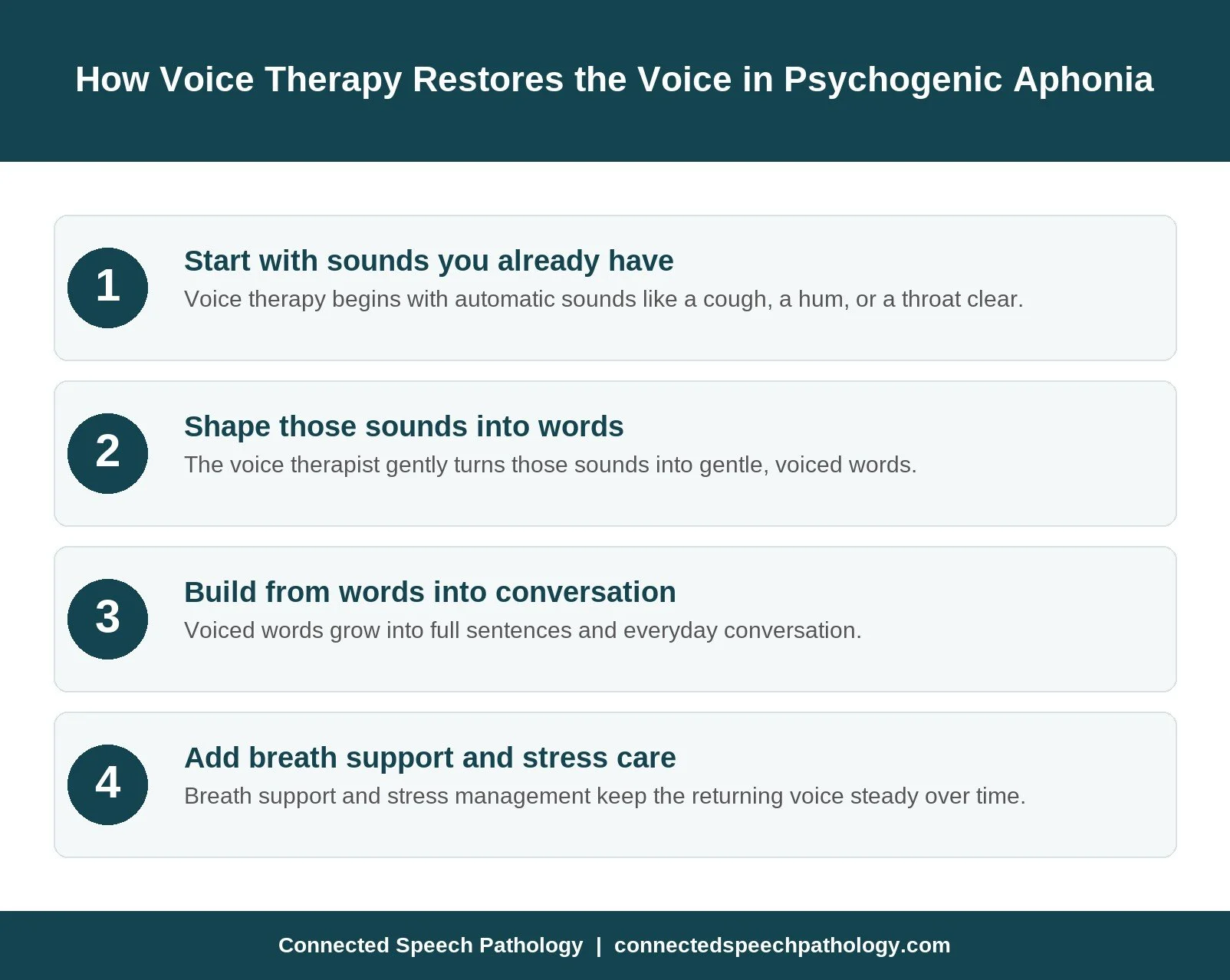
Voice therapy usually starts with sounds someone can already make, like a cough, a hum, or a throat clear. The voice therapist gently shapes those automatic sounds into words, then into full sentences. Sessions use gentle voice exercises for production and coordination, plus breathing exercises, breath support, and resonant voice techniques that ease throat tension.
These are examples. The speech-language pathologist picks the exercises that fit each patient, since not every technique suits every situation. Many people improve early, and the voice sometimes returns within the first sessions.
Aphonia can be temporary or longer lasting, depending on the cause. Recovery often takes a few weeks to a few months.
Understanding that the condition is real and treatable often eases anxiety and supports faster recovery. Treatment can involve a multidisciplinary approach with several healthcare professionals. Counseling is added when significant stress is present.
When someone is ready, online voice therapy makes this care easy to reach. Mental health support lowers the risk that the voice loss comes back.
Living with Psychogenic Aphonia and Rebuilding Communication

Living with psychogenic aphonia can be frustrating. Everyday tasks like answering the phone, joining a meeting, or talking with a friend suddenly feel out of reach. Many people pull back from social life, partly from the effort of explaining what is wrong.
Clear information about the condition often brings real relief. Knowing the vocal folds are healthy takes weight off everyday life. It also helps to hear that the voice usually comes back.
During recovery, simple tools lower the pressure to speak. Writing, texting, and gestures keep someone connected while the voice returns, and they support communication for now without replacing it for good. If your voice keeps giving out for reasons that are not clear, voice loss that keeps coming back deserves a professional look.
As the work continues, sound returns bit by bit, and small wins build confidence. Many people find that each steady word makes the next one easier. Support from family and friends makes those early weeks easier.
What We See Working with Clients

We work with adults whose voice matters in daily life, and a sudden loss of voice is one of the more distressing reasons they reach out.
The examples below are real clients of ours. Identifying details have been changed to protect privacy.
A woman in her twenties lost her voice within a day of a stressful family event. Her doctor examined her vocal folds, found them healthy, and sent her for voice therapy.
We started with the sounds she still had, a soft hum and a gentle cough, and shaped them into short words. Over a few weeks, she moved from single words to full sentences, and her speaking voice came back.
A teacher watched his voice fade to a whisper during a stressful stretch at work, and it did not bounce back on its own. An ENT specialist confirmed his vocal cords were normal, which pointed to a functional voice disorder.
We rebuilt his voice with easy voicing and breath-voice coordination, and we worked with a counselor on the stress behind it. He went back to teaching with a steady voice and a plan for the tense weeks.
Frequently Asked Questions About Psychogenic Aphonia

1. Can psychological stress cause aphonia?
Yes. Psychological stress can directly cause psychogenic aphonia and a sudden loss of voice. Stress changes how the brain controls the larynx and breathing, and that can shut down voice production with no physical damage.
2. Is psychogenic aphonia a real disorder?
Yes. Psychogenic aphonia is a real functional voice disorder with measurable symptoms. The vocal folds look normal, yet voice production is genuinely impaired, and the voice loss is involuntary.
3. What is the difference between aphonia and dysphonia?
Aphonia means no voice, while dysphonia means a hoarse or weak voice. With psychogenic aphonia, the voice is absent, and someone can usually only whisper. Dysphonia still produces sound, though it is rough or strained.
4. How is psychogenic aphonia diagnosed?
Psychogenic aphonia is diagnosed by ruling out structural voice problems first. An ENT specialist examines the vocal cords, sometimes with a videostroboscopic examination, to check for inflammation, lesions, or paralysis. When the vocal folds look healthy, a speech-language evaluation confirms the functional pattern.
5. How long does it take to get your voice back?
Recovery varies from person to person. Many people improve fast, and the voice sometimes returns within the first sessions. For others, it takes a few weeks to a few months, especially when the underlying stress is treated too.
6. Can psychogenic aphonia come back after treatment?
Psychogenic aphonia can return if the psychological triggers are not addressed. It comes back less often when a person finishes speech therapy and builds coping skills. Ongoing stress management and counseling help keep the voice steady.
How Connected Speech Pathology Can Help

Connected Speech Pathology provides online speech therapy for adults with psychogenic aphonia and other voice disorders. Our speech-language pathologists check voice quality, vocal function, breathing, and communication skills. Then they build a treatment plan around each patient's symptoms and goals.
What makes the work different is the focus on the voice you use in real life, from the first steady sounds to full conversations at home and at work. The online model makes this care easy to reach from home, and steady practice supports real, significant improvement.
Summary
Psychogenic aphonia is a functional voice disorder. It causes real voice loss with no structural damage to the vocal folds. Psychological stress disrupts normal voice production, leaving a person whispering or unable to speak clearly.
Diagnosis starts with a medical examination to rule out physical causes. An ENT specialist often uses a videostroboscopic examination. Once organic causes are ruled out, a speech-language pathologist leads voice therapy to rebuild the voice.
With speech therapy and the right support, most people get a strong voice back and return to everyday conversation. Treating the stress behind it helps keep the voice steady over time.

About the Author
Allison Geller, M.A., CCC-SLP, is a communication coach, speech-language pathologist, and founder of Connected Speech Pathology, an international online practice providing professional communication coaching and speech therapy for children, teens, and adults. With more than two decades of experience, she has worked in medical and educational settings and published research on aphasia. Today, she leads a team of specialists who help clients improve their skills in public speaking, vocal presence, accent clarity, articulation, language, fluency, and interpersonal communication.