What Causes Voice Cracks in Adults and Teens? Key Reasons and Remedies
Voice cracks are an unexpected break in your voice: a sudden shift in pitch or a brief loss of sound that interrupts your speech or singing. Adults experience voice cracking more often than most realize, and the causes range from something as simple as dehydration to vocal cord disorders that warrant professional attention.
This article covers the primary reasons voice cracks occur in adults and teens, what the research shows about vocal register transitions, and the most effective ways to stabilize your voice.
Whether you're a professional singer, a public speaker, or someone who just keeps losing their voice at inconvenient moments, understanding the causes of voice cracks is the first step toward preventing them. The good news is that most voice cracks can be addressed directly once you identify which factor is driving them.
Key Takeaways
A voice crack happens when the vocal folds momentarily lose coordinated vibration, most often during rapid pitch changes, register transitions, or periods of vocal fatigue, dehydration, or muscle tension. Understanding the mechanism behind voice cracking is the first step toward addressing it effectively.
Adults' and teens’ voices crack for different reasons. In teens, the larynx is actively growing, and the vocal folds are thickening. In adults, cracking is more likely linked to technique, hydration, stress, or an underlying vocal cord condition.
Most voice cracks can be reduced or eliminated. Consistent hydration, proper warm-up, and sound breath support address the most common triggers. Medical causes, including laryngitis, vocal cord lesions, or spasmodic dysphonia, require evaluation by an ENT or speech-language pathologist.
Persistent voice cracks that don't resolve with self-care are a signal to get assessed. A speech-language pathologist or voice coach can determine whether the cause is technique, habit, or a condition requiring clinical attention.
What Causes Voice Cracks in Adults?
How Can You Prevent Voice Cracks?
What We See Working with Clients
What Is a Voice Crack?

A voice crack is a brief, involuntary disruption in the sound your voice produces, such as a sudden shift in pitch, a squeak, or a moment where the voice cuts out entirely.
To understand why voice cracking happens, it helps to know how the voice is produced. Air from the lungs passes through the larynx, or voice box, where the vocal folds, two membranous folds of tissue, vibrate together to create sound. The pitch of your voice depends on how tightly or loosely the folds are stretched: thin and stretched folds vibrate at higher frequencies, while thicker, looser folds produce lower tones.
Think of it like guitar strings. A tight, thin string produces a high-pitched note; a thicker, looser string vibrates at a lower frequency. The muscles of the larynx adjust this tension continuously as you speak and sing, and a voice crack occurs when that adjustment fails, either too suddenly or under conditions that make smooth vibration impossible.
The cricothyroid muscle is the primary driver of pitch change. When it tightens too abruptly, the vocal folds can't transition smoothly, and the voice breaks. This is especially common when moving quickly across vocal registers or when the folds are fatigued, dry, or irritated.
What Causes Voice Cracks in Adults?
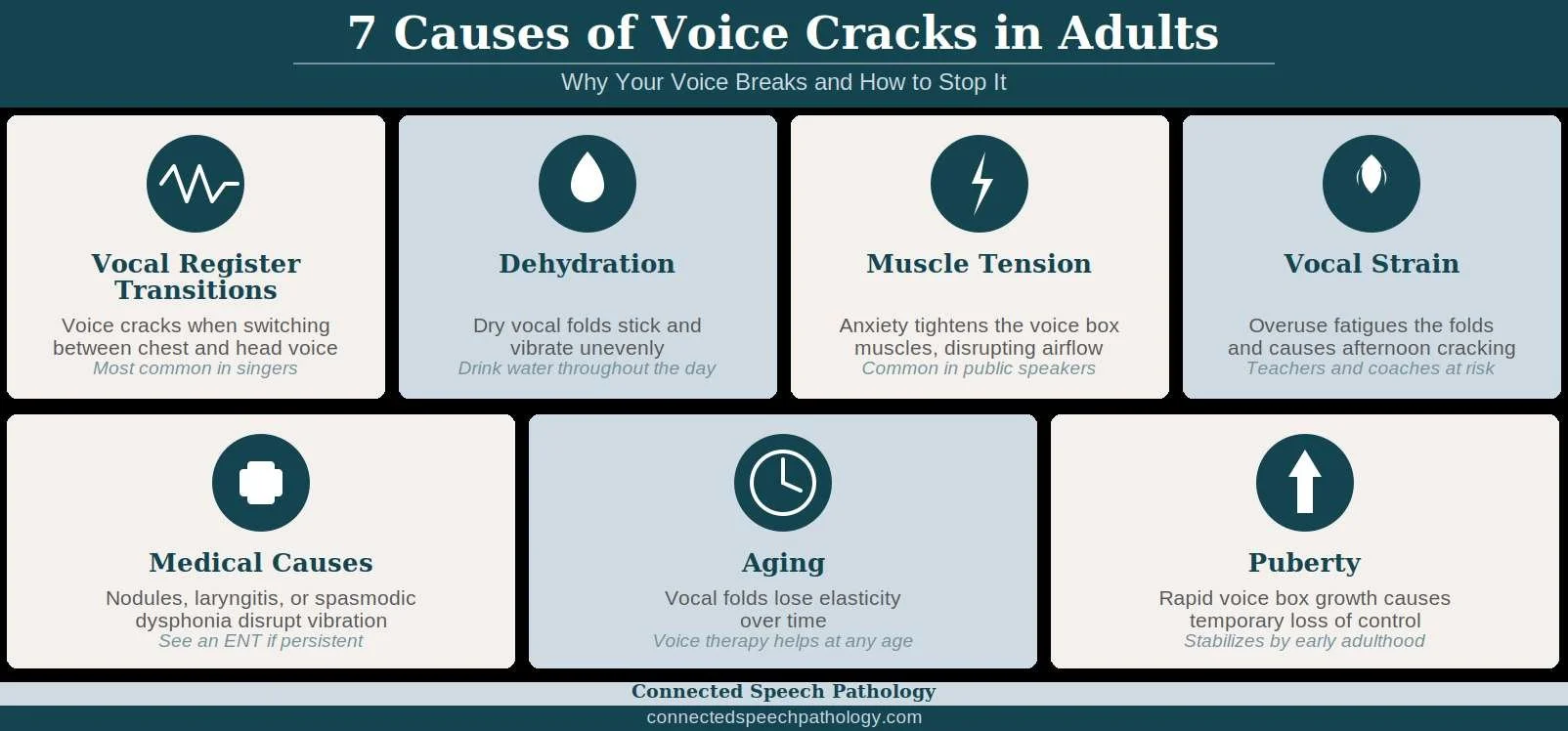
Voice cracks occur in adults for several distinct reasons. Each has its own mechanism and its own solution, so identifying the cause matters.
Vocal Register Transitions
The most common trigger for voice cracking in singers, and one that affects speakers too, is the transition between vocal registers. The human voice has two primary registers: chest voice, which carries the lower, richer tones most adults use in everyday speech, and head voice, which produces the higher, lighter sounds used in upper ranges. Mixed voice describes the blend between them.
The passaggio is the transition zone between registers, from the Italian word for "passage." Moving through the passaggio requires careful coordination between the cricothyroid and thyroarytenoid muscles. When a speaker or singer tries to push chest voice too high, or shifts abruptly from one register to another without sufficient breath support, the muscles lose coordination, and the voice cracks.
Singers who avoid training the passaggio and instead force chest voice through high notes are especially prone to register-break cracking. Voice cracking at specific pitches, particularly in the upper-middle range, almost always points to a register transition issue rather than a medical problem.
Dehydration
The vocal folds require both systemic hydration, meaning water circulating in the body, and topical hydration, meaning moisture on the surface of the folds themselves, to vibrate efficiently. When the folds are dry, they lose elasticity and begin to stick slightly on each contact cycle. That brief sticking interrupts the smooth, continuous vibration, resulting in cracking, roughness, or a voice that feels unreliable.
Caffeine and alcohol are diuretics that reduce mucosal hydration in the throat, and dry air directly draws moisture away from the fold surface. Drinking enough water throughout the day helps, but it takes time for systemic hydration to reach the folds. A humidifier in dry environments can maintain topical hydration more immediately.
Muscle Tension and Anxiety
When adults feel nervous or anxious, muscles throughout the body tighten, including the laryngeal muscles surrounding the voice box. That tension restricts the free movement of the vocal folds, making smooth vibration harder to maintain. Anxiety also disrupts breathing: shallow, upper-chest breathing reduces the airflow that supports vocal fold vibration, making a voice crack more likely under pressure.
Public speakers and performers frequently experience voice cracking for this reason, especially during high-stakes moments. The anticipation of a crack can itself cause the tension that produces one, a well-documented cycle in voice therapy.
Techniques that reduce laryngeal tension, including controlled breathing, gentle downward pitch glides, and supported phonation exercises, effectively interrupt this cycle. Stress and anxiety can also cause you to temporarily lose your voice, and similar tension-management strategies apply in both situations.
Vocal Strain and Overuse
Overusing the voice, such as speaking loudly for extended periods, shouting, or forcing volume without adequate breath support, fatigues the vocal folds. Fatigued folds lose the precise muscle coordination needed for clean phonation, especially at the higher end of someone's speaking range. The result is a voice that cracks or goes rough in the afternoon or evening after heavy morning use.
Teachers, coaches, and call center professionals are among the adults most frequently affected. Pushing through vocal fatigue without rest can lead to more significant tissue stress over time.
Screaming and extreme vocal overuse carry their own risks. Recognizing the signs of vocal cord damage from screaming early allows for faster recovery and reduces the risk of lasting tissue changes.
Medical Causes
Several medical conditions directly affect how the vocal folds vibrate and can cause persistent voice cracking in adults.
Vocal cord lesions, including nodules, polyps, and cysts, are growths on the vocal fold tissue that prevent the folds from making clean contact. When the folds can't fully approximate, the voice cracks or suddenly loses power. Vocal nodules are especially common in adults who use their voices professionally without adequate technique or recovery time.
Speech therapy for vocal polyps addresses another category of lesion. Vocal polyps tend to cause more dramatic cracking than nodules because they are softer and more disruptive to fold contact during vibration.
Laryngitis is inflammation of the larynx, most often caused by viral infection but also by chronic acid reflux, smoking, or prolonged vocal overuse. Inflamed vocal folds can't vibrate smoothly, and the voice cracks or disappears temporarily. Laryngitis from infection typically resolves in one to two weeks with rest and hydration; chronic laryngitis that persists beyond that window warrants ENT evaluation.
Spasmodic dysphonia is a neurological condition that causes involuntary muscle spasms in the laryngeal muscles, making the voice break, strain, or cut out during speech. It is often misdiagnosed as a habit or anxiety problem. Spasmodic dysphonia requires specialist evaluation to identify and a different treatment approach than technique-based cracking.
Vocal cord paralysis affects the movement of one or both vocal folds, causing a breathy, weak, or crackling voice quality. It can result from a viral infection, a surgical complication, or a neurological event.
If voice cracking is persistent, unexplained by technique or hydration, and accompanied by pain, breathiness, or significant pitch change, an ENT evaluation is the appropriate first step.

How to Know if Your Vocal Cords Are Damaged and What to Do
Check out our blog discussing damaged vocal cords for more information!
Aging
The vocal folds change with age. As adults move into their 50s and 60s, the folds lose some elasticity and muscle mass, a process called presbyphonia, which can make the voice sound thinner, less stable, and more prone to cracking. Women often experience additional vocal changes around menopause as hormones affect the mucous membrane lining the vocal folds.
These changes are real, but they are not inevitable in their severity. Voice therapy, regular vocal exercise, and good hydration all support vocal fold health as adults age. Adults who continue to use their voices actively tend to maintain better vocal stability than those who reduce their voice use over time.
Puberty in Teens
Teen boys are most familiar with voice cracking during puberty, but girls experience it too, though less dramatically. Testosterone drives significant larynx growth in males, causing the vocal folds to lengthen and thicken rapidly, and the voice drops an average of one full octave. Girls' larynxes also grow, and their voices drop roughly three to four semitones, but the change is more gradual.
As the larynx grows, the muscles controlling the vocal folds haven't yet adapted to the new instrument size, and cracking results. Adult pitch typically stabilizes between ages 21 and 25, though the most dramatic changes happen earlier. Consistent use of voice and patience are the primary tools during this period.
How Can You Prevent Voice Cracks?

Preventing voice cracks starts with addressing the specific cause, but several practices support vocal stability regardless of the cause.
Stay Consistently Hydrated
Drinking enough water throughout the day is the single most accessible habit for reducing voice cracks. Aim for at least 8 glasses of water daily, and increase that in dry environments or during heavy voice use. Herbal teas at a warm temperature also soothe the throat without the diuretic effect of caffeine.
Avoid alcohol and excessive caffeine before significant speaking or singing. Both reduce mucosal moisture in the larynx and increase the risk of dryness-related cracking. A humidifier in home or office environments helps maintain topical hydration in dry climates and heated indoor spaces.
Warm Up Before Heavy Voice Use
Warming up the voice before a long meeting, a presentation, or a singing performance significantly reduces the likelihood of cracking. A good warm-up includes humming within a comfortable pitch range, lip trills (blowing air through loosely closed lips while vocalizing), and gentle pitch glides from low to high and back.
These exercises increase blood flow to the laryngeal muscles, improve coordination between the registers, and ease the vocal folds through the passaggio before demanding use. Singers benefit especially from voice therapy for singers that builds comfort in the mixed voice zone and trains the muscles to navigate register transitions without cracking.
Rest Your Voice
Voice rest is underutilized and effective. After a long day of heavy voice use, giving the vocal folds a few hours of quiet allows the tissue to recover. Chronic voice fatigue without rest leads to tissue irritation, which makes cracking more frequent over time.
Whispering is not a substitute for voice rest. It actually creates significant laryngeal tension and can increase strain. When rest is needed, silence is more effective than a whispered conversation.
Support Your Breath
Most voice cracking during speech is linked, at least in part, to inadequate breath support. The voice needs a consistent, supported airflow to vibrate cleanly. When adults run out of breath mid-sentence, speak with upper-chest breathing only, or hold their breath during tense moments, the airflow supporting vocal fold vibration becomes irregular, causing the voice to crack.
Breathing exercises that strengthen lower diaphragmatic support significantly reduce cracking in adults whose voices break during conversation or presentations. Targeted vocal exercises assigned by a speech-language pathologist specializing in voice challenges work much faster than generalized breathing tips alone.
What We See Working with Clients

Adults who come in for voice cracking often assume the cause is medical, but in practice, the majority of cases we see involve a technique or habit component, even when a clinical factor is also present.
One pattern we see frequently is the adult professional whose voice cracks reliably in the afternoon, typically a teacher, manager, or trainer who uses their voice hard all morning with no warm-up and no hydration strategy. By early afternoon, the vocal folds are fatigued and dry, and the voice starts to break on higher-pitched questions or stressed syllables. Once we establish a pre-session warm-up, scheduled water breaks, and end-of-day voice rest, the afternoon cracking resolves within a few weeks without any clinical intervention.
A different pattern shows up with singers and performers who crack specifically at one pitch area, usually because they've been avoiding that range, which reinforces the tension that causes the break. When we work through the passaggio systematically, using lip trills, humming, and then sustained vowels throughout the transition, the crack gradually diminishes as the muscles learn to coordinate. The before-and-after shift is usually audible within three to four sessions.
We also see adults who crack when nervous or emotional, often in professional settings like presentations or difficult conversations. In these cases, the crack is driven by laryngeal tension and disrupted breathing. Teaching controlled pre-speech breathing, gentle pitch downglides to release laryngeal tension, and supported phonation exercises addresses the pattern without requiring them to eliminate the emotion, just to keep the breath and muscles from working against each other.
Frequently Asked Questions About Voice Cracks in Adults

1. Why does my voice crack even though I'm not going through puberty?
Adults experience voice cracking for several reasons unrelated to puberty, with dehydration, laryngeal muscle tension, vocal strain, and register transition difficulties being the most common. Medical conditions, including laryngitis, vocal cord nodules, and spasmodic dysphonia, can also cause voice cracking in adults at any age. A voice that cracks persistently, or cracks in the same place every time, warrants evaluation by a speech-language pathologist or ENT to identify the specific cause.
2. Can voice cracks come from vocal cord lesions?
Yes: nodules, vocal polyps, and cysts on the vocal folds prevent the folds from making clean contact during vibration, causing the voice to crack, cut out, or sound rough. If you experience persistent cracking along with hoarseness, reduced vocal range, or voice fatigue that doesn't improve with rest and hydration, vocal cord lesions are a possible explanation. An ENT can evaluate the vocal folds directly with laryngoscopy and determine whether voice therapy, rest, or another intervention is the appropriate next step.
3. Is it normal for women to experience voice cracks?
Voice cracking in women is common and often underreported, but it stems from the same causes as in men: dehydration, technique, fatigue, and tension. Hormonal changes around menstruation, pregnancy, and menopause also affect the mucous membrane of the vocal folds, making the voice more variable and prone to cracking. Women who sing or speak professionally often notice increased cracking during specific hormonal phases and benefit from voice therapy that accounts for those changes.
4. How do you know if your vocal cords are damaged?
Signs of vocal cord damage include persistent hoarseness, a breathy or strained voice quality, reduced vocal range, voice fatigue after short periods of speaking, or frequent voice cracks that don't resolve with rest and hydration. You can also review the signs of vocal cord damage to help determine whether your symptoms warrant an evaluation. If symptoms last longer than two weeks, assessment from a speech-language pathologist or ENT is recommended.
5. When should I see a professional about voice cracking?
See a speech-language pathologist or voice coach if voice cracking is frequent, affects your professional performance or daily life, or has persisted for more than a few weeks without an obvious cause. See an ENT if cracking is accompanied by pain, significant hoarseness, a sudden change in pitch, or breathiness. Voice cracking that appears suddenly in an adult with no history of vocal issues, especially after a respiratory illness or surgery, warrants prompt medical evaluation.
How Connected Speech Pathology Can Help

Connected Speech Pathology works with adults and teens whose voice cracking is affecting their professional confidence, performance, or daily communication. Our speech-language pathologists assess the full picture: technique, breath support, hydration habits, vocal demands, and any clinical factors, before designing a personalized voice therapy plan.
For adults with technique-driven cracking, we work on register coordination, breath support, and vocal warm-up strategies that address the specific pitch zones and settings where cracking occurs. For those dealing with tension-related cracking, we use targeted exercises to reduce laryngeal muscle tension and retrain breathing patterns that support clean phonation. When a medical evaluation is appropriate, we coordinate with ENT specialists and work in parallel or following medical treatment.
For teens, voice cracking is often tied to growth, voice change, or inconsistent coordination between breath and vocal folds. We focus on building control and stability through age-appropriate exercises, helping them feel more confident speaking in class, in social situations, in sports, or in performances. We also address habits such as pushing, straining, or avoidance that can develop during this stage.
All sessions are delivered online, so teens and adults can work on their voice from home, their office, or wherever they're most comfortable. Book a free consultation to start.
Summary
Voice cracks in adults and teens result from a breakdown in vocal fold coordination, whether due to register transitions, dehydration, muscle tension, vocal strain, a medical condition, puberty, or aging. Technique-driven cracking responds well to consistent warm-ups, hydration, and breath support, whereas persistent or unexplained cracking warrants evaluation by a speech-language pathologist or voice coach.
Connected Speech Pathology offers online voice therapy for adults and teens seeking a more stable, confident voice in every speaking and singing situation.

About the Author
Allison Geller, M.A., CCC-SLP, is a communication coach, speech-language pathologist, and founder of Connected Speech Pathology, an international online practice providing professional communication coaching and speech therapy for children, teens, and adults. With more than two decades of experience, she has worked in medical and educational settings and published research on aphasia. Today, she leads a team of specialists who help clients improve their skills in public speaking, vocal presence, accent clarity, articulation, language, fluency, and interpersonal communication.