Voice Therapy for Singers: What It Is and How It Helps
Your voice is your instrument. When it stops working the way it should, every rehearsal, performance, and recording session becomes harder than it has to be.
Voice therapy for singers is a clinical treatment provided by a speech-language pathologist that targets the underlying causes of vocal problems, restores function, and helps singers return to full performance.
Singers face vocal problems at far higher rates than the general population. A 2012 study by Nanjundeswaran and colleagues found that 65% of amateur singers and up to 87% of professional singers report voice problems at some point in their careers.
The demands of singing, sustaining high notes, projecting over music, and performing repeatedly place unique stress on the vocal cords that speaking alone never does. Read on to learn when voice therapy is the right step, how it works, and what to expect.
Key Takeaways
Voice therapy for singers is delivered by a speech-language pathologist specializing in voice disorders and addresses both the speaking and singing voice.
Common causes of vocal problems in singers include muscle tension dysphonia, vocal nodules, reflux laryngitis, and vocal cord lesions caused by overuse or faulty technique.
Voice treatment combines vocal hygiene education, breathing exercises, resonant voice techniques, and exercises designed to retrain healthier vocal habits.
Most singers see meaningful improvement within weeks to a few months of consistent voice therapy, often without surgery.
Why Are Singers Uniquely Vulnerable to Voice Problems?
What Is Voice Therapy for Singers?
What Voice Disorders Are Common in Singers?
What Voice Therapy Techniques Are Used for Singers?
What Should You Expect During Voice Therapy Sessions?
What Vocal Hygiene Habits Support Voice Therapy?
What We See Working with Clients
Why Are Singers Uniquely Vulnerable to Voice Problems?

Singers are more vulnerable to voice disorders than most other voice users because of a principle voice specialists describe as "too much, too loud, too often, and too high." The demands of singing push the vocal cords well beyond what normal speech ever requires, and most singers keep performing through early warning signs rather than stopping.
The vocal cords are two bands of tissue inside the larynx, or voice box, that vibrate when air passes through them to create sound. During singing, they can collide with each other hundreds of times per second. Over a rehearsal season or years of training with imperfect technique, that repeated stress can build into a real injury.
Voice therapy is most effective when it begins early, before compensatory habits layer on top of the original problem. A singer who tightens the throat muscles to manage pain can develop muscle tension dysphonia on top of an existing condition.

Vocal Health for Singers: How to Protect Your Singing Voice
Check out our blog on vocal health for singers for more information!
What Is Voice Therapy for Singers?
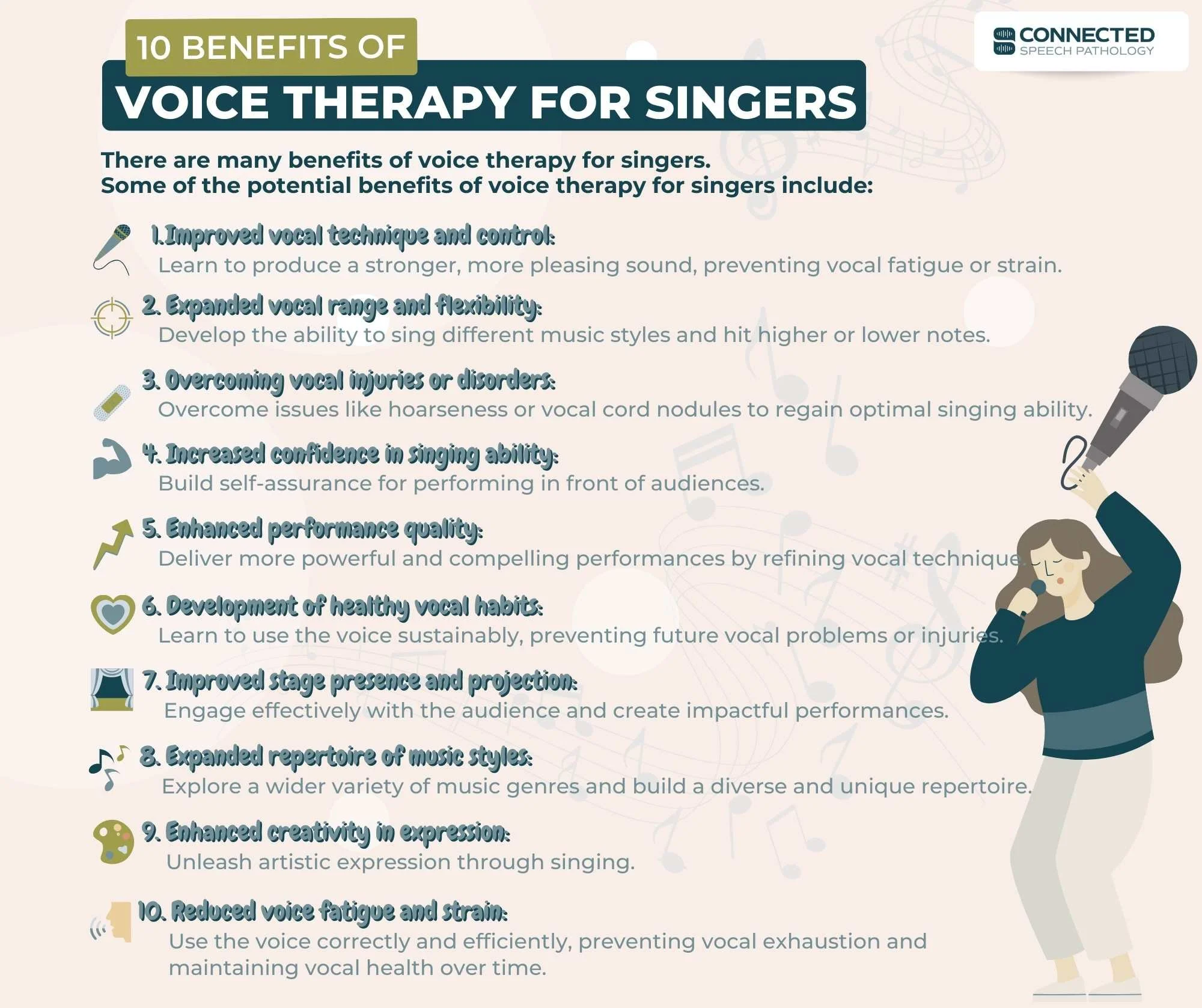
Voice therapy for singers is a type of treatment that addresses the function and health of the singing voice. The clinician who combines that treatment with singing training is a singing voice specialist. A speech-language pathologist trained in voice disorders and singing techniques evaluates how the vocal cords vibrate, how breath supports sound production, and which habits or conditions contribute to the problem.
Singing voice therapy differs from speaking voice therapy in a key way. Speaking voice therapy targets everyday communication. Singing voice therapy also accounts for performance-specific demands: sustaining long notes, shifting between vocal registers, varying dynamics, and projecting over music.
Most adults are referred to voice therapy after an evaluation by an otolaryngologist (also called an ENT doctor) who has identified or ruled out structural causes. The speech-language pathologist then develops a plan targeted to the singer's diagnosis, vocal goals, and performance schedule.
What Voice Disorders Are Common in Singers?
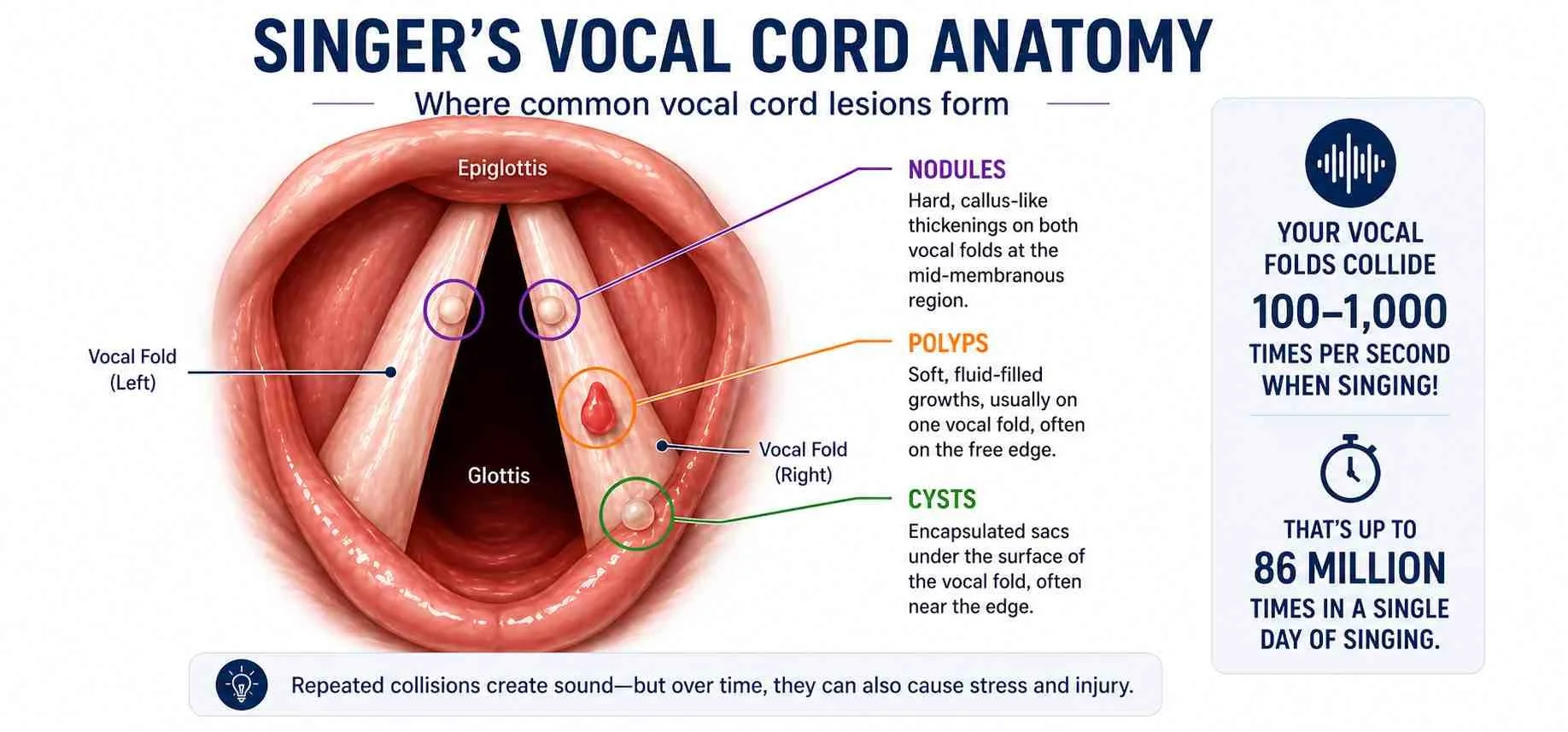
Several voice disorders appear with particular frequency in singers. Each has a distinct cause and responds differently to treatment.
Vocal Nodules
Vocal nodules are small, callus-like growths that form on the vocal cords at the point where they collide most often during singing. They develop when the tissue is stressed faster than it can repair itself, causing hoarseness, a breathy tone, and reduced ability to hold high notes. Voice therapy for vocal nodules addresses the vocal habits that created them, which is why voice therapy alone resolves most cases without surgery.
Muscle Tension Dysphonia
Muscle tension dysphonia (MTD) occurs when the muscles around the voice box tighten excessively during speaking or singing. Singers often develop MTD as a secondary problem, bracing the throat to compensate for breath support issues or pain from another condition. Muscle tension dysphonia therapy targets those muscle patterns directly and can sometimes include massage to release neck tension.
Reflux Laryngitis
Laryngopharyngeal reflux, or throat reflux, occurs when stomach acid travels up and irritates the back of the throat and voice box. Unlike heartburn, throat reflux often produces no burning sensation in the chest. Singers notice persistent throat clearing, a feeling of mucus, and hoarseness that is worse in the morning.
The irritated tissue swells, preventing the vocal cords from closing cleanly. Managing throat reflux requires dietary changes and, often, voice therapy to address behaviors like throat clearing that worsen the irritation.
Vocal Polyps and Cysts
Vocal polyps are soft growths that typically form on one vocal cord after a single injury event, such as screaming or a sudden, violent cough. Vocal cysts are fluid-filled sacs embedded in the cord tissue. Both cause hoarseness and uneven vibration between the two cords.
Surgery is often recommended for polyps and cysts, but voice therapy is needed both before surgery to optimize technique and after surgery for safe rehabilitation.
Spasmodic Dysphonia
Spasmodic dysphonia is a neurological disorder in which the muscles controlling the voice box spasm involuntarily during speech. Depending on the type, the voice sounds strained and strangled, or weak and breathy. Unlike muscle tension dysphonia, the cause is a neurological signal problem rather than a learned habit.
Voice therapy does not cure spasmodic dysphonia, but it helps manage symptoms and improve day-to-day function alongside medical treatments such as injections.
What Voice Therapy Techniques Are Used for Singers?

Voice therapy for singers draws on evidence-based techniques, adapted to the singer's diagnosis, vocal goals, and performance demands.
Resonant Voice Therapy
Resonant voice therapy teaches singers to produce sound by directing vibration forward toward the lips and front of the face, rather than squeezing it through a tight throat. Singers describe the sensation as a buzzing or tingling in the lips.
The result is a strong, clear sound that places far less physical stress on the vocal cords. That forward vibration is particularly effective for nodules and muscle tension dysphonia because it produces more sound with less effort and less cord impact.
Vocal Function Exercises
Vocal function exercises are a set of four structured tasks that strengthen the muscles involved in voice production. The exercises include sustaining a high-pitched "whee," gliding from low to high on "whoop," and holding a series of steady tones. Research by Joseph Stemple and colleagues has shown improvements in how long a person can sustain a note, their pitch range, and overall voice quality with regular practice.
For singers, these exercises also build the endurance and coordination needed to hold long notes in performance.
Semi-Occluded Vocal Tract Exercises
Semi-occluded exercises include lip trills, tongue trills, humming, and straw phonation, where the singer produces sound through a thin straw. Partially blocking the vocal tract's exit creates a gentle internal pressure that reduces the force of cord contact while the cords continue vibrating. Straw phonation in particular is gentle enough to use even on days when the voice is irritated, making it a good low-impact warm-up before performances.
Breath Support Retraining
Shallow chest breathing is one of the most common contributors to vocal strain in singers. Without steady airflow driven from the diaphragm, the throat muscles compensate by gripping and squeezing to produce sound.
Breath support retraining teaches singers to power the voice from the diaphragm and abdominal muscles instead, which drives pitch changes and phrase length without adding tension to the throat. Many singers find that fixing their breath support alone resolves symptoms they had attributed to a structural problem.
Manual Laryngeal Therapy
Manual laryngeal therapy uses gentle massage and sometimes includes repositioning of the voice box and the surrounding muscles. The speech-language pathologist applies careful pressure to the muscles on the outside of the larynx to release long-held tension patterns.
Many singers notice an improvement in voice quality and comfort during a session. That improvement needs to be reinforced through vocal exercises and habit changes to become lasting.
What Should You Expect During Voice Therapy Sessions?

Voice therapy for singers begins with a comprehensive evaluation. The speech-language pathologist listens to both the speaking and singing voice, asks about performance history and onset of symptoms, and may use software to measure pitch range, how long a note can be held, and overall voice quality. That information shapes the entire treatment plan.
Sessions are usually 45 to 60 minutes, one to two times per week. Each session introduces new techniques, provides the singer with real-time feedback on their execution, and assigns home practice.
Timeline varies by diagnosis and severity. Singers with early-stage muscle tension dysphonia or mild nodules often notice meaningful improvement within three to six weeks of consistent practice. More complex conditions, or cases where compensatory habits have built up over the years, typically take several months.
For more details on what sessions involve, see What Is a Voice Therapist and How Can They Help You?.
What Vocal Hygiene Habits Support Voice Therapy?
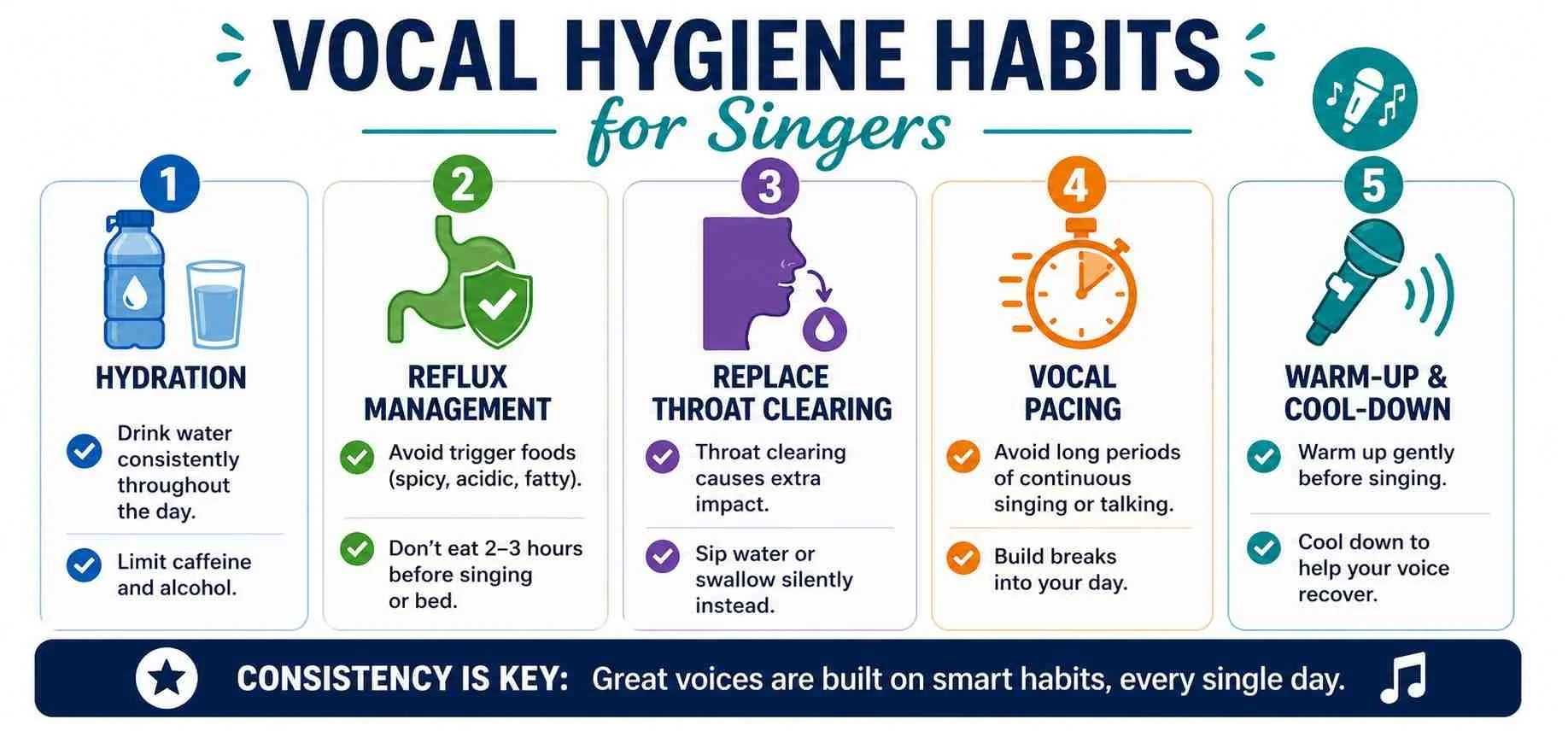
Vocal hygiene refers to the daily behaviors that protect the vocal cords and support healing. Voice therapy outcomes improve significantly when singers build these habits alongside clinical sessions.
Hydration
The thin lining of the vocal cords must stay moist to vibrate smoothly. When the cords dry out, they rub together with more friction and require more muscular effort to produce sound. Singers benefit from drinking six to eight glasses of water throughout the day and limiting caffeine and alcohol, which dry out the throat.
Using a humidifier in dry environments also helps, particularly during air travel. Systemic hydration works far better than throat sprays or lozenges, which only coat the throat and do not reach the cords themselves.
Vocal Rest and Voice Use Pacing
Vocal rest means reducing unnecessary voice use, not going completely silent. Complete voice rest is rarely prescribed outside of post-surgical recovery, because total silence can cause the cords to stiffen.
Singers are taught to pace their voice across the week: quieter days before heavy performance days, warm-ups before extended use, and cool-down exercises after rehearsals. Whispering is not a safe form of voice rest because it actually increases strain on the cords.
Managing Reflux and Throat Clearing
Acid reflux is a common and often overlooked contributor to vocal problems in singers. Eating smaller meals, avoiding food for 3 hours before sleep, and elevating the head of the bed can all reduce the amount of acid that reaches the throat overnight.
Throat clearing is equally harmful. Each forceful throat clear slams the cords together and can worsen nodules, polyps, and general irritation. Singers learn to replace the habit with a silent swallow followed by a small, quiet cough.
What We See Working with Clients

Many singers who come to us have been told to "just rest" for months with no improvement. Rest alone does not resolve what faulty technique or reflux created.
Once we start working on breath support and resonance placement, most clients notice how quickly the effortful quality in their voice changes. The shift from pushing to forward resonance feels different in the first session, and they often describe it as finally using less energy for more sound.
We also see how automatic throat clearing has become for many singers. Clients often have no idea how frequently they clear their throats throughout the day until we start tracking it together.
When they replace the habit with a silent swallow, their morning voice is noticeably clearer within two to three weeks. That single change reinforces everything else we work on.
Post-surgical recovery is one of the places we see the clearest results. Singers who complete voice therapy after surgery return to their pre-injury baseline far more reliably than those who wait for the voice to come back on its own.
Frequently Asked Questions About Voice Therapy for Singers

1. Do singers need a different kind of voice therapy than other patients?
Yes. Singing voice therapy specifically addresses performance demands that standard voice therapy does not: sustained high notes, shifts between vocal registers, dynamic variation, and endurance over a full show. A speech-language pathologist with training in singing voice incorporates those demands into the evaluation and treatment plan from the start.
2. How do I know if I need voice therapy or just more rest?
Voice rest is the right first step after acute overuse, such as a demanding performance run. If hoarseness, strain, or pain persists beyond two weeks of rest, voice therapy is indicated.
Conditions like vocal nodules, muscle tension dysphonia, and throat reflux do not clear up on their own. Each requires targeted treatment that addresses the underlying cause.
3. Will voice therapy affect my singing style or technique?
Voice therapy does not change your artistic style. It addresses the physical patterns that are causing damage or holding your voice back. Most singers find that the changes they make in therapy, better breath support, less throat tension, and more efficient resonance, improve rather than constrain their technique.
4. How long does voice therapy for singers take?
Most singers with mild to moderate conditions see measurable improvement within four to eight weeks of consistent practice, with full recovery taking two to four months. Post-surgical rehabilitation follows a timeline set by the ENT doctor, usually beginning two to three weeks after surgery. How quickly the voice responds depends on severity, how consistently the singer practices at home, and whether vocal hygiene habits are in place.
5. Can I continue performing during voice therapy?
In most cases, yes. The speech-language pathologist works around the performance schedule and helps manage voice use between sessions.
Post-surgical recovery and acute vocal cord injuries are exceptions where temporary performance restrictions apply. Outside of those situations, voice therapy is designed to support continued performance while the voice heals and strengthens.
How Connected Speech Pathology Can Help

Connected Speech Pathology provides online voice therapy for singers, led by speech-language pathologists with specialized training in vocal health and singing-voice rehabilitation. Our team has clinical experience working alongside ENTs and laryngologists, giving us a deep understanding of what singers need at every stage: prevention, recovery from injury, and preparation for performance.
Online sessions are as effective as in-person therapy for voice disorders. Our voice therapists assess your voice in real time, guide you through exercises, and give you the detailed feedback that helps technique changes stick. Sessions are scheduled around your rehearsal and performance calendar.
Summary
Voice therapy for singers is a clinical treatment delivered by a speech-language pathologist specializing in voice disorders. Singers face an elevated risk of conditions, including vocal nodules, muscle tension dysphonia, throat reflux, and vocal polyps, because of the sustained physical demands their instrument places on the voice box.
Voice treatment combines resonant voice techniques, breath support retraining, semi-occluded vocal tract exercises, and vocal hygiene education to restore healthy function. Most singers recover without surgery when voice therapy begins early.
Connected Speech Pathology offers online voice therapy that fits a performer's schedule, providing the clinical expertise singers need from anywhere.

About the Author
Allison Geller, M.A., CCC-SLP, is a communication coach, speech-language pathologist, and founder of Connected Speech Pathology, an international online practice providing professional communication coaching and speech therapy for children, teens, and adults. With more than two decades of experience, she has worked in medical and educational settings and published research on aphasia. Today, she leads a team of specialists who help clients improve their skills in public speaking, vocal presence, accent clarity, articulation, language, fluency, and interpersonal communication.