Singing Voice Specialist: What They Do and How to Work with One Online

A singing voice specialist is a singing teacher or speech-language pathologist with extra medical training. They help singers heal a vocal injury and sing with more ease. Here is what to know about them: what they do, how they differ from voice teachers, what the work involves, and how to choose one online.
If you are an adult singer coming back from an injury, a performer whose voice tires early, or a heavy voice user, this is the expert trained for you. An injured singing voice rarely settles on its own, and the wrong help can strain hurt tissue further.
Key Takeaways:
A singing voice specialist treats the injured singing voice as part of a medical voice team. They are a singing teacher or speech pathologist who added training in the other field.
Singing voice rehabilitation starts with a thorough evaluation, not exercises. Customized exercises, vocal pacing, and a graded return after surgery follow from what it finds.
No certification program governs the title of singing voice specialist. Ask about training, medical collaboration, and experience with voices like yours.
Voice experts can do this work online, because it runs on listening and cueing. The exam side still needs a laryngologist in person.
What Is a Singing Voice Specialist?
How Singing Voice Rehabilitation Works
How to Choose a Singing Voice Specialist Online
What We See Working with Clients
What Is a Singing Voice Specialist?
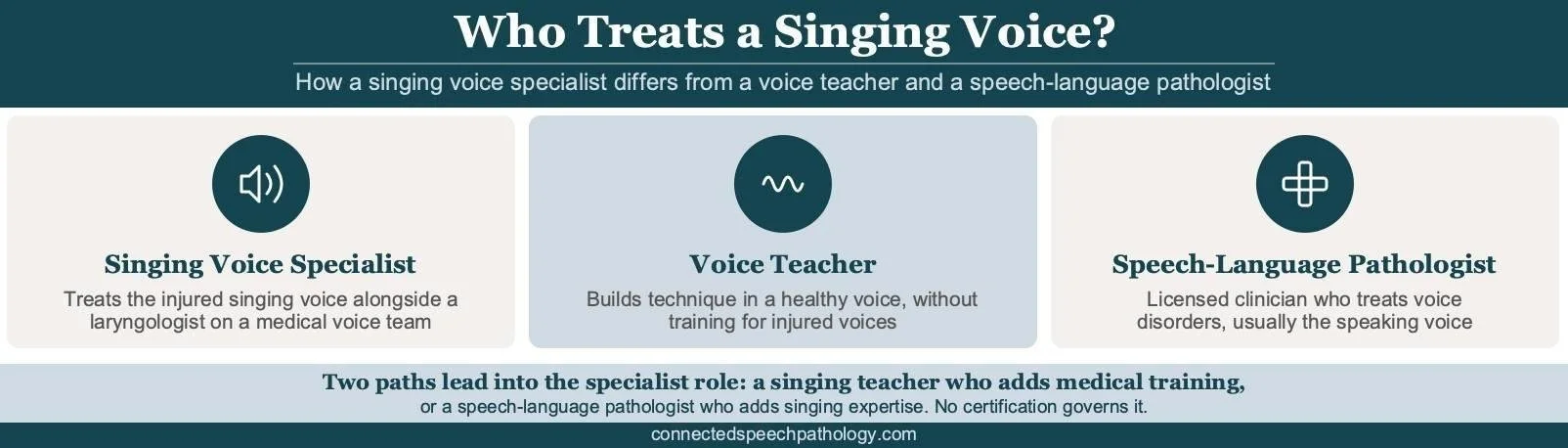
A singing voice specialist treats the injured singing voice. The Voice Foundation describes the role as a singing teacher trained to practice in a medical setting with patients who have sustained vocal injury. The term was coined in 1981.
Two paths lead into this work. Some voice specialists begin as singing teachers and add training in how the larynx works and how injured voices heal. Others begin as speech-language pathologists and bring singing expertise into their clinical practice.
Either way, a singing voice specialist rarely works alone. They collaborate with laryngologists as part of a medical voice team, so vocal pathologies get treated, not worked around.
That medical grounding separates them from voice teachers, who build technique in a healthy voice. A specialist understands voice disorders, and knows the exercises that help injured vocal cords rather than strain them.
Who Can Benefit From Working With A Singing Voice Specialist?

Singing voice rehabilitation starts with measurement. A thorough singing voice evaluation assesses your vocal range, stamina, and technique, and a voice evaluation adds pitch and loudness.
Videolaryngostroboscopy then shows how the vocal cords vibrate during sound production, allowing the voice team to see what the tissue is doing.
From there, the specialist finds the inefficient habits in your technique. Specialized exercises restore vocal function, and straw phonation, humming through a narrow straw, promotes vocal efficiency. Sustained work across your registers smooths the transitions behind vocal breaks.
Voice misuse can lead to vocal disorders, so vocal health education runs alongside the exercises. A specialist recommends vocal hygiene practices for optimal vocal health: cutting voice overuse, staying hydrated, and leaving throat clearing alone.
Vocal Pacing and Voice Rest
Vocal pacing is the scheduling half of recovery. It means planned voice rest intervals during the day, and longer voice rest periods for heavy voice users. Without recovery times, vocal cords heal more slowly, so vocal pacing prevents repeat vocal injuries.
Recovery After Vocal Cord Surgery
Surgery changes the sequence. Microsurgery can remove noncancerous vocal cord lesions through a small incision, and complete voice rest sometimes follows. Voice therapy is essential after microsurgery, with customized exercises that rebuild vocal quality and stamina and help prevent re-injury.

Voice Therapy for Singers: What It Is and How It Helps
Check out our blog on voice therapy for singers for more information.
How to Choose a Singing Voice Specialist Online
No formal training programs exist for singing voice specialists, and no certification sits behind the title. That puts the vetting on you, and four questions reveal the most:
Where did their specialized training come from? Voice pedagogy, speech-language pathology, or a mix are all reasonable. Vagueness is not.
Who do they work with? A specialist who names the laryngologists and voice clinic teams they work with is describing a real medical voice team.
Have they treated voices like yours? A soprano recovering from surgery and a worship leader with muscle tension dysphonia need different plans.
What happens in the first session? You should hear a clear answer about evaluation before exercises.
Remote and virtual coaching options suit this work, because so much of singing voice rehabilitation is listening, cueing, and adjusting exercises in real time. Working online also widens your choice beyond the voice experts who practice near you.
What We See Working with Clients

In our practice, we work with singers and heavy voice users, from students to touring performers. The examples below are real clients of ours. Identifying details have been changed to protect privacy.
A musical theater performer came to us after being diagnosed with a vocal fold injury. Her voice was tired by the second act, and sustained high notes had started to crack. She had begun turning down auditions to save her voice.
We used straw phonation warm-ups, sustained vowel work through her register transition, and vocal pacing built into her show week. Once her laryngologist cleared her, we added a graded return to full singing. Her sound held through a complete show.
A worship leader came to us for a different reason. He sings and speaks across several services each weekend, and by Sunday evening he was hoarse into his Monday meetings.
We worked on breath support for steady airflow, replaced his throat clearing with a silent swallow and a sip of water, and reviewed hydration and reflux timing over his weekend. Rest intervals were taken between services. He now gets through the weekend without the Sunday hoarseness.
Frequently Asked Questions About Singing Voice Specialists

1. Do you need a certification to be a singing voice specialist?
No. Nothing regulates the title. Training is usually built through apprenticeship, observation, and coursework in voice pedagogy or speech-language pathology, so a specialist's background is worth asking about.
2. Can a singing voice specialist work with you online?
Yes, for the voice work itself. The exam side still happens in person, so a good online specialist keeps a referral route to a laryngologist open for anything that needs a scope.
3. Is vocal damage from singing permanent?
Usually not. Many vocal injuries respond to voice therapy, voice rest, and technique changes. Outcomes depend on the injury and how early voice treatment starts, so a voice clinic evaluation is worth scheduling early.
4. Do you still need voice therapy after vocal cord surgery?
Yes. Voice therapy is essential after microsurgery for optimal recovery. Surgery addresses the lesion, and voice therapy rebuilds vocal quality and stamina while helping you avoid the habits that contribute to it.
5. When should you see a doctor instead of a singing voice specialist?
See a doctor first for hoarseness lasting more than two weeks. Pain, breathing trouble, or sudden loss of voice can also come first. A laryngologist can examine your vocal cords and rule out conditions that require a doctor's care before voice work begins.
How Connected Speech Pathology Can Help

Our speech pathologists provide online voice therapy for singers and other professional voice users, and voice and performance coaching for people who want more from a healthy voice. We match the approach to the person rather than the diagnosis, so a touring singer and a weekend worship leader get different plans. Sessions run from wherever you sing.
Summary
A singing voice specialist blends singing training with medical knowledge to heal an injured singing voice. They work alongside a laryngologist when a condition, such as muscle tension dysphonia, is involved. The work runs from a thorough evaluation to exercises such as straw phonation and a vocal pacing plan.
No certification governs the title, so a specialist's training and medical ties are what to ask about. The work relies on listening and real-time coaching, so it translates well to online sessions.

About the Author
Allison Geller, M.A., CCC-SLP, is a communication coach, speech-language pathologist, and founder of Connected Speech Pathology, an international online practice providing professional communication coaching and speech therapy for children, teens, and adults. With more than two decades of experience, she has worked in medical and educational settings and published research on aphasia. Today, she leads a team of specialists who help clients improve their skills in public speaking, vocal presence, accent clarity, articulation, language, fluency, and interpersonal communication.