Understanding Stuttering in Teenagers: Causes and Solutions
Stuttering in teenagers is a fluency disorder that disrupts the normal flow of speech. No one knows what causes developmental stuttering, the most common form. It runs in families, and imaging studies show differences in the brain areas that plan speech, but neither of those explains every case. Less often, stuttering starts after a brain injury or after significant emotional trauma. Sorting out which of these fits is where speech therapy starts.
If your teenager has started stuttering, is stuttering more than before, or is pulling back from speaking, understanding the cause is the first step. The sections below explain how stuttering develops, why it can start or worsen during puberty, and what treatment and family support look like. Teens who connect with a speech-language pathologist before avoidance behaviors take hold make the most meaningful gains.
Key Takeaways
Stuttering in teenagers is a fluency disorder with three distinct types. Developmental, neurogenic, and psychogenic stuttering each require a different treatment path.
Puberty is a common point where stuttering starts or worsens. The brain undergoes significant reorganization during adolescence.
About 40% of teenagers who stutter also experience anxiety or depression. Emotional support belongs alongside speech therapy.
The goal of stuttering therapy is not perfect fluency. It is the ability to communicate confidently in everyday school, social, and work situations.
Causes of Stuttering in Teenagers
Sudden Stuttering in Teenagers
Supporting a Teenager Who Stutters
The Role of a Speech-Language Pathologist in Stuttering Treatment
What We See Working with Clients
Frequently Asked Questions About Stuttering in Teenagers
How Connected Speech Pathology Can Help Teenagers Who Stutter
What Is Stuttering?

Stuttering is a speech disorder marked by disruptions in the normal flow of speech. It produces involuntary sound repetitions, prolongations, or blocks where sound stops before the next word comes out. The symptoms of stuttering in teenagers can vary widely from person to person, and a single cause does not explain most cases.
These patterns are not habits. They are disruptions in the motor planning and fluency system that a child cannot produce smoothly on demand.
Symptoms of stuttering in teenagers often include disruptions in the normal flow of speech, such as repeating sounds, prolonged vowels, or complete blocks. Physical tension in the face or neck sometimes accompanies these moments. Stuttering is a motor-planning disorder with neurological and genetic roots, not caused by nervousness, poor parenting, or an emotional failing.
Stuttering often becomes more noticeable during the teen years for a specific reason. Social awareness grows, and a teenager who has a speech problem starts noticing reactions from peers, teachers, and others. That awareness can lead to avoidance behaviors, such as word changing, staying silent in class, or pulling back from activities. These avoidance patterns are typically not present in younger children.
About 1% of people stutter, and without treatment it often continues past childhood. What changes during the teen years is usually not the stuttering itself but the effort to hide it. Younger children rarely swap words or go quiet to avoid a disfluency. Noticing that shift early means a teenager can work on avoidance before it becomes automatic.
Causes of Stuttering in Teenagers

No single factor explains stuttering. Genetics, brain development, and speech and language development all seem to interact, and the mix is different from one teenager to the next. The clearest link so far is family history. A teenager with a parent, sibling, or child who stutters is significantly more likely to stutter too.
Brain structure differences in the speech-motor planning network have been documented across brain imaging studies. Environmental stress can also worsen stuttering in a teen who is already predisposed. Recognizing a child's stuttering symptoms early helps pinpoint the type and guide treatment.
Three distinct types account for most cases of stuttering in teenagers. The type shapes how a speech-language pathologist approaches treatment. The table below outlines the key differences.
| Type | Main Cause | When It Starts | Typical Treatment |
|---|---|---|---|
| Developmental stuttering | Genetic predisposition; brain structure differences in speech-motor planning | Early childhood; sometimes persists or worsens in adolescence | Evidence-based fluency and modification techniques with self-advocacy coaching |
| Neurogenic stuttering | Brain injury, stroke, head trauma, or lesion affecting speech processing | Sudden onset following a neurological event, in childhood or adolescence | Medical evaluation first, then speech therapy once the cause is identified |
| Psychogenic stuttering | Emotional trauma or prolonged psychological stress affecting speech fluency | Sudden onset following a trauma or significant stressor | Cognitive behavioral therapy alongside speech therapy |
| Connected Speech Pathology | connectedspeechpathology.com | |||
Developmental Stuttering
Developmental stuttering comes from a genetic tendency and how the brain organizes the speech network. It typically begins in early childhood, and a family history of stuttering raises the risk of persistent stuttering continuing into the teen years. Puberty is a common point where it surfaces or worsens in a teen who was already predisposed.
Neurogenic Stuttering
Neurogenic stuttering occurs when a neurological event, such as brain tumors, strokes, head trauma, or neurodegenerative diseases, disrupts speech production. Unlike developmental stuttering, it has a clear onset point tied to that event. A medical evaluation would be performed before any speech therapy begins.
Psychogenic Stuttering
Psychogenic stuttering follows significant emotional trauma or extreme stress affecting speech and communication. Among the three types, it is the least common in teenagers. A combination of CBT and speech therapy typically produces the best outcomes.
Understanding the type is a common step before a speech pathologist establishes a care plan with a client. Neurogenic stuttering requires medical evaluation before speech therapy begins. Psychogenic stuttering benefits most when emotional support is established from the start.
Sudden Stuttering in Teenagers

Stuttering can start or worsen suddenly during the teenage years, and puberty is the most common reason. The brain undergoes major changes during adolescence, including in areas that support language development. Rapid language acquisition can unmask or amplify a fluency disorder that was previously mild.
Searches for stuttering in teenagers with sudden onset often reflect a parent noticing a change in a teen who had little or no previous stuttering. Late-onset developmental stuttering during puberty is the most common explanation. Hormonal changes can worsen stuttering symptoms in a teen who was already predisposed, and speech therapists who work with teens see this pattern regularly.
A speech-language pathologist can help a family understand whether this is a first-time stutter or a known tendency that puberty has amplified.
Neurogenic stuttering requires prompt attention when it is the cause of sudden onset. It occurs when a traumatic brain injury, stroke, or lesion disrupts speech production. When a teenager begins stuttering after a head injury or loss of consciousness, medical professionals and a speech-language pathologist should both assess.
Other neurological symptoms, such as headaches or vision changes, raise the urgency of that evaluation. The cause determines the correct treatment path. Prompt assessment from both a physician and a speech-language pathologist can lead to the best outcomes.
Psychogenic stuttering can also begin in a teenager following significant trauma or prolonged stress. Among the three types, it is the least common reason a teenager develops a sudden stutter. A combination of CBT and speech therapy typically produces good outcomes, and most teens make meaningful gains when both are addressed together.
Supporting a Teenager Who Stutters
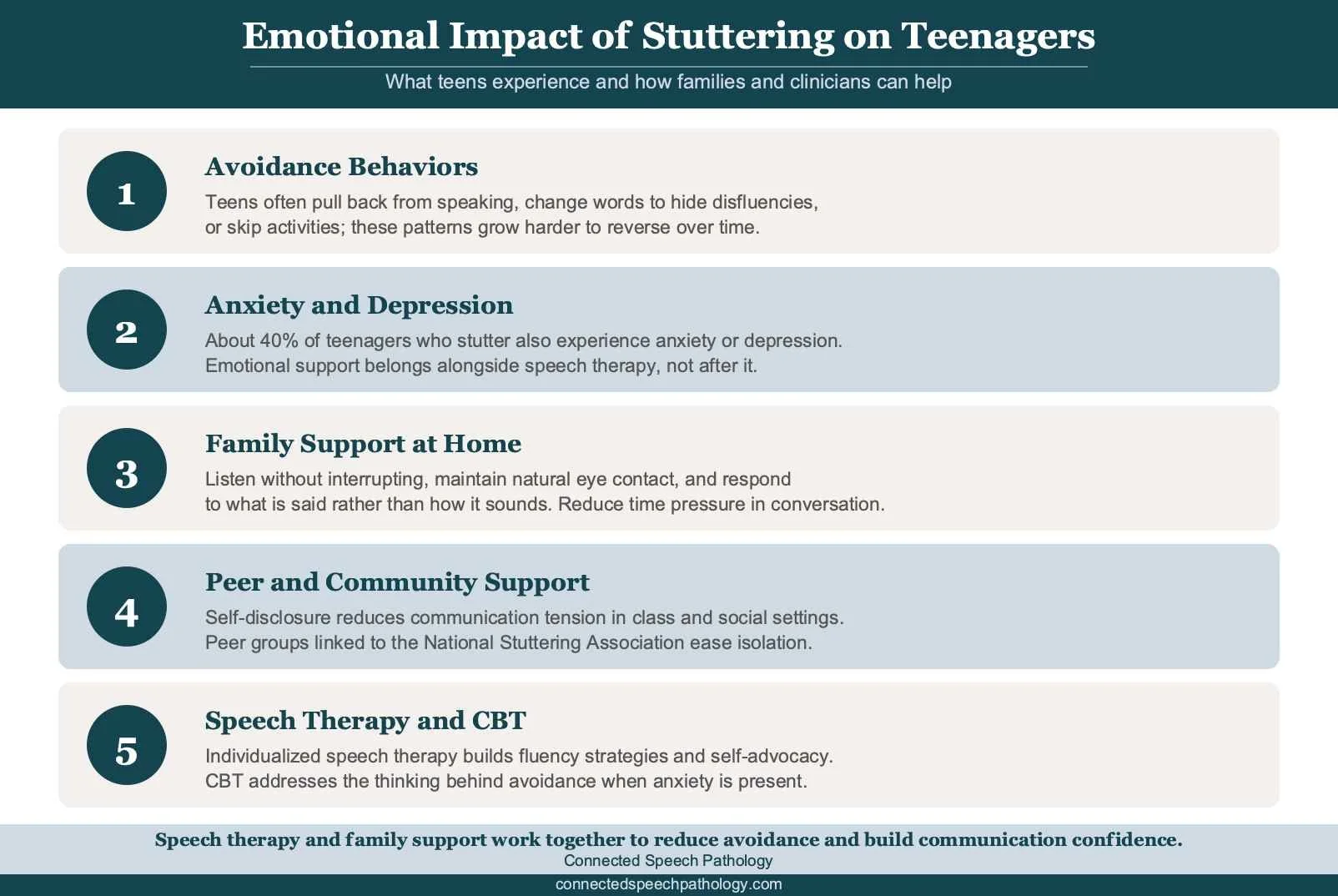
Avoidance behaviors can worsen the impact of a stutter over time. A stuttering teen who pulls back from speaking, changes words to hide disfluencies, or skips activities builds avoidance patterns that grow harder to reverse. Early intervention gives a stuttering teen access to strategies before those patterns take hold.
About 40% of teenagers with stuttering symptoms also experience anxiety or depression. That figure makes emotional well-being a clinical priority, not an add-on. Open communication helps teens feel safe discussing stuttering rather than managing it alone.
Self-disclosure about stuttering can help alleviate communication tension. A speech therapist can guide both the teen and the family through this process.
Communication attitudes shift when a teen understands that confident communication is achievable even when disfluency is present. Empowering teens can help them embrace their stutter.
Family and Home Environment
Support from family and educators can greatly shape a teenager's experience with stuttering. At home, parents can listen without interrupting, maintain natural eye contact, and respond to what is said rather than how it comes out. Gradual desensitization, guided by a speech-language pathologist, helps reduce speaking avoidance, and working with the child's teachers can extend these gains into school settings.
Reducing time pressure in daily conversations has a direct effect on how the teen approaches speaking elsewhere. Parents who practice this consistently often see gradual change in their teen's willingness to speak up.
School and Peer Support
Self-disclosure about stuttering can alleviate communication tension in classroom and peer settings, which can directly improve academic performance. Speech therapists often help teens practice explaining their stutter clearly and calmly when they choose to.
Peer support groups such as those at the National Stuttering Association and the Stuttering Foundation can reduce feelings of isolation and connect stuttering teens with others who understand the experience.
Cognitive Behavioral Therapy
Psychological counseling, particularly cognitive behavioral therapy, can reduce social anxiety, anxious thought patterns, and speaking avoidance. CBT addresses the psychological or emotional factors behind avoidance and works alongside speech therapy, not instead of it. A referral to a therapist is standard for teenagers with significant distress, combining anxiety work with fluency practice.
The Role of a Speech-Language Pathologist in Stuttering Treatment

Speech therapy is the primary approach for stuttering in teenagers. Sessions are individualized to the stuttering type, severity, and teen's communication goals. Early intervention improves outcomes across most fluency disorders.
Each evaluation looks at the specific challenges, goals, and emotional factors present before a plan is built.
Fluency Shaping
Fluency shaping teaches different speaking habits through controlled breathing, gentle voice onset, slow speech, and strategic pausing. These techniques reduce stuttering episodes by changing the underlying production patterns. Better speech fluency develops with practice, improving communication in everyday speaking situations.
Stuttering Modification
Stuttering modification does not try to eliminate disfluency. It helps a teenager ease through a block rather than fight it, which reduces the physical tension that often builds around moments of stuttering. A fluency specialist typically uses both approaches to manage stuttering, adjusting the balance based on the teenager's goals.
Goals of Stuttering Therapy for Teenagers
The goal of stuttering therapy for teenagers is confident communication, not perfect fluency. Teens develop communication skills and language abilities and learn to speak effectively across school, social life, and eventually work. Multiple speech therapy sessions also build language skills and self-advocacy, giving teens tools to explain their needs to teachers, coaches, and others they meet daily.

Speech Therapy for a Teenager
Learn more about speech therapy for a teenager in this blog.
What We See Working with Clients

Speech-language pathologists who work with teenagers notice a consistent pattern. The stutter itself is rarely the only challenge. Speaking avoidance and the emotional weight around it develop quickly in the teen years.
The examples below are real clients of ours. Identifying details have been changed to protect privacy. Each case reflects a different type of stuttering and a different path into care.
A 15-year-old came to us after a stutter that had been mild in middle school worsened significantly in ninth grade. By the time her family reached out, she was avoiding oral presentations, rarely raising her hand, and had stopped participating in clubs she had previously enjoyed.
Her speech therapist used stuttering modification techniques alongside self-disclosure coaching. That meant structured practice for telling a teacher or peer about her stutter before a high-stakes speaking moment. She also worked with a therapist for CBT to address the avoidance patterns that had built up.
Within six months, she had joined her school's debate team and was raising her hand in class regularly.
A 14-year-old developed a sudden stutter several weeks after a concussion during a soccer game. His family recognized the stutter was new and distinct from anything he had experienced before.
His speech-language pathologist coordinated with his neurologist, who used brain scans to rule out a structural cause, before beginning fluency therapy. Controlled breathing and gentle voice onset exercises were practiced in sessions and introduced in daily conversations at home with parent coaching.
Over four months, his speech returned to a comfortable baseline across most everyday situations. Parent coaching at home was a key part of that progress.
Frequently Asked Questions About Stuttering in Teenagers

1. Can you develop a stutter as a teenager?
Yes, a teenager can develop a stutter or other speech problem. Stuttering in teenage situations most often begins as a developmental pattern, a neurogenic event, or a psychogenic response to stress. A speech-language pathologist can identify the type and recommend the right approach.
2. Is stuttering in teenagers permanent?
Stuttering in teenagers is not necessarily permanent. Many build meaningful communication skills through speech therapy, with the focus shifting to communicate effectively in the situations that matter. For many teens, speech therapy produces lasting gains in fluency and in managing disfluency when it occurs.
3. What is the best treatment for stuttering in teenagers?
A speech therapist is the best resource for stuttering in teenagers. CBT is often recommended alongside it when avoidance and distress are significant. The most effective stuttering treatments are built around the type of stuttering and the teenager's specific needs.
4. Does stuttering get worse during puberty?
Puberty can make stuttering worse in this age group, particularly for those already predisposed. The brain undergoes significant changes during adolescence that affect language processing. A speech pathologist who initiates early intervention can help prevent stuttering from deepening as those changes settle.
5. How can parents best support a teenager who stutters?
The best support is responding to what is said, not how it comes out. Give the teen time to finish, have open conversations, and connect with a speech-language pathologist early. Doing so gives the teenager individualized strategies and removes the guesswork for the whole family.
How Connected Speech Pathology Can Help Teenagers Who Stutter

Connected Speech Pathology offers stuttering therapy for teenagers through sessions with speech-language pathologists who specialize in fluency disorders. Each plan is built around the teenager's goals, the type and severity of stuttering, and the emotional and social factors present. Sessions are available online, so teens can work with a qualified therapist from home or school.
Many teens work with a therapist to overcome stuttering's impact, boost confidence, and improve their communication abilities over time.
Summary
Stuttering in teenagers is a manageable communication disorder that may involve repetitions, prolongations, and blocks. Working with a speech-language pathologist can help teens learn strategies to manage their stuttering, communicate more confidently, and advocate for their needs.
Family support and cognitive behavioral therapy (CBT), when appropriate, can also play an important role. Together, these approaches help teenagers participate more fully in school, social situations, and future work opportunities.

About the Author
Allison Geller, M.A., CCC-SLP, is a communication coach, speech-language pathologist, and founder of Connected Speech Pathology, an international online practice providing professional communication coaching and speech therapy for children, teens, and adults. With more than two decades of experience, she has worked in medical and educational settings and published research on aphasia. Today, she leads a team of specialists who help clients improve their skills in public speaking, vocal presence, accent clarity, articulation, language, fluency, and interpersonal communication.