How Many Words Should an 18-Month-Old Say?
Parents often ask how many words an 18-month-old should say, and the honest answer is a range, not a single number. Most 18-month-olds say about 10 to 50 words, and anywhere in that range can be considered normal. Here is what to know about language at 18 months: the typical word count, the words toddlers learn first, what shapes their language skills, and when slower language development may be a sign of a language delay.
If you are a parent or caregiver wondering whether your child is on track, this guide gives you a calm, clear answer. Knowing what is normal helps you guide your toddler early, when it matters most.
Key Takeaways
Most 18-month-olds use about 10 to 50 words. The average is near 20, and many toddlers understand far more than they can say.
In 2022, the Centers for Disease Control and Prevention (CDC) and the American Academy of Pediatrics moved away from using a single word count as a milestone. Instead, they also consider gestures, the ability to understand simple directions, and other early communication skills.
Gestures, following simple instructions, and copying sounds matter just as much as the number of words. Looking at all of these skills together gives a better picture of how your toddler's speech and language skills are developing.
If your toddler isn't saying any words by 18 months, talk with your pediatrician or a speech-language pathologist. Early help lets late-talking children catch up.
How Many Words Is Typical at 18 Months?
Words to Teach an 18-Month-Old and Encourage Talking
Factors Influencing Language Development
When to Worry About a Late Talker
What We See Working with Toddlers and Families
Frequently Asked Questions About 18-Month-Old Language Milestones
How Many Words Is Typical at 18 Months?
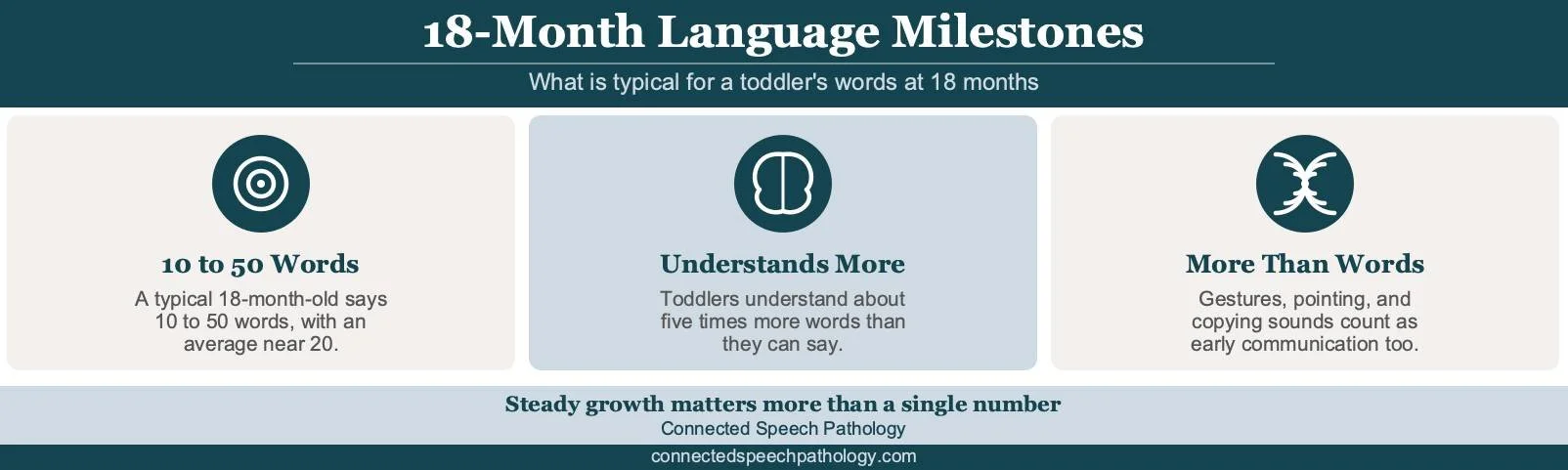
A typical 18-month-old says about 10 to 50 words, with an average of about 20. The development of a toddler's speech varies significantly from one child to another, so there is no single timeline that fits every child.
Some children say only a handful of words and are still developing typically. Others already use more than 100. That wide range is one reason a single word count can be misleading.
In 2022, the CDC and the American Academy of Pediatrics removed strict counts from their developmental milestones for this age. Instead of asking only how many words a toddler says, they look at how a child uses and understands language. Rather than focusing on a single word count, speech-language pathologists often look for a few consistent words by 18 months, with steady growth month to month.
What counts as a word is broad, too. Animal sounds, family names like "mama," and even part of a word like "ba" for ball, all count when your child uses more words with meaning.
Typical 18-Month-Old Vocabulary
By 18 months, many toddlers move past early babbling toward combining ideas. A couple of years later, you can check their progress against 4-year-old speech milestones. Some begin pairing two words into short phrases, such as "more milk," though full sentences come much later. New words often appear slowly at first, then vocabulary growth accelerates.
Understanding Language
Many toddlers understand far more words than they can say. It's common for a child to understand about five times more than they speak, so your 18-month-old can follow simple instructions, point to body parts like their nose, and find familiar pictures long before speaking them aloud. Strong skills are among the best early signs that spoken words are on the way.
Types of Words
An 18-month-old's vocabulary usually goes beyond names. Toddlers use action words ("go," "eat"), social words ("hi," "bye"), and everyday nouns like "dog," "car," and "mama." A mix of word types matters more than the total.
Words to Teach an 18-Month-Old and Encourage Talking
Encourage new words by focusing on the people, objects, and routines your child already loves. Simple, clear words stick best because your toddler hears them every day. Good first words to model include family names like" mama", favorite foods, animals and their noises, and routines like bath time and meals.
Everyday moments build language best. Narrate what you are doing, read books together, and sing nursery rhymes and fun songs your child enjoys. Follow your toddler's interest: if they point to a dog, name it, add short phrases, and wait for them to respond.
Factors Influencing Language Development

Most children build vocabulary at their own pace, so many things shape how many words a toddler says without signaling a problem. Bilingual children often produce fewer words in one language at first while building two at once. Toddlers with older siblings sometimes talk less when others speak for them.
Boys often take a little more time than girls to build a large vocabulary, sometimes up to two years. Experts also recommend limiting screen time so your toddler gets more real, back-and-forth interaction.
Frequent conversation and reading together help foster vocabulary growth, and interaction with others gives toddlers opportunities to hear and try new words. Hearing is also foundational to speech and language development, which is why it is often evaluated when a toddler is slower to start talking.

What is the Most Common Cause of Speech Delay?
Check out our blog on the most common cause of speech delay for more information!
When to Worry About a Late Talker

A late talker is a toddler who is slower to start talking but is developing typically in other areas. The number of words matters less than the whole picture. It is more concerning when a toddler does not point, copy sounds or animal noises, follow simple instructions, or show interest in communicating with others.
Watch for these signs around 18 months:
Says no words at all, or has stopped using words they once said
Does not respond to their name or to familiar sounds
Rarely points, waves, or reaches to communicate
Does not seem to understand simple questions or directions
If you notice these signs, reach out to your child's doctor. Research shows that early intervention leads to better outcomes for many children with speech and language delays, making an early speech and language evaluation worthwhile if you have concerns.
What We See Working with Toddlers and Families
We often work with parents who are unsure whether their child's speech and language development is on track. The examples below are based on real client experiences from our work. Names and details have been changed to protect privacy.
One family came to us because their 18-month-old used only a few words and became frustrated when he could not communicate what he wanted. During virtual sessions, we coached his parents in real time as they practiced language-building strategies with him at home.
Together, we modeled simple words, paused to encourage a response, and created opportunities for him to communicate during meals, bath time, and play. Over the next several weeks, he began imitating more sounds and using new words throughout the day.
Another toddler understood simple directions and enjoyed interacting with her family, but rarely used spoken words. Through telepractice, we coached her parents during shared book reading and play, showing them how to pair gestures with short phrases and create opportunities for her to communicate instead of anticipating her needs. Before long, she was pointing more often, attempting single words, and naming familiar pictures during story time.
Frequently Asked Questions About 18-Month-Old Language Milestones

1. Why does my 18-month-old only say a few words?
A small vocabulary at 18 months is often still typical. It is reassuring if your child also understands you, points, and copies sounds. Some toddlers build words slowly before a later burst of language.
2. How many words should an 18-month-old be saying?
Most say about 10 to 50 words. The average is near 20, but steady growth and your child's understanding matter more than an exact number.
3. Should I be concerned if my 18-month-old understands but isn't talking?
A strong understanding is a reassuring sign. Still, no spoken words by 18 months is worth raising with your pediatrician for peace of mind.
4. What is considered a speech delay at 18 months?
Few or no spoken words, especially when paired with limited gestures, can signal language delays. A speech therapist can tell the difference between a late talker and a child with a delay who needs support.
How Connected Speech Pathology Helps

Our speech-language pathologists provide online evaluations and parent coaching for late talkers and toddlers with speech and language delays.
Through telepractice, we coach parents in real time during everyday routines, helping them build language-learning opportunities into play, meals, book reading, and other activities at home.
Learn more about our speech therapy for toddlers and how online speech therapy works.
Summary
How many words should an 18-month-old say? Most toddlers use about 10 to 50 words, but milestones now place less emphasis on a single word count and more on how your child communicates, understands language, and continues to make progress.
Gestures, following simple directions, understanding familiar words, and continued progress over time all provide important clues about language development. If your toddler is not saying any words by 18 months, a speech-language pathologist can determine whether they are a late talker or have a speech or language delay and recommend the next steps.
About the Author
Allison Geller, M.A., CCC-SLP, is a communication coach, speech-language pathologist, and founder of Connected Speech Pathology, an international online practice providing professional communication coaching and speech therapy for children, teens, and adults. With more than two decades of experience, she has worked in medical and educational settings and published research on aphasia. Today, she leads a team of specialists who help clients improve their skills in public speaking, vocal presence, accent clarity, articulation, language, fluency, and interpersonal communication.