Puberphonia Voice Treatment for Teens

During puberty, male voices typically deepen as the larynx grows. When this change does not occur, and the voice remains high, the condition is known as puberphonia.
This can be frustrating and affect confidence in everyday communication. Education about puberphonia treatment helps families understand why this happens and how change is possible.
Key Takeaways
Puberphonia is a voice disorder in which a post-pubescent male’s voice remains high in pitch despite normal physical development.
Voice therapy is the primary treatment and focuses on healthy voice production and appropriate pitch control.
Early intervention often leads to faster and more stable improvements in vocal pitch and overall voice quality.
Achieving a lower, more appropriate pitch can improve daily communication, confidence, and self-esteem.
Puberphonia as a Voice Disorder
Voice Production, Vocal Cords, and Speech and Language
Puberphonia Treatment Through Voice Therapy
Early Intervention and What to Expect During Treatment
Daily Life After Voice Improvement
Puberphonia as a Voice Disorder
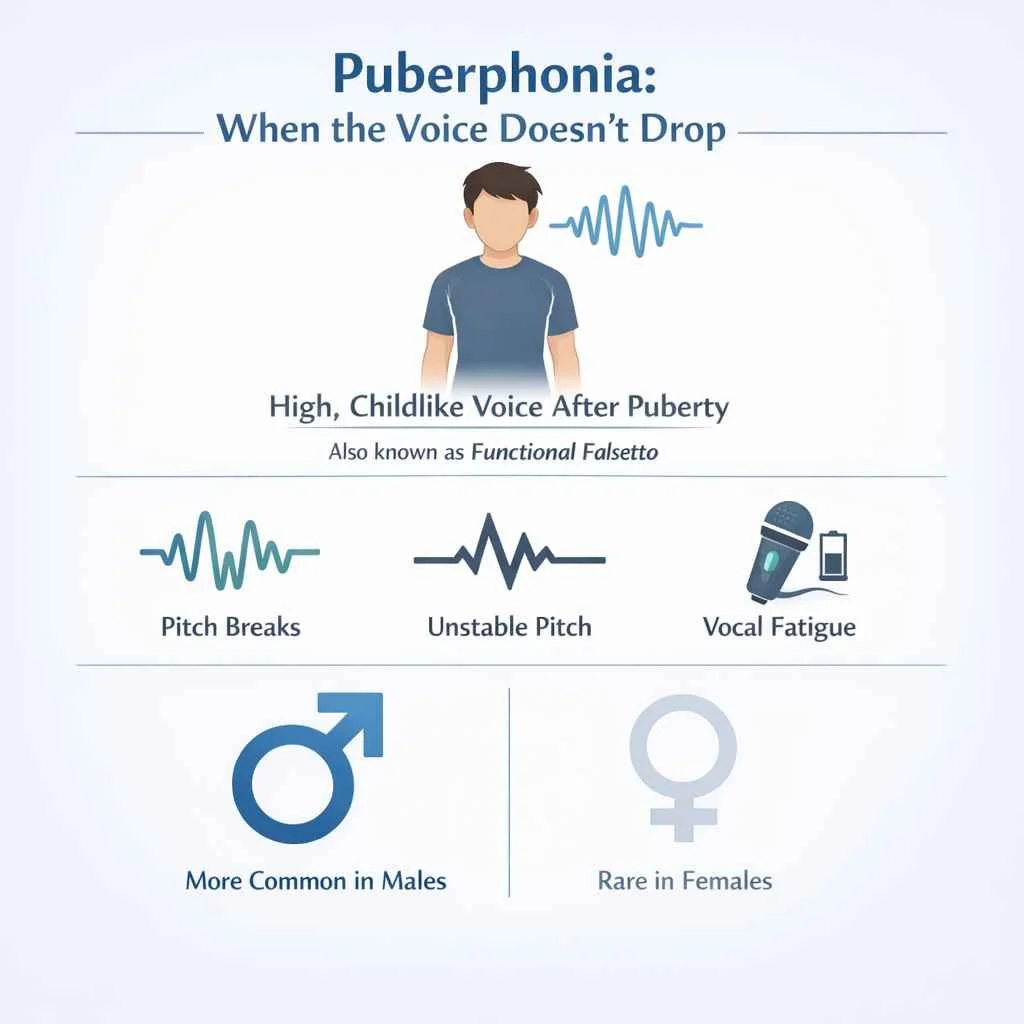
Puberphonia is a functional voice disorder where a teen continues using a very high-pitched voice after puberty. This condition is also known as functional falsetto or mutational falsetto. The voice sounds higher than expected, even though the body has matured.
Primary Symptoms of Functional Falsetto and Mutational Falsetto
The primary symptom is a persistent high voice that does not match physical development. Some teens experience pitch breaks, unstable pitch quality, or a voice that fatigues easily. These voice sounds can interfere with speaking in class or social situations.
Effects on Male Voice and Female Voice
Puberphonia most often affects the male voice after puberty. The voice does not settle into a normal male voice or a deeper pitch. In rare cases, pitch control issues may also affect a female voice.
Voice Production, Vocal Cords, and Speech and Language

Voice production occurs when air passes through the vocal cords in the voice box. During puberty, the vocal folds grow longer and thicker, lowering vocal pitch. In patients with puberphonia, this growth occurs, but the voice remains high.
Vocal Folds, Pitch Range, and Muscle Tension
Excess muscle tension around the throat and thyroid cartilage keeps the vocal folds stretched. This limits the pitch range and prevents access to a lower pitch. Tension may also affect vocal projection and vocal quality.
Emotional Stress and Psychological Factors
Emotional stress and psychological factors often influence puberphonia. Fear of change or concern about sounding different can reinforce a high voice. These factors are addressed during voice therapy to support lasting improvement.
Puberphonia Treatment Through Voice Therapy

Puberphonia treatment focuses on changing voice habits rather than relying on medical interventions. Voice therapy is the primary form of treatment. Surgery is rarely needed.
Comprehensive Voice Assessment Before Treatment for Puberphonia
Voice treatment begins with a comprehensive voice assessment. This includes perceptual assessment, pitch scale analysis, and visual assessment of vocal quality. Some teens also complete a detailed ENT evaluation with an ENT surgeon to view the vocal cords and diagnose a voice disorder.
Direct Voice Therapy Techniques for Lower Pitch
Speech-language pathologists are trained voice therapists who specialize in assessing and treating pitch and voice disorders such as puberphonia. In voice therapy, the speech therapist works with the client to safely access and stabilize a lower vocal pitch during speech.
Vocal exercises may include vegetative sounds, sustained vowel production, and structured pitch-control exercises. Treatment methods focus on reducing excessive tension and eliminating hard glottal attack, while promoting smooth, healthy voice onset and a more appropriate pitch.
Indirect Voice Therapy and Language Therapy Support
Indirect voice therapy supports healthy voice use outside sessions. Teens learn relaxation techniques, throat-clearing reduction, and healthy speaking habits. Language therapy strategies may help build confidence in conversation.
Early Intervention and What to Expect During Treatment

Speech therapy sessions are structured and goal-driven. Many teens hear a new voice early in treatment. Continued practice supports consistent voice use.
Customized Voice Therapy Program and Therapy Techniques
Each teen follows a customized voice therapy program based on their patient’s voice. Programs combine voice therapy and behavioral therapy techniques. This structure supports steady progress.
Practice Speaking and Intervention Outcomes
Practicing exercises between sessions helps stabilize a lower pitch. Many teens experience significant improvement in pitch quality and vocal range. Early intervention supports stronger intervention outcomes.

Speech Therapy for a Teenager
Check out our blog on teenager speech therapy for more information!
Daily Life After Voice Improvement

A lower-pitched voice often feels more natural and comfortable. Teens may notice improved confidence and clearer communication. Changes in voice quality can positively affect school, social life, and self-esteem.
Frequently Asked Questions About Puberphonia Treatment

1. What is the primary treatment for puberphonia?
Speech therapy is the primary treatment for puberphonia. Speech-language pathologists focus on pitch control, vocal quality, and healthy voice production. Treatment does not usually involve medication or surgery. Consistent practice helps maintain progress.
2. How long does puberphonia treatment take?
Many teens notice improvement within the first few speech therapy sessions. Continued voice therapy sessions support stable use of a lower pitch. The timeline for treating puberphonia depends on practice habits and comfort with the new voice. Early intervention often leads to faster results.
3. Is puberphonia caused by damaged vocal cords?
The vocal cords are usually healthy in puberphonia. The issue concerns how the vocal folds function during speech. A comprehensive voice assessment confirms normal structure. Treatment focuses on function rather than damage.
4. Can puberphonia affect daily life?
Puberphonia can affect communication, confidence, and social interaction. Teens may avoid speaking due to voice concerns. Speech therapy helps improve vocal quality and ease of speaking. These changes often support better participation at school.
How Connected Speech Pathology Can Help

At Connected Speech Pathology, we provide online voice therapy for individuals diagnosed with puberphonia. Our speech pathologists support teens using a multi-dimensional voice program focused on pitch quality and voice production. We deliver care through secure and accessible online sessions.
We begin with a comprehensive voice assessment to understand vocal pitch, vocal range, and voice quality. Each treatment plan supports a stable lower pitch and confident communication.
Our online services support consistent practice speaking between sessions. We focus on real-life voice use across school, home, and social settings. Our goal is a comfortable voice that fits the teen’s development.
Summary
Puberphonia is a voice disorder in which the voice remains high after puberty. Voice therapy helps teens access a lower pitch and healthier voice production. With practice and guidance, many teens experience great improvement in voice quality and confidence.

About the Author
Allison Geller is a communication coach, speech-language pathologist, and founder of Connected Speech Pathology, an international online practice providing professional communication coaching and speech therapy for children, teens, and adults. With more than two decades of experience, she has worked in medical and educational settings, published research on aphasia, and leads a team of specialists helping clients improve skills in public speaking, vocal presence, accent clarity, articulation, language, fluency, and interpersonal communication.