How to Enunciate Better in Conversations, Presentations, and Calls

Learning how to enunciate better is less about effort and more about retraining physical habits. Most people who struggle with mumbling or unclear speech have developed jaw tension, shallow breath patterns, and rushed pacing that work against clarity. The tips in this guide cover the mechanics of why clarity breaks down and the specific exercises that build lasting muscle memory.
With consistent daily practice, most adults see distinct improvement within a few weeks. The key is targeting the right physical habits, not just speaking more slowly or trying harder. The exercises in this guide are ordered by impact, with the highest-yield changes first.
Key Takeaways
Enunciation problems most often trace back to jaw tension, reduced mouth opening, and rushed pacing, not carelessness. Identifying the root cause is the first step toward lasting change.
Targeted exercises like tongue twisters, vowel practice, and resistance training build the muscle memory needed for clear talking. Consistency matters more than duration.
Breath control from the diaphragm supports a steadier voice and reduces the shallow breathing that leads to dropped consonants. It is the foundation most people overlook.
Recording yourself is one of the fastest ways to hear what others hear. Most people are surprised on playback.
How to Enunciate Better: What It Actually Means
Why Your Jaw and Mouth Are Working Against You
Enunciation Exercises That Build Real Muscle Memory
How Breath Control Helps You Enunciate Better
How Posture Changes the Way You Sound
Tools That Support Clearer Speech
What We See Working with Clients
How to Enunciate Better: What It Actually Means
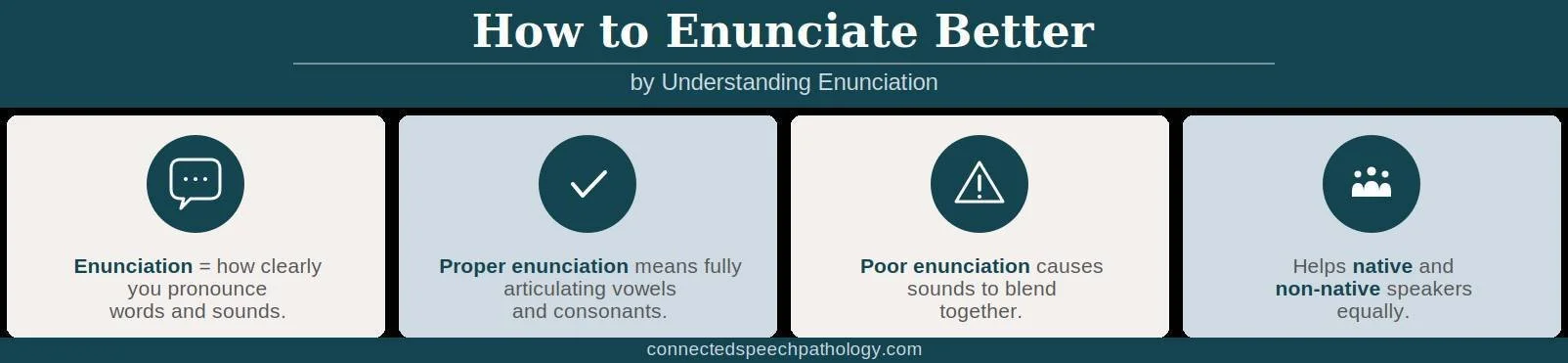
Enunciation is the clarity of your speech sounds. To enunciate better means making each syllable, consonant, and vowel sound distinct and fully formed so listeners can follow without effort.
Clear speech differs from correct pronunciation. Pronunciation is about accuracy, getting the right sounds for a word. Enunciation is about clarity, making those sounds distinct and audible in real conversation.
You can pronounce every word correctly and still be hard to understand if the sounds are soft, blended, or underpowered. Poor enunciation is usually a physical problem, not a language one.
Proper enunciation is not the same as formal speech. It means every sound lands clearly enough that listeners do not have to fill in gaps.
For more context on this skill, see our complete guide linked below.

Enunciation: Causes, Exercises, and How to Improve It
Check out our blog on how to improve enunciation for more information.
Why Your Jaw and Mouth Are Working Against You

A tight jaw is the most common driver of mumbling and unclear talking in adults. When the jaw does not open wide enough, sound forms in a compressed space, and vowels cannot fully form, producing speech that is muffled.
Jaw tension builds during high-stakes moments: video calls, presentations, and fast-paced conversations. Over time, the habit becomes default, and mumbling that started under pressure becomes the resting state.
The good news is that jaw muscles respond quickly to targeted training. Most people notice more open movement within a few days of consistent practice.
The resulting articulation problems are muscular, not language-based. The jaw, tongue, and lips have stopped producing the precise shapes required for distinct speech, and training those muscles directly is what changes the outcome.
Open Your Mouth Wider to See Immediate Change
Opening your mouth wider is one of the most direct ways to improve clarity right away. Many adults speak with their teeth barely apart, forcing every sound through a narrow channel.
Exaggerate your mouth opening while reading a paragraph aloud. The sounds feel silly at first, which means the muscles are working harder than usual. That exaggeration trains the jaw toward a wider, more open baseline.
How the Tongue and Jaw Shape Every Word
Tongue and jaw placement shape sounds at the moment of production. Distinct consonants like "p," "b," and "m" require complete closure at the front of the mouth. Rounded vowels require full lip rounding.
When facial muscles are underused, these shapes become approximate, and words start to blur together. A person can be putting in real effort and still be hard to follow if the jaw and tongue are not moving enough.
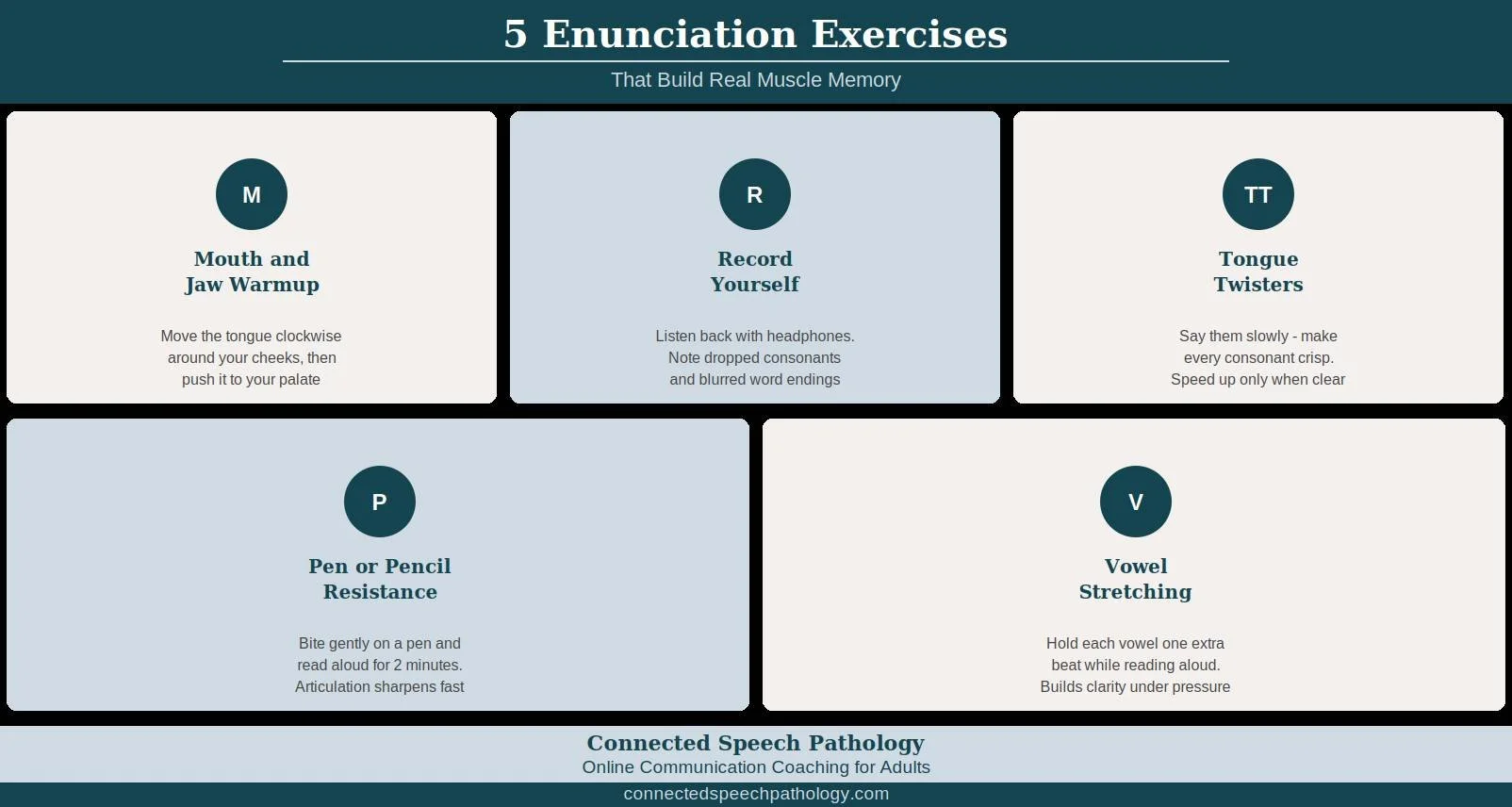
Daily tongue warm-ups prepare the voice before speaking. Move the tongue clockwise around the inside of your cheeks, then reverse. Push it to your palate and hold for two seconds, then release.
Enunciation Exercises That Build Real Muscle Memory
Precise movement is what these exercises demand. That precision creates motor patterns the brain recalls automatically during real conversation.
A few minutes of focused daily work produce faster results than hours of passive effort.
How Tongue Twisters Build Pronunciation Muscle Memory
The goal is not to say them quickly. Make every consonant pop, sizzle, and snap while keeping each syllable distinct.
Start with: "around the rugged rocks the ragged rascal ran," "she sells seashells by the seashore," and "Betty bought a bit of butter, but the butter was bitter." Say each one slowly. Speed up only when every sound stays crisp.
Five minutes each morning before calls or presentations is enough. The improvement tends to show up within the first few days. The reason these exercises work is motor learning: repeating a precise movement pattern under controlled conditions writes it into muscle memory faster than incidental speaking ever does.
Vowel Stretching and the Pen Resistance Exercise
Vowel sounds are where most adults lose clarity under pressure. Stretching vowels during drills trains the jaw and tongue to fully form them, even when pacing increases. Hold each vowel one extra beat while reading aloud, then return to normal speed.
One of the most effective tips for quick results is the pen resistance exercise. Bite gently on a pen held horizontally and read aloud for two minutes. The resistance forces your oral muscles to work louder and harder.
When you remove the pen, your articulation is measurably sharper. Daily repetition builds that sharpness into your resting baseline.
A variation is biting the knuckle of your thumb for the same effect without a prop. Both exercises work because the added resistance forces your oral muscles to produce more deliberate, exaggerated shapes, which is exactly what muscle memory training requires.
Recording Yourself to Hear What Others Hear
Recording yourself is one of the most efficient exercises available. Most people are surprised on playback. Common patterns include dropping final consonants, blurring word endings, and rushing through familiar lines.
Listen for sounds on words ending in "t," "d," "k," and "g." Also listen for vowel sounds in unstressed syllables, which tend to flatten when pacing increases.
Do this three times per week, and the shift in how you talk becomes audible within two to three weeks. Many people are surprised to find their speech clarity issue has nothing to do with how loud they speak and everything to do with specific sound placement.
How Breath Control Helps You Enunciate Better

Breath control is the foundation of vocal clarity. When the diaphragm drives airflow, the voice has steady support to sustain sounds through to the end of a word.
Shallow breathing cuts off airflow mid-phrase, and the final letters of words disappear. Speakers are clear at the start of a sentence and mumbling by the end.
Engage the diaphragm by letting the belly expand on the inhale, not the chest. Place one hand on your abdomen. A proper breath for speaking moves that hand outward first.
Many people only make this connection when they try breath-first speaking for the first time, shifting focus from the words to the air underneath them.
Controlled breath work also reduces tension in the larynx and vocal cords, removing the tight, clipped quality that makes speakers hard to follow.
Repeat this pattern before a call or presentation. The more automatic it becomes, the less clarity degrades under pressure. Many people who sound unclear on calls are simply tensing in anticipation, and breath-first speaking breaks that cycle.
For a structured approach, our guide on breathing exercises for public speaking under pressure covers specific techniques.
How Posture Changes the Way You Sound

Good posture gives your voice the physical space it needs. When you slouch, the ribcage compresses, diaphragm movement is restricted, and the voice loses strength on consonant sounds.
Keep your head level with your chin straight and parallel to the floor. Let your shoulders relax back. Check whether your neck juts forward at a desk, and bring your head back over your shoulders.
Body language and posture signal confidence to listeners. An open stance also produces a noticeably louder, clearer voice.
On video calls, a lens set below eye level causes most people to tuck their chins. Raise your screen to eye level, and the improvement is immediate.
If you have a standing desk, use it for presentations or long calls. Standing opens the ribcage fully, making diaphragmatic breath support easier to maintain.
The connection between posture, breath, and clarity means addressing all three together produces better results than working on any one in isolation. Speakers who fix their posture often find that breath and enunciation problems resolve more easily as a result.
Tools That Support Clearer Speech
The exercises above work best when paired with tools that reinforce daily practice. Together, they give you a complete system for learning to speak clearly and consistently.
Apps like ELSA Speak and Speeko offer pronunciation drills with real-time feedback. Non-native English speakers find them especially useful for vowel sounds and consonant placements that are hard to self-monitor.
For pacing, a slow metronome during read-aloud drills forces pausing at phrase boundaries and prevents the rushed pacing that blurs words. Staying hydrated keeps the tongue and airway ready. Dehydration is a real but overlooked factor in clarity loss during long-stage presentations or meetings.
For more on signs that communication patterns need attention, see our guide on signs of poor communication skills.
The clarity of speech guide covers specific strategies for adults who want a more comprehensive approach to how they come across in professional settings.
What We See Working with Clients

A sales director began sessions after hearing the same feedback for months: people could not follow him on calls.
Once we reviewed recordings of his calls together, the pattern became obvious. He sped through familiar sections, dropped final consonants, and barely moved his jaw once he got going.
We focused on slowing the pace slightly, increasing jaw movement, and practicing difficult phrases out loud. Within a couple of weeks, people stopped asking him to repeat himself nearly as often.
Another client was preparing for a board-level presentation and thought she was running out of breath. The issue was actually throat tension building before she even started speaking.
Once we shifted the focus away from “sounding clear” and toward releasing tension before each sentence, her speech became much more consistent across the full presentation.
Frequently Asked Questions About Enunciation

1. Why do I mumble even when I try to speak clearly?
Mumbling usually has a physical cause. The most common drivers are a tight jaw, insufficient jaw opening, and shallow breath that drops off before word endings. Trying harder without addressing the underlying mechanics rarely produces lasting change.
2. Do tongue twisters actually improve clarity for adults?
Yes, and the research on motor learning explains why. Tongue twisters create demanding movement sequences that strengthen coordination between the tongue and jaw. Practiced slowly and with focus on each sound rather than speed, they build muscle memory that transfers to natural conversation.
3. What is the difference between enunciation and pronunciation?
Pronunciation is about producing the correct sounds for a given word. Enunciation refers to the clarity and crispness of those sounds as you actually talk. A person can pronounce every word correctly and still find it difficult to understand if the enunciation is soft or imprecise.
4. How long until you start seeing results?
Most adults notice a difference within two to three weeks of consistent daily effort. Feedback from others typically follows within four to six weeks.
The timeline depends on how deeply the underlying patterns are habituated; people who record themselves and review the audio tend to see faster results.
5. When should I work with a communication coach?
Self-guided practice works well for mild clarity issues. A communication coach makes sense when the problem is affecting professional performance, when exercises have not produced results, or when you want structured feedback on your specific vocal patterns.
How Connected Speech Pathology Can Help

At Connected Speech Pathology, our communication coaches work with adults who want to speak more clearly in the situations that matter most. Sessions are online, structured around your specific vocal patterns, and built around the real contexts you speak in rather than drills in isolation.
Summary
How to enunciate better comes down to addressing the physical patterns that cause unclear talking: jaw tension, restricted opening, shallow breath support, and rushed pacing. Consistent daily exercises, including tongue twisters, resistance training with a pen, vowel stretching, and diaphragm support, build the muscle memory that makes clarity automatic. Most adults see real change within a few weeks of focused practice.

About the Author
Allison Geller, M.A., CCC-SLP, is a communication coach, speech-language pathologist, and founder of Connected Speech Pathology, an international online practice providing professional communication coaching and speech therapy for children, teens, and adults. With more than two decades of experience, she has worked in medical and educational settings and published research on aphasia. Today, she leads a team of specialists who help clients improve their skills in public speaking, vocal presence, accent clarity, articulation, language, fluency, and interpersonal communication.