How to Be More Coherent When Speaking

You can speak more coherently by organizing your ideas, slowing your pace, and reducing filler words. Coherent speech is a skill you can learn, and it grows with steady practice and a bit of self-awareness. Here is what to know about speaking coherently: what it means, the habits that get in the way, and the techniques that make your ideas easy to follow.
Maybe you are wondering how to be more coherent when speaking, after a talk where your thoughts came out tangled. If you struggle to get your point across, get asked to repeat yourself, or lean on filler words, small changes can make a real difference. Clear speech changes how people respond to you at work and at home, and it is easy to build with practice.
Key Takeaways
Coherent speech means your ideas arrive in an order a listener can follow. It depends far more on how you organize what you say than on which words you choose.
Deciding on three points before you speak is the fastest way to sound organized. You always know what comes next, so you spend less energy searching mid-sentence.
Slowing down and pausing gives you time to form the next idea. Those pauses are also what cut filler words like "um" and "like."
Delivery carries as much of your message as the words do. Clear articulation, eye contact, and varied tone make you easier to follow.
What Does It Mean to Speak Coherently?
How to Be More Coherent When Speaking in Everyday Conversation
Improve Articulation to Become More Articulate
Use Body Language to Improve Clarity and Connection
Practice Speaking to Become a More Well-Spoken Speaker
What We See Working with Clients
What Does It Mean to Speak Coherently?

Coherent speech means expressing your ideas in a clear, logical order so your audience follows your point without confusion. Each sentence connects to the next, your message stays focused, and listeners can track where you are going. When speech loses that structure, it sounds scattered and becomes hard to follow.
A few common habits undermine coherent speech more than any others. The table below pairs each one with what listeners experience and a simple fix.
| Common barrier to coherent speech | What listeners experience | What to do instead |
|---|---|---|
| Speaking faster than you think | Ideas arrive jumbled and unfinished | Slow down and pause between points |
| Filler words like um or you know | Attention drifts from your message | Replace the filler with a brief silence |
| No clear structure | Listeners lose the thread | Organize around three key points |
| Vague references like it or that | Confusion about what you mean | Restate the noun you are pointing to |
| Flat, monotone delivery | Emphasis and meaning get lost | Vary your tone and add natural pauses |
| Connected Speech Pathology | connectedspeechpathology.com | ||
You struggle to speak coherently when you try to talk faster than your thoughts can form. When you rush, you lose your train of thought or reach for filler words to cover the silence, which breaks the flow of your ideas.
Stress adds to it too. Under pressure, your voice tightens, and your articulation slips, so your listener has to work harder to understand you. Small bad habits build up over time as well, like interrupting yourself or switching topics without warning.
When your speech is coherent, your audience spends its energy on your thoughts instead of trying to make sense of your words. You become easier to understand, more convincing, and more memorable.
How to Be More Coherent When Speaking in Everyday Conversation
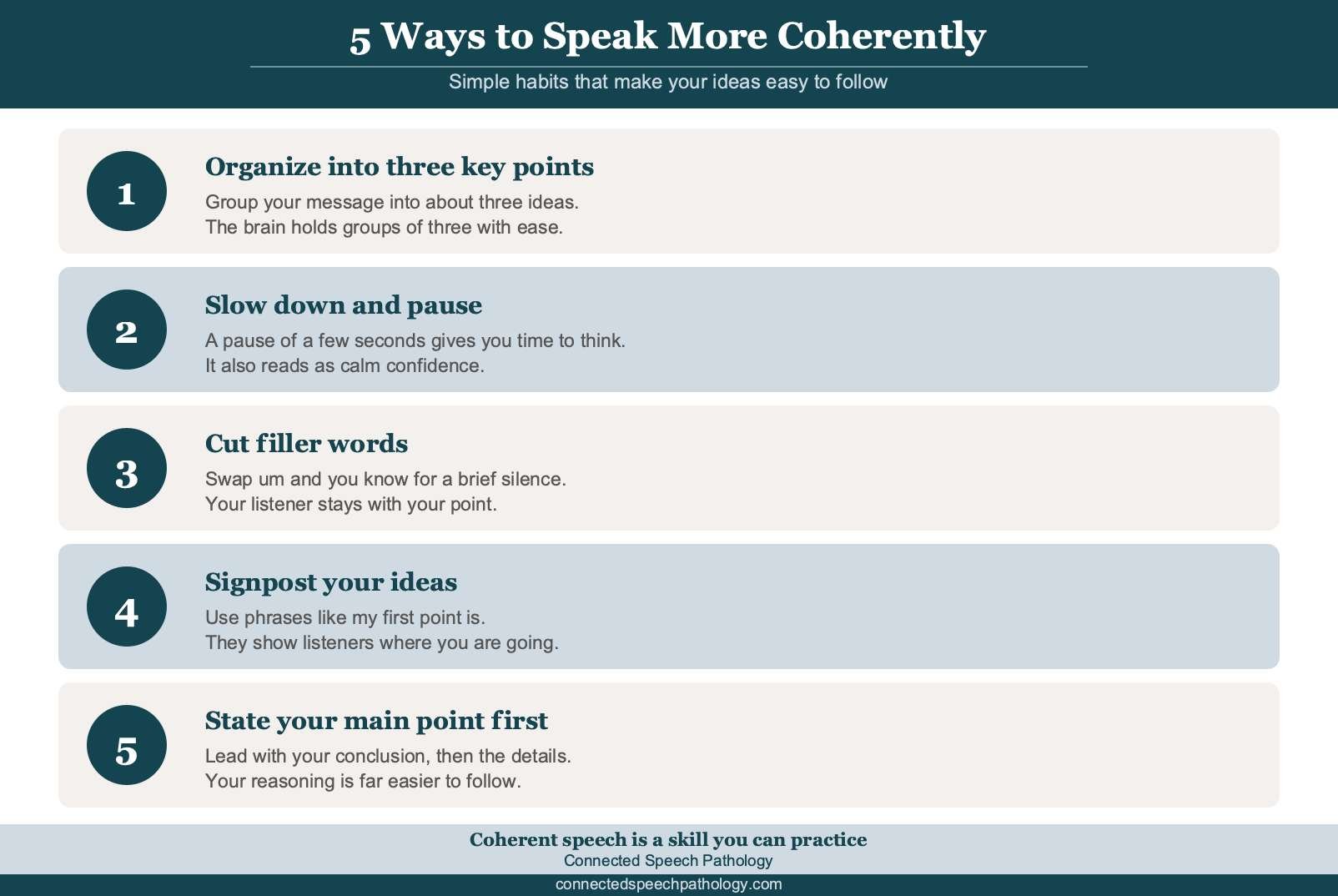
Everyday conversation gives you the lowest-stakes place to practice coherent speech. A few deliberate habits make your ideas easier to follow the moment you start talking.
Organize Your Ideas Into Three Key Points
Before you speak, group what you want to say into about three key points, for example, the situation, the problem, and what you want to happen next. The human brain tracks and remembers groups of three unusually well, so a short list is simple to hold in mind. Many confident speakers keep simple mental notes, and for a detailed topic, writing a few lines first helps you organize your thoughts into clear words.
Slow Down and Use Pauses
When you speak slowly and intentionally, you improve clarity and control. A pause of a few seconds gives your brain time to prepare the next sentence, and it gives your listener a better understanding of the last one.
A short silence reads as confidence, while rushing makes you sound less sure. Deliberate pacing, not speed, is what sounds polished.
Manage Filler Words and Signpost Your Ideas
Filler words are a normal part of spontaneous speech, and every speaker uses them. They only work against you when they come often enough that listeners notice them instead of your point. Reducing them takes a conscious effort, so start with the one or two you rely on most and replace them with a brief pause. Pausing has the added benefit of giving your audience a moment to absorb what you said.
Signposting helps too, and short phrases like "my first point is" or "here is why that matters" tell your listener what is coming next. When you use a vague word like this or that, restate the noun so your listener does not have to guess what you mean. Repeating a key word from your previous sentence connects one idea to the next.
State Your Main Point First
Lead with your conclusion, then give the supporting details, and prune the ones that add nothing. When you state your main point first, your listener has a frame to fit everything else into, and your reasoning becomes far easier to follow. Leading with the point is the opposite of building slowly toward a reveal, which often loses people before you arrive.
Improve Articulation to Become More Articulate

Clear articulation makes coherent speech easier to follow, even when your ideas are well organized. Articulation is how precisely you form each sound. Small improvements help you sound more articulate.
Focus on the vowel sounds and the last sound of each word. Dropping a final sound blurs your meaning, and proper pronunciation keeps you clear. Tongue twisters strengthen your articulation, and exaggerating your mouth movements builds the same control.
These exercises are suggestions, not a fixed program. A speech therapy provider or communication coach can help you pick the ones that fit your voice.
Use Body Language to Improve Clarity and Connection

Body language supports your spoken message and helps listeners stay with you. Eye contact shows confidence and keeps your audience engaged, interested, and open gestures invite them into what you are saying.
Your tone matters as much as your words. A flat, monotone voice drains the emotion from a strong point, while varied pitch adds emotion and meaning, and keeps people listening. Strong nonverbal cues and a warm tone build the emotional connection that words alone cannot.

Improve Your Body Language in Public Speaking
Check out our blog on improving your body language in public speaking for more information!
Practice Speaking to Become a More Well-Spoken Speaker

Coherent speech grows through low-pressure practice long before it shows up in high-stakes moments. A few regular habits build the fluency you want.
Start with friends you trust. Talk through a topic with one of them and ask whether your ideas came across clearly, because honest, helpful feedback speeds up your progress.
Reading aloud every day strengthens the flow between your ideas, connects your writing to your speech, and improves clarity. Practicing by explaining something out loud shows you exactly where your thinking is still fuzzy.
Coherent conversation runs both ways, so active listening skills matter as much as talking. When you fully follow what the other person says, your responses fit better and stay on topic.
Good listening also gives you time to plan. While the other person talks, you can gather your thoughts and pick the one idea you want to add. As you build confidence, step gradually outside your comfort zone by practicing with friends, joining group discussions, or sharing a single point in a meeting.
Public Speaking and Coherent Speech
Public speaking raises the stakes on coherent speech, so preparation and structure carry even more weight. An outline built around a few clear key points lowers your stress and keeps you organized.
Practice your talk several times at a slower pace, and focus on one idea per sentence so listeners can hear and follow each step. Controlling your breathing helps you organize your thoughts under pressure, and a slow, deep breath before you start keeps your voice calm.
Shorter sentences make the logical relationships between your ideas easier to hear. Each time you rehearse, you build confidence and strengthen your ability to express yourself clearly.
What We See Working with Clients

In our communication coaching sessions, we work with adults who know their material well but find that listeners have trouble following them. The examples below are real clients of ours. Identifying details have been changed to protect privacy.
One client, a project manager, came to us because his meeting updates rambled. Colleagues frequently asked him to repeat his point, and he left meetings frustrated.
We worked on organizing each update into three points, with his conclusion first. He practiced that structure before every meeting. Within a few weeks, colleagues had stopped asking him to repeat himself, and his team could act on his updates right away.
Another client, a graduate student preparing for her thesis defense, spoke so quickly that her committee could not tell where one idea ended and the next began. We worked on deliberate pauses and on signposting phrases that told her committee what was coming next.
She also read her key sections aloud each day so the slower pacing became familiar. By her defense, she was pausing before each new point, and her committee could follow her answers the first time.
Frequently Asked Questions About Speaking Coherently

1. How can I have a more coherent conversation every day?
Pick one topic and explain it out loud for about two minutes. Record yourself, then listen for filler words and for places where you moved to a new idea before finishing the one before it. Repeat this a few times a week until the slower pace and the three points come without you having to think about them.
2. Why do I use so many filler words when I talk?
Filler words appear when your brain needs time to organize the next idea. Speaking too fast makes this worse. Pausing for a second instead of filling the silence improves your clarity and makes you sound more confident.
3. How do I become a more articulate and well-spoken person?
You become more articulate by choosing precise words and sharpening your articulation skills. Practice clear vowel sounds and every final sound, and read aloud daily. Tongue twisters strengthen control, and organizing your thoughts first keeps your speech clear. Practicing in low-pressure settings builds confidence in speaking.
4. How does body language affect coherent speech?
Body language shapes how clearly people understand you. Eye contact, open gestures, and a varied tone reinforce your words and keep listeners interested. Strong nonverbal cues make a coherent conversation feel confident and easy to follow.
5. How can I speak more coherently under pressure?
Pressure makes most people rush, so slow down on purpose. Take a breath, name your main point, then add one or two details. Focusing on a single idea at a time keeps your speech clear when nerves rise.
6. Can communication coaching help adults improve clarity and confidence?
Yes, communication coaching helps many adults improve clarity, articulation, and organization. A coach reviews your pace, word choice, and delivery, then builds targeted practice so you communicate clearly in everyday life.
How Connected Speech Pathology Can Help

At Connected Speech Pathology, we provide online communication coaching for adults who want to be easier to understand. Our coaches assess your articulation, pacing, organization, voice, and body language, then build a plan around your actual conversations and presentations.
We work on the habits that make speech easier to follow, including using fewer filler words, organizing your ideas before you start, and keeping a steady pace. Sessions use your own material, whether that is a weekly team update or a conference talk. We also offer communication coaching for companies when an organization wants to help its team communicate more clearly.
Summary
How to be more coherent when speaking is mostly a question of structure. Coherent speech means your ideas reach a listener in an order they can follow, and the biggest change most people can make is organizing what they want to say into a few clear points before they start. Keeping a steady pace, pausing between ideas, and using signposting phrases all make you easier to follow.
Delivery matters too, since clear articulation, eye contact, and varied tone make you easier to listen to. Using fewer filler words helps, though everyone uses some, and the goal is not to remove them all. These are habits rather than quick techniques, so they change with steady practice over weeks rather than in a single conversation.

About the Author
Allison Geller, M.A., CCC-SLP, is a communication coach, speech-language pathologist, and founder of Connected Speech Pathology, an international online practice providing professional communication coaching and speech therapy for children, teens, and adults. With more than two decades of experience, she has worked in medical and educational settings and published research on aphasia. Today, she leads a team of specialists who help clients improve their skills in public speaking, vocal presence, accent clarity, articulation, language, fluency, and interpersonal communication.