How Connected Speech Pathology Compares to Local Clinics

Choosing speech support often means deciding between a local clinic and an online provider. Connected Speech Pathology offers fully virtual speech therapy and communication coaching for children, teens, and adults, designed to fit real-life schedules. Understanding how in-person versus virtual service models differ can make a significant difference in choosing speech therapy that supports consistent care and long-term progress.
Below, we compare Connected Speech Pathology with local clinics across key factors to help you decide which option is the best fit.
Key Takeaways
In-person and virtual speech therapy differ in how care is accessed, scheduled, and delivered. Each model supports speech and language needs in distinct ways.
Client interaction, scheduling flexibility, accessibility, and engagement all play a role in determining the best fit. These factors directly influence the consistency of care and overall outcomes.
Personal preferences, comfort with technology, and communication goals often influence which option feels sustainable over the long term.
Connected Speech Pathology vs In Person Clinics
In-Person Speech Therapy at a Local Clinic
Virtual Speech Therapy Through Online Platforms
Scheduling, Accessibility, and Daily Life Fit
Key Benefits of In-Person and Virtual Speech Therapy
Choosing the Right Model for Your Needs
Frequently Asked Questions About Connected Speech Pathology vs Local Clinic
Connected Speech Pathology vs In Person Clinics
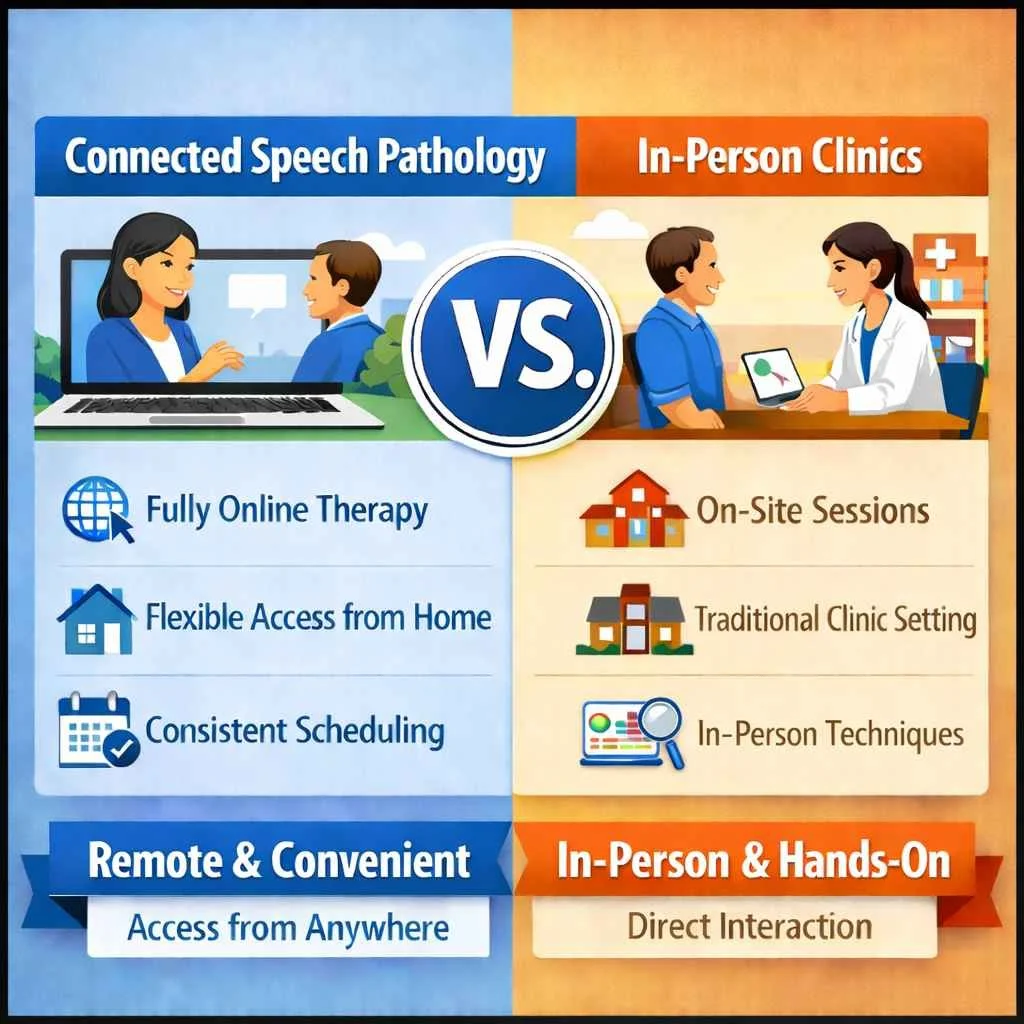
Choosing speech support can feel overwhelming, especially when deciding between a local clinic and a virtual provider. Connected Speech Pathology offers fully remote speech-language pathology services for children, teens, and adults, while local clinics provide care across school and medical environments. Understanding how these models differ can significantly improve the likelihood of finding the right fit.
Although virtual services such as Connected Speech Pathology and in-person sessions share the same clinical goals, their delivery models differ.
Connected Speech Pathology operates as a fully remote, teletherapy-based practice, while local clinics provide in-person services across school, healthcare, and outpatient settings. These distinctions influence access, consistency, and effective communication throughout the care process.
In-Person Speech Therapy at a Local Clinic

Local clinics offer in-person speech therapy, with speech-language pathologists physically present in the room with the client, enabling direct, traditional face-to-face interaction. In-person speech-language pathology services are typically provided in private clinics, hospitals, rehabilitation centers, school settings, or client homes.
In these environments, SLPs may address speech sound disorders, language disorders, swallowing disorders, and communication challenges related to traumatic brain injuries. In-person therapy may be a better fit for individuals who require hands-on techniques, hand-over-hand cueing, or physical prompting to support learning and regulation.
For some school-aged children and adults, in-person therapy offers a highly structured environment that supports attention and participation. School-based SLPs often deliver services within educational settings, coordinating speech therapy goals with classroom expectations.
In private practice and medical environments, speech-language pathologists may provide specialized services alongside physical and occupational therapists through coordinated or co-treatment sessions. This approach is common in inpatient and outpatient care for individuals requiring interdisciplinary support.
Virtual Speech Therapy Through Online Platforms

Virtual speech-language pathology services deliver live care through secure video platforms. Speech therapy sessions take place in real time, allowing clients to participate from home or another convenient location while working directly with a speech-language pathologist. Connected Speech Pathology provides all services through this fully remote, live virtual model.
Virtual sessions use video interaction, screen sharing, interactive games, and digital materials to support active practice and immediate feedback. Speech-language pathologists rely on facial expressions, body language, vocal cues, and changes in vocal quality to guide therapy and adjust strategies in the moment.
Virtual speech therapy is often a strong fit for individuals who can engage through a screen, follow verbal and visual cues, and participate independently or with minimal caregiver support. It is particularly well-suited for school-aged children, teens, and adults seeking to improve speech clarity, expressive and receptive language, and functional communication skills.
Scheduling, Accessibility, and Daily Life Fit

In-person speech therapy is often tied to clinic hours, travel time, and fixed appointment slots. For some families and adults, this structure is helpful. For others managing busy schedules, transportation and scheduling demands can create barriers to ongoing therapy.
Virtual therapy removes many of these constraints by allowing sessions to take place from home or work. This flexibility can support consistent attendance, particularly for working professionals, families with multiple commitments, and individuals living in rural or underserved areas. For some, however, technology barriers or a lack of caregiver support may make virtual care less practical.
Client Engagement, Carryover, and Real-World Practice
Engagement during sessions and carryover into daily life are essential for progress. In-person therapy allows for physical prompts, environmental control, and structured routines that can support engagement for some individuals.
Virtual therapy emphasizes applying communication strategies in real-world environments. Practicing skills at home supports carryover and reinforces effective communication during daily interactions, including conversations, academic tasks, and workplace communication.
This approach can be especially beneficial for clients working on self-monitoring, conversational skills, and generalization beyond the therapy session.
Key Benefits of In-Person and Virtual Speech Therapy

Both in-person and virtual speech therapy models offer meaningful benefits when matched appropriately to client needs. Understanding the strengths of each approach can help individuals and families choose the option that best supports consistency, engagement, and long-term progress.
Key Benefits of In-Person and Virtual Speech Therapy
Both service models offer meaningful benefits when matched appropriately to client needs.
In-person therapy provides hands-on guidance, a structured environment, and access to interdisciplinary care in medical or educational settings. It may be preferred by individuals who benefit from physical prompting or separation between therapy and home.
Virtual therapy supports flexibility, access, and continuity of care. Live virtual sessions enable clinicians to observe communication in natural environments and use digital tools to support engagement and progress.

Compare In-Person vs Online Speech Therapy
Check out our blog to learn the differences between in-person vs online speech therapy!
Choosing the Right Model for Your Needs

The best speech therapy option depends on communication goals, learning style, access to technology, and daily routines. Some individuals benefit most from in-person services, while others thrive in a virtual model that supports consistency and flexibility.
Understanding how each approach addresses communication challenges, engagement, and long-term carryover can help families and individuals choose the option that best supports progress.
Frequently Asked Questions About Connected Speech Pathology vs Local Clinic

1. Is online speech therapy as effective as in-person speech therapy?
Online speech therapy is effective for many speech and language goals. Research supports positive outcomes for language therapy, speech clarity, and communication skills through virtual sessions. Results depend on consistent attendance and appropriate assessment tools.
2. Who benefits most from virtual speech therapy?
Virtual speech therapy is often a strong fit for individuals who can engage through a screen and participate independently or with minimal support. It is especially beneficial for people in rural or underserved areas, as well as children, teens, and adults managing busy schedules who need flexible appointment options to support consistent care.
3. Are speech therapists licensed to provide online therapy?
Speech therapists providing online therapy meet the same licensing standards as in-person providers. Professional requirements apply across all service delivery models. Ethical considerations remain the same.
4. Can online therapy support brain injury recovery?
Online therapy supports many adults and children with brain injury. Speech-language pathologists adjust treatment plans to support communication skills and language recovery. Some clients may also require an in-person evaluation.
How Connected Speech Pathology Can Help

Connected Speech Pathology provides virtual speech therapy using secure online platforms. We support both adults and children.
Our speech-language pathologists deliver speech therapy focused on communication disorders, speech clarity, and language skills. We use digital tools, screen sharing, and structured activities to support effective sessions.
We serve people across locations, including rural or underserved areas. Our approach supports consistent care, ongoing support, and flexible scheduling.
Summary
Choosing between online and local speech services depends on access, preferences, and daily demands. Both models support speech and language goals with consistent care. Clear priorities help clients select the best fit for their communication needs.
About the Author
Allison Geller is a communication coach, speech-language pathologist, and founder of Connected Speech Pathology, an international online practice providing professional communication coaching and speech therapy for children, teens, and adults. With more than two decades of experience, she has worked in medical and educational settings, published research on aphasia, and leads a team of specialists helping clients improve skills in public speaking, vocal presence, accent clarity, articulation, language, fluency, and interpersonal communication.