Developing a Stutter as an Adult: Causes, Treatment, and What to Do

You have spoken your whole life fluently, and suddenly you are stumbling on words you have said a thousand times. If you are developing a stutter as an adult, you are not imagining it, and you are not alone.
Adult-onset stuttering, also called acquired stuttering, can begin gradually or appear overnight in someone with no childhood history of stuttering.
Why does it happen? Adults can develop a stutter after a neurological event, because of psychological factors, or as a side effect of certain medications. Speech therapy with a speech-language pathologist trained in stuttering and fluency disorders can improve fluency and help adults communicate more confidently.
Key Takeaways
Adult-onset stuttering is real and can often improve with treatment. Acquired stuttering can begin in adulthood due to neurological, psychological, or medication-related causes and may respond well to speech therapy.
Three main categories account for many adult-onset cases. Neurogenic stuttering, linked to stroke, traumatic brain injury, or neurodegenerative disease, psychogenic stuttering related to emotional trauma or psychological stress, and pharmacogenic stuttering related to medication side effects represent the most common categories.
Sudden onset with other neurological symptoms can signal a medical emergency. Stuttering that appears suddenly alongside facial droop, weakness, confusion, or severe headache should be evaluated immediately in an emergency setting.
Speech-language pathologists often play a central role in treatment. An SLP evaluates speech patterns, helps identify contributing factors, and builds a plan using fluency shaping, stuttering modification, and counseling support.
Common Causes of Developing a Stutter as an Adult
How Adult-Onset Stuttering Impacts Daily Life
Speech Therapy Treatment for Adult-Onset Stuttering
What We See Working with Clients
Frequently Asked Questions About Developing a Stutter as an Adult
What Is Stuttering?

Stuttering, also called stammering, is a speech disorder that disrupts the natural flow of speech. It shows up as involuntary repetitions of sounds, syllables, or words, prolongations of single sounds, and blocks where speech stops mid-word and will not come out.
Most stuttering begins in early childhood and is called developmental stuttering. Around 75% of children who stutter recover naturally before puberty (Yairi & Ambrose, 2013).
When stuttering starts in adulthood without a childhood history, speech-language pathologists use a different label: acquired stuttering. It breaks down into three recognized subtypes: neurogenic, psychogenic, and pharmacogenic.
Adults developing a stutter for the first time most often fall into one of these three categories. Some cases remain idiopathic, meaning the cause is unknown even after a thorough analysis.
Common Causes of Developing a Stutter as an Adult
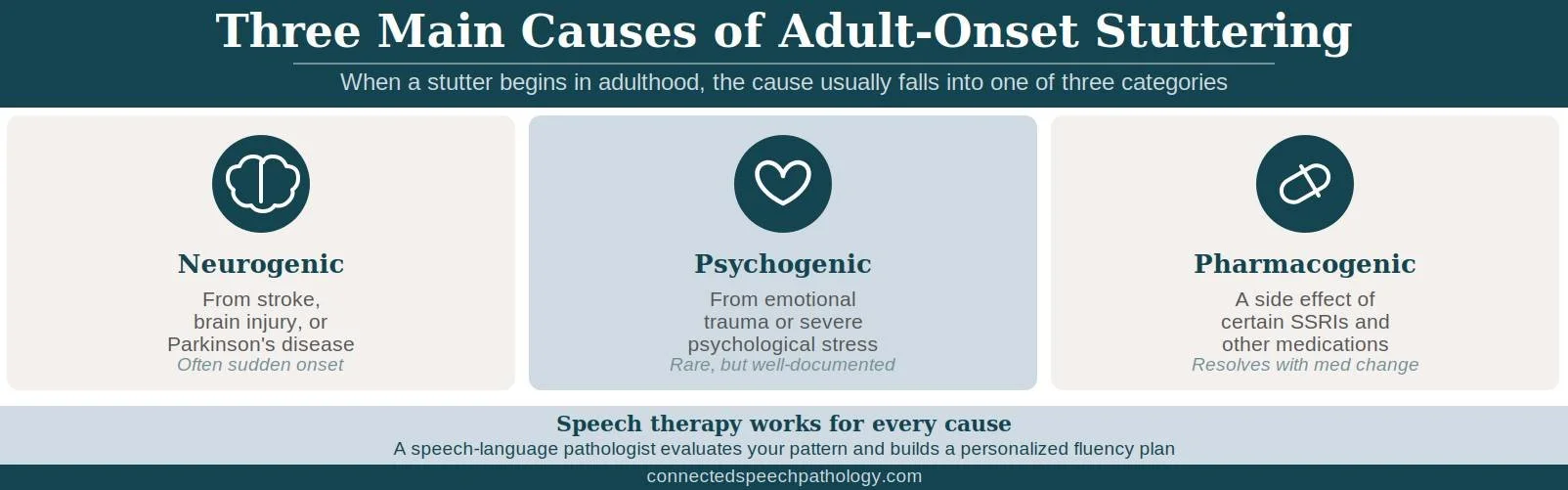
Adults can develop a stutter for several reasons. Neurogenic stuttering may follow brain damage from a stroke, traumatic brain injury, or a neurodegenerative disease, such as Parkinson’s disease. Psychogenic stuttering can emerge after emotional trauma or severe psychological stress, while pharmacogenic stuttering may occur as a side effect of medications that affect the central nervous system.
Neurogenic Stuttering: Stroke, Traumatic Brain Injury, and Neurodegenerative Disease
Neurogenic stuttering is the most common form of acquired stuttering in adults. It results from damage to brain areas that coordinate speech motor control.
The hallmark is sudden onset, often within hours or days of a neurological event.
Stroke is the leading neurological cause. Damage to brain areas controlling speech motor planning produces post-stroke stuttering in roughly two to five percent of stroke patients (Theys et al., 2008), and the disfluencies can appear immediately or in the weeks following the event.
For a deeper look at recovery after a cerebrovascular event, see our guide on stuttering after a stroke.
Traumatic brain injury is another frequent trigger. A concussion, closed-head injury, or penetrating brain injury can disrupt the timing networks that produce smooth speech. Our guide to TBI speech therapy goes deeper into recovery.
Neurogenic stuttering from TBI tends to be more persistent than transient post-stroke stuttering and often benefits from longer-term speech therapy.
Neurodegenerative diseases also produce adult-onset disfluency. Parkinson's disease, multiple sclerosis, and amyotrophic lateral sclerosis (ALS) can all generate stuttering-like patterns as motor control degrades.
In Parkinson's disease, disfluencies sometimes accompany hypokinetic dysarthria, a separate but related motor speech symptom. Brain tumors and recovery from neurosurgery round out the neurogenic causes.
Sudden stuttering paired with facial droop, one-sided weakness, vision changes, confusion, or severe headache is a medical emergency. Call 911 immediately.
These are signs of a possible stroke, and time matters. Sudden stuttering without other neurological symptoms still warrants medical evaluation, especially if the change is new or unexplained.
Learn more in our article on sudden stuttering in adults.
Psychogenic Stuttering: Emotional Trauma, Psychological Stress, and Functional Neurological Symptoms
Psychogenic stuttering is rare but well-documented. It can emerge after emotional trauma, severe psychological stress, or as part of a functional neurological disorder (FND), a condition where neurological symptoms occur without structural brain damage.
Unlike neurogenic stuttering, brain imaging often shows no clear structural injury. Disfluencies may appear suddenly after a triggering event or develop over days to weeks.
Common precipitants include grief, a traumatic accident, post-traumatic stress reactions, severe anxiety, or major life disruptions. The speech pattern can resemble developmental stuttering with repetitions and prolongations, but secondary behaviors, such as eye blinking or facial tension, may be less pronounced.
Learn more in our guide to psychogenic stuttering.
Anxiety is strongly associated with stuttering, but anxiety alone does not directly cause most cases. Once stuttering is present, anxiety can amplify disfluencies and increase avoidance behaviors. Iverach and colleagues reported in 2009 that many adults who stutter also meet criteria for social anxiety disorder, creating a feedback loop where fear of stuttering contributes to more noticeable disfluency.

Can Anxiety Lead to Stuttering?
Read our companion article on the connection between anxiety and stuttering.
Psychogenic stuttering responds well to a combined approach. Speech therapy paired with mental health support works best when trauma or psychological stress is the suspected trigger.
Pharmacogenic Stuttering: Medication Side Effects
Pharmacogenic stuttering is a documented side effect of several medications that act on the central nervous system. The disfluencies typically begin within weeks of starting a new medication or adjusting a dose. They resolve when the medication is changed.
Drug classes with documented stuttering side effects include selective serotonin reuptake inhibitors (SSRIs), such as sertraline and fluoxetine, tricyclic antidepressants, anticonvulsants like topiramate and gabapentin, and stimulants. Bronchodilators containing theophylline have also been linked to acquired stuttering in case reports (Brady, 1998).
If you suspect a medication is contributing to your stuttering, do not stop or adjust the medication on your own. Talk to the prescribing provider. They can evaluate whether a dose change, an alternative medication, or watchful waiting is the right next step.
Idiopathic Acquired Stuttering: When the Cause Stays Unclear
In a meaningful percentage of adult-onset cases, no neurological, psychological, or medication cause can be identified after a thorough workup. Speech-language pathologists call this idiopathic stuttering. The frustration is real because a clear cause feels like the first step toward fixing the problem.
Idiopathic does not mean untreatable. The same speech therapy approaches that work for cases with identified causes still produce gains.
An SLP can build a fluency program based on your speech patterns and goals, regardless of whether the underlying trigger is ever named.
How Adult-Onset Stuttering Impacts Daily Life

Adult-onset stuttering can be unsettling because it appears after years of typical speech. Many adults notice changes in confidence, communication, and daily interactions as they adjust to the new pattern.
Frustration and self-consciousness are common. Some adults describe feeling less confident in conversations that once felt automatic.
Many start avoiding situations that place extra pressure on speaking. Others rehearse words before phone calls, meetings, or introductions to reduce the chance of getting stuck.
Workplace communication can become more stressful, especially in roles that rely on presentations, meetings, sales calls, or client conversations. Some adults begin turning down public speaking opportunities or shifting away from highly verbal responsibilities.
Social situations may feel different, too. Phone calls, restaurant orders, or introducing yourself in a group can trigger anticipatory anxiety, especially when stuttering is new and unpredictable.
These changes are often manageable with the right support. Treatment for fluency disorders in adults can improve fluency, reduce avoidance behaviors, and help adults communicate with greater confidence in daily life.
Not sure whether speech therapy is the right next step? Our quick speech therapy quiz walks through a few questions to help you decide.
Speech Therapy Treatment for Adult-Onset Stuttering

A speech-language pathologist experienced in fluency disorders typically leads treatment. The first step is a comprehensive evaluation that looks at speech patterns, communication demands, avoidance behaviors, and possible contributing medical or psychological factors.
Treatment for adult-onset stuttering is individualized. Many adults benefit from a combination of fluency techniques, cognitive and emotional support strategies, and real-world communication practice.
Fluency Techniques for Adult-Onset Stuttering
Speech therapy can help adults reduce physical tension and speak with greater ease and control. Common strategies include adjusting speaking rate, using gentler speech onsets, reducing articulatory tension, and practicing smoother transitions between sounds and words.
The goal is not perfect fluency in every situation. Many adults work toward more comfortable, effective communication with less avoidance and frustration.
Stuttering Modification Approaches
Stuttering modification focuses on reducing struggle during moments of disfluency. Adults learn strategies for moving through blocks with less tension and reacting to stuttering with less fear or avoidance.
Techniques may include cancellations, pull-outs, preparatory sets, and voluntary stuttering exercises. Many adults find these approaches helpful in high-pressure speaking situations.
For a broader overview, see our guide on how to stop stuttering.
Cognitive and Emotional Support in Stuttering Treatment
Adult-onset stuttering often affects confidence, participation, and anxiety around communication. Many treatment plans include cognitive behavioral strategies, desensitization work, or structured exposure to feared speaking situations.
These approaches can help adults reduce avoidance behaviors and communicate more comfortably in work, social, and everyday settings.
Technology and Support Tools
Some adults benefit from supportive technology during treatment. Delayed auditory feedback devices, pacing tools, recording exercises, and mobile practice apps may help with self-monitoring and carryover between sessions.
These tools work best as supplements to speech therapy rather than standalone treatments. A speech-language pathologist can help determine which supports fit a person’s communication goals and stuttering pattern.
What We See Working with Clients

Two recent client situations illustrate how adult-onset stuttering plays out in real life.
A marketing director in her mid-40s returned to work three months after a mild stroke. Her recovery appeared complete until she began stumbling over multisyllabic words during client presentations. She had no history of stuttering in childhood.
After twelve weeks of fluency-shaping work paired with pacing strategies, she returned to leading pitch meetings with a measurable reduction in blocks. The shift she described as most important was learning that she could briefly disclose what was happening when necessary, rather than avoiding meetings altogether.
A software engineer in his early 30s came to us six weeks after a significant personal loss. His stuttering had appeared suddenly, with no neurological findings on his workup. The pattern fits psychogenic stuttering.
He worked on gentle onsets and slowed speech with us, and on trauma-focused work with a psychologist. Speech fluency improved markedly within four months, and he told us he felt like himself in conversation again.
Each client's path is different, but the pattern holds. Meaningful gains happen when treatment addresses both the speech mechanics and the emotional context in which the stuttering lives.
Frequently Asked Questions About Developing a Stutter as an Adult

1. Can you develop a stutter as an adult?
Yes, adults can develop a stutter without any childhood history of disfluency. Speech-language pathologists call this acquired stuttering, which may be due to one of the following causes: neurogenic (brain injury or disease), psychogenic (emotional trauma or stress), and pharmacogenic (medication side effect).
The disfluencies can appear suddenly or develop over weeks, and either pattern is worth investigating further by a physician.
2. What causes sudden stuttering in adults?
Sudden adult-onset stuttering most often points to a neurological event. Stroke, traumatic brain injury, and acute medication reactions can all produce disfluencies within hours or days, and psychogenic stuttering can also appear suddenly within weeks of a traumatic emotional event. If sudden stuttering occurs alongside other neurological symptoms, such as weakness, facial droop, or confusion, treat it as a medical emergency and call 911.
3. Can adult-onset stuttering go away on its own?
Sometimes. Stuttering related to stroke or other neurological events may improve during the early stages of recovery, especially within the first several months. Medication-related stuttering can also improve after the medication is adjusted or discontinued under medical supervision.
Other cases persist without treatment. Adults with psychogenic or neurogenic stuttering often benefit from speech therapy, particularly when the stuttering affects daily communication, confidence, or participation in work and social situations.
4. Is adult onset stuttering the same as neurogenic stuttering?
No. Adult-onset stuttering is the broader category, covering any stutter that begins in adulthood, while neurogenic stuttering is one subtype within that category, specifically stuttering caused by brain damage or neurological disease. Psychogenic and pharmacogenic stuttering are also forms of adult-onset stuttering but have different causes and respond to different treatment angles.
5. When should I see a doctor versus a speech-language pathologist?
It depends on how the stuttering started. Sudden stuttering with facial droop, weakness, confusion, severe headache, or recent head injury warrants prompt medical evaluation. A speech-language pathologist evaluates the speech changes and helps adults improve fluency and communication confidence.
How Connected Speech Pathology Can Help

At Connected Speech Pathology, our team works with adults who are developing a stutter for any cause: neurogenic, psychogenic, pharmacogenic, or idiopathic. A speech-language pathologist evaluates your speech patterns, identifies the techniques that fit your situation, and builds a plan focused on your specific communication goals at work and in everyday life.
We deliver every session online. That means no commute, flexible scheduling around a demanding career, and access from anywhere with a stable connection.
For executives, professionals, and adults who cannot take an afternoon off to drive to a clinic, the remote model is the difference between getting treatment and putting it off indefinitely.
Our speech-language pathologists use a blend of evidence-based and individualized approaches tailored to each adult’s communication goals, including fluency shaping, stuttering modification, CBT-informed counseling, and supportive technology when appropriate. We adjust the approach session by session based on your progress, and many clients see noticeable change within their first four to six sessions.
Summary
Developing a stutter as an adult is rare enough to feel disorienting, but it is a recognized and treatable condition. Acquired stuttering breaks into three primary causes: neurogenic (stroke, traumatic brain injury, neurodegenerative disease), psychogenic, and pharmacogenic, with a smaller group of idiopathic cases.
The path forward starts with the right diagnosis. A medical evaluation comes first if the onset was sudden or paired with other symptoms, followed by an assessment with a speech-language pathologist. From there, targeted speech therapy restores fluency and confidence in conversations, presentations, and the day-to-day interactions that make up adult life.

About the Author
Allison Geller, M.A., CCC-SLP, is a communication coach, speech-language pathologist, and founder of Connected Speech Pathology, an international online practice providing professional communication coaching and speech therapy for children, teens, and adults. With more than two decades of experience, she has worked in medical and educational settings and published research on aphasia. Today, she leads a team of specialists who help clients improve their skills in public speaking, vocal presence, accent clarity, articulation, language, fluency, and interpersonal communication.