Executive Function Disorder in Adults: A Complete Guide to Signs, Causes, and Support
You know what needs to get done, but starting feels impossible. Tasks pile up, deadlines sneak up on you, and simple responsibilities take more effort than they seem to take for everyone else. Executive function disorder in adults refers to ongoing trouble with the skills you use to plan, organize, manage time, and finish tasks.
The sections below explain what executive function disorder in adults involves. You will find the core executive function skills, common signs and causes, how it is assessed, and what helps.
Read on if you keep missing deadlines, lose track of tasks, or feel overwhelmed by daily routines. The same goes if you care about an adult who struggles this way.
Left unmanaged, executive dysfunction can wear on your work, your relationships, and your confidence. Better still, it responds well to the right strategies and support.
Key Takeaways
It is a pattern, not a diagnosis. Executive function disorder is a set of symptoms, not a medical diagnosis.
Core skills work together. Executive function skills include working memory, flexible thinking, inhibitory control, planning, and time management.
Causes are usually other conditions. Common causes include attention deficit hyperactivity disorder (ADHD), autism spectrum disorder (ASD), anxiety, depression, and brain injuries.
It is manageable. Daily strategies, external supports, and professional help all make a difference.
Coaching can help. A speech-language pathologist can develop a plan to strengthen executive function skills.
What Is Executive Function Disorder in Adults?
The Core Executive Function Skills
Executive Dysfunction Symptoms in Adults
Common Causes and Risk Factors in Adults
How Executive Function Disorder Is Diagnosed and Treated
Everyday Support for Executive Function Disorder
Professional Help and Executive Function Coaching
What We See Working with Clients
Frequently Asked Questions About Executive Function Disorder
How Connected Speech Pathology Can Help Adults with Executive Function Disorder
What Is Executive Function Disorder in Adults?

Executive function disorder in adults refers to a pattern of difficulties with planning, organization, focus, and follow-through. These challenges can be linked to underlying conditions such as attention deficit hyperactivity disorder (ADHD), autism, depression, a brain injury, or chronic stress.
It includes the skills that help you set goals, make plans, stay organized, and carry tasks through to completion. Researchers often associate executive function with the prefrontal cortex, the area of the brain located just behind the forehead.
One important detail is that executive function issues are typically closely connected to language. Many people rely on inner speech to guide themselves through tasks, remember steps, and stay focused on a goal. As a result, difficulties with organizing thoughts and managing tasks often appear together.
Executive dysfunction exists on a spectrum, and everyone experiences occasional lapses in planning, focus, or organization. The challenges become more significant when they are persistent and interfere with daily life, including work, home responsibilities, or relationships.
In short, executive function disorder describes a gap between intention and action. Many adults with executive dysfunction do not struggle because they lack motivation. They struggle because the systems that support planning, starting, prioritizing, and following through are overloaded.
Recognizing the pattern is often the first step toward addressing it.
The Core Executive Function Skills
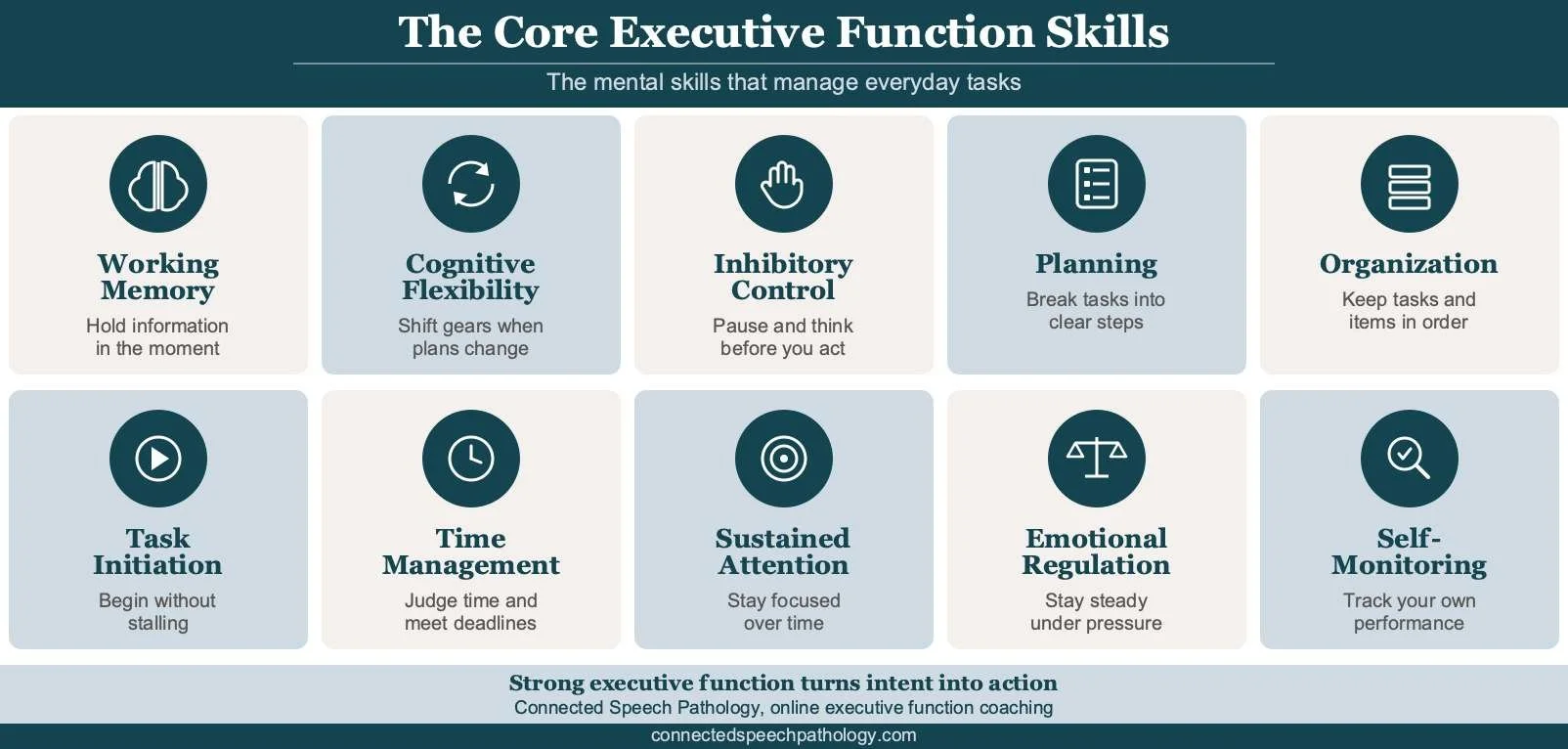
Executive function is not a single ability. It is a group of cognitive skills that help you manage your thoughts, actions, emotions, and time. Researchers often describe working memory, cognitive flexibility, and inhibitory control as the foundation of executive function, while other skills build on those abilities and shape daily life.
Most adults do not notice these skills when they are working well. They notice them when something breaks down, such as forgetting important information, struggling to start a project, losing track of time, feeling overwhelmed by competing demands, or losing track of what they want to say during a conversation.
Working Memory
Working memory holds information in mind long enough to use it. It helps you remember a phone number while dialing, follow multi-step directions, and keep track of key information during a conversation. When working memory is weak, instructions fade quickly, and it becomes harder to keep track of what comes next.
Cognitive Flexibility
Cognitive flexibility is the ability to adjust your thinking when circumstances change. It helps you switch between tasks, adapt to new information, and consider different solutions to a problem. Adults with reduced cognitive flexibility often find unexpected changes stressful or disruptive.
Inhibitory Control
Inhibitory control helps you pause before acting. It supports impulse control, reduces distractions, and creates space to think before speaking or making a decision. When inhibitory control is weak, a person may interrupt others, act too quickly, or struggle to stay focused.
Planning
Planning helps you identify the steps needed to reach a goal. It allows you to break large projects into manageable tasks and decide what should happen first. Weak planning skills can make even straightforward responsibilities feel overwhelming.
Organization
Organization helps you keep information, materials, and priorities in order. It supports everything from managing a calendar to tracking important documents. Difficulties with organization often create unnecessary stress and wasted time.
Task Initiation
Task initiation is the ability to begin a task without excessive delay. Adults with executive dysfunction often know exactly what needs to be done but struggle to get started. This difficulty is frequently mistaken for procrastination or lack of motivation.
Time Management
Time management helps you estimate how long tasks will take, meet deadlines, and balance competing responsibilities. Weak time-management skills can lead to chronic lateness, missed deadlines, and rushed work.
Sustained Attention
Sustained attention is the ability to maintain focus over time. It helps you stay engaged with a task even when it is repetitive, challenging, or not immediately rewarding. Weak sustained attention can make it difficult to complete projects or follow through on long-term goals.
Emotional Regulation
Emotional dysregulation is a common symptom of executive dysfunction. Emotional regulation supports staying calm during setbacks and recovering from frustration when tasks become difficult. Challenges with emotional regulation can make it harder to stay focused and productive.
Self-Monitoring
Self-monitoring is the ability to evaluate your own performance and adjust when needed. It helps you recognize mistakes, track progress, and notice when a strategy is not working. Without strong self-monitoring, it can be difficult to learn from experience and make effective changes.
Executive function skills support nearly every part of adult life. They help you manage responsibilities at work, maintain relationships, complete daily tasks, and work toward long-term goals. When executive function is working well, most of these processes happen in the background.
The effects of executive dysfunction can build gradually over time. Difficulties with planning, organization, task initiation, and sustained attention can affect performance at work and create stress at home. That stress can also contribute to anxiety and low mood, making executive function challenges harder to manage.
Strengthening executive function skills does more than improve productivity. Better executive function can reduce daily stress, increase confidence, and make important goals feel more achievable.
Executive Dysfunction Symptoms in Adults

Executive dysfunction in adults tends to surface in the places that demand the most planning and follow-through. The same person can function well in a calm setting yet fall apart when tasks pile up and deadlines collide.
Today's work environment often places constant demands on executive function. Many adults spend the day switching between emails, messages, meetings, and competing priorities, which can expose weaknesses that were easier to manage in simpler environments.
Recognizing the key symptoms is often the first step toward getting help.
At work, executive function challenges often look like the patterns below, repeating week after week:
Missing deadlines or chronic lateness due to poor time management
Trouble prioritizing tasks and deciding what to do first
Difficulty starting large projects, even important ones
Losing track of details across complex tasks
Forgetting steps when no written reminder exists
At home, executive function challenges often show up in the routines that are supposed to feel automatic:
Difficulty planning and organizing routines
Feeling overwhelmed by routine chores like bills or laundry
Trouble switching from one task to the next
Impulse spending or speaking without thinking
Emotional reactions that feel bigger than the moment
Executive function challenges can also affect communication. Adults may lose their train of thought mid-conversation, struggle to organize ideas before speaking, forget important details they planned to mention, or have difficulty following complex discussions. In workplace meetings, they may jump between points, miss key information, or leave conversations feeling like they did not express themselves clearly.
These communication challenges can be frustrating because the person often knows what they want to say. The difficulty lies in holding information in mind, organizing it, and delivering it at the right moment. As a result, executive dysfunction can affect relationships, workplace performance, and confidence just as much as missed deadlines or disorganization.
Executive Dysfunction vs. Procrastination
Executive dysfunction is a brain-based difficulty with starting and managing tasks. Procrastination is choosing to delay something you mean to do, and from the outside, the two can look identical.
Someone who procrastinates can usually start once the deadline gets close. An adult with executive dysfunction often wants to start and knows why it matters, yet still feels stuck at the first step. The block is in task initiation, not in motivation or character.
Seen this way, the issue is a problem-solving gap in the brain's startup system, not a flaw in willpower. Executive function decides how a task gets broken down and begun. When that step stalls, even simple jobs can feel out of reach.
The distinction matters for self-compassion and for getting help. Treating the problem as a skill gap, not a personal failing, opens the door to effective strategies.
Common Causes and Risk Factors in Adults

In many adults, executive dysfunction is linked to an underlying condition or life circumstance rather than occurring on its own. Executive function depends on brain systems that support attention, memory, self-regulation, and planning. When those systems are affected, executive function skills can become harder to use consistently.
Neurodevelopmental conditions are one common source of executive function challenges. Many adults with ADHD experience difficulties with task initiation, organization, working memory, and time management. Autism can also affect skills such as cognitive flexibility, planning, and self-regulation.
Our guide on how to improve executive function with ADHD covers that connection in more detail.
Mental health conditions can also affect executive function. Anxiety, depression, bipolar disorder, obsessive-compulsive disorder, and some learning disabilities are often associated with difficulties in attention, organization, decision-making, and follow-through. In some cases, improvements in mental health are accompanied by improvements in executive function.
Neurological conditions are another important contributor. Traumatic brain injuries, stroke, Parkinson's disease, and other neurological disorders can affect the brain networks that support executive function. Many people notice changes in planning, problem-solving, memory, or self-regulation during recovery or disease progression.
Neurodegenerative conditions can also affect executive function over time. Dementia, including Alzheimer's disease, may gradually reduce a person's ability to organize information, make decisions, and manage daily tasks. Supporting communication and cognitive skills is often an important part of care.
Not all executive function challenges stem from a diagnosed condition. Chronic stress, poor sleep, burnout, major life changes, and some medications can temporarily affect attention, planning, memory, and self-control.
Burnout can look surprisingly similar to executive dysfunction. Adults experiencing prolonged stress often report difficulty concentrating, staying organized, making decisions, and following through on tasks that once felt manageable. When the underlying stressor improves, executive function often improves as well.
Hormonal changes can affect executive function as well. Many women notice new challenges with attention, working memory, organization, and mental flexibility during perimenopause and menopause. In some cases, these changes resemble ADHD or executive dysfunction and may prompt adults to seek an evaluation for the first time.
Understanding the source of executive dysfunction helps guide treatment and support. The strategies that help someone with ADHD may differ from those that help a person recovering from a brain injury, managing depression, or coping with chronic stress. A thorough assessment can help identify the factors contributing to the difficulty.
How Executive Function Disorder Is Diagnosed and Treated

An evaluation can help when executive function challenges start affecting work performance, relationships, finances, or day-to-day responsibilities.
Executive dysfunction is typically evaluated by a psychologist, neuropsychologist, physician, or another qualified healthcare provider. The assessment focuses on how difficulties with planning, organization, attention, memory, and self-regulation affect daily life.
Most executive functioning tests include a clinical interview, questionnaires, and standardized tests. The provider may ask about challenges at work, at home, and in relationships to understand how executive function difficulties show up across different situations.
Online self-tests can help you recognize a pattern, but they cannot determine the cause of executive dysfunction. If challenges with organization, follow-through, time management, or decision-making regularly interfere with daily life, a professional evaluation can help identify the factors involved.
The goal of an assessment is not simply to assign a label. The goal is to understand which executive function skills are affected and use that information to guide treatment, support, or workplace and academic accommodations.
Everyday Support for Executive Function Disorder
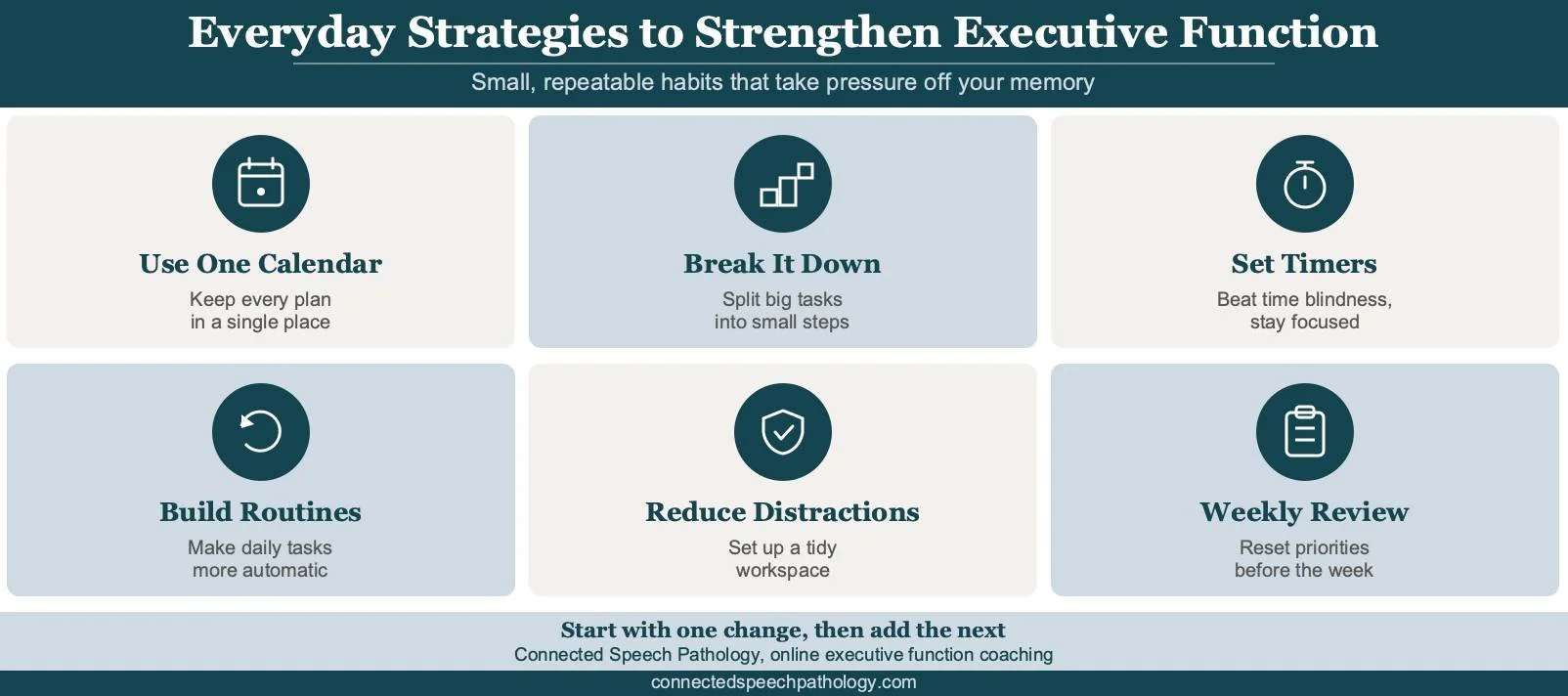
Adults can strengthen certain executive function skills by making small, consistent changes to how they organize tasks, manage information, and support communication. The most effective strategies combine external supports with routines that reduce reliance on memory alone. The goal is to make important responsibilities easier to plan, track, and complete.
Instead of trying to remember every deadline, appointment, task, or conversation point, you create a place where that information lives. The goal is not to become more disciplined. The goal is to rely less on memory for things that matter.
A few simple habits help many adults get started:
Use calendars, reminders, and alarms instead of relying on memory. For example, schedule a reminder to pay a bill two days before it is due or set an alert 15 minutes before an appointment.
Keep one calendar for work, personal commitments, and important events.
Break large tasks into smaller steps. Instead of writing "finish taxes" on a to-do list, create separate tasks for gathering documents, logging into the tax portal, and reviewing forms.
Use a written to-do list and focus on one task at a time. A list of three priority tasks is often easier to manage than a list of thirty.
Set timers for focused work periods to improve time awareness and reduce distractions.
Build routines for recurring tasks. For example, review your calendar with your morning coffee or pay bills at the same time each week.
Organize your workspace to reduce visual and environmental distractions.
Schedule a weekly review to update priorities and plan the week ahead.
Executive function strategies can also support communication. Many adults benefit from writing down key points before a meeting, conversation, or presentation rather than trying to hold everything in mind.
Others use brief notes, outlines, or templates to organize their thoughts and stay on topic. Pausing before responding, summarizing key information, and reviewing important conversations afterward can also strengthen self-monitoring and reduce communication breakdowns.
Digital work can place heavy demands on executive function. Constant notifications, emails, messages, and meetings require frequent task switching, which can make planning and follow-through more difficult. Many adults benefit from setting specific times to check email and turning off unnecessary notifications during focused work.
Many executive function strategies work because they reduce the number of decisions you need to make throughout the day. A routine answers the question before you have to think about it. A calendar removes the need to remember. A checklist eliminates the need to figure out the next step.
A quick review at the end of the day can reveal patterns that are easy to miss in the moment. A brief end-of-day review can help you track what was completed, identify obstacles, and adjust your approach for the next day. Small adjustments are often more effective than major changes that are difficult to sustain.
Lifestyle habits can support executive function as well. Regular exercise is linked to improvements in attention and cognitive flexibility, while mindfulness practices may support self-control and emotional regulation. Consistent sleep and good nutrition also provide a stronger foundation for focus, communication, and decision-making.
No single strategy solves executive dysfunction on its own. Over time, however, consistent habits and appropriate support can make daily responsibilities feel more manageable, improve communication, and increase confidence in your ability to follow through.
Professional Help and Executive Function Coaching

Professional support can help adults build executive function skills and apply them more consistently in daily life. The most effective approach depends on the underlying cause of the difficulty, the person's goals, and the situations in which the challenges occur most often.
Mental health professionals and healthcare providers may all play a role. Cognitive behavioral therapy can help with emotional regulation, impulsivity, stress, and daily functioning.
A speech-language pathologist offers another perspective because executive function challenges often show up in communication. Adults may lose their train of thought during conversations, struggle to organize ideas before speaking, forget key points in meetings, or have difficulty explaining complex information clearly.
Executive function can also affect listening, note-taking, workplace communication, and the ability to follow multi-step discussions. Speech therapy focuses on the thinking and communication skills behind these situations, using strategies such as metacognitive training, self-monitoring, goal-setting, and structured problem-solving.
Executive function support works best when it is tied to real-life demands. Sessions may focus on preparing for important meetings, organizing ideas for presentations, managing competing work priorities, following multi-step routines, or creating systems that make deadlines easier to track and meet. The goal is to build strategies that work outside the therapy room.
Some adults benefit from support from more than one professional. For example, a physician may help address an underlying condition while a coach, therapist, or speech-language pathologist works on day-to-day strategies and skill development. The right combination depends on the individual's needs and goals.
Medication may also be part of treatment for some people. When executive dysfunction is related to ADHD or another medical condition, a physician can determine whether medication is appropriate. Medication is often most effective when combined with practical strategies and ongoing support.

Executive Dysfunction Strategies for Adults
Learn more about executive dysfunction strategies for adults in this blog.
What We See Working with Clients

We work with adults whose executive function challenges affect their performance at work, daily routines, communication, and independence. Names and details have been changed to protect privacy.
One client with ADHD was struggling to manage multiple projects at work. Important tasks were getting buried in email, deadlines were slipping, and she often started reports the day before they were due.
Together, we built a single planning system using a task list, calendar reminders, and a weekly review. We also practiced a goal-plan-do-review framework to help her break larger projects into manageable steps and track her progress.
She also often interrupted colleagues before they finished speaking, lost track of the point she wanted to make, and jumped between ideas without fully explaining them. Together, we practiced pausing before responding, jotting down key points during meetings, and organizing ideas into a clear sequence before speaking. We also used self-monitoring strategies to help her recognize when she went off-topic and return to her main point more effectively.
Another client was recovering from a stroke and found everyday routines difficult to manage independently. Preparing breakfast, taking medications, and getting ready for appointments required frequent reminders from family members. We worked on breaking routines into written steps, using checklists, and developing self-monitoring strategies. Over time, he relied less on prompts and completed familiar routines more consistently.
The details vary from person to person, but the process is similar. We identify the situations that matter most, develop practical strategies, and refine them until they fit the person's daily life.
Frequently Asked Questions About Executive Function Disorder

1. Is executive function disorder a real medical diagnosis?
Executive dysfunction is a real and well-recognized clinical concern, but "executive function disorder" is not a formal diagnosis in the DSM-5-TR. Instead, executive function difficulties are often viewed as symptoms or characteristics associated with conditions such as ADHD, autism, depression, brain injury, or other neurological and mental health conditions.
2. Can you have executive dysfunction without ADHD?
Yes. Although executive dysfunction is common in ADHD, it can also occur in people with autism, anxiety, depression, brain injuries, neurological conditions, chronic stress, or sleep problems.
3. What makes executive dysfunction worse?
Stress, poor sleep, burnout, and competing demands on attention can make executive function challenges more noticeable. Untreated medical, neurological, or mental health conditions may also contribute to worsening symptoms.
4. Can executive dysfunction be cured?
Executive dysfunction is usually managed rather than cured. Many adults improve with a combination of strategies, professional support, and treatment for any underlying condition.
5. Does executive dysfunction get worse with age?
Executive function can change across the lifespan. Some adults notice new challenges during major life transitions, including menopause, when hormonal changes may affect attention, memory, and mental flexibility. Executive function may also decline when neurological conditions such as dementia are present.
6. Can a speech therapist help with executive function?
Yes. Speech-language pathologists often work on executive function skills that support communication, organization, planning, problem-solving, and follow-through. Speech therapy may include strategies for managing daily tasks, improving self-monitoring, and organizing thoughts more effectively.
How Connected Speech Pathology Can Help Adults with Executive Function Disorder

Connected Speech Pathology offers online executive function coaching for adults. Speech-language pathologists are uniquely trained to work at the intersection of language, thinking, and daily functioning. Our speech therapists assess how executive function challenges affect your daily life. Then we build a plan around your goals, tailored to you rather than a fixed program.
The work is practical and uses personalized strategies you can apply right away, from managing time to organizing thoughts. We also help adults whose executive dysfunction follows ADHD, a brain injury, or a recent diagnosis. If you are ready for the right support, our team can help you get started.
Summary
Executive function disorder in adults refers to ongoing difficulties with the mental skills that manage daily tasks, such as working memory and cognitive flexibility. It is not a formal diagnosis. Instead, it is a sign of an underlying cause like ADHD, autism, or a brain injury.
Most importantly, it responds to help. With daily strategies, external supports, and coaching from a speech-language pathologist, adults can manage executive dysfunction and make everyday tasks feel lighter.

About the Author
Allison Geller, M.A., CCC-SLP, is a communication coach, speech-language pathologist, and founder of Connected Speech Pathology, an international online practice providing professional communication coaching and speech therapy for children, teens, and adults. With more than two decades of experience, she has worked in medical and educational settings and published research on aphasia. Today, she leads a team of specialists who help clients improve their skills in public speaking, vocal presence, accent clarity, articulation, language, fluency, and interpersonal communication.