Nonverbal Communication Training for Adults

Every gesture, glance, and shift in tone carries meaning before a single word lands. In a meeting, on a video call, or across a negotiating table, your body is already telling the other person what to expect.
When silent signals match your words, trust builds. If they don't, listeners feel something is off even if they can't name why.
Nonverbal communication training teaches adults to consciously manage and read these wordless cues. Confident, open body language significantly boosts your odds in interviews and promotions, while mismatched signals can cost you deals and credibility.
Below: the five core channels, how training works, and what to practice if you want to communicate with more authority and presence at work.
Key Takeaways
Nonverbal communication training builds conscious control over body language, facial expressions, eye contact, gestures, and tone of voice so adults can communicate with clarity and authority.
The five core channels are kinesics (body movement), proxemics (personal space), haptics (touch), oculesics (eye behavior), and vocalics (tone, pitch, and pace).
Microexpressions and mismatched signals often reveal what words try to hide, which is why reading nonverbal cues accurately matters as much as managing your own.
Video-recorded roleplay is one of the most effective methods for identifying unconscious habits like fidgeting, closed body language, or rushed gestures.
What Is Nonverbal Communication Training?
What Are the Core Channels of Nonverbal Communication?
How Do You Use Body Language to Project Authority?
How Do You Recognize Nonverbal Cues in Others?
How Does Nonverbal Communication Training Work?
What We See Working with Clients
Frequently Asked Questions About Nonverbal Communication Training
What Is Nonverbal Communication Training?

Nonverbal communication training teaches you to manage wordless cues like body language, facial expressions, and tone of voice. The goal is to help you align what you say with how you say it, so your message lands with the clarity and confidence you intend.
Sessions typically combine self-awareness exercises, video review, and structured practice in real workplace scenarios across one-on-one meetings, group discussions, and client-facing presentations.
The skill matters because people often respond as much to delivery as to the words themselves. Albert Mehrabian’s 1971 research, frequently cited in discussions about interpersonal communication, found that tone of voice and facial expression strongly influence how listeners interpret emotion and intent. Modern communication research continues to support the idea that nonverbal cues shape trust, clarity, confidence, and connection during conversation.
When verbal and nonverbal cues align, you communicate clearly, and your listener feels understood. Conflicting signals make listeners default to the nonverbal cue, often picking up on feelings the speaker is trying to hide.
Working professionals usually seek communication coaching for a specific professional goal. Some want to project more presence during leadership meetings. Others are preparing for promotion interviews, client presentations, or high-stakes conversations where qualifications alone may not shape how they are perceived.
How Is It Different From Public Speaking Coaching?
Public speaking coaching and communication training overlap in several areas. Both can address eye contact, facial expression, posture, gestures, vocal delivery, and audience presence.
The difference usually lies in the setting and goal. Public speaking coaching focuses on presentations, speeches, pitches, and other structured speaking situations. Nonverbal communication training applies those same skills to everyday interactions, including meetings, interviews, video calls, networking events, and one-on-one conversations.
Many adults benefit from both. Someone may feel confident giving a presentation but still struggle with conversational timing, facial expression, or reading social cues during less structured interactions.
What Are the Core Channels of Nonverbal Communication?
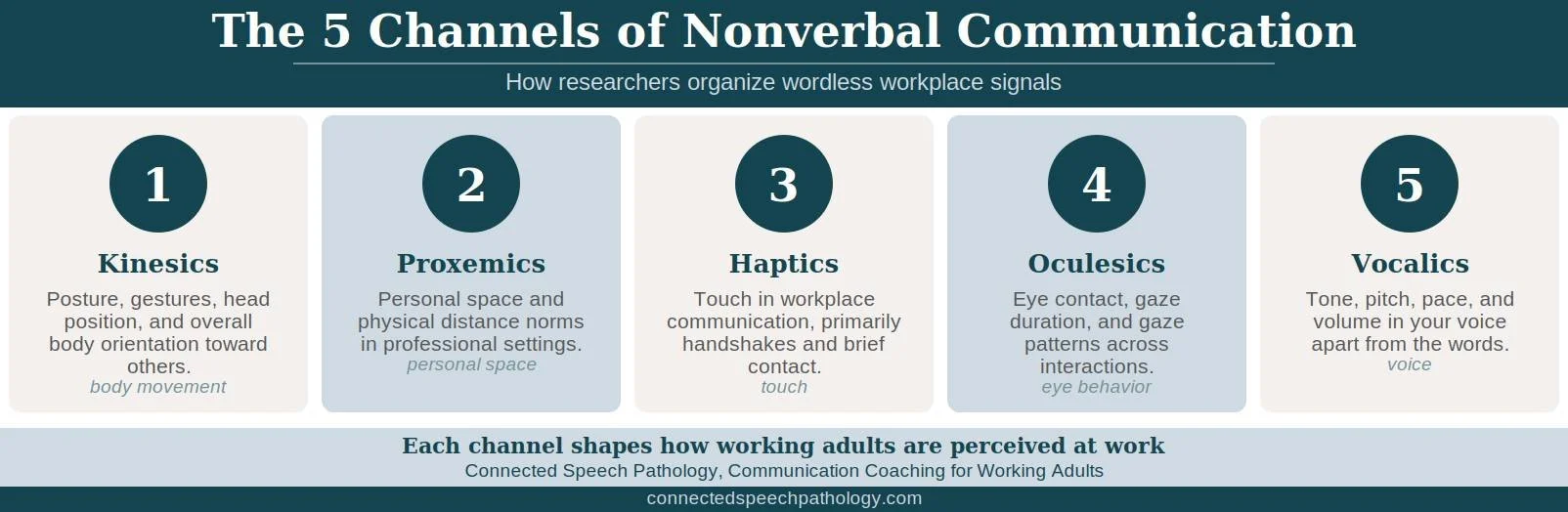
Communication researchers organize nonverbal communication skills into five core channels, each with its own academic name. Knowing them helps you target the nonverbal communication skills you most need to develop.
Each channel runs alongside your verbal communication. Aligned signals let you communicate clearly. Conflicting cues let the body win, and the spoken message gets lost.
Kinesics: Body Language, Posture, and Gesture
Kinesics, a term coined by anthropologist Ray Birdwhistell in 1952, covers everything your body does while you talk. Posture, hand gestures, facial expressions, and overall orientation toward the other person all fall within the category.
A grounded stance with shoulders back communicates authority. Closed body language, like crossed arms or a turned-away torso, signals defensiveness whether you feel it or not.
Hand gestures matter just as much. Open palms read as honesty and warmth, while pointing or chopping gestures can feel aggressive. The same gesture can carry different meanings across cultures, so context awareness matters in international business settings.
Proxemics: Personal Space and Distance
Proxemics, developed by anthropologist Edward T. Hall in 1963, is the study of how physical distance shapes meaning. Standing too close in a professional setting feels invasive, while standing too far back signals disengagement.
Most American business contexts call for about three to four feet of distance during a one-on-one conversation. The norms shift in other cultures and in smaller meeting rooms, which is why cross-cultural awareness matters for global teams.
Haptics: Touch in Professional Contexts
Haptics involves communication through physical contact. Touch communicates a variety of messages, with different types of physical contact, such as a handshake or a hug, conveying different meanings in social interactions.
A firm handshake of appropriate duration still signals confidence in most professional settings. Anything more familiar should align with the relationship and cultural context.
Oculesics: Eye Behavior and Gaze
Oculesics is the technical name for how eye contact and gaze function in communication. It's a subcategory of kinesics, but researchers treat it separately because eye behavior carries unusually heavy meaning.
Steady eye contact communicates focus, confidence, and respect, while avoiding it reads as nervousness or disinterest. The right balance depends on the context, the relationship, and cultural norms.
Vocalics: Tone, Pitch, Pace, and Volume
Vocalics, sometimes called paralanguage, covers everything in your voice that isn't the words themselves. Tone, pitch, pace, and volume all shape how your message lands, and your tone of voice often signals more about your emotions than the actual message.
A rushed, high-pitched delivery can make a confident statement sound anxious, while a slower tone can make the same words sound assured. Listeners pick up tone shifts within the first seconds of a conversation.
Many of the clients we work with on vocal tone are surprised by how much their delivery undermines their content.
How Do You Use Body Language to Project Authority?

Strong body language starts with noticing the habits you fall into without realizing it. Many professionals tense their shoulders during difficult conversations, tap their feet in meetings, or fidget during video calls without realizing how visible those behaviors can be.
Posture sets the tone before you speak. Standing or sitting upright with relaxed shoulders and grounded feet can make you look steadier and more engaged.
Small shifts also change how people read the interaction. Leaning slightly forward during a conversation often signals attention, while crossed arms and leaning back can create distance.
Gestures and facial expressions add another layer. Natural hand movements, steady eye contact, and responsive facial expressions help conversations feel warmer and more confident.
Most polished communicators are not perfectly rehearsed. Their verbal and nonverbal communication simply match. When someone says they feel confident while shrinking their posture or avoiding eye contact, people tend to trust the body language more than the words.

How to Improve Your Body Language in Public Speaking
Check out our blog on improving body language for more information!
What About Eye Contact?
Making eye contact is the fastest way to signal confidence and engagement in professional interactions. Holding someone's gaze for a few seconds at a time, then briefly looking away, then returning, creates a natural rhythm that reads as warm rather than intense.
Constant unbroken eye contact feels predatory; constant avoidance reads as evasive or insecure.
In a group meeting, distribute your gaze across the people present rather than locking onto one decision-maker. On video calls, look at the camera rather than your own image on screen.
Cultural context matters here. Direct, sustained gaze is read as confidence in most American and Western European business settings, but in parts of East Asia and the Middle East, prolonged eye contact with senior leaders can be read as challenging or disrespectful.
For a deeper look at this skill, practicing balanced eye contact is one of the highest-leverage habits a professional can build.
How Do You Recognize Nonverbal Cues in Others?

Recognizing nonverbal behaviors in others is one of the communication skills that separates good listeners from persuasive ones. You can't respond to what someone feels until you understand it, and most feelings show up in the body before they appear in speech.
Three nonverbal communication skills do most of the work: reading microexpressions, noticing mirroring, and catching alignment mismatches. Together, they form the foundation of active listening in every workplace conversation.
Reading Microexpressions
Microexpressions, identified by psychologist Paul Ekman through his work on facial expressions, are fleeting facial movements that reveal true emotions before the speaker can mask them. Ekman's research mapped six basic emotions, happiness, sadness, anger, surprise, fear, and disgust, that flash across the face universally across cultures. These involuntary expressions last less than half a second, which makes them one of the most honest signals you'll ever get.
A flash of surprise when you name a budget number, a tightening around the eyes when a colleague hears bad news, a lip compression signaling disagreement, all too fast to fake. Each one is a glimpse of the real emotions the speaker is trying not to express.
Most professionals miss microexpressions because they aren't looking for them. Training to notice them is mostly about slowing down and watching the upper face during the first second of someone's reaction, before social politeness covers everything up.
Noticing Mirroring
Matching nonverbal signals creates subconscious comfort and rapport between strangers. When two people are genuinely engaged, their body language, gesture pace, and even breathing tend to sync without anyone trying.
Noticing whether someone is mirroring you or conspicuously isn't gives you a quick read on whether they feel connected to the conversation.
You can also use mirroring deliberately by adjusting your pace and posture to match a colleague's. Subtle adjustments build rapport. Obvious copying reads as mimicry and backfires.
Catching Alignment Mismatches
Nonverbal communication cues can significantly influence how others perceive your honesty and engagement during interactions, often speaking louder than words themselves. The same logic works in reverse when you're reading other people.
When someone says "I'm completely on board," but their arms are crossed, and their tone flattens, their body is telling you the real message. Listening with your eyes catches what the spoken words leave out.
Reading subtle nonverbal cues from colleagues is a form of active listening that lets you show empathy, understand when someone needs support, and communicate with diplomacy and tact before conflicts escalate.
How Does Nonverbal Communication Training Work?
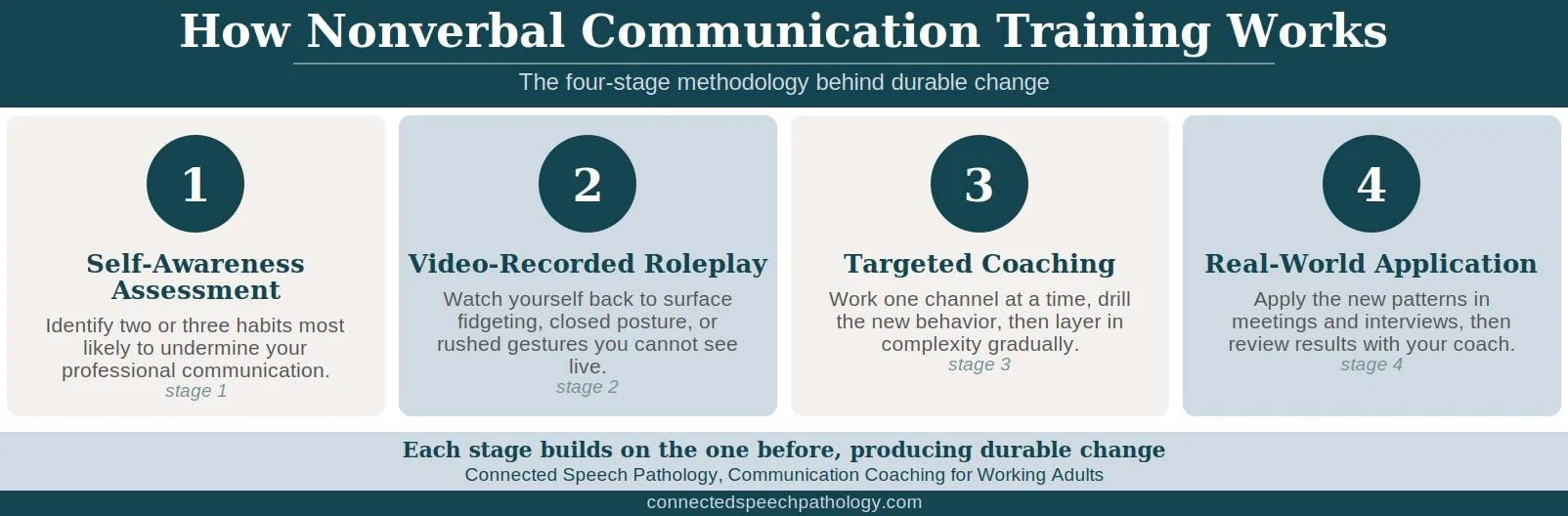
To improve nonverbal communication, adults first need to identify habits that may be affecting how others perceive them. Feedback from coworkers, friends, managers, or a communication coach can help uncover patterns that are easy to miss, such as limited eye contact, flat facial expression, closed posture, or distracting gestures.
Coaching is often the piece that helps those insights turn into consistent change. Many adults know what they want to improve, but struggle to apply it during real conversations, meetings, or presentations.
Communication training usually progresses through four stages, with each stage building on the last. The full process can take anywhere from a few weeks to a few months, depending on how established the habits are and how often the person practices between sessions.
Stage 1: Self-Awareness Assessment
To improve your nonverbal communication, you first need to understand where you tend to fall short. Most clients start by seeking feedback from coworkers, paired with a structured self-assessment that flags habits you don't notice in the moment.
The goal isn't to catalog every flaw but to identify the two or three patterns most likely to undermine your professional communication.
Stage 2: Video-Recorded Roleplay
Video-recorded roleplay is effective for identifying unconscious habits like fidgeting, closed body language, or rushed gestures. Watching yourself back is uncomfortable for almost everyone the first time, but the discomfort fades once you see specific habits you can change.
Most clients are shocked by something on the first watch: a hand that won't stop moving, a downward gaze during key moments, or a voice that trails off at the ends of sentences.
Stage 3: Targeted Coaching and Practice
Training programs use interactive exercises, video analysis, and role playing to refine specific core channels of nonverbal communication. A communication coach helps you isolate one channel at a time, drill the new behavior, and then layer in complexity.
Modeling nonverbal cues is an effective way to teach nonverbal communication, helping clients understand the meaning conveyed beyond words.
Trying to fix everything at once tends to fail. Working on one channel for two or three weeks until it feels natural, then adding the next, is what produces durable change.
Stage 4: Real-World Application and Feedback
The final stage is applying the new communication skills in actual meetings, interviews, or client interactions, then bringing the results back to the coach. The feedback loop is where unconscious habits get fully replaced, and new skills become automatic.
Many communication coaches ask clients to record real low-stakes interactions, with permission, so they can review what showed up under genuine pressure.
What We See Working with Clients

A VP candidate in her mid-40s came to us for interview-preparation coaching after her second-round meeting, where she received the feedback, "strong on substance but didn't feel like a leader." The video-recorded mock interview clearly showed the gap.
She nodded constantly while interviewers spoke, looked down when discussing strategic decisions, and gave a small apologetic shoulder shrug when stating her qualifications.
After six sessions practicing a grounded stance, deliberate pauses in place of reflexive nodding, and a steady gaze during her answers, she landed the role. The next interview, she said, "felt like a conversation, not a defense."
A different client, a senior sales director working with international enterprise accounts, lost a major Japanese account after a video pitch he was certain had gone well. The buyer's feedback was that the team felt "rushed," a common signal of cross-cultural communication mismatch.
We reviewed the recording with him, and the pattern was obvious. His hand gestures moved at American pace, his eye contact pulsed in two-second bursts, and his sentences ran together.
Coaching centered on slowing his kinesic pace and adding short pauses between thoughts to give his message room to land. He closed his next three international deals.
Frequently Asked Questions About Nonverbal Communication Training

1. What are the 5 types of nonverbal communication?
The five core channels are kinesics, proxemics, haptics, oculesics, and vocalics. Researchers sometimes group facial expressions and microexpressions separately, though they technically sit inside kinesics. Knowing the channels helps you pick the nonverbal communication skills to develop first.
2. How long does it take to improve nonverbal communication?
Most clients notice meaningful changes within four to six weeks of consistent practice. Deeper habits take three to six months to fully shift, depending on how ingrained the patterns are and how often you practice between sessions. People preparing for a specific event often see rapid improvement in a few targeted sessions.
3. Can nonverbal communication training help in job interviews?
Yes, and it's one of the highest-impact uses of this coaching. Confident, open body language significantly boosts chances during job interviews and promotions, and interviewers often form a judgment within the first 30 seconds based on posture, handshake, and eye contact alone. Training helps you replace habits that undercut your qualifications with ones that reinforce them.
4. Is nonverbal communication the same as body language?
Body language is one part of nonverbal communication, not the whole thing. Interpersonal communication also includes facial expressions, eye behavior, vocal tone, personal space, and touch. Body language usually refers to posture, gestures, and orientation, while nonverbal communication covers every wordless signal you send.
How Connected Speech Pathology Can Help

Connected Speech Pathology offers online coaching for adults who want stronger verbal and nonverbal communication at work. Clients often come in with a specific goal, such as preparing for a promotion interview, leading meetings more confidently, improving executive presence, or sounding more polished on video calls. Communication coaches build personalized programs around the situations each client faces every day.
Sessions may include the methodology described above: self-awareness assessment, video-recorded role-play, targeted feedback, and real-world application. Practice scenarios mirror the situations clients face at work, from board presentations to negotiations to senior leadership conversations. Role-playing social scenarios allows clients to practice nonverbal communication skills in a safe, structured setting, which is particularly useful for those who struggle with social communication.
All sessions are delivered online, allowing clients to participate from home or the office.
Summary
Nonverbal communication training gives adults conscious control over the five channels that shape every professional interaction: kinesics, proxemics, haptics, oculesics, and vocalics. The skills progress from awareness to deliberate practice through methods such as video-recorded role-play, which surface the unconscious habits that undermine credibility in meetings, interviews, and negotiations.
Reading nonverbal cues in others matters just as much. Microexpressions, mirroring patterns, and alignment mismatches tell you what people actually think before they decide what to say.
With targeted coaching and practice, professionals build a presence that makes them harder to misread and easier to trust.

About the Author
Allison Geller, M.A., CCC-SLP, is a communication coach, speech-language pathologist, and founder of Connected Speech Pathology, an international online practice providing professional communication coaching and speech therapy for children, teens, and adults. With more than two decades of experience, she has worked in medical and educational settings and published research on aphasia. Today, she leads a team of specialists who help clients improve their skills in public speaking, vocal presence, accent clarity, articulation, language, fluency, and interpersonal communication.