How to Reduce Your Indian Accent for Clearer English Pronunciation

Learning how to reduce an Indian accent involves adjusting a few sounds and speech patterns to improve clarity for listeners most familiar with General American English.
Accent training covers a clear set of areas: how regional languages shape Indian English, which sounds cause confusion, how stress and intonation differ from American English, and the daily routine that builds new habits. If you are an adult who speaks English with an Indian-influenced accent and want to be understood the first time at work, this is for you.
Clearer pronunciation lowers friction in everyday conversations. It lets your ideas, not your accent, carry the moment.
Accent training focuses on clarity, not on erasing identity. Indian English is a widely spoken variety of English, and many speakers choose to modify their accents to improve communication in specific settings.
Key Takeaways
Reducing an Indian accent is about clarity, not correctness. You keep your identity while making pronunciation changes that help more listeners understand you easily.
A handful of sounds carry most of the confusion. The "th," the "v" and "w" swap, the retroflex T and D, and the American "r" are the main targets.
American English is stress-timed; many Indian languages are syllable-timed. Adjusting rhythm and the schwa often helps more than fixing single sounds.
Clear communication depends on more than pronunciation. Speech rate, rhythm, and intonation all contribute to how easily listeners understand you.
Daily practice of about 25 minutes can improve clarity in six to eight weeks. Personalized coaching speeds up the process.
What Does It Mean to Reduce an Indian Accent?
How Regional Languages Shape Indian English
The Sounds to Focus On for Clearer English Pronunciation
Accent Training Strategies and a Practice Routine
How Long Does It Take to Reduce an Indian Accent?
What We See Working With Clients
What Does It Mean to Reduce an Indian Accent?

To reduce an Indian accent is to adjust the sounds and speech patterns that most affect how easily other people understand your English. A nasal-sounding voice can also affect how clearly you come across, so our guide on how to fix a nasally voice may help. You keep the parts of your voice you want, and accent training focuses on intelligibility rather than changing every aspect of your speech.
There is no single "Indian accent." Speakers from different regions and language backgrounds often pronounce the same English sounds differently, so accent modification is always personalized. You decide which speech patterns to adjust based on your own speech and communication goals.
Part of the process is choosing a target accent. Many Indian English speakers learned British English pronunciation or spelling conventions in school, while others use Indian English as their primary variety. If your goal is to communicate more naturally with people who are most familiar with Standard American English, your training focuses on the pronunciation patterns of that accent.
A foreign accent is not a flaw to hide. Accent modification is about improving clarity for the people you communicate with while keeping the parts of your voice that reflect your identity. Clearer speech can make everyday interactions, from phone calls and presentations to job interviews, feel easier and more confident.
How Regional Languages Shape Indian English

Your first language influences how English sounds. Our guide to online accent reduction for non-native speakers of English explains how an accent trainer works on these patterns over live video. Understanding those speech patterns makes accent modification more targeted and efficient. The sound patterns below show up for many Indian speakers because they carry over from a first language, such as Hindi, Tamil, or Bengali.
Indian languages produce retroflex consonants, the T and D sounds made by curling the tongue back. English "t" and "d" can then sound harder than listeners familiar with General American English expect.
Many Indian languages use fewer vowel contrasts than American English. Word pairs that sound clearly different to Americans can blur together.
Indian English often swaps the "v" and "w" sounds, so "wet" and "vet" can sound alike.
The "th" sound is often replaced by "t" or "d." So "think" drifts toward "tink," and "this" toward "dis."
Consonant clusters can be tricky, so a word like "strengths" can gain an extra vowel or lose a sound.
Your specific first language matters. Hindi speakers often carry the strongest retroflex sounds. Tamil tends to avoid some consonant clusters, so an extra vowel can slip into a word like "school."
Bengali speakers often map English vowels onto a smaller home set. Naming your first language early makes a practice plan more specific. It tells a coach what patterns to expect.
Region matters as well. A regional accent from northern India can differ from one in the south, so a one-size-fits-all plan rarely fits any single speaker well.
Speakers of other first languages can use the same approach, like those reducing a Spanish accent. We also help speakers improve French-accented English.
None of these patterns is wrong. Indian English often has clear, evenly stressed syllables that many speakers find precise.
The Sounds to Focus On for Clearer English Pronunciation
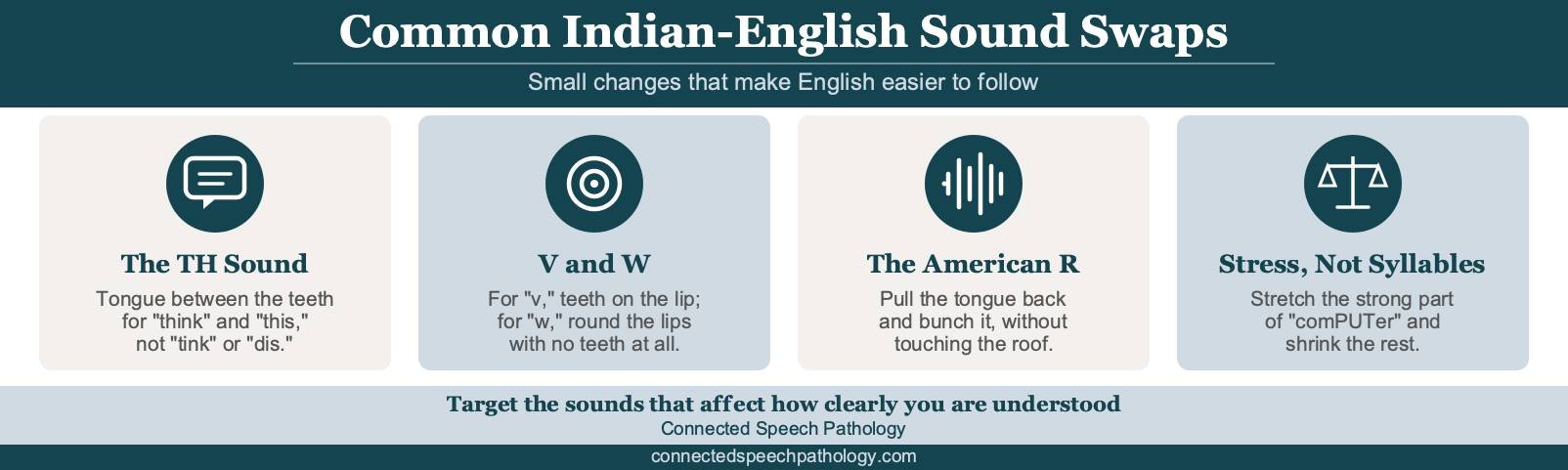
Some speech patterns have a greater impact on intelligibility than others. The sections below explain the consonants, vowels, stress patterns, and intonation features that most often distinguish Indian English from General American English.
Consonants that change the most
Several consonants commonly differ between Indian English and General American English. The "th" sounds in words such as think and this, the distinction between "v" and "w," the American "r," and the pronunciation of "t," "d," "n," and "l" are among the speech features that listeners notice most.
Many of these differences reflect the tongue's position when producing English sounds. For example, the tongue should strike the ridge behind the top teeth for American English when producing sounds such as "t," "d," "n," and "l," while some Indian languages use a more retroflex tongue position.
The American "R" is pronounced strongly and requires tongue tension, which makes it sound different from the "r" used in wide varieties of Indian English. These pronunciation differences can affect intelligibility, even though they are all valid ways of speaking.
Vowels and the schwa
Vowel pronunciation is another common area of difference. Many Indian languages have different vowel systems from English, so some vowel contrasts in General American English may sound similar to speakers who did not grow up using them.
One of the most noticeable differences is the schwa, the reduced "uh" sound in unstressed syllables such as banana and about. General American English relies heavily on vowel reduction, while wide varieties of Indian English pronounce unstressed vowels more fully.
Other vowel contrasts, such as the difference between ship and sheep, also vary depending on a speaker's language background.
Some vowel contrasts also depend on how much space speakers create inside the mouth. In many cases, widening mouth space improves sound clarity in speech by making similar English vowels easier to distinguish.
Stress and rhythm
American English is stress-timed, meaning stressed words and syllables receive more emphasis, while unstressed ones are shortened. Many Indian languages are more syllable-timed, so speakers often give each syllable a more even rhythm.
These differences influence both word stress and sentence rhythm. For example, some speakers may pronounce every syllable with similar weight or add an extra vowel to consonant clusters or "-ed" endings. Those patterns reflect the rhythm of many Indian languages rather than General American English.
Sentence stress also affects intelligibility. General American English places greater emphasis on content words, such as nouns and verbs, while reducing the use of many shorter function words. Those rhythm patterns contribute significantly to how easily listeners understand connected speech.
Intonation and pace
Intonation patterns also differ between Indian English and General American English. For example, yes/no questions in General American English often end with a rising pitch, while many varieties of Indian English use a flatter intonation pattern.
Pitch variation enhances the clarity of speech by helping listeners recognize emphasis, emotion, and sentence type. Greater pitch variation can also make speech sound more natural to listeners who are most familiar with General American English.
Speech rate is another important factor in intelligibility. Slowing speech by 20% enhances clarity for American listeners by giving them more time to process unfamiliar pronunciation patterns and distinguish similar sounds.

Online Accent Reduction for Non-Native Speakers of English
Check out our blog on online accent reduction for more information.
Accent Training Strategies and a Practice Routine
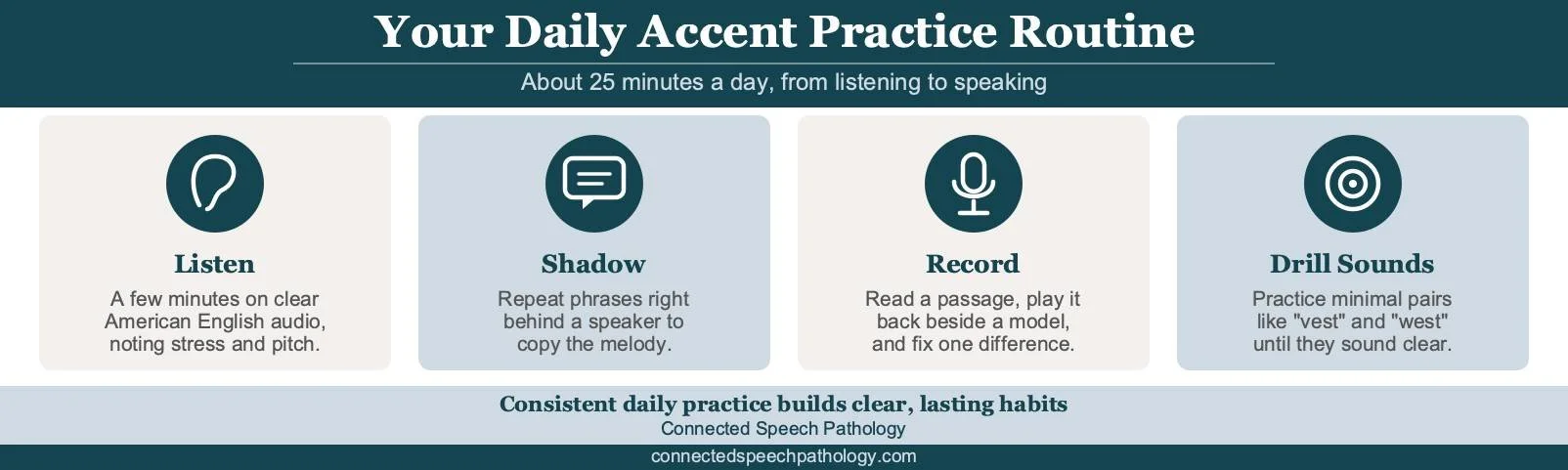
Daily practice reinforces the speech patterns introduced during accent training sessions. Your speech-language pathologist or accent trainer may recommend different activities depending on your goals, but most home practice combines listening, speaking, and self-feedback. The strategies below are common homework assignments for building new speaking habits between sessions.
Listen Closely to General American English
Listening to speakers who use General American English helps build awareness of rhythm, stress, and intonation. Accent trainers often recommend podcasts, audiobooks, or news broadcasts because hearing these patterns regularly makes them easier to recognize and produce.
Shadow and Repeat
Shadowing is a common accent training exercise in which you repeat short phrases immediately after a model speaker. Rather than focusing on individual sounds, shadowing helps develop natural rhythm, stress, and intonation across connected speech.
Record Yourself and Compare
Self-recording is another common homework activity. Listening to recordings helps you notice pronunciation patterns that are difficult to hear while speaking and makes it easier to track progress over time. Many speech-language pathologists recommend comparing recordings to a General American English model to identify patterns that still need attention.
Use Accent Training Tools
Speech-language pathologists and accent trainers may also recommend apps that provide feedback on individual sounds between sessions. These tools can reinforce daily practice and help build consistency, although they work best alongside personalized coaching and feedback.
For a deeper look at how structured practice fits together, see our guide to private online accent training.
How Long Does It Take to Reduce an Indian Accent?

Accent training works best with guidance from a speech-language pathologist or accent coach who specializes in accent modification. Because speech-language pathologists receive extensive training in speech sound production, they are well equipped to identify the pronunciation patterns that matter most and develop an individualized training plan.
Practice between sessions is what turns new speech patterns into lasting habits. Your accent trainer may recommend activities such as listening practice, minimal pairs, reading aloud, self-recording, conversation practice, or focused work on specific sounds, stress patterns, or intonation. The exercises depend on your goals and the speech features that need the most attention.
Most people notice clearer pronunciation within a couple of months of steady work. Practicing for about 25 minutes each day can improve clarity in roughly six to eight weeks, although the timeline depends on the speech patterns you are changing and how consistently you practice.
Consistency matters more than intensity. A focused 25 minutes each day is usually more effective than occasional long practice sessions because regular repetition helps new speech patterns become habitual. Many people find it easier to stay consistent by attaching practice to an existing routine, such as a morning commute or coffee break.
What We See Working With Clients

Our practice works with adults who speak fluent English but want to communicate more clearly in professional, academic, and everyday settings. The examples below are based on real client experiences. Names and details have been changed to protect privacy.
One client came to us because coworkers often asked him to repeat himself during meetings. His English was fluent, but a few pronunciation patterns made certain words difficult for listeners to understand at first.
An evaluation identified the "th" sound, the distinction between "v" and "w," and a fast speaking pace as the biggest contributors to reduced intelligibility. We focused on those patterns during sessions and reinforced them through structured practice between appointments. Over time, he found that conversations flowed more smoothly and interruptions became less common.
Another client felt that her speech sounded natural to family and friends but was harder for American coworkers to follow. Her pronunciation was generally clear, but differences in stress, rhythm, and intonation occasionally made her speech less familiar to listeners.
Accent training focused on developing more natural speech rhythm and pitch patterns through conversation practice and self-recording. As those patterns became more consistent, she reported feeling more comfortable speaking in meetings and everyday conversations.
Frequently Asked Questions About Indian Accent Modification

1. How long does it take to reduce an Indian accent?
Most people notice clearer speech in six to eight weeks. That assumes about 25 minutes of daily practice. Steady daily work matters more than long, rare sessions.
2. Can I reduce my Indian accent while keeping my own voice?
Yes, you can. Accent training focuses on clarity, not on erasing identity. You choose what to adjust and what to keep.
3. Why are sounds like "th" and "r" hard for Indian English speakers?
These sounds rarely exist in Indian languages. The "th" often becomes "t" or "d." The American "r" needs a tension that many first languages do not use.
4. Do accent reduction classes work for Indian English speakers?
They can, especially when practice is personalized. A coach identifies the exact sounds that affect your clarity and builds drills around them. Our look at how accent reduction classes work explains what to expect.
5. Is the goal to sound exactly like a native speaker?
No. The goal is to be understood easily by American listeners. Most people aim for clearer, more neutral speech, not a flawless native accent.
6. Will accent training help me at work?
Yes. Clearer pronunciation means fewer repeated questions on calls and in meetings. Many adults take up accent reduction to feel more confident in interviews, presentations, and daily conversations with colleagues.
How Connected Speech Pathology Can Help

At Connected Speech Pathology, our communication coaches help adults speak English clearly while keeping their own voice. We offer online accent modification built around your goals.
Many clients come to us preparing for presentations, interviews, or everyday calls with American colleagues. Personalized training from an accent coach targets your specific pronunciation issues. It works on the details of American English pronunciation and intonation that matter most.
In each session, you work on the specific areas that affect your clarity, such as the exact sounds and stress that trip listeners up. You practice real situations from your week and build new habits through daily reps. Working with a coach each day can lead to clear gains in six to eight weeks.
Summary
Learning how to reduce your Indian accent comes down to a few high-value sounds and patterns. You adjust them while keeping your identity intact.
A small set of consonants, the schwa, stress-timed rhythm, and rising intonation carry most of the clarity. Slowing your pace gives listeners more time to process unfamiliar pronunciation patterns.
Practice for about 25 minutes a day through listening, shadowing, and recording. Add personalized coaching when you want it. With steady work, clearer English pronunciation becomes a real step toward clearer communication.

About the Author
Allison Geller, M.A., CCC-SLP, is a communication coach, speech-language pathologist, and founder of Connected Speech Pathology, an international online practice providing professional communication coaching and speech therapy for children, teens, and adults. With more than two decades of experience, she has worked in medical and educational settings and published research on aphasia. Today, she leads a team of specialists who help clients improve their skills in public speaking, vocal presence, accent clarity, articulation, language, fluency, and interpersonal communication.