Toastmasters Alternative: Top Options for Adults to Improve Public Speaking

For many adults, Toastmasters International is the first place they turn when they want to become more confident speakers. However, it is not the right fit for everyone.
A Toastmasters alternative refers to any public speaking course outside of Toastmasters International that helps adults build stronger communication skills. These options range from structured programs like Dale Carnegie Training to online courses, college classes, niche speaking groups, and one-on-one coaching.
Toastmasters is a strong fit for adults who enjoy group-based learning and peer feedback. It is affordable, widely available, and has helped many people build confidence over time.
That said, the format does not work for everyone. Some adults want faster progress, more personalized feedback, or support with a specific speaking goal. Others find it difficult to commit to weekly meetings or feel uncomfortable practicing in a group setting.
This guide breaks down the top Toastmasters alternatives for adults, including what each option offers, typical costs, and who each path is best suited for.
Key Takeaways
Top-named alternatives include several formats. Dale Carnegie courses, online programs like Coursera and LinkedIn Learning, community college speech classes, niche speaking clubs, and private one-on-one coaching.
Cost range varies widely. Toastmasters runs about $120 per year, Dale Carnegie courses cost about $2,000 to $2,500, and online courses can be free or a few hundred dollars. Private coaching is priced per session.
Group versus one-on-one is the key choice. Club-based programs build comfort speaking in front of others. Private communication coaching builds targeted skills faster and works for adults with anxiety or specific goals.
Match the option to your goal. A club works for steady, long-term practice. A course gives a structured curriculum. A communication coach can handle interview prep, executive presence, or accent work.
What Is Toastmasters and Who Is It For?
Why Some Adults Look for a Toastmasters Alternative
Top Alternatives to Toastmasters for Adults
How One-on-One Coaching Compares to Toastmasters
What We See Working with Clients
What Is Toastmasters and Who Is It For?

Toastmasters International is a nonprofit organization with more than 14,000 clubs in over 140 countries. Local clubs meet weekly or biweekly. Members take turns delivering speeches, leading meetings, and giving peer feedback.
A typical Toastmasters meeting follows a fixed agenda. One member serves as the host or emcee, called the Toastmaster. Others give prepared speeches, run impromptu Table Topics, or evaluate fellow speakers.
Membership costs roughly $120 per year, plus club-specific fees. Many community colleges, workplaces, and the National Speakers Association host affiliated clubs, which makes Toastmasters easy to find in most cities.
Toastmasters works well for adults who feel comfortable in group settings and want long-term practice. It suits people who can attend weekly, accept slow progress, and benefit from peer evaluation. The structure is supportive, but it is not built for individual goals or fast results.
Why Some Adults Look for a Toastmasters Alternative

Adults search for a Toastmasters alternative when the group format slows them down, raises their anxiety, or misses their actual goal. Research on public speaking anxiety shows it affects a large share of adults, and many of them report that it gets worse in front of a peer group.
For people who already struggle with anxiety when speaking in groups, a club format can reinforce the problem rather than ease it. Each meeting becomes another high-stakes performance, and the slow-exposure model that many groups rely on does not work for everyone.
Common reasons adults seek another option:
Anxiety that group meetings make worse rather than better
A specific goal like a job interview, board pitch, or wedding toast
Feedback from peers that is supportive but lacks expert depth
A schedule that does not work for weekly club meetings
A preference for online sessions instead of in-person events
Communication challenges that need targeted help, not group practice
Some adults also want help with skills that Toastmasters does not focus on, such as acing a job interview. Others want to build strong presentation skills or sharpen vocal delivery.
A communication coach who helps with refining their vocal tone can adjust pace, resonance, and inflection in ways a peer group rarely can. These goals call for an alternative that provides expert feedback and a curriculum tailored to the individual.
Top Alternatives to Toastmasters for Adults
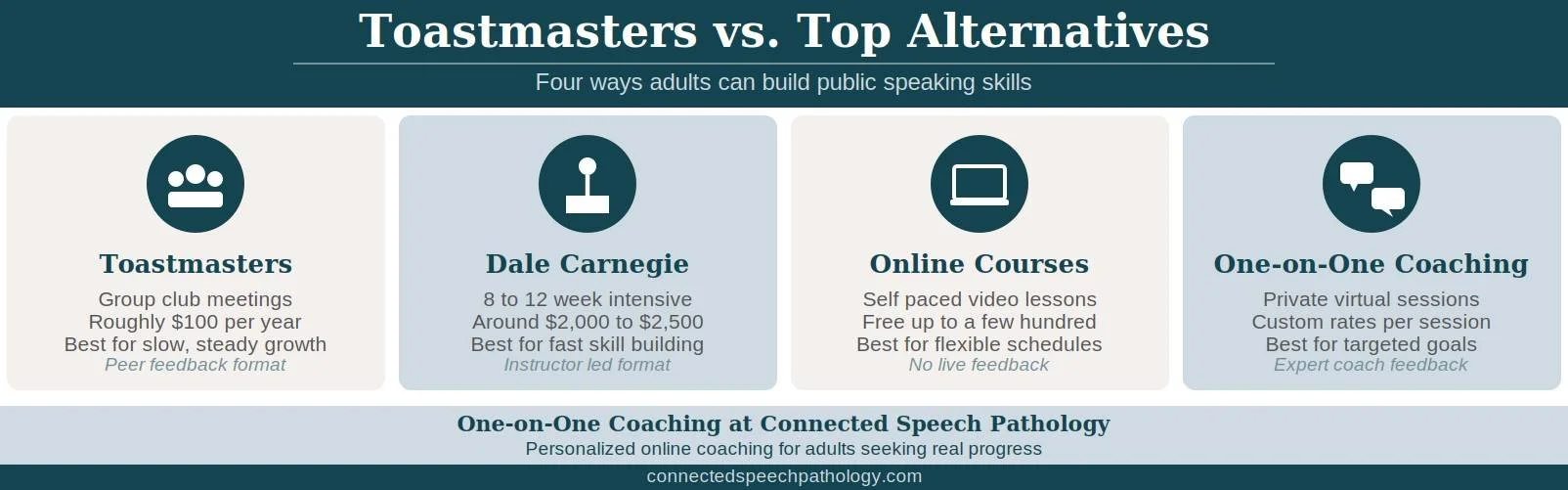
Public speaking options for adults fall into five main categories. Each one has a different format, cost, and best use case.
Dale Carnegie Course
The Dale Carnegie Course is an eight to 12-week instructor-led program. Founded in 1912, it teaches communication, leadership, and presentation skills in a small classroom setting. Members deliver speeches each session and receive feedback from a trained instructor.
Cost: roughly $2,000 to $2,500 per program. Dale Carnegie also offers shorter workshops and an unlimited subscription in some regions for around $299 per month.
Best for: adults who want faster, more intensive training than Toastmasters offers and prefer working with a professional instructor rather than a peer group.
Online Courses on Coursera, Udemy, and LinkedIn Learning
Online courses offer flexible, self-paced video lessons in public speaking. Coursera carries university-backed programs from Wharton and others. LinkedIn Learning includes short modules on presence, persuasion, and presentation design.
Udemy ranges from free to about $100 per course. These platforms suit learners who want to study on their own schedule. The trade-off is that there is no live feedback; you watch, take notes, and practice on your own.
Best for: adults who want low cost, flexibility, and a structured curriculum without the commitment of a group club or a coaching contract.
Community College and University Speech Classes
Many community colleges and universities run public speaking and rhetoric classes open to working adults. A typical course runs 12 to 16 weeks and is graded. Students give a series of speeches in front of a small class and an instructor.
Tuition varies by region, often ranging from $300 to $800 for a single-semester course. Some employers cover the cost through professional development funds.
Best for: adults who like a graded, academic structure and want a transcript record of the work. Useful for career changers or returning students.
Niche Speaking Clubs and Meetup Groups
Niche speaking clubs offer the group format of Toastmasters with a different focus. Examples include AgoraSpeakers, Speakers League, Storymasters circles, and local Meetup public speaking groups. Some focus on storytelling, others on debate, others on impromptu work.
Most charge a small annual fee or are free to join. Meeting size is usually capped at 8 to 12 people, smaller than that of many Toastmasters clubs.
Best for: adults who want peer practice but found Toastmasters too formal or want a topical focus like storytelling, debate, or impromptu work.
One-on-One Communication Coaching
One-on-one coaching pairs an adult with a professional communication coach. Sessions run online, typically for 30 to 60 minutes, and the curriculum is built around the client. There is no fixed program length.
Rates vary by coach and credential. Sessions generally start around $75 to $200, depending on the provider and specialty.
Best for: adults with specific goals, anxiety that group settings worsen, communication differences, or a tight timeline. Also a good fit for executives building presence and credibility, or people preparing for a high-stakes speaking event.
How One-on-One Coaching Compares to Toastmasters

One-on-one communication coaching is an ideal Toastmasters alternative for most adults seeking targeted progress. It delivers targeted feedback, a curriculum built around your goals, and fast results.
Coaching and Toastmasters differ in three core ways: feedback quality, curriculum, and pace.
Toastmasters gives peer feedback from fellow members, most of whom are also learning. Alternatively, a private session with a communication coach gives targeted feedback grounded in professional training, voice science, and years of working with adult speakers. The depth is different.
Toastmasters has a fixed educational track that every member moves through. On the other hand, a coach builds the curriculum around your specific goals. If your challenge is interview pacing, focus on it.
Coaching also moves faster because every minute targets what you actually need. Many clients see meaningful change in six to 12 sessions, though timelines vary by goal. Coaches can address stuttering, accent clarity, vocal strain, or executive function challenges that a Toastmasters meeting does not have time to cover.
The trade-off is cost and a less consistent audience practice. One-on-one coaching typically costs more per hour than a Toastmasters membership and does not always include weekly opportunities to speak in front of a group.
Many clients pair coaching with occasional visits to Toastmasters or workplace speaking opportunities to get both personalized feedback and real audience practice. Some private coaches also offer small-group sessions, giving clients a chance to apply skills in a supportive, guided setting.
Leadership Skills Strong Public Speakers Develop

Strong leadership depends on strong speaking skills. Public speaking is more than delivering a presentation. It is the ability to lead meetings, provide clear direction, and communicate decisions under pressure.
Whether you choose Toastmasters or an alternative, the leadership skills that matter stay the same: organizing your thoughts and speaking with purpose, staying calm in front of a room, and adjusting delivery to the audience.
Club-based programs build these skills through repetition. Coaching builds them through targeted practice and immediate correction. The right approach depends on how you learn and how fast you need to grow your leadership communication skills.

Leadership Communication Training
Check out our blog on leadership communication training for more information!
What We See Working with Clients

Adults who come to us after trying Toastmasters usually fall into two groups. Both tend to find that one-on-one work fills the gap.
The first group is professionals with a specific event. A senior manager preparing for a board presentation joined two Toastmasters clubs over six months and felt no better when the date approached. In four coaching sessions, she rebuilt her opening, slowed her pace, and walked into the boardroom calm.
The second group is adults whose anxiety made group settings harder. One client described leaving every Toastmasters meeting more nervous than when he arrived. Private sessions let him work on his pacing and breathing without an audience of evaluators.
Both clients said the same thing afterward. Group practice gave them a stage. Coaching gave them a plan.
Frequently Asked Questions About Toastmasters Alternatives

1. How much does Toastmasters cost compared to alternatives?
Toastmasters costs around $120 per year, well below most alternatives. Dale Carnegie courses cost $2,000 to $2,500, online courses range from free to about $300, and private communication coaching is priced per session.
2. Is Dale Carnegie better than Toastmasters?
Dale Carnegie is faster and more intensive, but costs roughly 20 times as much. Its eight-week instructor-led format suits adults who want quick results and professional teaching. Toastmasters suits those who want low-cost, long-term practice and a peer community.
3. Are there good online alternatives to Toastmasters?
Yes. Coursera, Udemy, and LinkedIn Learning offer structured public speaking courses for self-paced study. Online one-on-one coaching is a stronger option if you want live expert feedback.
4. Can one-on-one coaching help if I have public speaking anxiety?
One-on-one coaching works well for adults whose anxiety gets worse in groups. Private sessions remove the audience, letting you build skills at your own pace. Coaches use specific strategies for pacing, breathing, and self-monitoring that address fear of public speaking over time.
5. Does coaching work for ADHD-related communication challenges?
Yes. Adults with ADHD often struggle with organizing thoughts before speaking, going off topic, or losing their train of thought. A communication coach can build strategies for structuring speech in real time and self-monitoring in conversations.
6. Who benefits most from a Toastmasters alternative?
Adults with specific goals, anxiety, communication differences, or tight timelines benefit most. Executives preparing for a presentation, professionals with social anxiety, and non-native English speakers seeking clarity often see better results from one-on-one coaching than from group settings.
How Connected Speech Pathology Can Help

Connected Speech Pathology offers personalized online communication coaching for adults seeking a Toastmasters alternative designed for their specific goals. Sessions are private, expert-led, and scheduled around your life.
Our coaches work with executives, professionals, non-native speakers, and adults working through anxiety or communication differences. We cover presentation skills, voice and performance coaching, interview prep, and executive presence.
For non-native English speakers, we also offer accent modification to sharpen clarity and confidence in professional settings.
Not sure where to start? Take our Communication Coaching Quiz to find the coaching focus that best fits your goals.
If you have tried Toastmasters and want faster, more targeted progress, book a free consultation to talk through your goals.
Summary
A Toastmasters alternative gives adults options outside the traditional group club format. The strongest choices are Dale Carnegie for intensive classroom learning, online courses on Coursera or LinkedIn Learning for flexible self-study, and one-on-one communication coaching for expert feedback and faster results.
The right Toastmasters alternative depends on your goal, timeline, learning style, and budget. For most adults seeking targeted progress with privacy and expert feedback, one-on-one coaching often delivers the best return on time and investment.
About the Author
Allison Geller, M.A., CCC-SLP, is a communication coach, speech-language pathologist, and founder of Connected Speech Pathology, an international online practice providing professional communication coaching and speech therapy for children, teens, and adults. With more than two decades of experience, she has worked in medical and educational settings and published research on aphasia. Today, she leads a team of specialists who help clients improve their skills in public speaking, vocal presence, accent clarity, articulation, language, fluency, and interpersonal communication.