Executive Presentation Skills Training: Coaching for Executives & Managers
Executive presentation skills training is one-on-one coaching that helps leaders give clear, confident, and persuasive presentations. If you are an executive, a senior manager, or a high-potential professional who presents to boards and clients, this training is for you. Here is what to know: what it covers, why it matters for senior leaders, the skills it builds, what to expect, and how to choose a coach.
Strong presentation skills shape how your ideas land and how others see your leadership. Many leaders still struggle to hold the attention of a room, and good ideas get lost behind flat delivery or a crowded slide deck. According to Forbes, about 70% of professionals say presentation skills matter for career growth.
Key Takeaways
Executive presentation skills training is one-on-one coaching. It sharpens how leaders deliver executive presentations, engage audiences, and project executive presence. The work centers on your real presentations, not generic exercises.
The training builds practical skills. The list includes storytelling, body language, vocal projection, slide design, and handling tough questions. Each skill is coached and practiced, not just discussed.
Sessions are personalized to your role, your audience, and your goals, with personalized feedback after each practice presentation. A coach names what works and gives you techniques to fix what does not.
Choosing the right executive presentation coach takes care. Look for experience with senior leaders and a coaching style that fits how you work. Fit matters as much as credentials.
With the right coaching, you can present with confidence. You can influence decisions and leave a positive impression in high-stakes business settings. Strong presentation skills start to feel like how you lead.
What Is Executive Presentation Skills Training?
Why Is Executive Presentation Skills Training Important?
Ten Skills You Can Learn in Executive Presentation Training
What To Expect From Executive Presentation Training Courses
How To Choose the Right Executive Presentation Coach
What We See Working with Clients
What Is Executive Presentation Skills Training?

Executive presentation skills training is personalized coaching that helps senior leaders plan and give impactful presentations. It centers on the skills executives use most. You learn to organize key messages, tell compelling stories, read executive audiences, and speak with a calm, confident voice.
The training treats executive presence as more than polish. It looks at how you act, speak, and look during high-stakes executive presentations. A coach watches you present, names what works, and gives you practical techniques to fix what does not.
The training is also different from a generic public speaking class. The work centers on your real executive presentations, your own audiences, and the daily demands of your role. You leave with new skills you can use in your next board meeting or client pitch.
Executive presentations carry higher stakes than everyday public speaking. A coach helps you prepare the exact presentation you're giving, then carries those skills into the next one. Over time, strong presentation skills stop feeling like a performance and start to feel like how you lead.
Why Is Executive Presentation Skills Training Important?

Executives deliver presentations all week, in a boardroom, on a video call, or on a conference stage. Effective communication makes ideas move faster, and teams align around clear key points. A flat presentation can stall even a strong strategy.
Executive presentations also shape how others read your leadership. A senior leader who speaks with executive presence builds trust with boards, investors, and leadership teams. In high-stakes business settings, confident public speaking signals that you are prepared and worth following.
There is a persuasion side too. Most executive presentations ask an audience to decide, fund, or change course. Strong presentation skills move people to a clear yes, so your executive presentations influence decisions, not just share them.
Ten Skills You Can Learn in Executive Presentation Training
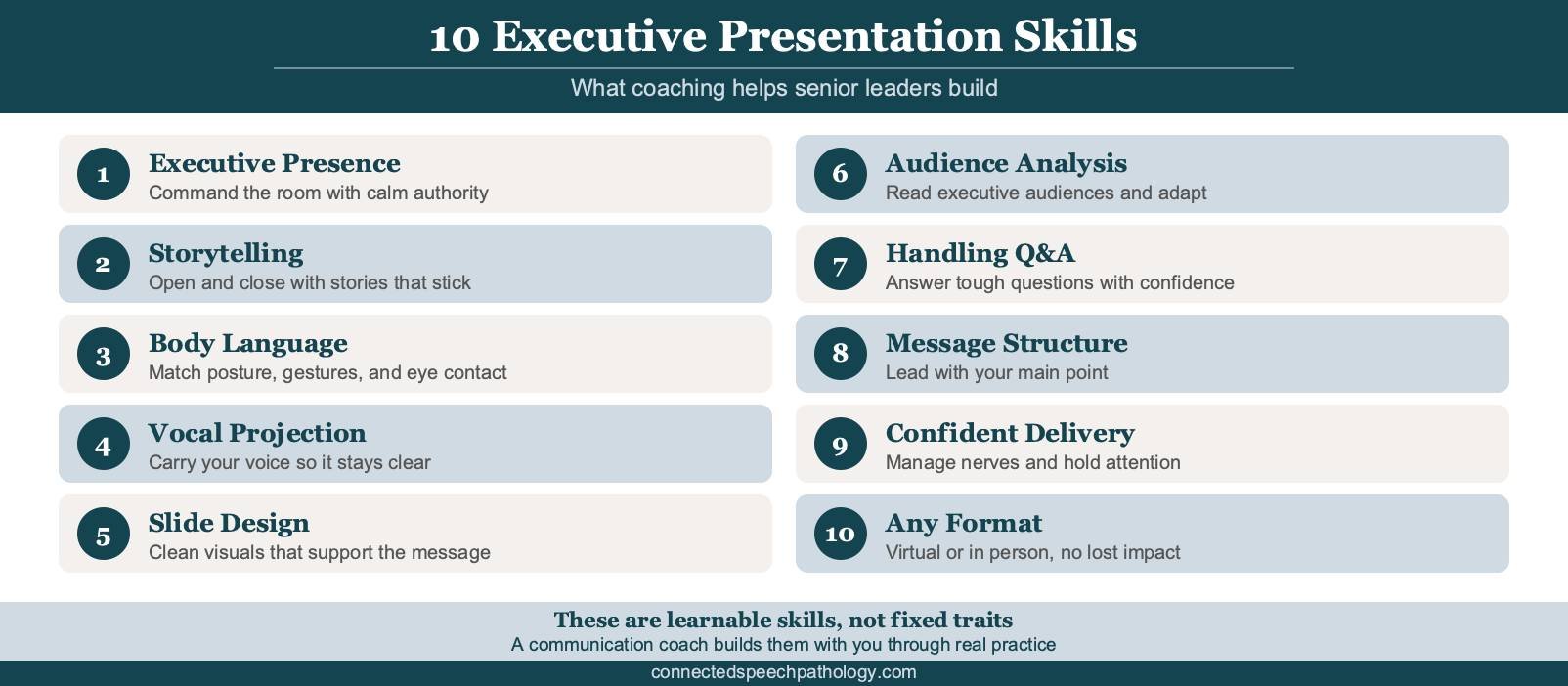
Executive presentation training builds a clear set of skills you can practice and measure. Each skill targets one part of how you prepare and give executive presentations. A coach focuses on the skills that matter most for your role and your audience.
Executive presence: Project calm authority. Stand tall, speak clearly, and hold the room.
Storytelling techniques: Open and close with compelling stories. A story makes complex information easy to follow.
Body language and facial expressions: Use posture, gestures, and eye contact that match your message.
Vocal projection and voice modulation: Control your voice so it carries, stays clear, and keeps the audience engaged.
Slide design and visual aids: Build a clean visual design that supports your message. Good slides clarify the point without crowding it.
Audience analysis: Read and analyze executive audiences. Then adapt your message to what they care about.
Handling tough questions: Stay composed during Q&A and answer them with confidence.
Structuring your message: Organize your main points so your big idea is clear from the first minute.
Confident delivery: Manage nerves and speak with the steady presence that earns attention. Learning to manage nerves starts with the breath, since a steady exhale is what keeps the voice even.
Adapting presentations: Adjust your public speaking for virtual presentations and in-person settings.
What To Expect From Executive Presentation Training Courses

Executive presentation training courses are built around your goals, not a fixed script. Most begin with a short look at how you present today. You and the coach then identify areas to improve and pick the focus areas.
These courses suit executives, leadership teams, and high-potential professionals. The goal is to sharpen key skills fast. With better communication skills, participants learn to communicate effectively.
Sessions can run in person or online, whichever fits your schedule. The focus always stays on real practice, not theory.
Course length varies. Some leaders take a focused two-day course. Others prefer ongoing presentation coaching over several weeks, in which participants learn by practicing.
Expect to present often during the course. You give a short presentation, then receive feedback before you try again. That loop of practice is how new presentation skills become habits.
The topics covered depend on your goals. A good course also includes interactive elements, like recorded run-throughs and live coaching. These reinforce learning, and customized programs match the executive presentations you give.

Presentation Coaching
Check out our blog on presentation coaching for more information!
How To Choose the Right Executive Presentation Coach

The right executive presentation coach has real experience with senior executives. Look for someone who has coached leaders through board updates and high-stakes pitches. That background means they know the pressure of executive presentations.
A strong coach offers customized training, not a one-size-fits-all course. They learn your personal goals, your unique challenges, and the communication skills you want, from listening skills to social skills. Clear communication is an essential skill, so ask how the coach will provide feedback.
Finally, pay attention to fit. You do your most honest practice with a coach you trust, so a comfortable style matters. A good coach helps you feel more prepared for executive presentations, not just corrected.
What We See Working with Clients

In our practice, we work with professionals at many stages of their careers, from first-time managers to senior executives. Presentation challenges often look different on the surface, but many of them come back to confidence, clarity, and effective communication under pressure.
Two examples show how a targeted coaching approach can help. Names and details have been changed to protect privacy.
One client was a newly promoted vice president who froze during executive presentations. Her ideas were strong, but she rushed through key points and struggled when senior leaders interrupted with questions.
We worked on organizing her opening message, slowing her pace, and handling questions without losing her train of thought. Over time, she became more comfortable leading board-level discussions and presenting to larger groups.
Another was a technical leader whose presentations contained far more detail than his audience needed. Stakeholders often left meetings unsure about the decision he wanted them to make.
We focused on simplifying his message, improving slide design, and building a clearer presentation structure. Colleagues soon reported that his presentations were easier to follow, and discussions became more productive.
Frequently Asked Questions About Presentation Skills

1. What are the 5 P's of presentation skills?
The five P's are planning, preparation, practice, performance, and passion. Together, they cover the full arc of a presentation, from organizing your main points to delivering them with energy. Coaching helps you strengthen each P so none of them becomes a weak link.
2. What are the three pillars of an effective presentation?
Most coaches describe the three pillars as content, delivery, and connection. Content is your message, delivery is your voice and body language, and connection is how well you read the audience. Effective presentations need all three working together.
3. What is the most important part of a presentation?
The most important part is a clear core message that your audience can repeat. In executive presentations, strong visuals, storytelling, and confident delivery all serve that one message. If people remember one key idea and why it matters, the presentation worked.
4. How long does executive presentation skills training take?
It depends on your goals. Some leaders see progress in a focused two-day course. Others choose ongoing public speaking coaching across several weeks, and a coach can suggest a course length after seeing how you handle executive presentations today.
5. Can executive presentation training be done virtually?
Yes. Many leaders train for virtual presentations because so much of their public speaking now happens on video. Coaching can take place online and still cover camera presence, vocal projection, and how to keep a remote audience engaged.
How Connected Speech Pathology Can Help

Connected Speech Pathology offers one-on-one executive presentation skills training led by experienced communication coaches. Our coaches have a strong background in voice and communication, so we pay close attention to how you sound and what you say. That means real work on vocal projection, voice modulation, and clear delivery, as well as structure and storytelling.
Our presentation coaching helps you deliver clear, powerful presentations and communicate effectively under pressure. Together, we work through the communication challenges that trip up many leaders.
Some leaders want to build confidence. Others want to persuade audiences or deliver world-class presentations with maximum impact. The plan adapts to you, so you move from shaky talks to high-impact presentations that lift audience engagement.
Every course is personalized. We start with your goals and watch how you handle executive presentations today. Then we build a plan around your role, your audience, and the presentations on your calendar.
You practice often, get specific feedback, and leave each session with techniques you can use right away. The aim is presentation skills that hold up under real pressure, not just in rehearsal. If you are ready to deliver presentations with more confidence, our coaches can help you take the next step.
Summary
Executive presentation skills training is personalized coaching that helps leaders give clear, confident, and powerful presentations. The work builds executive presence, sharpens storytelling, and strengthens the public speaking skills that hold a room. With the right coach and steady practice, your executive presentations can win the room, influence decisions, and show the leader you already are.

About the Author
Allison Geller, M.A., CCC-SLP, is a communication coach, speech-language pathologist, and founder of Connected Speech Pathology, an international online practice providing professional communication coaching and speech therapy for children, teens, and adults. With more than two decades of experience, she has worked in medical and educational settings and published research on aphasia. Today, she leads a team of specialists who help clients improve their skills in public speaking, vocal presence, accent clarity, articulation, language, fluency, and interpersonal communication.