Business Communication Coach: How to Advance Your Career and Communicate with Confidence

A business communication coach is a professional who helps working adults speak clearly and with confidence at work. Here's what to know: what a coach does, the skills coaching builds, how to choose one, what to expect, and why a background in speech makes a real difference. Good coaching turns communication into a skill you can practice and improve.
Maybe you are an executive, a manager, or a professional who wants to be heard. You want to shine in meetings, land high-stakes presentations, or step into leadership. How well you communicate shapes how far your career goes, and the right coach helps you get there faster.
Key Takeaways:
A good communication coach helps you turn strong ideas into clear, confident messages. Coaching sharpens skills such as executive presence, listening, and public speaking that shape how leaders see you.
The best coaching is personal. A good coach starts with an assessment, sets clear goals, and gives you honest notes on real workplace scenarios.
A coach trained in speech-language pathology adds voice and delivery skills most coaches do not have. You get clearer speech, a stronger voice, and lasting habits.
Most professionals notice early gains within a few weeks. Remote coaching fits a busy schedule and works from home or the office.
What Is a Business Communication Coach?
What Can Communication Coaching Do for You?
Why Speech-Language Pathology Training Sets Coaches Apart
How to Choose the Right Communication Coach
What to Expect From Business Communication Coaching
What We See Working with Clients
What Is a Business Communication Coach?

A communication coach helps working adults communicate more clearly and persuasively on the job. Coaching is built on assessment, practice, and honest feedback, and it targets skills like public speaking, executive presence, and clear messaging. When your coach is trained in speech-language pathology, that work is grounded in the science of speech and voice.
Coaching is personal and practical. Your coach watches how you speak in real situations, names the habits that hold you back, and gives you tools for your next meeting. The work is elective skill-building for professionals, so you do not need a speech or language disorder to benefit.
Effective communication is essential for career success. The professionals who advance are often those who communicate effectively, listen well, and remain calm in high-stakes conversations. Poor communication does the opposite, since unclear messages slow projects and spark conflict on teams.
A good coach helps you develop those business communication skills deliberately, not by trial and error. Muddled messaging can quietly stall a career; clear messaging does the opposite, and it strengthens your personal brand along the way. When you speak with clarity, colleagues trust your judgment and leaders picture you in bigger roles.
Business communication coaching helps if you:
Lose your point or ramble past it when you speak under pressure
Feel overlooked in meetings, even with strong ideas
Dread presentations and difficult conversations
Want more presence as you move into leadership
Coaching meets you where you are. Whether you are a new manager or at the senior level, the work starts from your real challenges, not a generic script. That is especially true for professionals who feel their skills have plateaued and want new tools that fit their role.
Types of Business Communication Coaches
A coach can specialize in different areas, so the right fit depends on your goals. A leadership communication coach improves how you guide teams and stakeholders. A corporate communication coach strengthens teamwork with company-wide communication training.
An executive communication coach focuses on high-stakes public speaking and presence at the senior level. An interpersonal communication coach helps you develop trust and empathy in daily conversations. Some newer AI communication coaches use technology to analyze speech and flag patterns, though they cannot replace a human coach's judgment.
Most professionals want a mix of these. A good coaching program blends leadership development, professional development, and presentation work into one plan built around you.
What Can Communication Coaching Do for You?
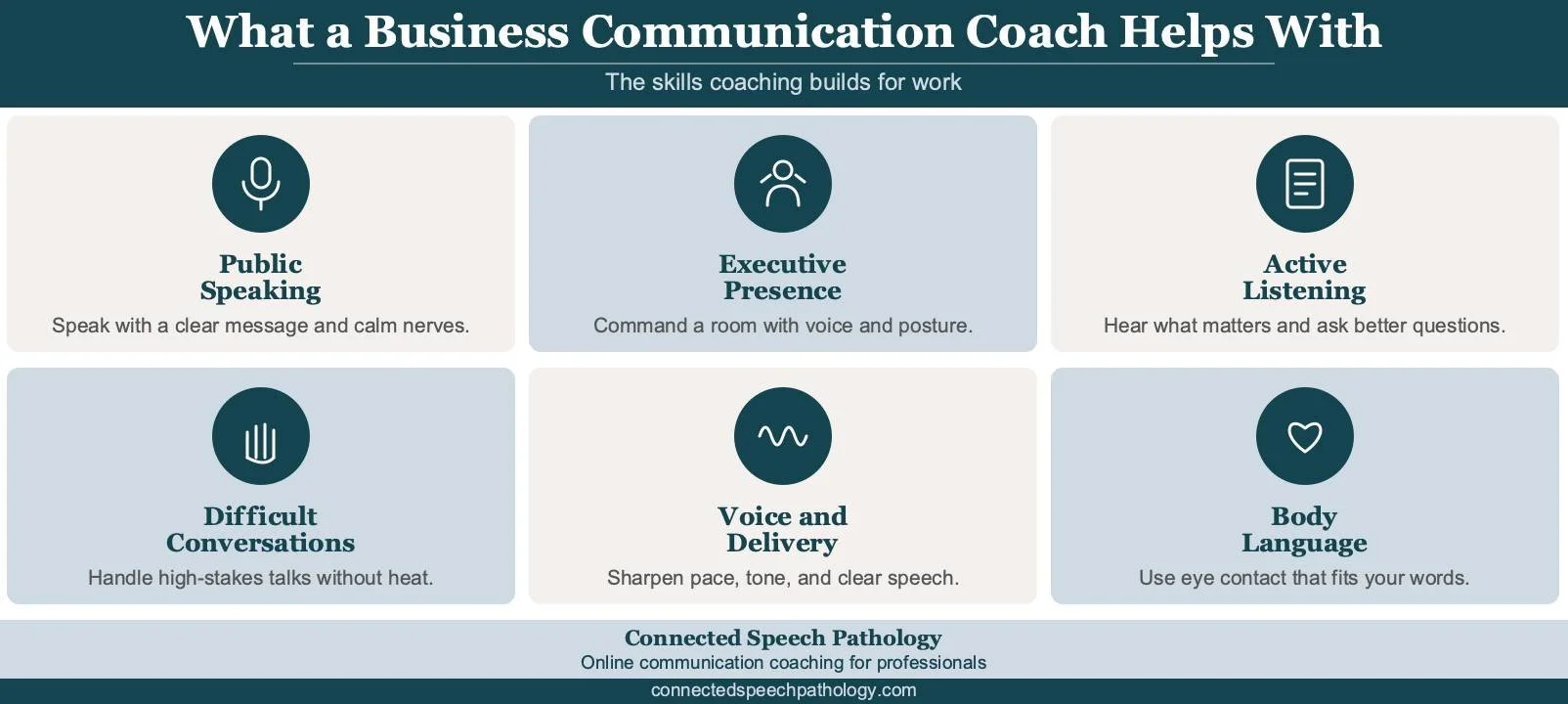
The right coaching targets the skills that carry the most weight at work. Coaching sessions cover public speaking, presence, listening, difficult conversations, and the voice and body language that back up your words. You practice each skill on real workplace scenarios, so the growth shows up where it counts, meeting by meeting.
Public Speaking and Presentation Skills
Coaching helps you handle public speaking and give presentations that hold attention. Your coach works with you to structure a clear message, build a compelling narrative with business storytelling, and steady your nerves. The more you practice, the less the anxiety grips you, and confidence grows over time.
Presentation skills matter well past formal speeches. The same coaching helps you brief a board, pitch an idea, or run a team meeting and keep everyone engaged. Storytelling applies in all of these, turning a routine update into something people remember.
Executive Presence and Leadership Communication Skills
Executive presence is the mix of voice, body language, and message that makes people listen. A coach helps you command attention, project more confidence, and communicate like a leader. Strong leadership communication skills set senior people apart, and coaching develops them through practice, not theory.
The more senior your role, the more your communication carries. Leaders who speak clearly build trust faster, and that trust opens doors to bigger roles and real influence
Listening, Difficult Conversations, and Emotional Intelligence
Active listening is a core skill for every strong communicator, and a coach can teach it. You learn to listen for what matters, ask better questions, and handle difficult conversations without heat. Coaching also builds the emotional awareness behind conflict resolution and connecting with different audiences.
Better listening leads to better conversations. When you hear people out, you resolve conflict faster and turn tense moments into progress.
Voice, Delivery, and Body Language
How you sound and how you carry yourself affect whether people actually take in your message. Coaching works on vocal variety, pace, eye contact, and articulation, so your delivery comes across as clear and convincing. A coach trained in speech can also cut the filler words, the ums and you-knows, that make you sound unsure.
The small habits matter. Steady eye contact, open posture, and other nonverbal signals can make the exact same words more convincing.
Why Speech-Language Pathology Training Sets Coaches Apart

A coach trained in speech-language pathology brings a science most coaches cannot match. Their graduate training covers the physiology of speech, voice, and language, so they see how clear communication works and where it breaks down. That depth lets them coach both your message and the mechanics behind it.
A coach with this background starts with a real evaluation. They assess your speech, voice, and delivery, then build a plan around your personal strengths and challenges. The added depth is why executive communication coaching from a speech expert reaches beyond generic tips.
A real evaluation looks concrete. Your coach often records you presenting and then reviews your pace, filler words, eye contact, and the way you structure a point. From there, you set clear coaching goals and track them week to week.
The work is elective training rather than a clinical service. You gain a coach who knows voice, articulation, and the nerves that come with high-stakes speaking. In short, you get clinical-level expertise applied to everyday professional growth.
How to Choose the Right Communication Coach
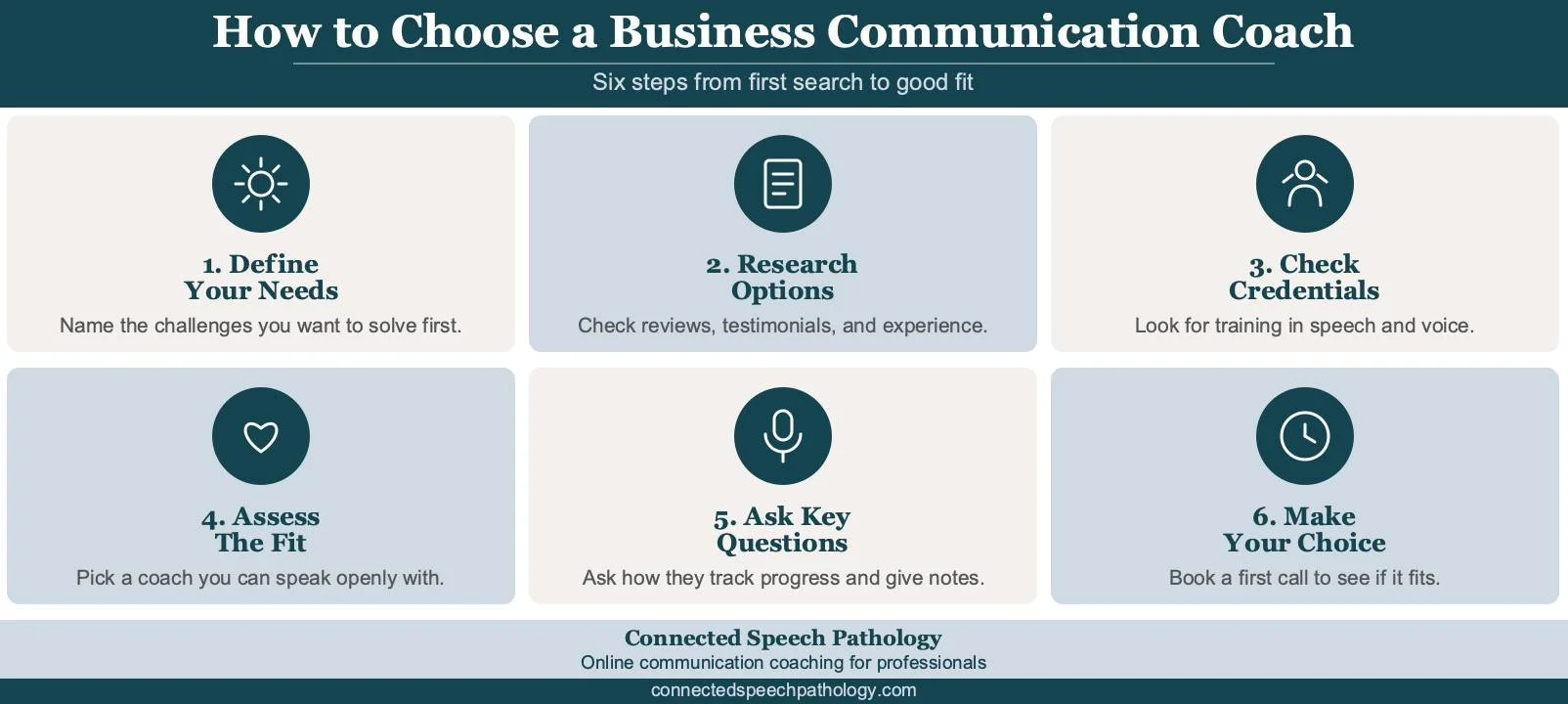
Choosing the right coach doesn't have to be complicated. Here are a few suggestions to make the process simpler.
1. Define your needs, from public speaking anxiety to presence in the boardroom, so you know what to solve.
2. Research your options by checking qualifications, testimonials, and relevant experience in your field.
3. Consider credentials and expertise, since a background in speech-language pathology adds voice and delivery depth.
4. Assess compatibility and communication style, because you will speak openly and need a coach you trust.
5. Ask key questions about their coaching methodology, how they track progress, and the notes you will get.
6. Make an informed decision after an initial consultation that shows whether the coach is a good fit.
Questions to Ask Before You Hire
What is your coaching experience and relevant background?
Are coaching sessions live and online, and what does a coaching program include?
What does a typical coaching session look like?
Good coaching services set clear expectations before you start. A trustworthy coach can explain their coaching methodology, share goals for the first month, and describe the coaching solutions they use for common communication challenges.
Watch for red flags, too. Be cautious with anyone who promises instant results or hands every client the same script. Improving communication takes practice, and honest coaches say so up front.

Leadership Communication Skills
Check out our blog on leadership communication skills for more information!
What to Expect From Business Communication Coaching

Real results come from clear goals, constructive feedback, and steady practice between sessions. Coaching methodologies that include practice, review, and accountability create lasting change.
Most professionals notice early gains within a few weeks. More lasting change tends to follow over about one to two months of coaching.
Personalized coaching is the main advantage over a self-paced online course. A course cannot watch you present and correct the habit in the moment. Live coaching and live sessions give you that expert ear, plus drills you repeat to develop new skills.
Coaching works for a wide range of professionals. Corporate executives use it to sharpen board presentations, and HR professionals use it to guide their own teams. In each case, measurable outcomes keep the work honest, from clearer review scores to a smoother quarterly update.
Expect a little homework between sessions. Your coach gives you a short drill, a script to practice, or a meeting to treat as a rehearsal. Small reps like these, done between sessions, are where new habits take hold and start to feel natural.
Remote coaching has become a popular and effective option. You meet online from your own home or the office, practice on camera in the same format as your real meetings, and review recordings with your coach. Online coaching also removes geographic constraints, so you can work with the right communication coach rather than the closest one.
What We See Working with Clients

In our practice, we coach professionals across industries, from new managers to senior executives preparing for the next step. The examples below are real clients of ours. Identifying details have been changed to protect privacy.
One client, a newly promoted operations manager, kept losing her ideas in leadership meetings. She would over-explain, bury her main point, and watch someone else get credit for the same idea minutes later.
In coaching, we built one-point message outlines, ran listening drills, and worked on pacing. Then she role-played her monthly updates on recorded video calls, and we tightened her opening lines together.
She now leads her monthly update with a clear headline, and she gets to the point before she loses the room. Her manager noticed the change within a month, and she has since volunteered to present at a company-wide meeting.
Another client, a senior engineer up for a director role, was hard to follow on calls. English is his second language, and fast, flat delivery made strong ideas easy to miss. He knew the content cold, but the message was not landing.
Our coaching focused on articulation, speech rate, and cutting filler words. From there, he practiced presence on camera, from posture to vocal variety, and drilled the high-stakes conversations he expected in the promotion process. We recorded each mock interview, so he heard the difference for himself.
He came across as clearer and more composed in his leadership interviews, and he felt more in control of how he sounded. Today he uses a warm-up routine before big calls, a habit that started in coaching.
Frequently Asked Questions About Communication Coaches

1. How much does a communication coach cost?
Rates vary by experience and format. Private coaching commonly runs a few hundred dollars per hour, while group programs and packages cost less per session. Many coaches offer a free first consultation, so you can compare a few before you commit.
2. Is a business communication coach worth it?
For most professionals, the answer is yes if the coaching aligns with your goals. The skills carry into every meeting, presentation, and negotiation for the rest of your career. That lasting return on career growth is why so many corporate executives and companies invest in coaching.
3. What is the difference between a communication coach and a speech therapist?
A communication coach helps healthy professionals sharpen skills like public speaking and presence. A speech therapist is trained to treat speech and language disorders. At Connected Speech Pathology, your coach is trained in both and offers communication coaching as elective work, so you get clinical-level expertise without the clinical setting.
4. How long does it take to see results from communication coaching?
Many clients notice early progress within the first few weeks. Every professional moves at a different pace. Lasting change follows the practice you put in between sessions, and most people see clear gains within one to two months.
5. Do communication coaches work online?
Yes, and remote coaching is often just as effective as meeting in person. You practice on camera in the same format as your real calls, and online coaching removes travel and distance. That makes it easy to find the right communication coach online rather than the nearest one.
6. Can a communication coach help if English is my second language?
Yes. Many professionals work with a coach on clarity, so their ideas come through on calls. Our accent modification coaching sharpens articulation and speech rate, without erasing how you sound.
How Connected Speech Pathology Can Help

Looking for a business communication coach? Connected Speech Pathology offers online communication coaching for professionals. Every coach on our team is trained in speech-language pathology, so your coach knows both your message and the voice behind it.
We tailor each coaching program to your goals. Maybe you are prepping a high-stakes talk, or building presence for a leadership role. We also coach teams, so companies can build stronger communication across a department.
Every session happens online. You practice on camera, from anywhere, in the same format as your next meeting.
Summary
A business communication coach helps you speak with clarity and confidence. Those skills shape your whole career. Coaching sharpens executive presence, active listening, and public speaking, and it gives you an expert ear that a course cannot.
Choose a coach by defining your goals, checking credentials, and meeting them for a consultation. When that coach is trained in speech-language pathology, you also gain deep knowledge of voice and delivery. Either way, clearer communication pays off in every conversation ahead.

About the Author
Allison Geller, M.A., CCC-SLP, is a communication coach, speech-language pathologist, and founder of Connected Speech Pathology, an international online practice providing professional communication coaching and speech therapy for children, teens, and adults. With more than two decades of experience, she has worked in medical and educational settings and published research on aphasia. Today, she leads a team of specialists who help clients improve their skills in public speaking, vocal presence, accent clarity, articulation, language, fluency, and interpersonal communication.