Family Empowerment Scholarship for Students with Unique Abilities

The Family Empowerment Scholarship for Students with Unique Abilities (FES-UA) is a Florida program that gives families more control over how they pay for their child’s education and support services. Eligible families receive funds through an education savings account that can be used for approved expenses, including therapies, educational programs, specialized services, and other resources that support their child’s individual needs.
For Florida families raising a child with a disability, FES-UA offers flexibility in choosing the services and resources that best meet their child’s needs. There is no income requirement to qualify, so eligibility is not limited to families within a certain income range.
This article explains how FES-UA works, who may qualify, how scholarship amounts are determined, what the funds can cover, and how to apply through Step Up For Students. We’ll also explain how families can use FES-UA funds for services such as online speech therapy.
Key Takeaways
One of Florida's largest programs: FES-UA gives families a personal education savings account, with awards that average about $10,000 per year deposited in quarterly installments.
Eligibility runs from age three through 22: your child qualifies with an eligible IEP from a Florida school district, or a qualifying diagnosis validated by a licensed physician, physician assistant, autonomous APRN, or psychologist. There is no household income requirement.
Your award depends on three things: your district, your child's grade, and the level of special-education services documented for your child. Step Up For Students posts the exact amounts by district each year.
Funds cover tuition, therapies, and tutoring: families can use FES-UA to pay for online speech therapy through an approved provider, often at zero out-of-pocket cost because approved services are paid directly from the account.
What Is the FES-UA Scholarship?
Who Qualifies for the FES-UA Scholarship?
How to Apply Through Step Up For Students
What the ESA Pays For: Therapies, Devices, and Tuition
What We See Working with Florida Families
What Is the FES-UA Scholarship?

The FES-UA scholarship is a Florida education savings account (ESA) for a student with a qualifying disability. It used to be called the Gardiner Scholarship. Parents direct the funds toward tuition, therapies, curriculum, and other approved services, and the award averages about $10,000 a year, paid each quarter.
FES-UA gives eligible families an education savings account they control. You can spend it across several providers instead of relying on one school to provide all of your child's services. A student cannot receive FES-UA funding while enrolled full-time in a public school.
Step Up For Students is the state-approved scholarship funding organization. It runs the Family Empowerment Scholarship program, processes applications, and manages accounts under the Florida Department of Education. Because the money sits in an education savings account, not a voucher, it stays in an eligible student account until you spend it on an approved purchase.

Step Up Scholarship Florida Program: Everything To Know
A plain-language overview of every Step Up For Students scholarship, so you can see where FES-UA fits.
Who Qualifies for the FES-UA Scholarship?
Three basic requirements determine FES-UA eligibility. Your child must meet the program’s age and school enrollment requirements, have a qualifying disability, and meet Florida residency requirements.
Age, Grade, and Residency Requirements
Your child must be at least three by December 31 of the application year, or old enough for a Florida public school. They must also be younger than 22 by the following September. Graduating from high school ends eligibility.
Applicants need a Florida residential address. Active-duty members of the United States Armed Forces who have received permanent change-of-station orders to Florida can apply before they officially relocate, which gives military families access during the move.
One rule catches families by surprise. A student cannot get new FES-UA funding while enrolled full-time in a public school. Money already in the account can still go toward eligible expenses.
Qualifying Disabilities for the Unique Abilities Scholarship
Florida law lists 23 qualifying conditions for the Unique Abilities Scholarship. The list covers autism spectrum disorder, intellectual disability, Down syndrome, cerebral palsy, and traumatic brain injury. It also includes hearing and visual impairment, specific learning disabilities, such as dyslexia, and speech or language impairment.
The list is broad, and it also covers anaphylaxis, emotional or behavioral disability, muscular dystrophy, orthopedic impairment, and other health impairment. Phelan-McDermid and Prader-Willi syndromes, spina bifida, Williams syndrome, rare diseases, and high-risk, hospital, or homebound status round out the qualifying list.
Childhood apraxia of speech is not its own category. A child with that diagnosis, or a language delay, may still qualify under speech or language impairment, depending on the documentation. A communication issue doesn't automatically qualify a child, so it's worth applying and letting the review confirm eligibility.
Documentation You Will Submit
Families can apply using either an eligible IEP from a Florida school district or documentation of a qualifying diagnosis.
If you're applying based on a diagnosis, the documentation must come from an approved provider. Florida accepts documentation from a licensed physician, physician assistant, autonomous APRN, or psychologist. With limited exceptions for out-of-state physicians, the provider must be licensed in Florida.
Speech-language pathologists are not included on the list of professionals who can provide the qualifying documentation for FES-UA. However, an SLP can still play an important role when a speech or language disorder is the basis for eligibility. The SLP can evaluate your child, diagnose the speech or language disorder, and provide a written evaluation report that a physician or other approved professional can review when determining whether to document the qualifying diagnosis.
You'll also submit proof of Florida residency and your child's Social Security number. For children ages three to five, you'll need a birth certificate or passport to confirm age. If you're applying with an IEP, request the most recent official copy from the district and keep any matrix of services pages available, since the matrix level can affect the scholarship amount.
How Much Is the FES-UA Award?
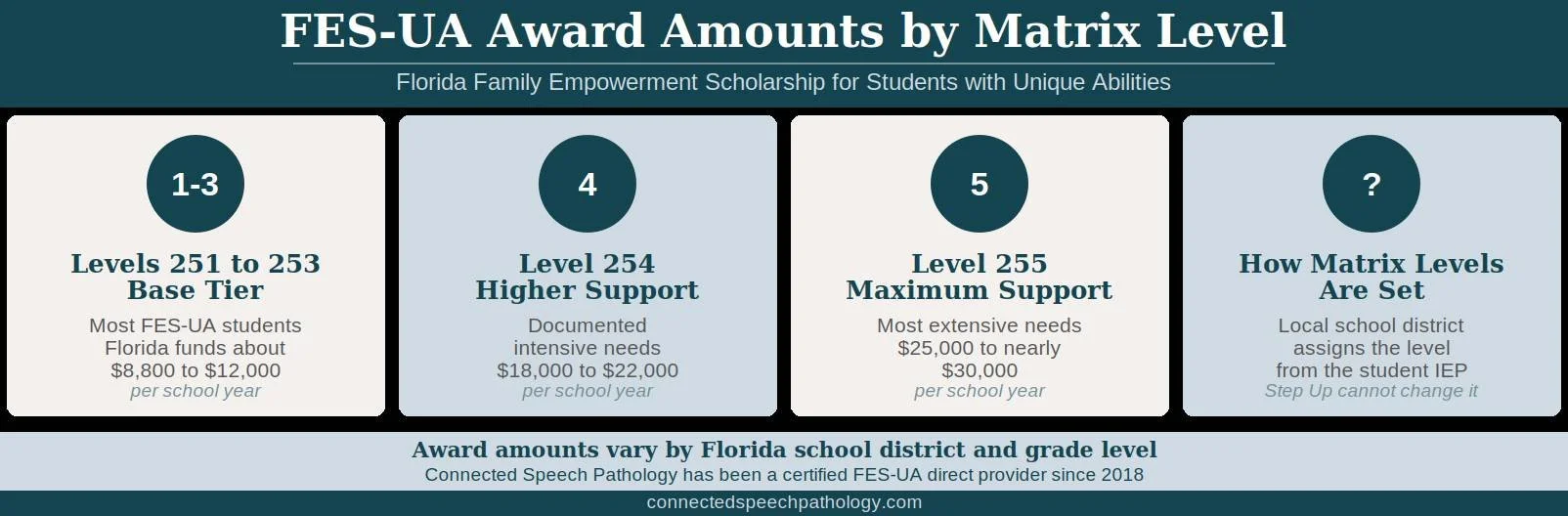
FES-UA scholarship amounts vary by student. The amount your child receives depends on your school district, your child’s grade level, and the level of services documented through Florida’s matrix of services.
How the Matrix of Services Works
The matrix of services is a Florida Department of Education tool that rates a student's special-education support needs. A local school district is the only body that can assign or revise that level, and it feeds into the state's funding formula. Put simply, the more support your child's documentation shows they need, the larger the award tends to be.
If your child qualifies through a medical diagnosis rather than an IEP matrix level, the award uses the district's standard funding amount. The district can update the matrix level when your child's documented needs change.
Award Amounts Vary by District
The FES-UA award averages about $10,000 a year, but the exact figure depends on your district, your child's grade band, and, when it applies, the matrix level. Amounts are set each year, and Step Up For Students publishes the current figures by district. Ask the scholarship funding organization for the exact number before you count on it.
How to Apply Through Step Up For Students

Families apply through the EMA portal, the account system Step Up For Students runs. Parents create the account, complete the application, and manage the funds from there.
Create your EMA account. Register on the Step Up For Students website using a parent's email address.
Choose the FES-UA program and start the education savings account application in EMA.
Complete the application with your child's information and the required residency and eligibility details.
Upload documentation. Add proof of residency, a Social Security number, and the IEP or diagnosis letter from an eligible professional, plus a birth certificate for children ages three to five.
Submit and track your status. Watch the portal for notifications, and accept or decline the award within the deadline in your letter.
Application windows and deadlines change every school year. Step Up For Students reviews applications and notifies families on a rolling basis, so the wait depends on when you apply. Contact the Florida Department of Education for application inquiries.
Families who already receive FES-UA should pay close attention to the renewal period, since renewing students receive priority over new applicants. Missing the renewal deadline may mean your application is treated as a new application.
Household income is not an FES-UA eligibility requirement. However, the program has a yearly enrollment limit, so apply as early as possible.
What the ESA Pays For: Therapies, Devices, and Tuition

Once your child is awarded, FES-UA deposits funds quarterly into a restricted-use account. You direct the money across approved providers and purchases rather than getting a lump sum.
Approved expenses include private school tuition and fees, private tutoring, online learning programs, instructional materials, devices, and curriculum for home education. If your child learns at home, our guide to homeschool speech therapy explains how sessions and practice can fit into your lessons. The scholarship also covers nationally norm-referenced testing for students learning at home. A portion can even be set aside for future community college costs or higher education expenses.
Specialized services are the second category. Approved services include speech-language pathology, occupational therapy, physical therapy, applied behavior analysis, and counseling from licensed professionals. The provider must be licensed by the Florida Department of Health and approved through the program, and online or telepractice delivery is eligible.
You can pay an approved provider two ways. With direct billing, they invoice the EMA portal. The other option is reimbursement, where you pay first and submit invoices.
Family Empowerment Scholarship at Connected Speech Pathology. See how our practice covers online speech therapy through the Family Empowerment Scholarship, with no out-of-pocket cost for approved services.
Paying for Online Speech Therapy Through the ESA
FES-UA funds cover speech-language services from an approved provider, and online sessions fit the model well. With direct billing, the provider submits invoices through the EMA marketplace, the scholarship funding organization releases payment from the account, and you don't handle reimbursement paperwork. As long as the scholarship funds in the account cover the sessions, families pay nothing out of pocket.
Direct billing also avoids the cash-flow gap that comes with paying first and waiting for reimbursement. That matters when your child needs steady weekly sessions across the whole school year.
Who Speech Therapy Helps Under FES-UA
Speech-language pathologists work with FES-UA students across a wide range of speech, language, and communication needs. Younger children may need early intervention speech therapy to build early communication skills, while other children may need support for articulation disorders, childhood apraxia of speech, fluency and stuttering, voice, or expressive and receptive language disorders.
Speech therapy can also address communication challenges associated with developmental differences. For example, children with Down syndrome may work on speech clarity and language development, while speech therapy for autism may focus on language, social communication, and everyday interactions.
For children and teens with ADHD or autism, therapy may also address areas of communication that are sometimes overlooked. This can include organizing thoughts, staying on topic, listening and responding during conversations, reading social cues, advocating for themselves, joining friendships and peer interactions, and communicating effectively when emotions are high.
Depending on the student’s individual needs, speech therapy may address:
Social skills and social communication
ADHD- and autism-related communication challenges
Executive functioning skills related to communication
Conversation skills
Self-advocacy and self-confidence
Friendship skills and peer interactions
Emotional regulation and communication
Speech clarity and articulation
Language development
Fluency and stuttering therapy
Voice therapy
Annual Renewal, Aging Out, and Common Mistakes
FES-UA requires annual renewal. Families who took part last year keep priority status, but only if they renew inside the priority window.
Eligibility ends when a student graduates from high school or turns 22 before September of the coming school year. Families near that boundary should plan ahead. Speech therapy and other supports often continue into adulthood through private pay or insurance.
A few mistakes come up again and again.
Missing the renewal deadline. Renewing families receive priority, but applications submitted after the renewal deadline may be treated as new applications. Check the current FES-UA deadlines each year so you don’t lose your renewal priority.
Using too much of the scholarship early in the year. FES-UA funds may need to cover services and educational expenses throughout the school year. Plan ahead for ongoing costs such as therapy, curriculum, and tutoring so you know how much funding to set aside for later in the year.
Assuming a purchase is covered. Each year's FES-UA family handbook lists approved and excluded expenses. Check the current handbook before a major purchase.
Mixing public school enrollment with the ESA. Enrolling full-time in a public school while receiving ESA funds forfeits eligibility for the year.
Waiting on documentation. A draft or addendum IEP isn't enough. Request the finalized version, including the matrix pages, before you submit.
What We See Working with Florida Families

The examples below are based on real clients we have worked with. Identifying details have been changed to protect privacy.
We’ve worked with FES-UA students with a wide range of needs, from young children working on speech clarity and language development to teens with ADHD or autism who need help organizing their thoughts, following conversations, reading social cues, or advocating for themselves.
What we love about working with these students is that speech therapy can go far beyond speech sounds. We can work on the communication skills that affect friendships, classroom participation, independence, and confidence every day.
Online therapy is especially well suited to this work. Students can meet with a specialist from home, without adding another commute to the family’s schedule. Sessions are individualized, interactive, and focused on skills students can immediately use at home, at school, and with their peers.
Frequently Asked Questions About the FES-UA Scholarship

1. Who qualifies for the FES-UA scholarship?
Florida residents ages three through 22 with a qualifying disability are eligible. You can prove it with an eligible IEP or a diagnosis from a licensed physician, physician assistant, autonomous APRN, or psychologist. There is no household income requirement.
2. How much is the FES-UA scholarship award?
Awards average about $10,000 a year, paid each quarter. The exact figure depends on your district, your child's grade, and, when it applies, the matrix level. Step Up For Students posts the current amounts by district each year.
3. Can FES-UA funds pay for speech therapy?
Yes. FES-UA covers speech-language services from an approved provider, including online sessions. With direct billing in the EMA portal, there is no out-of-pocket cost while the account balance covers the sessions.
4. Can a speech-language pathologist provide the diagnosis needed for FES-UA eligibility?
A speech-language pathologist can evaluate and diagnose speech and language disorders, but an SLP’s diagnosis alone does not meet FES-UA eligibility requirements. If a speech or language disorder is the basis for eligibility, the SLP’s evaluation and diagnosis can be provided to an approved professional, such as a licensed physician, physician assistant, autonomous APRN, or psychologist, who can provide the qualifying documentation. Families may also qualify using an eligible IEP.
5. Is FES-UA the same as the Gardiner Scholarship?
FES-UA was formerly known as the Gardiner Scholarship. Florida folded its older disability scholarship into one education savings account, with more flexibility across therapies, curriculum, and tutoring.
6. Does FES-UA include a transportation stipend?
No. A public school transportation stipend is a separate program. FES-UA funds cover school costs, therapies, and tuition, not transportation.
How Connected Speech Pathology Can Help

Connected Speech Pathology has been a direct FES-UA provider since 2018. We provide online speech therapy and evaluations to students across Florida, with approved services paid directly through FES-UA scholarship funds.
Our speech-language pathologists work with children and teens with a wide range of communication needs, including childhood apraxia of speech, autism, ADHD-related communication challenges, articulation and phonological disorders, language disorders, social communication difficulties, stuttering, voice disorders, and communication challenges related to conditions such as hearing loss or acquired brain injury. We also work on communication-related executive functioning skills, including organizing thoughts, staying on topic, listening effectively, self-advocacy, and handling conversations and peer interactions.
We are an approved provider in the EMA marketplace and submit eligible services directly through the scholarship account. Before each billing cycle, we confirm sessions with families and provide a monthly update on the account balance.
Every family starts with a conversation with our lead speech-language pathologist to learn about your child’s needs and match them with a therapist whose experience and expertise are the best fit.
Summary
The Family Empowerment Scholarship for Students with Unique Abilities gives Florida families a flexible way to pay for a child's education and services. Step Up For Students runs the account under the state. Families use it, on average, about $10,000 a year for what their child needs, from tuition to speech therapy.
It runs from age three through 22 for a child with a qualifying disability, as shown by an IEP or a diagnosis. The student's grade, district, and special-education service level can affect the award. As an approved FES-UA provider, Connected Speech Pathology offers online speech therapy across Florida, with no out-of-pocket cost for approved services.
About the Author
Allison Geller, M.A., CCC-SLP, is a communication coach, speech-language pathologist, and founder of Connected Speech Pathology, an international online practice providing professional communication coaching and speech therapy for children, teens, and adults. With more than two decades of experience, she has worked in medical and educational settings and published research on aphasia. Today, she leads a team of specialists who help clients improve their skills in public speaking, vocal presence, accent clarity, articulation, language, fluency, and interpersonal communication.