Does Dyslexia Affect Speech? Understanding the Connection

Does dyslexia affect speech? It can, though usually indirectly. Dyslexia is a language-based learning disorder rooted in how the brain processes the sounds within words.
Those differences can influence how someone speaks, not just how they read and spell. Most discussions of dyslexia focus on children, reading, and spelling. This guide takes a different approach.
It explores how dyslexia can affect adults' speech, word-finding, and everyday conversations. The sections below explain what dyslexia is, how it may influence spoken communication, how it differs from a speech disorder, and how the right support can help.
Key Takeaways
Dyslexia affects speech indirectly through phonological processing. The core challenge involves working with the sounds in words, which can affect word-finding, pronunciation, and speech fluency.
Dyslexia is not a speech disorder. It is a language-based learning disorder, not a problem with the muscles used for speech. That distinction separates it from conditions such as apraxia of speech, articulation disorders, and stuttering, even though some signs can overlap.
Research suggests a connection between dyslexia and stuttering. One study found that about 34% of adults with dyslexia had stuttered as children, compared with roughly 1% of the general population. The likelihood of stuttering also appears to increase with dyslexia severity.
Speech therapy can help at any age. Phonological awareness training, speech exercises, and compensatory strategies can support clearer communication, stronger word retrieval, and greater confidence in conversations.
How Dyslexia Affects Speech in Adults
The Link Between Dyslexia and Stuttering
Is Dyslexia a Speech Disorder? How It Differs
Early Signs: How Dyslexia Shows Up Before Reading
What Is Dyslexia?

Dyslexia is a common learning disorder that affects reading, spelling, and writing. These challenges are greater than expected for a person of that age and educational background. They are not related to intelligence, motivation, or effort.
The condition often runs in families. Many people with dyslexia are strong problem-solvers and creative thinkers. They simply process written language differently.
Dyslexia makes it harder to connect letters with their corresponding sounds. As a result, sounding out unfamiliar words and recognizing words quickly can take more effort. Reading comprehension may suffer when so much attention is focused on decoding individual words.
The same underlying difficulty can affect spelling and the order of letters in writing. At the center is a difference in phonological processing, the brain's ability to recognize, organize, and manipulate the sounds within words.
That phonological system supports more than reading. It also helps people break spoken words into smaller sound units, hold those sounds in memory, and blend them together again. When phonological awareness or phonological memory is weaker, those tasks become more difficult.
Speech relies on the same sound-processing system. Retrieving the correct sequence of sounds may take longer, which can contribute to word-finding difficulties or occasional speech errors during conversation. A weaker phonological memory can also make it harder to hold onto a word while preparing to say it.
Reading, spelling, writing, and spoken language all draw on this shared phonological foundation. For that reason, some of the same sound-based challenges can appear across multiple communication tasks. None of these differences affects a person's intelligence or ability to think clearly.
Some people use the term "speech dyslexia" to describe these spoken-language challenges. No formal diagnosis carries that name. The phrase reflects a real connection between dyslexia and spoken language, both of which rely on the same underlying phonological system.

Phonological Processing Disorder: Symptoms and Strategies
Learn more about phonological processing disorder.
How Dyslexia Affects Speech in Adults
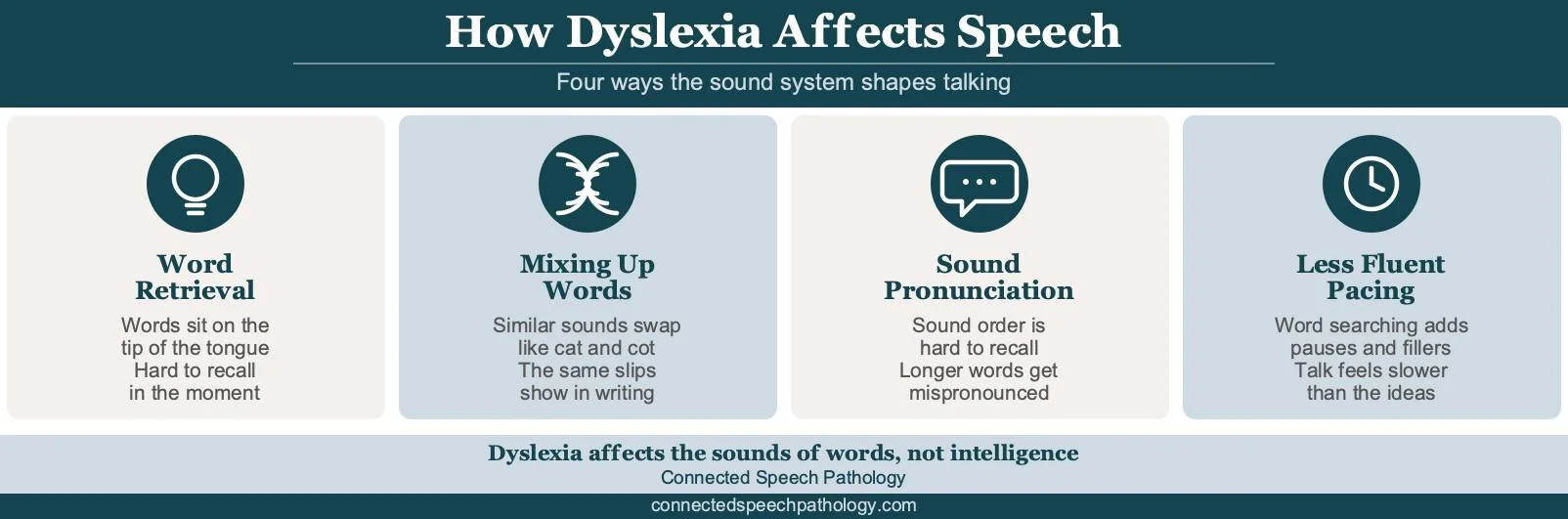
So, can dyslexia affect speech directly? Not in the same way as a lisp or stuttering. Dyslexia affects how the brain processes and retrieves speech sounds, which can lead to word-finding difficulties, pronunciation errors, and less fluent speech.
Many adults with dyslexia notice these challenges most during conversation. Common patterns include:
Word-finding difficulties. A familiar word may feel just out of reach. The person knows what they want to say, but retrieving the word quickly can take extra time.
Mixing up similar-sounding words. Words with similar sound patterns can sometimes be confused. Someone might substitute one word for another, especially when speaking quickly or under pressure.
Pronunciation errors. Recalling the exact sequence of sounds in a word can be difficult. As a result, occasional mispronunciations may occur even when the speaker fully understands the word's meaning.
Less fluent speech. Extra time spent searching for words can create pauses, hesitations, or filler words. The pace of conversation may seem slower than the person's actual thinking.
These challenges do not reflect intelligence, knowledge, or communication ability. The message is there. The difficulty lies in accessing and organizing speech sounds quickly enough to keep pace with conversation.
Dyslexia also persists into adulthood. Many adults develop effective strategies that make reading challenges less obvious. Word-finding and speech-related difficulties can still appear at work, in social settings, or during high-pressure conversations, and understanding the reason behind them often brings a sense of relief.
At Work
In meetings, people who struggle to find a word feel it vanish just when they need it. Names, numbers, and familiar terms may be harder to recall under pressure. Some people rely on fillers or mentally rehearse a point before speaking.
Those workarounds are common, and workplace communication coaching can help make conversations feel more natural. Word-finding difficulties often become more noticeable when quick responses are expected. Our guide to word retrieval difficulties explains why the tip-of-the-tongue feeling happens.
In Social Settings
Fast-moving conversations can be challenging when finding the right word takes extra time. That pause often feels much longer to the speaker than it does to anyone listening. Figurative language adds another layer, since the condition can make sarcasm and idioms harder to catch.
Many adults notice that speaking feels easier in smaller, more relaxed groups. A slower pace gives them more time to organize their thoughts and express themselves. Building confidence in speaking can be just as valuable as learning specific communication strategies.
The Link Between Dyslexia and Stuttering
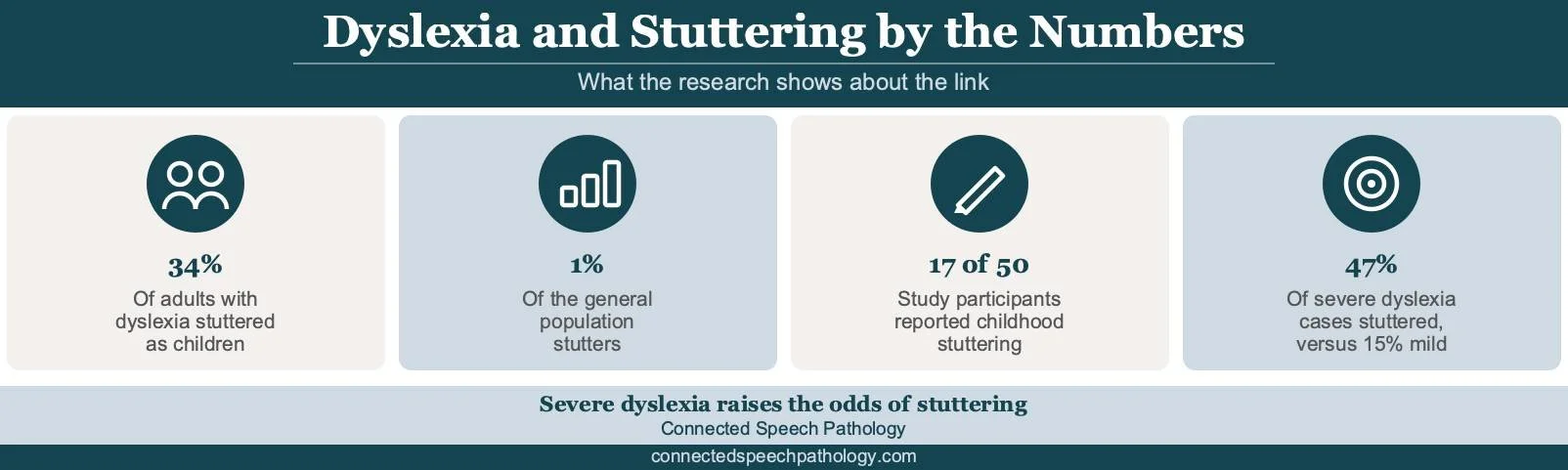
Research suggests a meaningful overlap between dyslexia and stuttering. One study found that 17 out of 50 adults with dyslexia (34%) reported childhood stuttering, compared with roughly 1% of the general population who have persistent stuttering.
The association also appears to be stronger in people with more severe dyslexia. Researchers found that childhood stuttering was reported more often as dyslexia severity increased. That pattern suggests the two conditions may share some of the same underlying phonological challenges.
A stutter that appears alongside dyslexia is usually linked to developmental stuttering, the common form that begins in childhood rather than after an injury or illness. If stuttering is part of your experience, our guides to fluency disorders and what causes stuttering in adults explain the condition in more detail.
Online speech therapy for stuttering can help adults develop smoother, more confident speech, whether stuttering occurs on its own or alongside dyslexia.
Is Dyslexia a Speech Disorder? How It Differs

Dyslexia is a language-based learning disorder, not a speech disorder. It affects how the brain processes written and spoken language rather than how the mouth produces sounds. Some signs can look similar, which is why dyslexia is often confused with other communication disorders.
Dyslexia vs. Apraxia
Apraxia of speech affects motor planning. A person knows the word they want to say but has difficulty coordinating the mouth movements needed to produce it. Dyslexia affects language processing instead. Our guide to speech apraxia explains how the two conditions differ.
Dyslexia vs. Stuttering
Stuttering is a fluency disorder that can involve sound repetitions, blocks, or prolonged sounds. Dyslexia affects reading, spelling, and phonological processing rather than speech fluency itself. The two conditions can occur together, but they are distinct disorders that require different approaches.
Dyslexia vs. Articulation and Phonological Disorders
Articulation disorders affect the production of specific speech sounds. Phonological disorders affect how speech sounds are organized and used. Dyslexia can overlap with both conditions, especially in childhood, but its primary impact is on reading and written language.
Our guide to articulation versus phonological disorders explains these differences in more detail.
Early Signs: How Dyslexia Shows Up Before Reading

Early speech delays can be warning signs of dyslexia. Dyslexia often impacts oral language development before reading skills. Adults with dyslexia often recognize these patterns when they look back on their own childhood experiences.
Delayed language development. Some children with dyslexia are slower to learn new words or combine words into longer sentences. Early language milestones may take more time to emerge.
Difficulty with rhymes and word sounds. Nursery rhymes, word games, and other activities that involve sound patterns can be challenging. These difficulties may reflect differences in phonological awareness, a skill that supports both spoken and written language.
Speech and language delays. A history of speech or language delay is more common in children who later develop dyslexia. While a speech delay does not mean a child will have dyslexia, it can be one piece of the overall picture.
Mixing up similar-sounding words. Children may confuse words that sound alike or have trouble learning and recalling new vocabulary. These challenges can appear years before reading instruction begins.
The overlap between dyslexia and language difficulties is well documented. Early identification can help children access support sooner and build stronger language and literacy skills over time.
How Speech Therapy Can Help

Speech therapy can help people with dyslexia strengthen the communication skills they use every day. The process begins with an evaluation to identify specific speech challenges and language-processing differences, such as word-finding difficulties, weaknesses in phonological awareness, or problems processing speech sounds. From there, treatment focuses on practical goals that support communication at school, work, and home.
Early intervention can improve outcomes for children, but adults can benefit as well. Many treatment plans include phonological awareness activities that help people recognize, separate, and manipulate the sounds within words. These skills support both spoken and written language.
Reading aloud, word-retrieval strategies, and structured language activities can improve confidence and communication. Articulation work may also help when dyslexia occurs alongside articulation difficulties that affect speech production. Reading aloud can strengthen vocabulary, reinforce sound patterns, and support clearer speech.
Assistive tools such as dictation software and text-to-speech apps can reduce the effort involved in reading and writing. For many people, this support frees up mental energy to organize ideas and choose the right words.
Researchers at Carnegie Mellon University have linked dyslexia to differences in procedural learning. Procedural learning is the system that helps repeated actions become automatic over time. Because this process may be less efficient in people with dyslexia, consistent practice is often an important part of building lasting communication and literacy skills.
Dyslexia reflects differences in language processing, not a lack of intelligence or ability. With patience and understanding, the right plan can ease the difficulty over time. For adults, our articulation and phonological therapy for adults blends these methods into focused online sessions.
Ways to Support Someone With Dyslexia
Small adjustments from the people around someone make a real difference in daily communication. The goal is to ease word-finding difficulty. Then the person can express their thoughts without rushing, because these differences in how we talk are nobody's fault.
Give extra time. Let a pause sit, and let people find their own answers. A few seconds of quiet often lets the right word arrive on its own.
Skip the finishing. Resist jumping in to supply the word unless asked, since being interrupted adds pressure and can scatter the thought.
Focus on the message, not the slip. A mixed-up or mispronounced word is no reflection of intelligence, so respect the person's ability and respond to what they mean.
Be mindful of feelings. Years of being misread can bruise a person's feelings, so warmth helps them develop strong communication skills and feel safe speaking up.
For parents of a child with dyslexia, the same patience supports clearer communication at home. Good communication is a two-way effort. Understanding the difference between a word slip and a person's bright ideas changes the whole tone.
What We See Working With Clients

Many adults don't connect their communication frustrations to dyslexia. They come in because they lose track of a word during a meeting, avoid reading aloud, or find themselves pausing more often than they would like in conversation. The connection usually becomes clearer once we look at the pattern across speaking, reading, and writing.
One client worked in a management role and dreaded being put on the spot during team discussions. He often knew exactly what he wanted to say, but could not retrieve the word quickly enough. As we worked on word-finding strategies and self-cueing techniques, those moments became less disruptive, and he spent less energy trying to work around them.
Another client sought help after receiving a dyslexia diagnosis in adulthood. She had started avoiding speaking up during meetings because word-finding pauses made her worry she sounded unprepared. Once she understood why those moments were happening, we focused on strategies for managing them in real conversations. Over time, she became more comfortable contributing without second-guessing every pause.
Frequently Asked Questions About Dyslexia

1. Is dyslexia a speech impediment?
No. Dyslexia is a language-based learning disorder, not a speech disorder. It affects how the brain processes language and speech sounds rather than how the mouth produces them. The two can overlap, but they are different conditions.
2. Can dyslexia affect adult speech?
Yes. Many adults with dyslexia experience word-finding pauses, tip-of-the-tongue moments, and occasional mispronunciations. These difficulties often become more noticeable during fast-paced conversations or situations that require quick responses.
3. Does dyslexia cause stuttering?
Dyslexia does not directly cause stuttering, but the two are reported to be linked. One study showed that around 34% of adults with dyslexia stuttered in childhood, far above the roughly 1% rate in the general population. The odds rise with more severe cases, and both seem to share a root in phonological processing.
4. Can dyslexia make you mix up or mispronounce words?
Yes. People with dyslexia may confuse similar-sounding words or occasionally mispronounce unfamiliar words. These errors are linked to difficulties processing and retrieving speech sounds rather than a lack of knowledge or effort. Examples of mixed-up words include 'cat' and 'cot'.
5. Do adults with dyslexia need speech therapy?
Not everyone does, but some people benefit. A speech-language pathologist can target word retrieval, phonological awareness, and confident speaking. That work eases the day-to-day moments where dyslexia affects how you talk, and sessions are shaped around each person's goals.
How Connected Speech Pathology Can Help

At Connected Speech Pathology, our speech-language pathologists help adults and children with communication challenges. Our speech-language pathologists start with a thorough evaluation to identify difficulties with word retrieval, phonological awareness, reading aloud, or spoken language. From there, we create a treatment plan based on the situations that matter most to you.
All sessions are virtual and tailored to your communication goals. Some clients want to reduce word-finding pauses in meetings or conversations.
Others want support with reading aloud, participating in meetings, or speaking more confidently. We focus on practical skills that carry over into daily communication at work, school, and home.
Summary
So, does dyslexia affect speech? Yes, indirectly. It centers on phonological processing, the mind's system for the sounds of words, which is why it can shape word retrieval, pronunciation, and fluency, not just reading.
It also explains why the tip-of-the-tongue feeling and the higher odds of stuttering are so common in people with dyslexia.
The encouraging part is that these patterns respond well to support. Phonological awareness training, articulation practice, and a speech-language pathologist can help adults and children speak more clearly. It is never too late to make talking feel easier.

About the Author
Allison Geller, M.A., CCC-SLP, is a communication coach, speech-language pathologist, and founder of Connected Speech Pathology, an international online practice providing professional communication coaching and speech therapy for children, teens, and adults. With more than two decades of experience, she has worked in medical and educational settings and published research on aphasia. Today, she leads a team of specialists who help clients improve their skills in public speaking, vocal presence, accent clarity, articulation, language, fluency, and interpersonal communication.